
QUALITY BY DESIGN 
Slide 1 May 2008 
Training Workshop on 
Pharmaceutical Development with 
focus on Paediatric Formulations 
Mumbai, India 
Date: May 2008
Dr Tom Sam 
President 
Industrial Pharmacy Section 
International Pharmaceutical 
Federation (FIP) 
Slide 2 May 2008 
QUALITY BY DESIGN
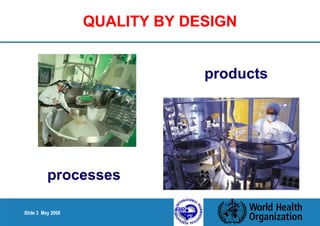
Slide 3 May 2008 
QUALITY BY DESIGN 
processes 
products
Slide 4 May 2008 
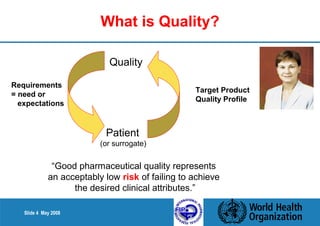
What is Quality? 
Quality 
Patient 
(or surrogate) 
Target Product 
Quality Profile 
Requirements 
= need or 
expectations 
“Good pharmaceutical quality represents 
an acceptably low risk of failing to achieve 
the desired clinical attributes.”
Slide 5 May 2008 
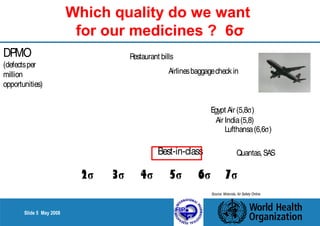
Which quality do we want 
for our medicines ? 6σ 
DPMO 
(defectsper 
million 
opportunities) 
Restaurant bills 
Airlines baggagecheck in 
Best-in-class 
Egypt Air (5,8s) 
Air India(5,8) 
Lufthansa (6,6s) 
Quantas, SAS 
2σ 3σ 4σ 5σ 6σ 7σ 
Source: Motorola, Air Safety Online 
Quelle: Motorola, Air Safety Online
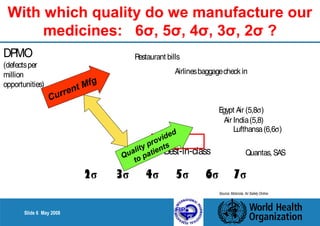
With which quality do we manufacture our 
medicines: 6σ, 5σ, 4σ, 3σ, 2σ ? 
DPMO 
(defectsper 
million 
opportunities) 
Slide 6 May 2008 
Restaurant bills 
Airlines baggagecheck in 
Best-in-class 
Egypt Air (5,8s) 
Air India(5,8) 
Lufthansa (6,6s) 
Quantas, SAS 
2σ 3σ 4σ 5σ 6σ 7σ 
Source: Motorola, Air Safety Online 
Quelle: Motorola, Air Safety Online 
Current Mfg 
Quality provided 
to patients
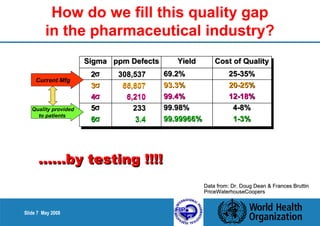
How do we fill this quality gap 
in the pharmaceutical industry? 
Slide 7 May 2008 
SSiiggmmaa ppppmm DDeeffeeccttss YYiieelldd 
22s 
330088,,553377 
33s 
6666,,880077 
44s 
66,,221100 
55s 
223333 
66s 
33..44 
6699..22%% 
9933..33%% 
9999..44%% 
9999..9988%% 
9999..9999996666%% 
CCoosstt ooff QQuuaalliittyy 
2255--3355%% 
2200--2255%% 
1122--1188%% 
44--88%% 
11--33%% 
Current Mfg 
Quality provided 
to patients 
DDaattaa ffrroomm:: DDrr.. DDoouugg DDeeaann & FFrraanncceess BBrruuttttiinn 
PPrriicceeWWaatteerrhhoouusseeCCooooppeerrss 
…………bbyy tteessttiinngg !!!!!!!!
Slide 8 May 2008 
The quality mantra 
“Quality can not be tested into 
products; it has to be built in 
by design”
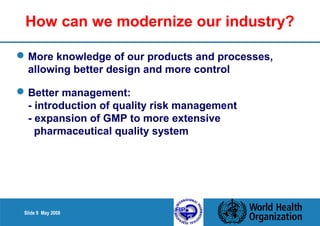
How can we modernize our industry? 
More knowledge of our products and processes, 
allowing better design and more control 
Better management: 
- introduction of quality risk management 
- expansion of GMP to more extensive 
pharmaceutical quality system 
Slide 9 May 2008
Slide 10 May 2008 
Dr Ajaz Hussain 
‘‘PPhhaarrmmaacceeuuttiiccaall GGMMPPss 
ffoorr tthhee 2211sstt CCeennttuurryy’’
Slide 11 May 2008 
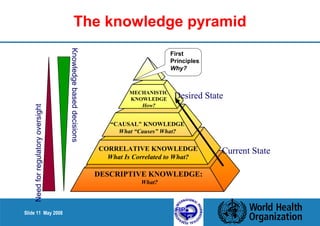
The knowledge pyramid 
MECHANISTIC 
KNOWLEDGE 
How? 
“CAUSAL" KNOWLEDGE 
What “Causes” What? 
CORRELATIVE KNOWLEDGE 
What Is Correlated to What? 
DESCRIPTIVE KNOWLEDGE: 
What? 
Need for regulatory oversight 
Knowledge based decisions 
Desired State 
Current State 
First 
Principles 
Why?
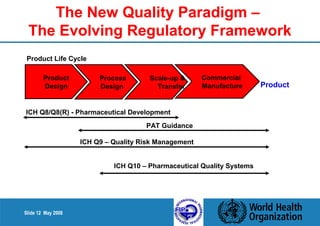
The New Quality Paradigm – 
The Evolving Regulatory Framework 
ICH Q8/Q8(R) - Pharmaceutical Development 
Slide 12 May 2008 
PAT Guidance 
ICH Q9 – Quality Risk Management 
ICH Q10 – Pharmaceutical Quality Systems 
Product 
Design 
Process 
Design 
Scale-up & 
Transfer 
Commercial 
Manufacture 
Product Life Cycle 
Product
Slide 13 May 2008
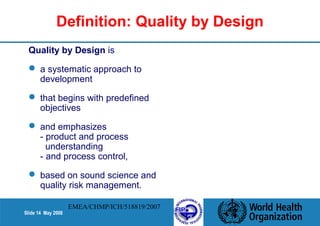
Definition: Quality by Design 
Quality by Design is 
 a systematic approach to 
development 
 that begins with predefined 
objectives 
 and emphasizes 
- product and process 
understanding 
- and process control, 
 based on sound science and 
quality risk management. 
Slide 14 May 2008 
EMEA/CHMP/ICH/518819/2007
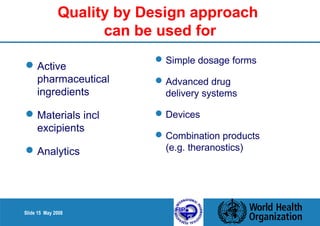
Quality by Design approach 
Slide 15 May 2008 
can be used for 
Active 
pharmaceutical 
ingredients 
Materials incl 
excipients 
Analytics 
Simple dosage forms 
Advanced drug 
delivery systems 
Devices 
Combination products 
(e.g. theranostics)
Slide 16 May 2008 
Impact of QbD 
Companies re-organize their science 
Universities change their curriculum 
Health authorities change their assessment and 
inspection
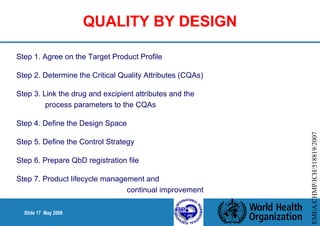
Step 1. Agree on the Target Product Profile 
Step 2. Determine the Critical Quality Attributes (CQAs) 
Step 3. Link the drug and excipient attributes and the 
process parameters to the CQAs 
Step 4. Define the Design Space 
Step 5. Define the Control Strategy 
Step 6. Prepare QbD registration file 
Step 7. Product lifecycle management and 
Slide 17 May 2008 
continual improvement 
EMEA/CHMP/ICH/518819/2007 
QUALITY BY DESIGN
Slide 18 May 2008 
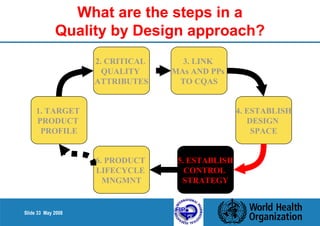
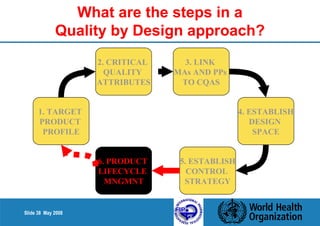
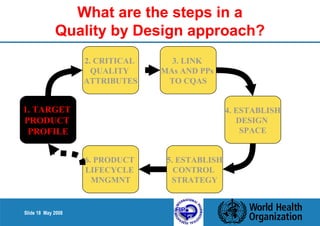
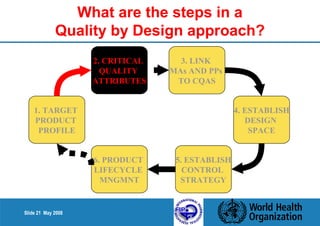
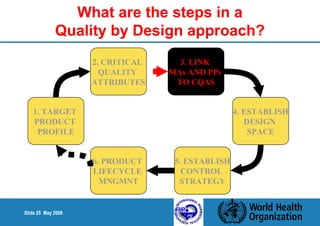
What are the steps in a 
Quality by Design approach? 
1. TARGET 
PRODUCT 
PROFILE 
2. CRITICAL 
QUALITY 
ATTRIBUTES 
6. PRODUCT 
LIFECYCLE 
MNGMNT 
3. LINK 
MAs AND PPs 
TO CQAS 
5. ESTABLISH 
CONTROL 
STRATEGY 
4. ESTABLISH 
DESIGN 
SPACE
Slide 19 May 2008 
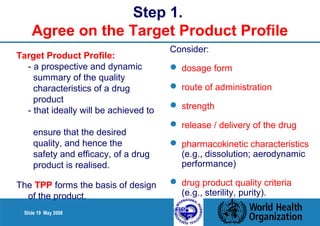
Step 1. 
Agree on the Target Product Profile 
Target Product Profile: 
- a prospective and dynamic 
summary of the quality 
characteristics of a drug 
product 
- that ideally will be achieved to 
ensure that the desired 
quality, and hence the 
safety and efficacy, of a drug 
product is realised. 
The TPP forms the basis of design 
of the product. 
Consider: 
 dosage form 
 route of administration 
 strength 
 release / delivery of the drug 
 pharmacokinetic characteristics 
(e.g., dissolution; aerodynamic 
performance) 
 drug product quality criteria 
(e.g., sterility, purity).
TPP for paediatric dosage form 
TPP adult TPP paediatric (may 
Slide 20 May 2008 
depend upon age group)
Slide 21 May 2008 
What are the steps in a 
Quality by Design approach? 
1. TARGET 
PRODUCT 
PROFILE 
2. CRITICAL 
QUALITY 
ATTRIBUTES 
6. PRODUCT 
LIFECYCLE 
MNGMNT 
3. LINK 
MAs AND PPs 
TO CQAS 
5. ESTABLISH 
CONTROL 
STRATEGY 
4. ESTABLISH 
DESIGN 
SPACE
CRITICAL QUALITY ATTRIBUTES 
Slide 22 May 2008 
- definition 
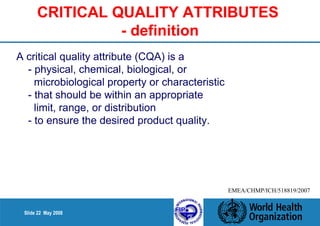
A critical quality attribute (CQA) is a 
- physical, chemical, biological, or 
microbiological property or characteristic 
- that should be within an appropriate 
limit, range, or distribution 
- to ensure the desired product quality. 
EMEA/CHMP/ICH/518819/2007
Step 2. Determine the Critical Quality 
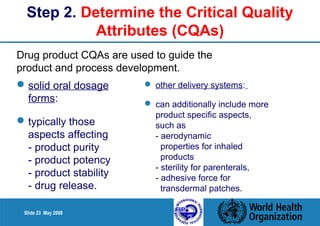
Drug product CQAs are used to guide the 
product and process development. 
Slide 23 May 2008 
Attributes (CQAs) 
solid oral dosage 
forms: 
typically those 
aspects affecting 
- product purity 
- product potency 
- product stability 
- drug release. 
 other delivery systems: 
 can additionally include more 
product specific aspects, 
such as 
- aerodynamic 
properties for inhaled 
products 
- sterility for parenterals, 
- adhesive force for 
transdermal patches.
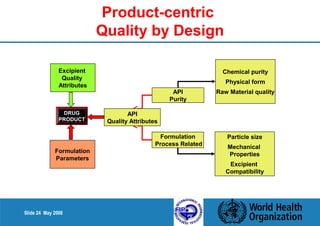
Excipient 
Quality 
Attributes 
Slide 24 May 2008 
Product-centric 
Quality by Design 
API 
Purity 
Chemical purity 
Physical form 
Raw Material quality 
Formulation 
Process Related 
Particle size 
Mechanical 
Properties 
Excipient 
Compatibility 
DRUG 
PRODUCT 
API 
Quality Attributes 
Formulation 
Parameters
Slide 25 May 2008 
What are the steps in a 
Quality by Design approach? 
1. TARGET 
PRODUCT 
PROFILE 
2. CRITICAL 
QUALITY 
ATTRIBUTES 
6. PRODUCT 
LIFECYCLE 
MNGMNT 
3. LINK 
MAs AND PPs 
TO CQAS 
5. ESTABLISH 
CONTROL 
STRATEGY 
4. ESTABLISH 
DESIGN 
SPACE
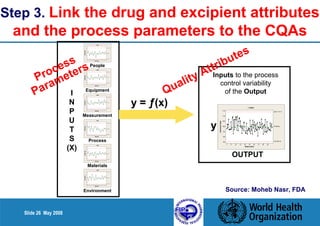
Step 3. Link the drug and excipient attributes 
and the process parameters to the CQAs 
Slide 26 May 2008 
Observat ion 
People 
Observat ion 
UCL=111.55 
UCL=112.65 
Equipment 
Observat ion 
UCL=112.65 
Measurement 
Process 
UCL=116.68 
UCL=111.55 
Materials 
UCL=111.17 
Environment 
INPUTS 
(X) 
Quality Attributes 
y = ƒ(x) 
Inputs to the process 
control variability 
OUTPUT 
y 
of the Output 
Observat ion 
Individual Value 
20 22 24 26 28 30 32 34 36 38 40 
120 
115 
110 
105 
100 
95 
90 
_ 
X=102.37 
LCL=88.05 
I Chart 
Individual Value 
40 42 44 46 48 50 52 54 56 58 60 
115 
110 
105 
100 
95 
90 
85 
80 
_ 
X=97.94 
LCL=83.23 
I Chart 
Observat ion 
Individual Value 
60 62 64 66 68 70 72 74 76 78 80 
115 
110 
105 
100 
95 
90 
_ 
X=99.63 
LCL=87.71 
I Chart 
Observat ion 
Individual Value 
80 82 84 86 88 90 92 94 96 98 100 
110 
105 
100 
95 
90 
85 
_ 
X=98.76 
LCL=86.35 
I Chart 
Individual Value 
40 42 44 46 48 50 52 54 56 58 60 
115 
110 
105 
100 
95 
90 
85 
80 
_ 
X=97.94 
LCL=83.23 
I Chart 
Individual Value 
60 62 64 66 68 70 72 74 76 78 80 
115 
110 
105 
100 
95 
90 
_ 
X=99.63 
LCL=87.71 
I Chart 
Process 
Parameters 
Observat ion 
Indiv idual Value 
1 11 21 31 41 51 61 71 81 91 
115 
110 
105 
100 
95 
90 
85 
UCL=114.17 
_ 
X=99.95 
LCL=85.72 
I Char t 
Source: Moheb Nasr, FDA
M1 
Material Attributes 
Slide 27 May 2008 
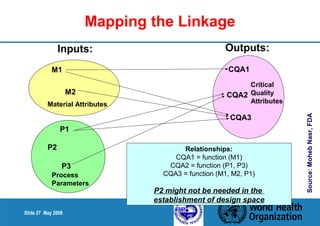
Mapping the Linkage 
Inputs: Outputs: 
M2 
P1 
P2 
P3 
CQA1 
CQA2 
CQA3 
Relationships: 
CQA1 = function (M1) 
CQA2 = function (P1, P3) 
CQA3 = function (M1, M2, P1) 
P2 might not be needed in the 
establishment of design space 
Process 
Parameters 
Critical 
Quality 
Attributes 
Source: Moheb Nasr, FDA
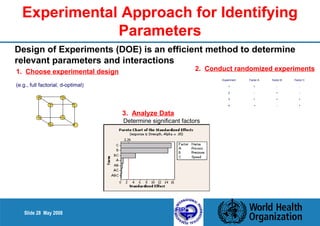
Experimental Approach for Identifying 
Design of Experiments (DOE) is an efficient method to determine 
relevant parameters and interactions 
Slide 28 May 2008 
Parameters 
1. Choose experimental design 
(e.g., full factorial, d-optimal) 
2. Conduct randomized experiments 
Experiment Factor A Factor B Factor C 
1 + - - 
2 - + - 
3 + + + 
4 + - + 
3. Analyze Data 
Determine significant factors
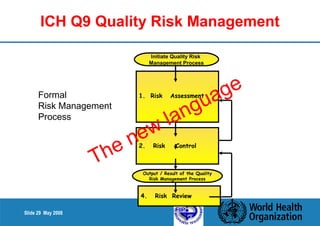
ICH Q9 Quality Risk Management 
Slide 29 May 2008 
Initiate Quality Risk 
Management Process 
1. Risk language 
Assessment 
The new 2. Risk Control 
Output / Result of the Quality 
Risk Management Process 
4. Risk Review 
Formal 
Risk Management 
Process
Slide 30 May 2008 
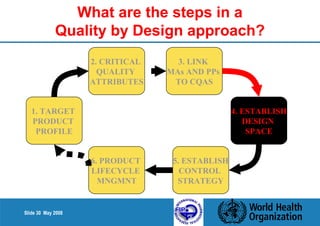
What are the steps in a 
Quality by Design approach? 
1. TARGET 
PRODUCT 
PROFILE 
2. CRITICAL 
QUALITY 
ATTRIBUTES 
6. PRODUCT 
LIFECYCLE 
MNGMNT 
3. LINK 
MAs AND PPs 
TO CQAS 
5. ESTABLISH 
CONTROL 
STRATEGY 
4. ESTABLISH 
DESIGN 
SPACE
Step 4. Define the Design Space 
The linkage between 
- the process inputs (input variables and process 
parameters) and 
- the critical quality attributes 
can be described in the design space. 
Slide 31 May 2008
Slide 32 May 2008 
Definition of Design Space 
The material attributes and process parameters that 
assure quality. 
The multidimensional combination 
and interaction of input variables 
(e.g. material attributes) and 
process parameters that have been 
demonstrated to provide assurance 
of quality. 
Roll pressure 
Gap width 
Screen Size 
300 
200 
100 
0 
-100 
Dataset - Run1-10a.M3 
Observed vs. Predicted $Time [Last comp.] (Aligned) 
0 10 20 30 40 50 60 70 80 90 100 110 120 130 140 150 160 170 180 190 200 210 220 230 240 250 260 
$Time (normalized) 
SIMCA-P+ 11.5 - 05/02/2007 23:17:07
Slide 33 May 2008 
What are the steps in a 
Quality by Design approach? 
1. TARGET 
PRODUCT 
PROFILE 
2. CRITICAL 
QUALITY 
ATTRIBUTES 
6. PRODUCT 
LIFECYCLE 
MNGMNT 
3. LINK 
MAs AND PPs 
TO CQAS 
5. ESTABLISH 
CONTROL 
STRATEGY 
4. ESTABLISH 
DESIGN 
SPACE
Slide 34 May 2008 
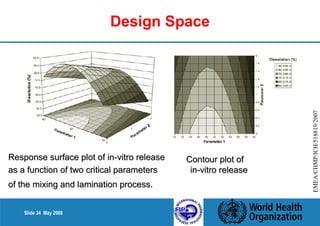
Design Space 
1a 
EMEA/CHMP/ICH/518819/2007 
RReessppoonnssee ssuurrffaaccee pplloott ooff iinn--vviittrroo rreelleeaassee 
aass aa ffuunnccttiioonn ooff ttwwoo ccrriittiiccaall ppaarraammeetteerrss 
ooff tthhee mmiixxiinngg aanndd llaammiinnaattiioonn pprroocceessss.. 
CCoonnttoouurr pplloott ooff 
iinn--vviittrroo rreelleeaassee
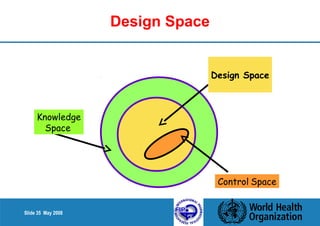
Knowledge 
Space 
Slide 35 May 2008 
Design Space 
Control Space 
Design Space
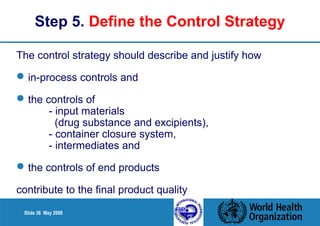
Step 5. Define the Control Strategy 
The control strategy should describe and justify how 
in-process controls and 
the controls of 
- input materials 
(drug substance and excipients), 
- container closure system, 
- intermediates and 
the controls of end products 
contribute to the final product quality 
Slide 36 May 2008
Slide 37 May 2008 
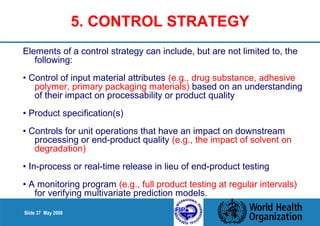
5. CONTROL STRATEGY 
Elements of a control strategy can include, but are not limited to, the 
following: 
• Control of input material attributes (e.g., drug substance, adhesive 
polymer, primary packaging materials) based on an understanding 
of their impact on processability or product quality 
• Product specification(s) 
• Controls for unit operations that have an impact on downstream 
processing or end-product quality (e.g., the impact of solvent on 
degradation) 
• In-process or real-time release in lieu of end-product testing 
• A monitoring program (e.g., full product testing at regular intervals) 
for verifying multivariate prediction models.
Slide 38 May 2008 
What are the steps in a 
Quality by Design approach? 
1. TARGET 
PRODUCT 
PROFILE 
2. CRITICAL 
QUALITY 
ATTRIBUTES 
6. PRODUCT 
LIFECYCLE 
MNGMNT 
3. LINK 
MAs AND PPs 
TO CQAS 
5. ESTABLISH 
CONTROL 
STRATEGY 
4. ESTABLISH 
DESIGN 
SPACE
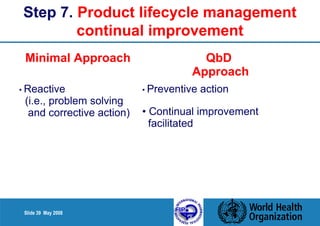
Step 7. Product lifecycle management 
Slide 39 May 2008 
continual improvement 
Minimal Approach QbD 
Approach 
• Reactive 
(i.e., problem solving 
and corrective action) 
• Preventive action 
• Continual improvement 
facilitated
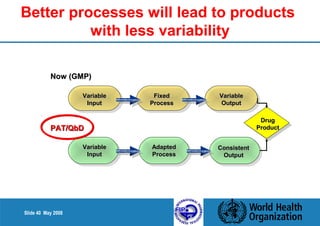
Better processes will lead to products 
Slide 40 May 2008 
with less variability 
NNooww ((GGMMPP)) 
DDrruugg 
PPrroodduucctt 
VVaarriiaabbllee 
IInnppuutt 
FFiixxeedd 
PPrroocceessss 
VVaarriiaabbllee 
OOuuttppuutt 
VVaarriiaabbllee 
IInnppuutt 
AAddaapptteedd 
PPrroocceessss 
CCoonnssiisstteenntt 
OOuuttppuutt 
PPAATT//QQbbDD
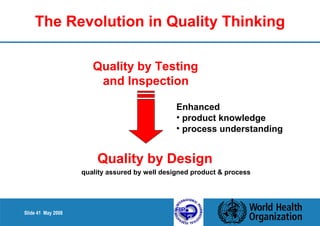
The Revolution in Quality Thinking 
Slide 41 May 2008 
Quality by Testing 
and Inspection 
Enhanced 
• product knowledge 
• process understanding 
Quality by Design 
quality assured by well designed product & process

Quality design

  • 1.
    QUALITY BY DESIGN Slide 1 May 2008 Training Workshop on Pharmaceutical Development with focus on Paediatric Formulations Mumbai, India Date: May 2008
  • 2.
    Dr Tom Sam President Industrial Pharmacy Section International Pharmaceutical Federation (FIP) Slide 2 May 2008 QUALITY BY DESIGN
  • 3.
    Slide 3 May2008 QUALITY BY DESIGN processes products
  • 4.
    Slide 4 May2008 What is Quality? Quality Patient (or surrogate) Target Product Quality Profile Requirements = need or expectations “Good pharmaceutical quality represents an acceptably low risk of failing to achieve the desired clinical attributes.”
  • 5.
    Slide 5 May2008 Which quality do we want for our medicines ? 6σ DPMO (defectsper million opportunities) Restaurant bills Airlines baggagecheck in Best-in-class Egypt Air (5,8s) Air India(5,8) Lufthansa (6,6s) Quantas, SAS 2σ 3σ 4σ 5σ 6σ 7σ Source: Motorola, Air Safety Online Quelle: Motorola, Air Safety Online
  • 6.
    With which qualitydo we manufacture our medicines: 6σ, 5σ, 4σ, 3σ, 2σ ? DPMO (defectsper million opportunities) Slide 6 May 2008 Restaurant bills Airlines baggagecheck in Best-in-class Egypt Air (5,8s) Air India(5,8) Lufthansa (6,6s) Quantas, SAS 2σ 3σ 4σ 5σ 6σ 7σ Source: Motorola, Air Safety Online Quelle: Motorola, Air Safety Online Current Mfg Quality provided to patients
  • 7.
    How do wefill this quality gap in the pharmaceutical industry? Slide 7 May 2008 SSiiggmmaa ppppmm DDeeffeeccttss YYiieelldd 22s 330088,,553377 33s 6666,,880077 44s 66,,221100 55s 223333 66s 33..44 6699..22%% 9933..33%% 9999..44%% 9999..9988%% 9999..9999996666%% CCoosstt ooff QQuuaalliittyy 2255--3355%% 2200--2255%% 1122--1188%% 44--88%% 11--33%% Current Mfg Quality provided to patients DDaattaa ffrroomm:: DDrr.. DDoouugg DDeeaann & FFrraanncceess BBrruuttttiinn PPrriicceeWWaatteerrhhoouusseeCCooooppeerrss …………bbyy tteessttiinngg !!!!!!!!
  • 8.
    Slide 8 May2008 The quality mantra “Quality can not be tested into products; it has to be built in by design”
  • 9.
    How can wemodernize our industry? More knowledge of our products and processes, allowing better design and more control Better management: - introduction of quality risk management - expansion of GMP to more extensive pharmaceutical quality system Slide 9 May 2008
  • 10.
    Slide 10 May2008 Dr Ajaz Hussain ‘‘PPhhaarrmmaacceeuuttiiccaall GGMMPPss ffoorr tthhee 2211sstt CCeennttuurryy’’
  • 11.
    Slide 11 May2008 The knowledge pyramid MECHANISTIC KNOWLEDGE How? “CAUSAL" KNOWLEDGE What “Causes” What? CORRELATIVE KNOWLEDGE What Is Correlated to What? DESCRIPTIVE KNOWLEDGE: What? Need for regulatory oversight Knowledge based decisions Desired State Current State First Principles Why?
  • 12.
    The New QualityParadigm – The Evolving Regulatory Framework ICH Q8/Q8(R) - Pharmaceutical Development Slide 12 May 2008 PAT Guidance ICH Q9 – Quality Risk Management ICH Q10 – Pharmaceutical Quality Systems Product Design Process Design Scale-up & Transfer Commercial Manufacture Product Life Cycle Product
  • 13.
  • 14.
    Definition: Quality byDesign Quality by Design is  a systematic approach to development  that begins with predefined objectives  and emphasizes - product and process understanding - and process control,  based on sound science and quality risk management. Slide 14 May 2008 EMEA/CHMP/ICH/518819/2007
  • 15.
    Quality by Designapproach Slide 15 May 2008 can be used for Active pharmaceutical ingredients Materials incl excipients Analytics Simple dosage forms Advanced drug delivery systems Devices Combination products (e.g. theranostics)
  • 16.
    Slide 16 May2008 Impact of QbD Companies re-organize their science Universities change their curriculum Health authorities change their assessment and inspection
  • 17.
    Step 1. Agreeon the Target Product Profile Step 2. Determine the Critical Quality Attributes (CQAs) Step 3. Link the drug and excipient attributes and the process parameters to the CQAs Step 4. Define the Design Space Step 5. Define the Control Strategy Step 6. Prepare QbD registration file Step 7. Product lifecycle management and Slide 17 May 2008 continual improvement EMEA/CHMP/ICH/518819/2007 QUALITY BY DESIGN
  • 18.
    Slide 18 May2008 What are the steps in a Quality by Design approach? 1. TARGET PRODUCT PROFILE 2. CRITICAL QUALITY ATTRIBUTES 6. PRODUCT LIFECYCLE MNGMNT 3. LINK MAs AND PPs TO CQAS 5. ESTABLISH CONTROL STRATEGY 4. ESTABLISH DESIGN SPACE
  • 19.
    Slide 19 May2008 Step 1. Agree on the Target Product Profile Target Product Profile: - a prospective and dynamic summary of the quality characteristics of a drug product - that ideally will be achieved to ensure that the desired quality, and hence the safety and efficacy, of a drug product is realised. The TPP forms the basis of design of the product. Consider:  dosage form  route of administration  strength  release / delivery of the drug  pharmacokinetic characteristics (e.g., dissolution; aerodynamic performance)  drug product quality criteria (e.g., sterility, purity).
  • 20.
    TPP for paediatricdosage form TPP adult TPP paediatric (may Slide 20 May 2008 depend upon age group)
  • 21.
    Slide 21 May2008 What are the steps in a Quality by Design approach? 1. TARGET PRODUCT PROFILE 2. CRITICAL QUALITY ATTRIBUTES 6. PRODUCT LIFECYCLE MNGMNT 3. LINK MAs AND PPs TO CQAS 5. ESTABLISH CONTROL STRATEGY 4. ESTABLISH DESIGN SPACE
  • 22.
    CRITICAL QUALITY ATTRIBUTES Slide 22 May 2008 - definition A critical quality attribute (CQA) is a - physical, chemical, biological, or microbiological property or characteristic - that should be within an appropriate limit, range, or distribution - to ensure the desired product quality. EMEA/CHMP/ICH/518819/2007
  • 23.
    Step 2. Determinethe Critical Quality Drug product CQAs are used to guide the product and process development. Slide 23 May 2008 Attributes (CQAs) solid oral dosage forms: typically those aspects affecting - product purity - product potency - product stability - drug release.  other delivery systems:  can additionally include more product specific aspects, such as - aerodynamic properties for inhaled products - sterility for parenterals, - adhesive force for transdermal patches.
  • 24.
    Excipient Quality Attributes Slide 24 May 2008 Product-centric Quality by Design API Purity Chemical purity Physical form Raw Material quality Formulation Process Related Particle size Mechanical Properties Excipient Compatibility DRUG PRODUCT API Quality Attributes Formulation Parameters
  • 25.
    Slide 25 May2008 What are the steps in a Quality by Design approach? 1. TARGET PRODUCT PROFILE 2. CRITICAL QUALITY ATTRIBUTES 6. PRODUCT LIFECYCLE MNGMNT 3. LINK MAs AND PPs TO CQAS 5. ESTABLISH CONTROL STRATEGY 4. ESTABLISH DESIGN SPACE
  • 26.
    Step 3. Linkthe drug and excipient attributes and the process parameters to the CQAs Slide 26 May 2008 Observat ion People Observat ion UCL=111.55 UCL=112.65 Equipment Observat ion UCL=112.65 Measurement Process UCL=116.68 UCL=111.55 Materials UCL=111.17 Environment INPUTS (X) Quality Attributes y = ƒ(x) Inputs to the process control variability OUTPUT y of the Output Observat ion Individual Value 20 22 24 26 28 30 32 34 36 38 40 120 115 110 105 100 95 90 _ X=102.37 LCL=88.05 I Chart Individual Value 40 42 44 46 48 50 52 54 56 58 60 115 110 105 100 95 90 85 80 _ X=97.94 LCL=83.23 I Chart Observat ion Individual Value 60 62 64 66 68 70 72 74 76 78 80 115 110 105 100 95 90 _ X=99.63 LCL=87.71 I Chart Observat ion Individual Value 80 82 84 86 88 90 92 94 96 98 100 110 105 100 95 90 85 _ X=98.76 LCL=86.35 I Chart Individual Value 40 42 44 46 48 50 52 54 56 58 60 115 110 105 100 95 90 85 80 _ X=97.94 LCL=83.23 I Chart Individual Value 60 62 64 66 68 70 72 74 76 78 80 115 110 105 100 95 90 _ X=99.63 LCL=87.71 I Chart Process Parameters Observat ion Indiv idual Value 1 11 21 31 41 51 61 71 81 91 115 110 105 100 95 90 85 UCL=114.17 _ X=99.95 LCL=85.72 I Char t Source: Moheb Nasr, FDA
  • 27.
    M1 Material Attributes Slide 27 May 2008 Mapping the Linkage Inputs: Outputs: M2 P1 P2 P3 CQA1 CQA2 CQA3 Relationships: CQA1 = function (M1) CQA2 = function (P1, P3) CQA3 = function (M1, M2, P1) P2 might not be needed in the establishment of design space Process Parameters Critical Quality Attributes Source: Moheb Nasr, FDA
  • 28.
    Experimental Approach forIdentifying Design of Experiments (DOE) is an efficient method to determine relevant parameters and interactions Slide 28 May 2008 Parameters 1. Choose experimental design (e.g., full factorial, d-optimal) 2. Conduct randomized experiments Experiment Factor A Factor B Factor C 1 + - - 2 - + - 3 + + + 4 + - + 3. Analyze Data Determine significant factors
  • 29.
    ICH Q9 QualityRisk Management Slide 29 May 2008 Initiate Quality Risk Management Process 1. Risk language Assessment The new 2. Risk Control Output / Result of the Quality Risk Management Process 4. Risk Review Formal Risk Management Process
  • 30.
    Slide 30 May2008 What are the steps in a Quality by Design approach? 1. TARGET PRODUCT PROFILE 2. CRITICAL QUALITY ATTRIBUTES 6. PRODUCT LIFECYCLE MNGMNT 3. LINK MAs AND PPs TO CQAS 5. ESTABLISH CONTROL STRATEGY 4. ESTABLISH DESIGN SPACE
  • 31.
    Step 4. Definethe Design Space The linkage between - the process inputs (input variables and process parameters) and - the critical quality attributes can be described in the design space. Slide 31 May 2008
  • 32.
    Slide 32 May2008 Definition of Design Space The material attributes and process parameters that assure quality. The multidimensional combination and interaction of input variables (e.g. material attributes) and process parameters that have been demonstrated to provide assurance of quality. Roll pressure Gap width Screen Size 300 200 100 0 -100 Dataset - Run1-10a.M3 Observed vs. Predicted $Time [Last comp.] (Aligned) 0 10 20 30 40 50 60 70 80 90 100 110 120 130 140 150 160 170 180 190 200 210 220 230 240 250 260 $Time (normalized) SIMCA-P+ 11.5 - 05/02/2007 23:17:07
  • 33.
    Slide 33 May2008 What are the steps in a Quality by Design approach? 1. TARGET PRODUCT PROFILE 2. CRITICAL QUALITY ATTRIBUTES 6. PRODUCT LIFECYCLE MNGMNT 3. LINK MAs AND PPs TO CQAS 5. ESTABLISH CONTROL STRATEGY 4. ESTABLISH DESIGN SPACE
  • 34.
    Slide 34 May2008 Design Space 1a EMEA/CHMP/ICH/518819/2007 RReessppoonnssee ssuurrffaaccee pplloott ooff iinn--vviittrroo rreelleeaassee aass aa ffuunnccttiioonn ooff ttwwoo ccrriittiiccaall ppaarraammeetteerrss ooff tthhee mmiixxiinngg aanndd llaammiinnaattiioonn pprroocceessss.. CCoonnttoouurr pplloott ooff iinn--vviittrroo rreelleeaassee
  • 35.
    Knowledge Space Slide35 May 2008 Design Space Control Space Design Space
  • 36.
    Step 5. Definethe Control Strategy The control strategy should describe and justify how in-process controls and the controls of - input materials (drug substance and excipients), - container closure system, - intermediates and the controls of end products contribute to the final product quality Slide 36 May 2008
  • 37.
    Slide 37 May2008 5. CONTROL STRATEGY Elements of a control strategy can include, but are not limited to, the following: • Control of input material attributes (e.g., drug substance, adhesive polymer, primary packaging materials) based on an understanding of their impact on processability or product quality • Product specification(s) • Controls for unit operations that have an impact on downstream processing or end-product quality (e.g., the impact of solvent on degradation) • In-process or real-time release in lieu of end-product testing • A monitoring program (e.g., full product testing at regular intervals) for verifying multivariate prediction models.
  • 38.
    Slide 38 May2008 What are the steps in a Quality by Design approach? 1. TARGET PRODUCT PROFILE 2. CRITICAL QUALITY ATTRIBUTES 6. PRODUCT LIFECYCLE MNGMNT 3. LINK MAs AND PPs TO CQAS 5. ESTABLISH CONTROL STRATEGY 4. ESTABLISH DESIGN SPACE
  • 39.
    Step 7. Productlifecycle management Slide 39 May 2008 continual improvement Minimal Approach QbD Approach • Reactive (i.e., problem solving and corrective action) • Preventive action • Continual improvement facilitated
  • 40.
    Better processes willlead to products Slide 40 May 2008 with less variability NNooww ((GGMMPP)) DDrruugg PPrroodduucctt VVaarriiaabbllee IInnppuutt FFiixxeedd PPrroocceessss VVaarriiaabbllee OOuuttppuutt VVaarriiaabbllee IInnppuutt AAddaapptteedd PPrroocceessss CCoonnssiisstteenntt OOuuttppuutt PPAATT//QQbbDD
  • 41.
    The Revolution inQuality Thinking Slide 41 May 2008 Quality by Testing and Inspection Enhanced • product knowledge • process understanding Quality by Design quality assured by well designed product & process

Editor's Notes

  • #3 <number> सितंबर 21, 2014