Definitions, concept of QC, QA and GMP
Quality Assurance and Quality
Management Concepts
1
2
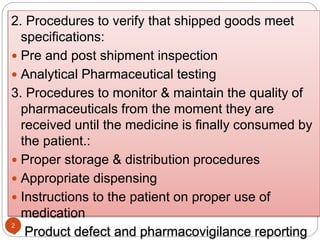
2. Procedures to verify that shipped goods meet
specifications:
 Pre and post shipment inspection
 Analytical Pharmaceutical testing
3. Procedures to monitor & maintain the quality of
pharmaceuticals from the moment they are
received until the medicine is finally consumed by
the patient.:
 Proper storage & distribution procedures
 Appropriate dispensing
 Instructions to the patient on proper use of
medication
 Product defect and pharmacovigilance reporting
:
3
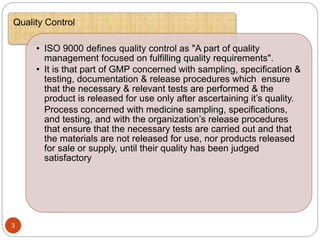
Quality Control
• ISO 9000 defines quality control as "A part of quality
management focused on fulfilling quality requirements".
• It is that part of GMP concerned with sampling, specification &
testing, documentation & release procedures which ensure
that the necessary & relevant tests are performed & the
product is released for use only after ascertaining it’s quality.
Process concerned with medicine sampling, specifications,
and testing, and with the organization’s release procedures
that ensure that the necessary tests are carried out and that
the materials are not released for use, nor products released
for sale or supply, until their quality has been judged
satisfactory
4
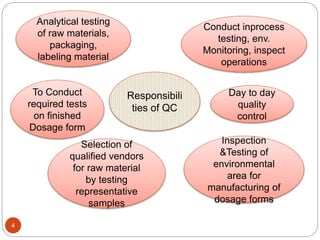
Responsibili
ties of QC
Day to day
quality
control
Analytical testing
of raw materials,
packaging,
labeling material
Conduct inprocess
testing, env.
Monitoring, inspect
operations
To Conduct
required tests
on finished
Dosage form
Selection of
qualified vendors
for raw material
by testing
representative
samples
Inspection
&Testing of
environmental
area for
manufacturing of
dosage forms
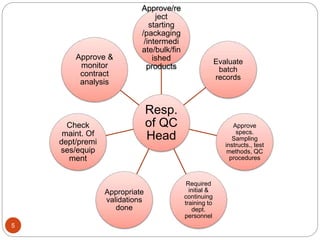
5
Resp.
of QC
Head
Approve/re
ject
starting
/packaging
/intermedi
ate/bulk/fin
ished
products
Evaluate
batch
records
Approve
specs.
Sampling
instructs., test
methods, QC
procedures
Required
initial &
continuing
training to
dept.
personnel
Appropriate
validations
done
Check
maint. Of
dept/premi
ses/equip
ment
Approve &
monitor
contract
analysis
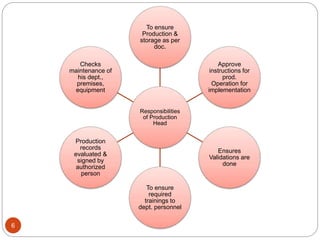
6
Responsibilities
of Production
Head
To ensure
Production &
storage as per
doc.
Approve
instructions for
prod.
Operation for
implementation
Ensures
Validations are
done
To ensure
required
trainings to
dept. personnel
Production
records
evaluated &
signed by
authorized
person
Checks
maintenance of
his dept.,
premises,
equipment
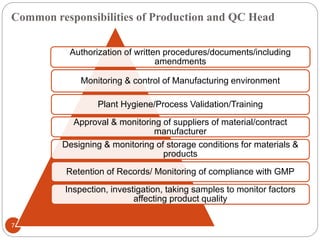
Common responsibilities of Production and QC Head
7
Authorization of written procedures/documents/including
amendments
Monitoring & control of Manufacturing environment
Plant Hygiene/Process Validation/Training
Approval & monitoring of suppliers of material/contract
manufacturer
Designing & monitoring of storage conditions for materials &
products
Retention of Records/ Monitoring of compliance with GMP
Inspection, investigation, taking samples to monitor factors
affecting product quality
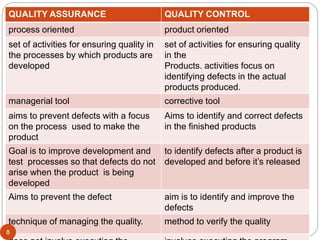
QUALITY ASSURANCE QUALITY CONTROL
process oriented product oriented
set of activities for ensuring quality in
the processes by which products are
developed
set of activities for ensuring quality
in the
Products. activities focus on
identifying defects in the actual
products produced.
managerial tool corrective tool
aims to prevent defects with a focus
on the process used to make the
product
Aims to identify and correct defects
in the finished products
Goal is to improve development and
test processes so that defects do not
arise when the product is being
developed
to identify defects after a product is
developed and before it’s released
Aims to prevent the defect aim is to identify and improve the
defects
technique of managing the quality. method to verify the quality
8
9
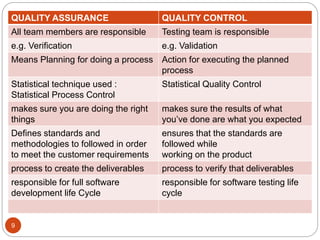
QUALITY ASSURANCE QUALITY CONTROL
All team members are responsible Testing team is responsible
e.g. Verification e.g. Validation
Means Planning for doing a process Action for executing the planned
process
Statistical technique used :
Statistical Process Control
Statistical Quality Control
makes sure you are doing the right
things
makes sure the results of what
you’ve done are what you expected
Defines standards and
methodologies to followed in order
to meet the customer requirements
ensures that the standards are
followed while
working on the product
process to create the deliverables process to verify that deliverables
responsible for full software
development life Cycle
responsible for software testing life
cycle
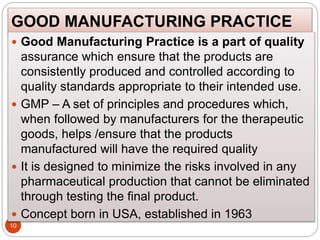
GOOD MANUFACTURING PRACTICE
10
 Good Manufacturing Practice is a part of quality
assurance which ensure that the products are
consistently produced and controlled according to
quality standards appropriate to their intended use.
 GMP – A set of principles and procedures which,
when followed by manufacturers for the therapeutic
goods, helps /ensure that the products
manufactured will have the required quality
 It is designed to minimize the risks involved in any
pharmaceutical production that cannot be eliminated
through testing the final product.
 Concept born in USA, established in 1963
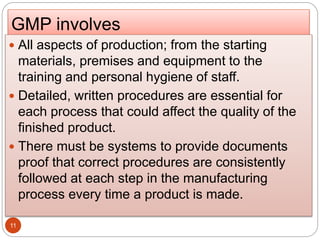
GMP involves
11
 All aspects of production; from the starting
materials, premises and equipment to the
training and personal hygiene of staff.
 Detailed, written procedures are essential for
each process that could affect the quality of the
finished product.
 There must be systems to provide documents
proof that correct procedures are consistently
followed at each step in the manufacturing
process every time a product is made.
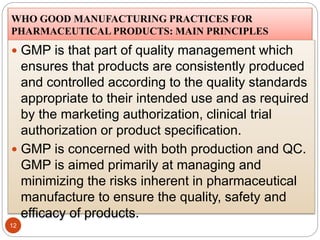
WHO GOOD MANUFACTURING PRACTICES FOR
PHARMACEUTICAL PRODUCTS: MAIN PRINCIPLES
12
 GMP is that part of quality management which
ensures that products are consistently produced
and controlled according to the quality standards
appropriate to their intended use and as required
by the marketing authorization, clinical trial
authorization or product specification.
 GMP is concerned with both production and QC.
GMP is aimed primarily at managing and
minimizing the risks inherent in pharmaceutical
manufacture to ensure the quality, safety and
efficacy of products.
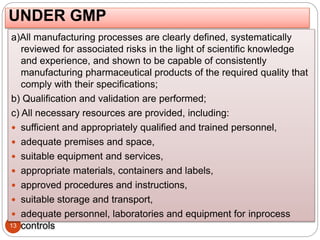
UNDER GMP
13
a)All manufacturing processes are clearly defined, systematically
reviewed for associated risks in the light of scientific knowledge
and experience, and shown to be capable of consistently
manufacturing pharmaceutical products of the required quality that
comply with their specifications;
b) Qualification and validation are performed;
c) All necessary resources are provided, including:
 sufficient and appropriately qualified and trained personnel,
 adequate premises and space,
 suitable equipment and services,
 appropriate materials, containers and labels,
 approved procedures and instructions,
 suitable storage and transport,
 adequate personnel, laboratories and equipment for inprocess
controls
14
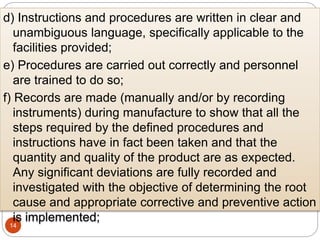
d) Instructions and procedures are written in clear and
unambiguous language, specifically applicable to the
facilities provided;
e) Procedures are carried out correctly and personnel
are trained to do so;
f) Records are made (manually and/or by recording
instruments) during manufacture to show that all the
steps required by the defined procedures and
instructions have in fact been taken and that the
quantity and quality of the product are as expected.
Any significant deviations are fully recorded and
investigated with the objective of determining the root
cause and appropriate corrective and preventive action
is implemented;
15
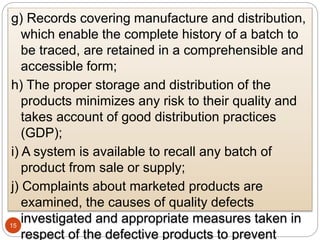
g) Records covering manufacture and distribution,
which enable the complete history of a batch to
be traced, are retained in a comprehensible and
accessible form;
h) The proper storage and distribution of the
products minimizes any risk to their quality and
takes account of good distribution practices
(GDP);
i) A system is available to recall any batch of
product from sale or supply;
j) Complaints about marketed products are
examined, the causes of quality defects
investigated and appropriate measures taken in
respect of the defective products to prevent
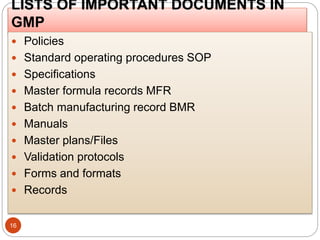
LISTS OF IMPORTANT DOCUMENTS IN
GMP
16
 Policies
 Standard operating procedures SOP
 Specifications
 Master formula records MFR
 Batch manufacturing record BMR
 Manuals
 Master plans/Files
 Validation protocols
 Forms and formats
 Records
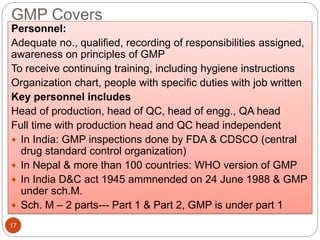
GMP Covers
17
Personnel:
Adequate no., qualified, recording of responsibilities assigned,
awareness on principles of GMP
To receive continuing training, including hygiene instructions
Organization chart, people with specific duties with job written
Key personnel includes
Head of production, head of QC, head of engg., QA head
Full time with production head and QC head independent
 In India: GMP inspections done by FDA & CDSCO (central
drug standard control organization)
 In Nepal & more than 100 countries: WHO version of GMP
 In India D&C act 1945 ammnended on 24 June 1988 & GMP
under sch.M.
 Sch. M – 2 parts--- Part 1 & Part 2, GMP is under part 1
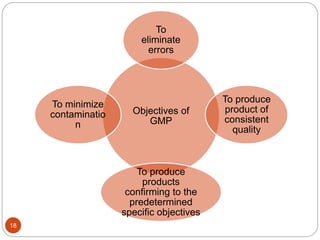
18
Objectives of
GMP
To
eliminate
errors
To produce
product of
consistent
quality
To produce
products
confirming to the
predetermined
specific objectives
To minimize
contaminatio
n
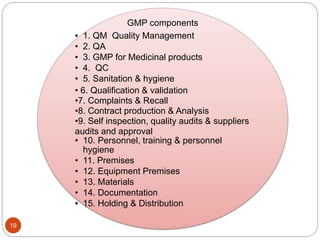
19
GMP components
• 1. QM Quality Management
• 2. QA
• 3. GMP for Medicinal products
• 4. QC
• 5. Sanitation & hygiene
• 6. Qualification & validation
•7. Complaints & Recall
•8. Contract production & Analysis
•9. Self inspection, quality audits & suppliers
audits and approval
• 10. Personnel, training & personnel
hygiene
• 11. Premises
• 12. Equipment Premises
• 13. Materials
• 14. Documentation
• 15. Holding & Distribution
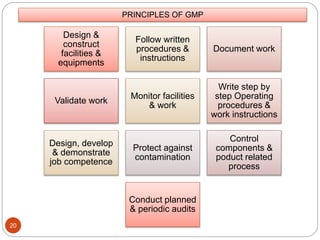
20
Design &
construct
facilities &
equipments
Follow written
procedures &
instructions
Document work
Validate work
Monitor facilities
& work
Write step by
step Operating
procedures &
work instructions
Design, develop
& demonstrate
job competence
Protect against
contamination
Control
components &
poduct related
process
Conduct planned
& periodic audits
PRINCIPLES OF GMP
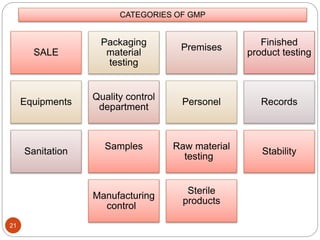
21
SALE
Packaging
material
testing
Premises
Finished
product testing
Equipments
Quality control
department
Personel Records
Sanitation
Samples Raw material
testing
Stability
Manufacturing
control
Sterile
products
CATEGORIES OF GMP
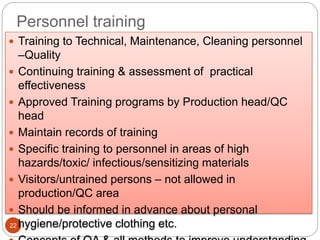
Personnel training
22
 Training to Technical, Maintenance, Cleaning personnel
–Quality
 Continuing training & assessment of practical
effectiveness
 Approved Training programs by Production head/QC
head
 Maintain records of training
 Specific training to personnel in areas of high
hazards/toxic/ infectious/sensitizing materials
 Visitors/untrained persons – not allowed in
production/QC area
 Should be informed in advance about personal
hygiene/protective clothing etc.
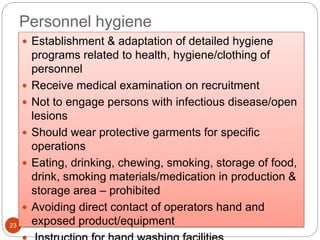
Personnel hygiene
23
 Establishment & adaptation of detailed hygiene
programs related to health, hygiene/clothing of
personnel
 Receive medical examination on recruitment
 Not to engage persons with infectious disease/open
lesions
 Should wear protective garments for specific
operations
 Eating, drinking, chewing, smoking, storage of food,
drink, smoking materials/medication in production &
storage area – prohibited
 Avoiding direct contact of operators hand and
exposed product/equipment
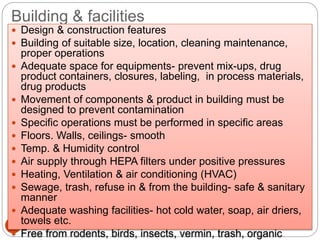
Building & facilities
24
 Design & construction features
 Building of suitable size, location, cleaning maintenance,
proper operations
 Adequate space for equipments- prevent mix-ups, drug
product containers, closures, labeling, in process materials,
drug products
 Movement of components & product in building must be
designed to prevent contamination
 Specific operations must be performed in specific areas
 Floors. Walls, ceilings- smooth
 Temp. & Humidity control
 Air supply through HEPA filters under positive pressures
 Heating, Ventilation & air conditioning (HVAC)
 Sewage, trash, refuse in & from the building- safe & sanitary
manner
 Adequate washing facilities- hot cold water, soap, air driers,
towels etc.
 Free from rodents, birds, insects, vermin, trash, organic
Equipments
25
 Appropriate design, size, location, cleaning,
maintenance
 Surfaces in contact with components, in process
materials, drugs, should not be reactive- to alter
safety, identity, strength, quality
 Cleaning and maintenance, sanitization at intervals
 Written procedures for cleaning etc.
 Assigning responsibility for cleaning
 Cleaning schedules
 Describing methods, equipments, materials used in
cleaning, methods to dissemble and re assemble
 Removal of previous batch identification
 Protection of clean equipment
 Inspection for cleanliness before use
SANITATION & HYGIENE
26
 Covers personnel, premises, equipments, apparatus,
production materials, containers, products for cleaning
& disinfection etc.
 Layout & design of premises to minimize the risk of
errors, permit effective cleaning, maintenance to avoid
cross contamination, build up of duct, dirt which may
effect the quality
 Dust if generated during various processes sampling,
weighing, mixing & processing operations, packaging
etc. Avoid cross contamination, facilitate cleaning.
 Personnel should be instructed to wash hands before
entering the production areas, sign boards,
instructions

2-Quality-assurance-6th-Sem Quality control and GMP

  • 1.
    Definitions, concept ofQC, QA and GMP Quality Assurance and Quality Management Concepts 1
  • 2.
    2 2. Procedures toverify that shipped goods meet specifications:  Pre and post shipment inspection  Analytical Pharmaceutical testing 3. Procedures to monitor & maintain the quality of pharmaceuticals from the moment they are received until the medicine is finally consumed by the patient.:  Proper storage & distribution procedures  Appropriate dispensing  Instructions to the patient on proper use of medication  Product defect and pharmacovigilance reporting
  • 3.
    : 3 Quality Control • ISO9000 defines quality control as "A part of quality management focused on fulfilling quality requirements". • It is that part of GMP concerned with sampling, specification & testing, documentation & release procedures which ensure that the necessary & relevant tests are performed & the product is released for use only after ascertaining it’s quality. Process concerned with medicine sampling, specifications, and testing, and with the organization’s release procedures that ensure that the necessary tests are carried out and that the materials are not released for use, nor products released for sale or supply, until their quality has been judged satisfactory
  • 4.
    4 Responsibili ties of QC Dayto day quality control Analytical testing of raw materials, packaging, labeling material Conduct inprocess testing, env. Monitoring, inspect operations To Conduct required tests on finished Dosage form Selection of qualified vendors for raw material by testing representative samples Inspection &Testing of environmental area for manufacturing of dosage forms
  • 5.
    5 Resp. of QC Head Approve/re ject starting /packaging /intermedi ate/bulk/fin ished products Evaluate batch records Approve specs. Sampling instructs., test methods,QC procedures Required initial & continuing training to dept. personnel Appropriate validations done Check maint. Of dept/premi ses/equip ment Approve & monitor contract analysis
  • 6.
    6 Responsibilities of Production Head To ensure Production& storage as per doc. Approve instructions for prod. Operation for implementation Ensures Validations are done To ensure required trainings to dept. personnel Production records evaluated & signed by authorized person Checks maintenance of his dept., premises, equipment
  • 7.
    Common responsibilities ofProduction and QC Head 7 Authorization of written procedures/documents/including amendments Monitoring & control of Manufacturing environment Plant Hygiene/Process Validation/Training Approval & monitoring of suppliers of material/contract manufacturer Designing & monitoring of storage conditions for materials & products Retention of Records/ Monitoring of compliance with GMP Inspection, investigation, taking samples to monitor factors affecting product quality
  • 8.
    QUALITY ASSURANCE QUALITYCONTROL process oriented product oriented set of activities for ensuring quality in the processes by which products are developed set of activities for ensuring quality in the Products. activities focus on identifying defects in the actual products produced. managerial tool corrective tool aims to prevent defects with a focus on the process used to make the product Aims to identify and correct defects in the finished products Goal is to improve development and test processes so that defects do not arise when the product is being developed to identify defects after a product is developed and before it’s released Aims to prevent the defect aim is to identify and improve the defects technique of managing the quality. method to verify the quality 8
  • 9.
    9 QUALITY ASSURANCE QUALITYCONTROL All team members are responsible Testing team is responsible e.g. Verification e.g. Validation Means Planning for doing a process Action for executing the planned process Statistical technique used : Statistical Process Control Statistical Quality Control makes sure you are doing the right things makes sure the results of what you’ve done are what you expected Defines standards and methodologies to followed in order to meet the customer requirements ensures that the standards are followed while working on the product process to create the deliverables process to verify that deliverables responsible for full software development life Cycle responsible for software testing life cycle
  • 10.
    GOOD MANUFACTURING PRACTICE 10 Good Manufacturing Practice is a part of quality assurance which ensure that the products are consistently produced and controlled according to quality standards appropriate to their intended use.  GMP – A set of principles and procedures which, when followed by manufacturers for the therapeutic goods, helps /ensure that the products manufactured will have the required quality  It is designed to minimize the risks involved in any pharmaceutical production that cannot be eliminated through testing the final product.  Concept born in USA, established in 1963
  • 11.
    GMP involves 11  Allaspects of production; from the starting materials, premises and equipment to the training and personal hygiene of staff.  Detailed, written procedures are essential for each process that could affect the quality of the finished product.  There must be systems to provide documents proof that correct procedures are consistently followed at each step in the manufacturing process every time a product is made.
  • 12.
    WHO GOOD MANUFACTURINGPRACTICES FOR PHARMACEUTICAL PRODUCTS: MAIN PRINCIPLES 12  GMP is that part of quality management which ensures that products are consistently produced and controlled according to the quality standards appropriate to their intended use and as required by the marketing authorization, clinical trial authorization or product specification.  GMP is concerned with both production and QC. GMP is aimed primarily at managing and minimizing the risks inherent in pharmaceutical manufacture to ensure the quality, safety and efficacy of products.
  • 13.
    UNDER GMP 13 a)All manufacturingprocesses are clearly defined, systematically reviewed for associated risks in the light of scientific knowledge and experience, and shown to be capable of consistently manufacturing pharmaceutical products of the required quality that comply with their specifications; b) Qualification and validation are performed; c) All necessary resources are provided, including:  sufficient and appropriately qualified and trained personnel,  adequate premises and space,  suitable equipment and services,  appropriate materials, containers and labels,  approved procedures and instructions,  suitable storage and transport,  adequate personnel, laboratories and equipment for inprocess controls
  • 14.
    14 d) Instructions andprocedures are written in clear and unambiguous language, specifically applicable to the facilities provided; e) Procedures are carried out correctly and personnel are trained to do so; f) Records are made (manually and/or by recording instruments) during manufacture to show that all the steps required by the defined procedures and instructions have in fact been taken and that the quantity and quality of the product are as expected. Any significant deviations are fully recorded and investigated with the objective of determining the root cause and appropriate corrective and preventive action is implemented;
  • 15.
    15 g) Records coveringmanufacture and distribution, which enable the complete history of a batch to be traced, are retained in a comprehensible and accessible form; h) The proper storage and distribution of the products minimizes any risk to their quality and takes account of good distribution practices (GDP); i) A system is available to recall any batch of product from sale or supply; j) Complaints about marketed products are examined, the causes of quality defects investigated and appropriate measures taken in respect of the defective products to prevent
  • 16.
    LISTS OF IMPORTANTDOCUMENTS IN GMP 16  Policies  Standard operating procedures SOP  Specifications  Master formula records MFR  Batch manufacturing record BMR  Manuals  Master plans/Files  Validation protocols  Forms and formats  Records
  • 17.
    GMP Covers 17 Personnel: Adequate no.,qualified, recording of responsibilities assigned, awareness on principles of GMP To receive continuing training, including hygiene instructions Organization chart, people with specific duties with job written Key personnel includes Head of production, head of QC, head of engg., QA head Full time with production head and QC head independent  In India: GMP inspections done by FDA & CDSCO (central drug standard control organization)  In Nepal & more than 100 countries: WHO version of GMP  In India D&C act 1945 ammnended on 24 June 1988 & GMP under sch.M.  Sch. M – 2 parts--- Part 1 & Part 2, GMP is under part 1
  • 18.
    18 Objectives of GMP To eliminate errors To produce productof consistent quality To produce products confirming to the predetermined specific objectives To minimize contaminatio n
  • 19.
    19 GMP components • 1.QM Quality Management • 2. QA • 3. GMP for Medicinal products • 4. QC • 5. Sanitation & hygiene • 6. Qualification & validation •7. Complaints & Recall •8. Contract production & Analysis •9. Self inspection, quality audits & suppliers audits and approval • 10. Personnel, training & personnel hygiene • 11. Premises • 12. Equipment Premises • 13. Materials • 14. Documentation • 15. Holding & Distribution
  • 20.
    20 Design & construct facilities & equipments Followwritten procedures & instructions Document work Validate work Monitor facilities & work Write step by step Operating procedures & work instructions Design, develop & demonstrate job competence Protect against contamination Control components & poduct related process Conduct planned & periodic audits PRINCIPLES OF GMP
  • 21.
    21 SALE Packaging material testing Premises Finished product testing Equipments Quality control department PersonelRecords Sanitation Samples Raw material testing Stability Manufacturing control Sterile products CATEGORIES OF GMP
  • 22.
    Personnel training 22  Trainingto Technical, Maintenance, Cleaning personnel –Quality  Continuing training & assessment of practical effectiveness  Approved Training programs by Production head/QC head  Maintain records of training  Specific training to personnel in areas of high hazards/toxic/ infectious/sensitizing materials  Visitors/untrained persons – not allowed in production/QC area  Should be informed in advance about personal hygiene/protective clothing etc.
  • 23.
    Personnel hygiene 23  Establishment& adaptation of detailed hygiene programs related to health, hygiene/clothing of personnel  Receive medical examination on recruitment  Not to engage persons with infectious disease/open lesions  Should wear protective garments for specific operations  Eating, drinking, chewing, smoking, storage of food, drink, smoking materials/medication in production & storage area – prohibited  Avoiding direct contact of operators hand and exposed product/equipment
  • 24.
    Building & facilities 24 Design & construction features  Building of suitable size, location, cleaning maintenance, proper operations  Adequate space for equipments- prevent mix-ups, drug product containers, closures, labeling, in process materials, drug products  Movement of components & product in building must be designed to prevent contamination  Specific operations must be performed in specific areas  Floors. Walls, ceilings- smooth  Temp. & Humidity control  Air supply through HEPA filters under positive pressures  Heating, Ventilation & air conditioning (HVAC)  Sewage, trash, refuse in & from the building- safe & sanitary manner  Adequate washing facilities- hot cold water, soap, air driers, towels etc.  Free from rodents, birds, insects, vermin, trash, organic
  • 25.
    Equipments 25  Appropriate design,size, location, cleaning, maintenance  Surfaces in contact with components, in process materials, drugs, should not be reactive- to alter safety, identity, strength, quality  Cleaning and maintenance, sanitization at intervals  Written procedures for cleaning etc.  Assigning responsibility for cleaning  Cleaning schedules  Describing methods, equipments, materials used in cleaning, methods to dissemble and re assemble  Removal of previous batch identification  Protection of clean equipment  Inspection for cleanliness before use
  • 26.
    SANITATION & HYGIENE 26 Covers personnel, premises, equipments, apparatus, production materials, containers, products for cleaning & disinfection etc.  Layout & design of premises to minimize the risk of errors, permit effective cleaning, maintenance to avoid cross contamination, build up of duct, dirt which may effect the quality  Dust if generated during various processes sampling, weighing, mixing & processing operations, packaging etc. Avoid cross contamination, facilitate cleaning.  Personnel should be instructed to wash hands before entering the production areas, sign boards, instructions