CHAPTER-8
DRAINS &
SEWER
SUB : WS&SE
BY : D.D.DATTANI
INDEX
• Surface drains
• Classification of drains
• Types of sewer
• Sewer section
• Materials for sewer
• Sewer apprantunces
• Laying of sewer line
• Testing of sewer lines
• Location & function of sewer lines
• Maintenance of sewer
• Non silting& scouring velocity
• Bio-gas plant
• Ventilation of sewer
SURFACE DRAINS
 Surface drainage refers to the
removal of surface water by
development of the slope of the land
utilizing systems of drains to carry
away the surplus water.
 Used for conveying water from
kitchen,bathroom,washing
places,roads,courtyard,roofs,open
ground etc.
 This drains collect sullage water only
and discharge to public sewer
 Cleaning required after short
intervals
Drains Section
• It should develop self cleaning velocity with minimum dry flow
• It should have sufficient free board
• It should be easy in construction
• It should be structurally safe and stable
• It should be such that it can be cleaned easily
The following sections are adopted for the
construction of surface drains
• Rectangular section
• Semi-circular section
• U-shaped section
• V-shaped section
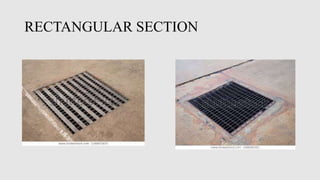
RECTANGULAR SECTION
RECTANGULAR SECTION
• Used for large discharge
• Not used for small discharge
• Constructed by laying plain cement concrete bed
• Due to difficulty in cleaning, this section is not commonly used.
•
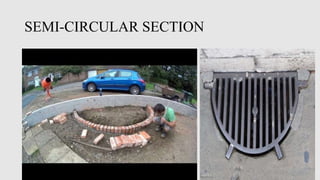
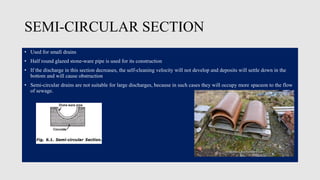
SEMI-CIRCULAR SECTION
• Used for small drains
• Half round glazed stone-ware pipe is used for its construction
• If the discharge in this section decreases, the self-cleaning velocity will not develop and deposits will settle down in the
bottom and will cause obstruction
• Semi-circular drains are not suitable for large discharges, because in such cases they will occupy more spaceon to the flow
of sewage.
U-Section
U-Section
• In semi-circular section if the sides are raised, it becomes u-section. It is used at such places where discharge is more and
cannot be taken by a semi-circular drain.
• Half stone ware pipe is laid in the bottom and over it masonry work is done
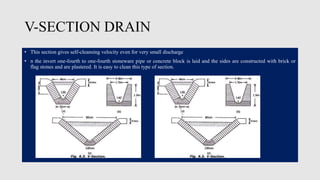
V-SECTION DRAIN
• This section gives self-cleansing velocity even for very small discharge
• n the invert one-fourth to one-fourth stoneware pipe or concrete block is laid and the sides are constructed with brick or
flag stones and are plastered. It is easy to clean this type of section.
TYPES OF SEWER
• MAIN TRUNK SEWER
• BRANCH SEWER
• LATERAL SEWER
• SEPARATE SEWER
• STROM WATER DRAINS
• COMBINED SEWER
• HOUSE SEWER
• DEPRESSED SEWER
• INTERCEPTING SEWER
• OUTFALL SEWER
• RELIEF OR OVERFLOW SEWER
TYPES OF SEWER
• MAIN TRUNK SEWER
• This sewer receives sewage from may branches
• BRANCH SEWER
• This sewer receives sewer from smaller area, usually from laterals and discharge into main sewer called branch sewer
• LATERAL SEWER
• Sewage collected directly from house
• SEPARATE SEWER
• Which collects two different waste i.e. sanitary waste and industrial waste
• STROM WATER DRAINS
• Which carries only storm water (rain water)
• COMBINED SEWER
• Which carry waste of sanitary waste and storm water
• HOUSE SEWER
• Carries sewage from building to street sewer
TYPES OF SEWER
• DEPRESSED SEWER
• Sewer constructed lower than adjacent section to overcome obstacle
• INTERCEPTING SEWER
• Sewer is usually a large sewer, flowing parallel to natural drainage.
• OUTFALL SEWER
• Final outlet discharge sewer
• RELIEF OR OVERFLOW SEWER
• This sewer meant to carry excess discharge from existing sewer known as relief sewer
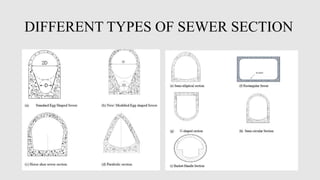
DIFFERENT TYPES OF SEWER SECTION
• Circular shaped sewer
• Standard egg shaped sewer
• New egg shaped sewer
• Horse shoe shaped egg sewer
• Parabolic shape sewer
• Rectangular sewer
• U-shape sewer
• Semi circular shape sewer
• Basket handle shape sewer
DIFFERENT TYPES OF SEWER SECTION
FACTORS AFFECTING MATERIALS OF
SEWER
• Cost
• Durability
• Weight
• Hydraulic efficiency
• Resistance to abrasion
• Resistance to corrosion
• Strength
• Imperviousness
SEWER JOINT
IDEAL CONDITION OF SEWER JOINT
(i) It should be easy to construct
(ii) It should be cheap and economical.
(iii) It should be flexible in nature so that it is not damaged due to slight settlements of the sewer line
(iv) It should be capable of resisting the effects of acidic, alkaline actions of the sewage.
(v) It should be non-absorbant and durable.
(vi) It should be water tight so that infiltration of ground water and exfiltrating of sewage are prevented.
SEWER JOINT
TYPES OF SEWER JOINT
1. BELL AND SPIGOT JOINT
2. COLLAR JOINT
3. SIMPLEX JOINT
4. FLEXIBLE OR BITUMINOUS JOINT
5. MECHANICAL JOINT
6. OPEN JOINT
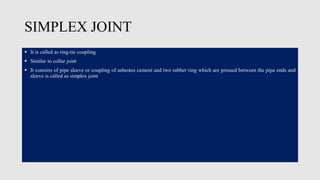
SIMPLEX JOINT
 It is called as ring-tie coupling
 Similar to collar joint
 It consists of pipe sleeve or coupling of asbestos cement and two rubber ring which are pressed between the pipe ends and
sleeve is called as simplex joint
SEWER APPURTENANCES
 Inlets
 Catch basins
 Clean outs
 Man holes
 Drop manhole
 Lamp hole
 Flushing tanks
 Grease and oil traps
 Inverted syphons
 Strom regulator
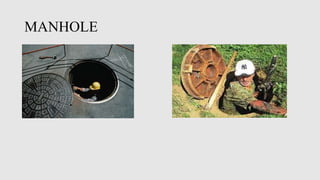
MANHOLE
MANHOLE
 A manhole or inspection chamber is unit constructed underground to provide access the utilities like a sewer system
,drainage system etc.
 Hence with the help of a manhole ,underground utilities are inspected modified cleaned and maintained.
 TYPES OF MANHOLE
 SHALLOW MANHOLE
 NORMAL MANHOLE
 DEEP MANHOLE
TYPES OF MANHOLE
 SHALLOW MAN HOLE :
 Size of manhole :0.7 – 0.9 depth
 Constructed at starting of sewer
 When there is no traffic
 Covered with light cover at top called inspection chamber
 NORMAL MANHOLE :
 Size : 1.5 in depth
 Shape : square or rectangular
 Covered with heavy cover at top
TYPES OF MANHOLE
 Deep manhole
 Deep manholes are those which are deeper than 1.5 m.
 The size of such manhole larger at bottom, which is reduced at the top to reduce the size of manhole cover.
 The reduction is size is achieved by providing an offset of R.C.C
 Steps are also provided on one vertical wall of the manhole to enable the -workers to go up-to the bottom.
 Such a manhole is provided with a heavy cover at top, with suitable C.I Frame.
DROP MANHOLE
1. When it is uneconomical or impracticable to arrange the connection with 60 cm of invert of the sewer and
manhole, then vertical shaft is constructed outside the manhole chamber through which the sewage of branch
sewer is allowed to enter the manhole.
2. Such a manholes which drop the level of invert of the incoming sewer by providing a vertical shaft are called
drop manhole.
3. The main purpose of drop manhole is to avoid the splashing of sewage on the man work.
USES OF MANHOLE
I. For the inspection of Sewer line. Cleaning and maintenance of sewer line.
II. To join sewer lines at different elevations and coming from different directions.
III. To change the direction of sewer line.
IV. If manhole covers are perforated, the manholes may allow the escape of undesirable gases produced in the sewer line,
thus providing ventilation of sewer line.
V. The manholes facilitate the laying of sewer lines in convenient lengths.
VI. The construction of drop man holes in excessive sloping ground reduces the quantityof excavation,
LAYING OF SEWER LINE
1. Setting out
2. Alignment & gradient
3. Excavation of trenches ,timbering and de-watering
4. Laying and jointing
5. Hydraulic testing of pipe
6. Backfilling of trenches
TESTING OF SEWER LINES
1. TEST FOR STRAIGHTNESS AND OBSTRUCTION
2. WATER TEST
3. SMOKE TEST
4. AIRTEST
THANK YOU

Drains and sewer

  • 1.
    CHAPTER-8 DRAINS & SEWER SUB :WS&SE BY : D.D.DATTANI
  • 2.
    INDEX • Surface drains •Classification of drains • Types of sewer • Sewer section • Materials for sewer • Sewer apprantunces • Laying of sewer line • Testing of sewer lines • Location & function of sewer lines • Maintenance of sewer • Non silting& scouring velocity • Bio-gas plant • Ventilation of sewer
  • 3.
    SURFACE DRAINS  Surfacedrainage refers to the removal of surface water by development of the slope of the land utilizing systems of drains to carry away the surplus water.  Used for conveying water from kitchen,bathroom,washing places,roads,courtyard,roofs,open ground etc.  This drains collect sullage water only and discharge to public sewer  Cleaning required after short intervals
  • 4.
    Drains Section • Itshould develop self cleaning velocity with minimum dry flow • It should have sufficient free board • It should be easy in construction • It should be structurally safe and stable • It should be such that it can be cleaned easily
  • 5.
    The following sectionsare adopted for the construction of surface drains • Rectangular section • Semi-circular section • U-shaped section • V-shaped section
  • 6.
  • 7.
    RECTANGULAR SECTION • Usedfor large discharge • Not used for small discharge • Constructed by laying plain cement concrete bed • Due to difficulty in cleaning, this section is not commonly used. •
  • 8.
  • 9.
    SEMI-CIRCULAR SECTION • Usedfor small drains • Half round glazed stone-ware pipe is used for its construction • If the discharge in this section decreases, the self-cleaning velocity will not develop and deposits will settle down in the bottom and will cause obstruction • Semi-circular drains are not suitable for large discharges, because in such cases they will occupy more spaceon to the flow of sewage.
  • 10.
  • 11.
    U-Section • In semi-circularsection if the sides are raised, it becomes u-section. It is used at such places where discharge is more and cannot be taken by a semi-circular drain. • Half stone ware pipe is laid in the bottom and over it masonry work is done
  • 12.
    V-SECTION DRAIN • Thissection gives self-cleansing velocity even for very small discharge • n the invert one-fourth to one-fourth stoneware pipe or concrete block is laid and the sides are constructed with brick or flag stones and are plastered. It is easy to clean this type of section.
  • 13.
    TYPES OF SEWER •MAIN TRUNK SEWER • BRANCH SEWER • LATERAL SEWER • SEPARATE SEWER • STROM WATER DRAINS • COMBINED SEWER • HOUSE SEWER • DEPRESSED SEWER • INTERCEPTING SEWER • OUTFALL SEWER • RELIEF OR OVERFLOW SEWER
  • 14.
    TYPES OF SEWER •MAIN TRUNK SEWER • This sewer receives sewage from may branches • BRANCH SEWER • This sewer receives sewer from smaller area, usually from laterals and discharge into main sewer called branch sewer • LATERAL SEWER • Sewage collected directly from house • SEPARATE SEWER • Which collects two different waste i.e. sanitary waste and industrial waste • STROM WATER DRAINS • Which carries only storm water (rain water) • COMBINED SEWER • Which carry waste of sanitary waste and storm water • HOUSE SEWER • Carries sewage from building to street sewer
  • 15.
    TYPES OF SEWER •DEPRESSED SEWER • Sewer constructed lower than adjacent section to overcome obstacle • INTERCEPTING SEWER • Sewer is usually a large sewer, flowing parallel to natural drainage. • OUTFALL SEWER • Final outlet discharge sewer • RELIEF OR OVERFLOW SEWER • This sewer meant to carry excess discharge from existing sewer known as relief sewer
  • 16.
    DIFFERENT TYPES OFSEWER SECTION • Circular shaped sewer • Standard egg shaped sewer • New egg shaped sewer • Horse shoe shaped egg sewer • Parabolic shape sewer • Rectangular sewer • U-shape sewer • Semi circular shape sewer • Basket handle shape sewer
  • 17.
    DIFFERENT TYPES OFSEWER SECTION
  • 18.
    FACTORS AFFECTING MATERIALSOF SEWER • Cost • Durability • Weight • Hydraulic efficiency • Resistance to abrasion • Resistance to corrosion • Strength • Imperviousness
  • 19.
    SEWER JOINT IDEAL CONDITIONOF SEWER JOINT (i) It should be easy to construct (ii) It should be cheap and economical. (iii) It should be flexible in nature so that it is not damaged due to slight settlements of the sewer line (iv) It should be capable of resisting the effects of acidic, alkaline actions of the sewage. (v) It should be non-absorbant and durable. (vi) It should be water tight so that infiltration of ground water and exfiltrating of sewage are prevented.
  • 20.
    SEWER JOINT TYPES OFSEWER JOINT 1. BELL AND SPIGOT JOINT 2. COLLAR JOINT 3. SIMPLEX JOINT 4. FLEXIBLE OR BITUMINOUS JOINT 5. MECHANICAL JOINT 6. OPEN JOINT
  • 21.
    SIMPLEX JOINT  Itis called as ring-tie coupling  Similar to collar joint  It consists of pipe sleeve or coupling of asbestos cement and two rubber ring which are pressed between the pipe ends and sleeve is called as simplex joint
  • 22.
    SEWER APPURTENANCES  Inlets Catch basins  Clean outs  Man holes  Drop manhole  Lamp hole  Flushing tanks  Grease and oil traps  Inverted syphons  Strom regulator
  • 23.
  • 24.
    MANHOLE  A manholeor inspection chamber is unit constructed underground to provide access the utilities like a sewer system ,drainage system etc.  Hence with the help of a manhole ,underground utilities are inspected modified cleaned and maintained.  TYPES OF MANHOLE  SHALLOW MANHOLE  NORMAL MANHOLE  DEEP MANHOLE
  • 25.
    TYPES OF MANHOLE SHALLOW MAN HOLE :  Size of manhole :0.7 – 0.9 depth  Constructed at starting of sewer  When there is no traffic  Covered with light cover at top called inspection chamber  NORMAL MANHOLE :  Size : 1.5 in depth  Shape : square or rectangular  Covered with heavy cover at top
  • 26.
    TYPES OF MANHOLE Deep manhole  Deep manholes are those which are deeper than 1.5 m.  The size of such manhole larger at bottom, which is reduced at the top to reduce the size of manhole cover.  The reduction is size is achieved by providing an offset of R.C.C  Steps are also provided on one vertical wall of the manhole to enable the -workers to go up-to the bottom.  Such a manhole is provided with a heavy cover at top, with suitable C.I Frame.
  • 27.
    DROP MANHOLE 1. Whenit is uneconomical or impracticable to arrange the connection with 60 cm of invert of the sewer and manhole, then vertical shaft is constructed outside the manhole chamber through which the sewage of branch sewer is allowed to enter the manhole. 2. Such a manholes which drop the level of invert of the incoming sewer by providing a vertical shaft are called drop manhole. 3. The main purpose of drop manhole is to avoid the splashing of sewage on the man work.
  • 28.
    USES OF MANHOLE I.For the inspection of Sewer line. Cleaning and maintenance of sewer line. II. To join sewer lines at different elevations and coming from different directions. III. To change the direction of sewer line. IV. If manhole covers are perforated, the manholes may allow the escape of undesirable gases produced in the sewer line, thus providing ventilation of sewer line. V. The manholes facilitate the laying of sewer lines in convenient lengths. VI. The construction of drop man holes in excessive sloping ground reduces the quantityof excavation,
  • 29.
    LAYING OF SEWERLINE 1. Setting out 2. Alignment & gradient 3. Excavation of trenches ,timbering and de-watering 4. Laying and jointing 5. Hydraulic testing of pipe 6. Backfilling of trenches
  • 30.
    TESTING OF SEWERLINES 1. TEST FOR STRAIGHTNESS AND OBSTRUCTION 2. WATER TEST 3. SMOKE TEST 4. AIRTEST
  • 31.