UNIT-I
SOURCES, QUALITY AND
DEMAND OF WATER
Presented by :
Dhara Dattani
Lecturer
Atmiya Institute Of Technology & Science For Diploma Studies, Rajkot.
CONTENTS
• Explain Importance of water supply engineering
• Identify sources of water for potable use
• Calculate water demand for future population
• Enlist factor affecting water demand
• Determine various impurities found in water source
• List Standards of quality of water with their permissible limits
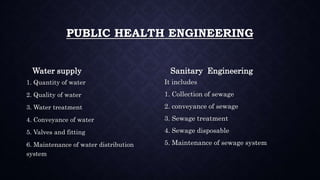
PUBLIC HEALTH ENGINEERING
Water supply
1. Quantity of water
2. Quality of water
3. Water treatment
4. Conveyance of water
5. Valves and fitting
6. Maintenance of water distribution
system
Sanitary Engineering
It includes
1. Collection of sewage
2. conveyance of sewage
3. Sewage treatment
4. Sewage disposable
5. Maintenance of sewage system
IMPORTANCE AND NECESSITY OF WATER
SUPPLY
• Various use of water:
• Drinking
• Cooking
• Bathing
• Sprinkling on garden
• Agricultural use
• Road washing
• Fire fighting
• Hydropower generation
• Construction swimming pool
• Industrial use, etc
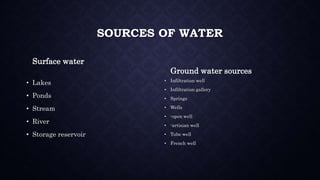
SOURCES OF WATER
1. Surface water sources
2. Ground water Sources
SOURCES OF WATER
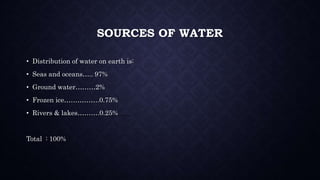
• Distribution of water on earth is:
• Seas and oceans….. 97%
• Ground water………2%
• Frozen ice…………….0.75%
• Rivers & lakes……….0.25%
Total : 100%
SOURCES OF WATER
Surface water
• Lakes
• Ponds
• Stream
• River
• Storage reservoir
Ground water sources
• Infiltration well
• Infiltration gallery
• Springs
• Wells
• -open well
• -artisian well
• Tube well
• French well
LAKES
• These are natural large sized depressions formed within the surface and filled with rainwater.
• The quality of water in a lake is generally good & doesn’t need much purification.
• Larger and older lakes provide comparatively pure water than the smaller and newer lakes.
• In lakes, growth of algae and some water are generally common.
• Famous lakes in India are :
• Dal lake- Jammu & Kashmir
• Dhebar lake- Rajasthan
• Nakki lake- Rajasthan
• Pushkar lake-Rajasthan
• Nal sarovar-Gujarat
• Hussain sagar- Andhra Pradesh
• Pulicat- Tamilnadu
• Kolleru- Andhra Pradesh
• Chilka-Orissa
• Vembanad-Kerala
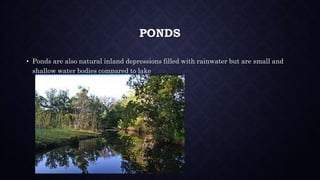
PONDS
• Ponds are also natural inland depressions filled with rainwater but are small and
shallow water bodies compared to lake
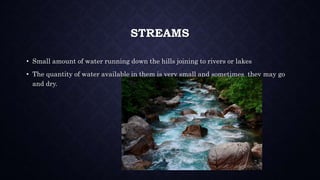
STREAMS
• Small amount of water running down the hills joining to rivers or lakes
• The quantity of water available in them is very small and sometimes they may go
and dry.
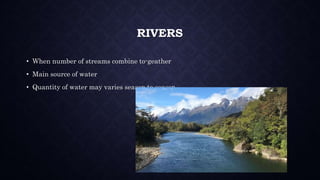
RIVERS
• When number of streams combine to-geather
• Main source of water
• Quantity of water may varies season to season
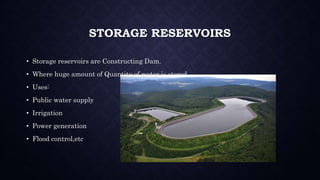
STORAGE RESERVOIRS
• Storage reservoirs are Constructing Dam.
• Where huge amount of Quantity of water is stored.
• Uses:
• Public water supply
• Irrigation
• Power generation
• Flood control,etc
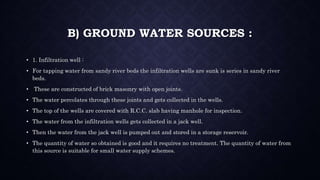
B) GROUND WATER SOURCES :
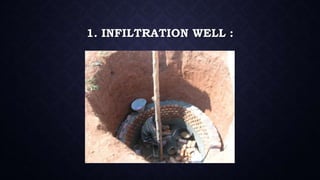
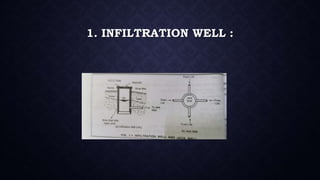
• 1. Infiltration well :
• For tapping water from sandy river beds the infiltration wells are sunk is series in sandy river
beds.
• These are constructed of brick masonry with open joints.
• The water percolates through these joints and gets collected in the wells.
• The top of the wells are covered with R.C.C. slab having manhole for inspection.
• The water from the infiltration wells gets collected in a jack well.
• Then the water from the jack well is pumped out and stored in a storage reservoir.
• The quantity of water so obtained is good and it requires no treatment. The quantity of water from
this source is suitable for small water supply schemes.
1. INFILTRATION WELL :
INFILTRATION GALLERY
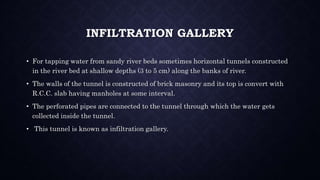
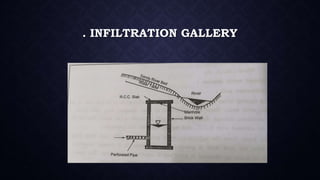
• For tapping water from sandy river beds sometimes horizontal tunnels constructed
in the river bed at shallow depths (3 to 5 cm) along the banks of river.
• The walls of the tunnel is constructed of brick masonry and its top is convert with
R.C.C. slab having manholes at some interval.
• The perforated pipes are connected to the tunnel through which the water gets
collected inside the tunnel.
• This tunnel is known as infiltration gallery.
. INFILTRATION GALLERY
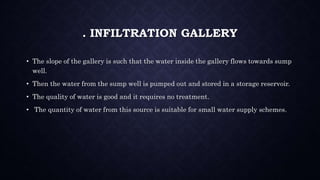
• The slope of the gallery is such that the water inside the gallery flows towards sump
well.
• Then the water from the sump well is pumped out and stored in a storage reservoir.
• The quality of water is good and it requires no treatment.
• The quantity of water from this source is suitable for small water supply schemes.
SPRINGS
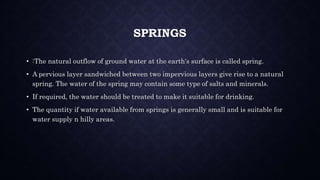
• :The natural outflow of ground water at the earth's surface is called spring.
• A pervious layer sandwiched between two impervious layers give rise to a natural
spring. The water of the spring may contain some type of salts and minerals.
• If required, the water should be treated to make it suitable for drinking.
• The quantity if water available from springs is generally small and is suitable for
water supply n hilly areas.
SPRINGS
• The following are the different types of springs
• :(i) Artesian spring
• (ii) Gravity spring
• (iii) Surface
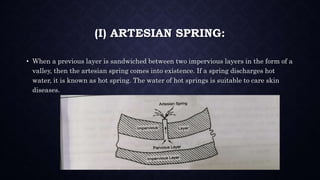
(I) ARTESIAN SPRING:
• When a previous layer is sandwiched between two impervious layers in the form of a
valley, then the artesian spring comes into existence. If a spring discharges hot
water, it is known as hot spring. The water of hot springs is suitable to care skin
diseases.
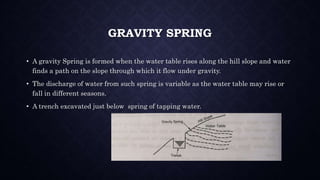
GRAVITY SPRING
• A gravity Spring is formed when the water table rises along the hill slope and water
finds a path on the slope through which it flow under gravity.
• The discharge of water from such spring is variable as the water table may rise or
fall in different seasons.
• A trench excavated just below spring of tapping water.
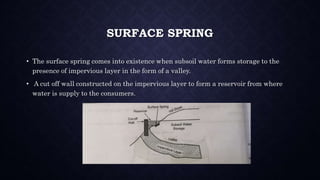
SURFACE SPRING
• The surface spring comes into existence when subsoil water forms storage to the
presence of impervious layer in the form of a valley.
• A cut off wall constructed on the impervious layer to form a reservoir from where
water is supply to the consumers.
SELECTION OF SOURCE OF WATER SUPPLY
• Location of water supply
• Elevation of intake point
• Quantity of available water
• Quality of available water
• Topography of the intervening area
SELECTION OF SOURCE OF WATER SUPPLY
• Location : The source of water must be situated as near as possible to the town or
city to minimise cost of conveyance
• Elevation of intake point : The reduced level (R.L.) of the intake point should be
higher than that of the city or the town to be supplied with water ,so as to make the
gravity flow possible.
• Quantity of available water : it shouldn’t be toxic, or poisonous. If available then it
should be such as to be remove easily by treatment method.
• Topography of intervening area : it should not contain deep valleys or high
mountainous and ridges.
CRITERIA FOR CONSIDERING FOR WATER
SUPPLY SCHEME:
• 1. financial aspect
• 2. population
• 3. Quality of water
• 4. rate of consumption
• 5. sources of water supply
• 6. sanitary survey of area
• 7. topography of area
• 8. trends of town development
DUTIES OF PHE
• The engineer should have perfect knowledge about planning. designing, constr and maintenance
of water works and sanitary works.
• He must be capable to operate the water works without fail and should supply safe potable water
to the public at desired pressure
• He should be able to detect the possible cause of contamination of water source should take
necessary measures to prevent such contamination
• He should know the various water treatment methods.
• He should know the laboratory tests which may be required for the treatment.
DUTIES OF PHE
• He should be aware of the latest techniques and methods of water purification
• He should have a knowledge of water distribution networks
• He should take the water samples at certain time intervals to maintain the quality of water.
• He design sewage and storm water drainage network for proper disposal of sewage.
• He do design, construction and operation of sewage treatment plants
• They design various treatment technologies for the municipal solid waste management.
• They deal with the concept of recycling and reuse of waste water
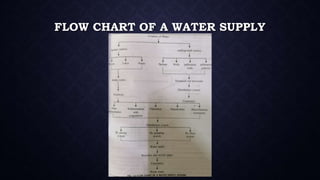
FLOW CHART OF A WATER SUPPLY
SCHEME
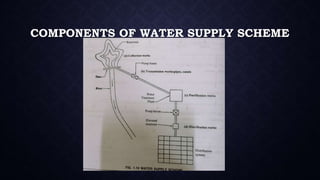
COMPONENTS OF WATER SUPPLY SCHEME
• 1. Collection works
• 2. transmission works
• 3. Purification of work
• 4.Distribution of work
COMPONENTS OF WATER SUPPLY SCHEME
• 1.Collection works :Collection works are meant for the development of surface water
or ground water resources criteria For major cities or where water requirements are
large, water is collected from a surface source mostly a river or stream.
• If the river is perennial, a direct intake structure can be built on river bank. If
however, river is not perennial, dam is built across a river so that water is stored in
the reservoir. Water is then drawn from the reservoir as per needs
COMPONENTS OF WATER SUPPLY SCHEME
• The collection works, therefore consists of a storage or diversion work, and an intake
structure.
• Transmission works :When collection works are far away from the city where water
is to be suppliers work is conveyed to the city through the transmission works.
Depending upon the topography of the between the two sites, the transmission
works may be in the form of pipes, canals or aqueducts. For simple gravity flow,
canals are generally used.
• But for uneven topography. Pumping have to be resorted to.
COMPONENTS OF WATER SUPPLY SCHEME
• Purification works :The water collected directly from the source may not be safe for
drinking because of physical, chemical and biological impurities. The principal aim
of the purification works is to ply clean and bacteria free water.
• Coagulation,
• Flocculation
• Sedimentation
• Filtration
• Disinfection
COMPONENTS OF WATER SUPPLY SCHEME
• Distribution works :The treated and purified water is finally supplied to the
consumers through suitable distribution system. In order that water may flow in the
water supply pipes under pressure, the purified water is stored in an elevated
service reservoirs.
• Main systems of water distribution are :
• Dead end system Grid iron system.
Sources and de mand and water supply

Sources and de mand and water supply

  • 1.
    UNIT-I SOURCES, QUALITY AND DEMANDOF WATER Presented by : Dhara Dattani Lecturer Atmiya Institute Of Technology & Science For Diploma Studies, Rajkot.
  • 2.
    CONTENTS • Explain Importanceof water supply engineering • Identify sources of water for potable use • Calculate water demand for future population • Enlist factor affecting water demand • Determine various impurities found in water source • List Standards of quality of water with their permissible limits
  • 3.
    PUBLIC HEALTH ENGINEERING Watersupply 1. Quantity of water 2. Quality of water 3. Water treatment 4. Conveyance of water 5. Valves and fitting 6. Maintenance of water distribution system Sanitary Engineering It includes 1. Collection of sewage 2. conveyance of sewage 3. Sewage treatment 4. Sewage disposable 5. Maintenance of sewage system
  • 4.
    IMPORTANCE AND NECESSITYOF WATER SUPPLY • Various use of water: • Drinking • Cooking • Bathing • Sprinkling on garden • Agricultural use • Road washing • Fire fighting • Hydropower generation • Construction swimming pool • Industrial use, etc
  • 5.
    SOURCES OF WATER 1.Surface water sources 2. Ground water Sources
  • 6.
    SOURCES OF WATER •Distribution of water on earth is: • Seas and oceans….. 97% • Ground water………2% • Frozen ice…………….0.75% • Rivers & lakes……….0.25% Total : 100%
  • 7.
    SOURCES OF WATER Surfacewater • Lakes • Ponds • Stream • River • Storage reservoir Ground water sources • Infiltration well • Infiltration gallery • Springs • Wells • -open well • -artisian well • Tube well • French well
  • 8.
    LAKES • These arenatural large sized depressions formed within the surface and filled with rainwater. • The quality of water in a lake is generally good & doesn’t need much purification. • Larger and older lakes provide comparatively pure water than the smaller and newer lakes. • In lakes, growth of algae and some water are generally common. • Famous lakes in India are : • Dal lake- Jammu & Kashmir • Dhebar lake- Rajasthan • Nakki lake- Rajasthan • Pushkar lake-Rajasthan • Nal sarovar-Gujarat • Hussain sagar- Andhra Pradesh • Pulicat- Tamilnadu • Kolleru- Andhra Pradesh • Chilka-Orissa • Vembanad-Kerala
  • 9.
    PONDS • Ponds arealso natural inland depressions filled with rainwater but are small and shallow water bodies compared to lake
  • 10.
    STREAMS • Small amountof water running down the hills joining to rivers or lakes • The quantity of water available in them is very small and sometimes they may go and dry.
  • 11.
    RIVERS • When numberof streams combine to-geather • Main source of water • Quantity of water may varies season to season
  • 12.
    STORAGE RESERVOIRS • Storagereservoirs are Constructing Dam. • Where huge amount of Quantity of water is stored. • Uses: • Public water supply • Irrigation • Power generation • Flood control,etc
  • 13.
    B) GROUND WATERSOURCES : • 1. Infiltration well : • For tapping water from sandy river beds the infiltration wells are sunk is series in sandy river beds. • These are constructed of brick masonry with open joints. • The water percolates through these joints and gets collected in the wells. • The top of the wells are covered with R.C.C. slab having manhole for inspection. • The water from the infiltration wells gets collected in a jack well. • Then the water from the jack well is pumped out and stored in a storage reservoir. • The quantity of water so obtained is good and it requires no treatment. The quantity of water from this source is suitable for small water supply schemes.
  • 14.
  • 15.
  • 16.
    INFILTRATION GALLERY • Fortapping water from sandy river beds sometimes horizontal tunnels constructed in the river bed at shallow depths (3 to 5 cm) along the banks of river. • The walls of the tunnel is constructed of brick masonry and its top is convert with R.C.C. slab having manholes at some interval. • The perforated pipes are connected to the tunnel through which the water gets collected inside the tunnel. • This tunnel is known as infiltration gallery.
  • 17.
  • 18.
    . INFILTRATION GALLERY •The slope of the gallery is such that the water inside the gallery flows towards sump well. • Then the water from the sump well is pumped out and stored in a storage reservoir. • The quality of water is good and it requires no treatment. • The quantity of water from this source is suitable for small water supply schemes.
  • 19.
    SPRINGS • :The naturaloutflow of ground water at the earth's surface is called spring. • A pervious layer sandwiched between two impervious layers give rise to a natural spring. The water of the spring may contain some type of salts and minerals. • If required, the water should be treated to make it suitable for drinking. • The quantity if water available from springs is generally small and is suitable for water supply n hilly areas.
  • 20.
    SPRINGS • The followingare the different types of springs • :(i) Artesian spring • (ii) Gravity spring • (iii) Surface
  • 21.
    (I) ARTESIAN SPRING: •When a previous layer is sandwiched between two impervious layers in the form of a valley, then the artesian spring comes into existence. If a spring discharges hot water, it is known as hot spring. The water of hot springs is suitable to care skin diseases.
  • 22.
    GRAVITY SPRING • Agravity Spring is formed when the water table rises along the hill slope and water finds a path on the slope through which it flow under gravity. • The discharge of water from such spring is variable as the water table may rise or fall in different seasons. • A trench excavated just below spring of tapping water.
  • 23.
    SURFACE SPRING • Thesurface spring comes into existence when subsoil water forms storage to the presence of impervious layer in the form of a valley. • A cut off wall constructed on the impervious layer to form a reservoir from where water is supply to the consumers.
  • 24.
    SELECTION OF SOURCEOF WATER SUPPLY • Location of water supply • Elevation of intake point • Quantity of available water • Quality of available water • Topography of the intervening area
  • 25.
    SELECTION OF SOURCEOF WATER SUPPLY • Location : The source of water must be situated as near as possible to the town or city to minimise cost of conveyance • Elevation of intake point : The reduced level (R.L.) of the intake point should be higher than that of the city or the town to be supplied with water ,so as to make the gravity flow possible. • Quantity of available water : it shouldn’t be toxic, or poisonous. If available then it should be such as to be remove easily by treatment method. • Topography of intervening area : it should not contain deep valleys or high mountainous and ridges.
  • 26.
    CRITERIA FOR CONSIDERINGFOR WATER SUPPLY SCHEME: • 1. financial aspect • 2. population • 3. Quality of water • 4. rate of consumption • 5. sources of water supply • 6. sanitary survey of area • 7. topography of area • 8. trends of town development
  • 27.
    DUTIES OF PHE •The engineer should have perfect knowledge about planning. designing, constr and maintenance of water works and sanitary works. • He must be capable to operate the water works without fail and should supply safe potable water to the public at desired pressure • He should be able to detect the possible cause of contamination of water source should take necessary measures to prevent such contamination • He should know the various water treatment methods. • He should know the laboratory tests which may be required for the treatment.
  • 28.
    DUTIES OF PHE •He should be aware of the latest techniques and methods of water purification • He should have a knowledge of water distribution networks • He should take the water samples at certain time intervals to maintain the quality of water. • He design sewage and storm water drainage network for proper disposal of sewage. • He do design, construction and operation of sewage treatment plants • They design various treatment technologies for the municipal solid waste management. • They deal with the concept of recycling and reuse of waste water
  • 29.
    FLOW CHART OFA WATER SUPPLY SCHEME
  • 30.
    COMPONENTS OF WATERSUPPLY SCHEME
  • 31.
    COMPONENTS OF WATERSUPPLY SCHEME • 1. Collection works • 2. transmission works • 3. Purification of work • 4.Distribution of work
  • 32.
    COMPONENTS OF WATERSUPPLY SCHEME • 1.Collection works :Collection works are meant for the development of surface water or ground water resources criteria For major cities or where water requirements are large, water is collected from a surface source mostly a river or stream. • If the river is perennial, a direct intake structure can be built on river bank. If however, river is not perennial, dam is built across a river so that water is stored in the reservoir. Water is then drawn from the reservoir as per needs
  • 33.
    COMPONENTS OF WATERSUPPLY SCHEME • The collection works, therefore consists of a storage or diversion work, and an intake structure. • Transmission works :When collection works are far away from the city where water is to be suppliers work is conveyed to the city through the transmission works. Depending upon the topography of the between the two sites, the transmission works may be in the form of pipes, canals or aqueducts. For simple gravity flow, canals are generally used. • But for uneven topography. Pumping have to be resorted to.
  • 34.
    COMPONENTS OF WATERSUPPLY SCHEME • Purification works :The water collected directly from the source may not be safe for drinking because of physical, chemical and biological impurities. The principal aim of the purification works is to ply clean and bacteria free water. • Coagulation, • Flocculation • Sedimentation • Filtration • Disinfection
  • 35.
    COMPONENTS OF WATERSUPPLY SCHEME • Distribution works :The treated and purified water is finally supplied to the consumers through suitable distribution system. In order that water may flow in the water supply pipes under pressure, the purified water is stored in an elevated service reservoirs. • Main systems of water distribution are : • Dead end system Grid iron system.