CHAPTER II
“The teacher is a diplomat and ambassador of tact
and sensitivity, as he/she facilitates productive, positive
interactions among the multiplicity of personalities,
cultures, beliefs and ideals”.
-Unknown-
A teacher is a facilitator of learning and of the
development of the youth; he shall, therefore, render the
best services by providing an environment conducive to
such learning and growth.
-Code of Ethics for Professional Teachers, Article III-
INTRODUCTION
 The teacher has two communities.
 Teaching community
 consists of his/her fellow teachers, colleagues and
superiors
 Community outside the school
 Includes the parents of his/her learners, local
officials, alumni/alumnae and other members of the
society in which the school is located
 To function well in the classroom and in the community,
he/she must be equipped with competencies.
 knowledge
 skills
 attitudes
Along with the:
• Commission on Higher education (CHED),
• Teacher Education Institutes (TEIs),
• Philippine Regulatory Commission (PRC),
• Department of Education (DepEd) and the
• Civil Service Commission (CSC) in partnership
with the
• different academic institution,
National Competency-Based
Teacher Standards (NCBTS)
was born.
What is National Competency-Based Teacher Standards
(NCBTS) ?
• It is an integrated theoretical framework that defines the
different dimensions of effective teaching
• result of the societal change, a reflection of what is
happening in the society and adopting our curriculum
into the 21st century globally competent education.
• A set of competencies (behaviors, attitudes, and skills)
• “The core values of Filipino teachers and on the principles of
effective teaching learning.”
LESSON 1
 Provides a single framework that define effective
teaching in all aspects of a teacher’s professional life
and in all phases of teacher development.
 Minimize confusion about what effective teaching is.
 Provides a better guide for all teacher development
programs and projects form the school-level up to the
national level.
Why do we need the NCBTS?
1. Social Regard for Learning (SRFL)
• It focuses on the ideal that teachers serve as positive
and powerful role models.
• Teacher’s actions demonstrate value for learning.
The Teacher:
 implements school policies and procedures;
 demonstrates punctuality;
 maintains appropriate appearance; and
 is careful about the effects of one’s behavior
on the students
2. Learning Environment (LE)
• It focuses on importance of providing a
social, psychological and physical environment
2.1 The Teacher creates an environment that
promotes fairness.
The Teacher:
 maintains an environment of courtesy and
respect for different learners’ abilities,
culture, and gender;
 provides a gender-fair opportunities for
learning; and
 recognizes that every learner has strengths.
2.2 The Teacher makes the classroom environment
conducive to learning.
The Teacher:
 maintains a safe, clean and orderly clean
classroom free from distractions; and
 arranges challenging activities given the
physical environment.
2.3 The Teacher communicates higher learning
expectations to each learner.
The Teacher:
 uses individual and cooperative learning
activities to improve capacities of learner’s for
higher learning;
 encourages learners to ask questions; and
 provides learners of variety of learning
experiences.
2.4 The Teacher establishes and maintains consistent
standards learners’ behavior.
The Teacher:
 handles behavior problems quickly and with
due respect to children’s rights;
 gives timely feedback to reinforce appropriate
to learners behavior;
 guides individual learner requiring
development of appropriate social and learning
behavior; and
 communicates school policies and procedures
for classroom behavior and see to it that they are
followed.
3. Diversity of Learners (DOL)
• It emphasizes the ideal that teachers can facilitate the
learning process even with diverse learners.
3.1 The Teacher is familiar with the children’s background
knowledge and experiences.
The Teacher:
 uses information on the learning styles and needs of
the learners to design and select learning experiences;
 establishes goals that define appropriate expectations
for all learners;
 paces lessons appropriate to needs and/ or abilities of
learners;
 provides differentiated activities for learners.
 initiates other learning approaches for learners whose
needs have not been met by usual approaches; and
 shows sensitivity to multi-cultural backgrounds of the
learners.
3.2 The Teacher demonstrates concern for holistic
development of learners.
The Teacher:
sets clear, challenging and achievable
expectations on the holistic development of all
learners;
identifies learning gaps and takes action to
enable learners to catch up;
employs integrative and interactive strategies
for meaningful and holistic development of
learners;
is sensitive to unusual behavior of learners
and takes appropriate action; and
provides opportunities to enhance learners
growth in all aspects.
4. Curriculum (Curr.)
• It refers to all elements of the teaching-learning
process that work in convergence.
• These elements include the teacher’s knowledge
of subject matter and the learning
process, teaching-learning approaches and
activities, instructional materials and learning
resources.
4.1 The Teacher demonstrates mastery on the
subject.
The Teacher:
 delivers accurate and updated content
knowledge using appropriate
methodologies, approaches and strategies;
 Integrates language, literacy and
quantitative skill development and values in
his/her subject area;
 Explains learning goals, instructional
procedures and content clearly and accurately
to students
Links the current content with past and
future lessons
Aligns with lesson objectives the teaching
methods, learning activities and instructional
materials or resources appropriate to learners
 Creates situations that encourages
learners to use high order thinking skills
Engages and sustains learners’ interest in
the subject by making content meaningful
and relevant to them
Integrates relevant scholarly works and
ideas to enrich the lesson as needed
Integrates content of subject area with
other disciplines
.
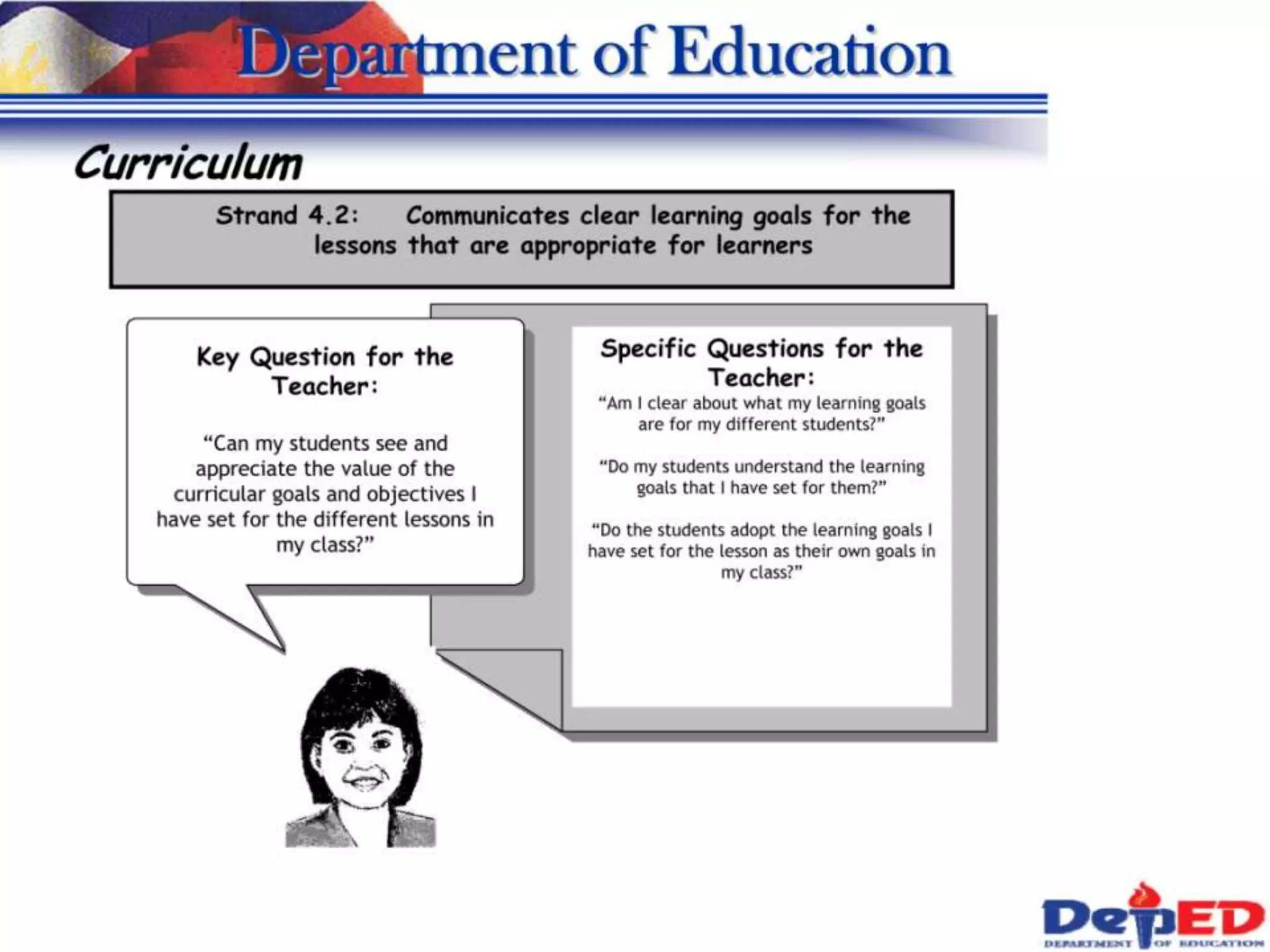
4.2 Communicates clear learning goals for the lessons
that are appropriate for learners
The Teacher:
 Sets appropriate learning goals
 Understands the learning goals
4.3 Makes good use of allotted instructions time.
The Teacher:
 establishes routines and procedures to
maximize instructional time
 plans lessons to fit within available
instructional time
4.4 Selects teaching methods, learning activities and
instructional materials or resources appropriate to
learners and aligned materials or to the objectives if
the lesson.
The Teacher:
 Translates learning competencies to
instructional objectives
 selects, prepares and utilizes instructional
materials appropriate to the learners and to the
learning objectives
 provides activities and uses materials which
fit the learners’ learning styles, goals and
culture
 uses a variety of teaching approaches and
techniques appropriate to the subject matter
and the learners
 utilizes information derived from assessment
to improve teaching and learning
Provides activities and uses materials which
involve students in meaningful learning
4.5 Teacher recognizes general learning processes as
well as unique processes of individual learners.
The Teacher:
 Design and utilizes teaching methods that
take into account the learning process
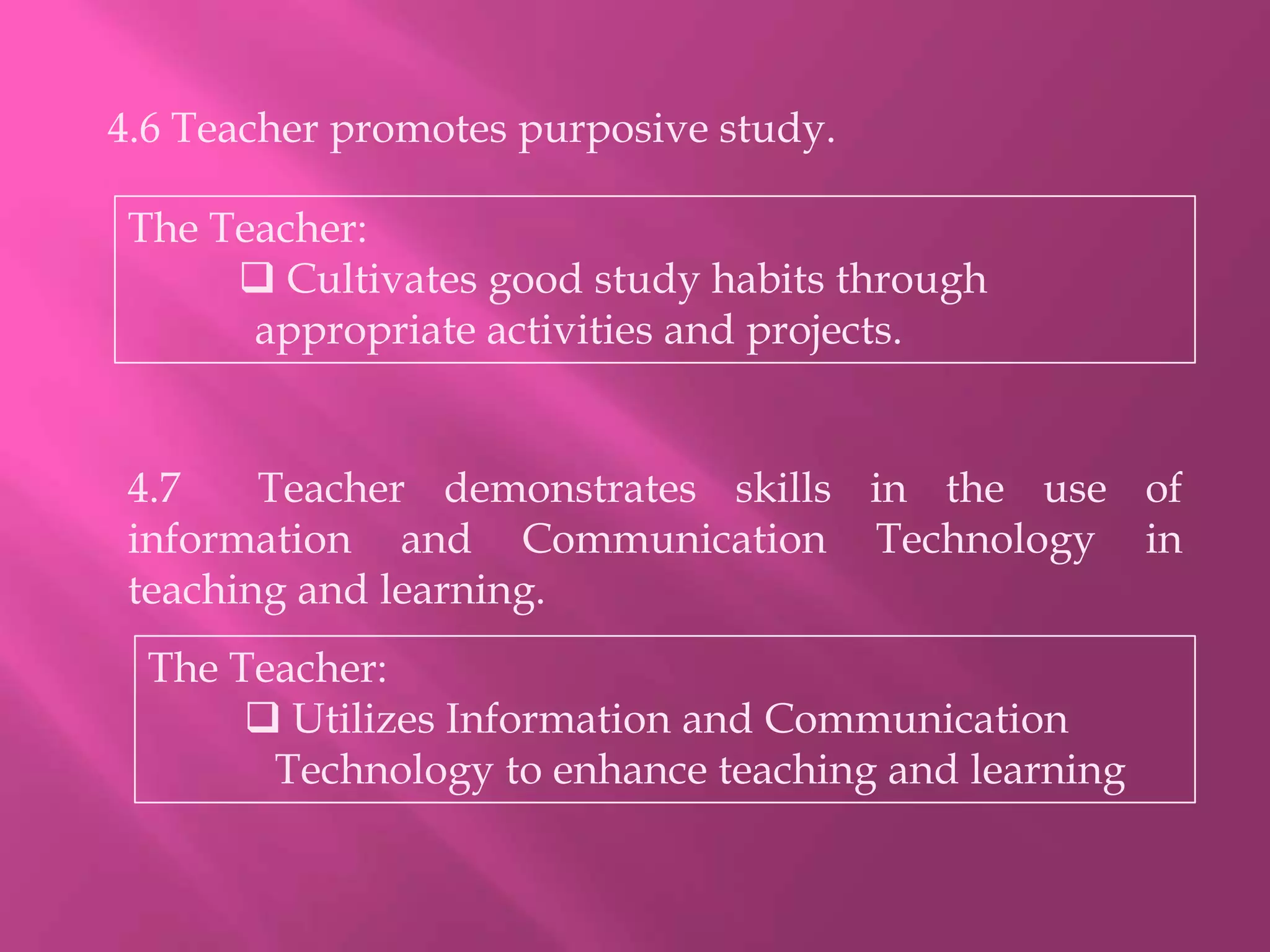
4.6 Teacher promotes purposive study.
The Teacher:
 Cultivates good study habits through
appropriate activities and projects.
4.7 Teacher demonstrates skills in the use of
information and Communication Technology in
teaching and learning.
The Teacher:
 Utilizes Information and Communication
Technology to enhance teaching and learning
5. Planning, Assessing Reporting (PAR)
• It refers to the alignment of assessment and
planning activities.
• It focuses on the :
(1) use of assessment data to plan and revise
teaching-learning plans;
(2) integration of assessment procedures in the
plan and implementation of teaching-learning
activities, and
(3) reporting of the learners’ actual
achievement and behaviour.
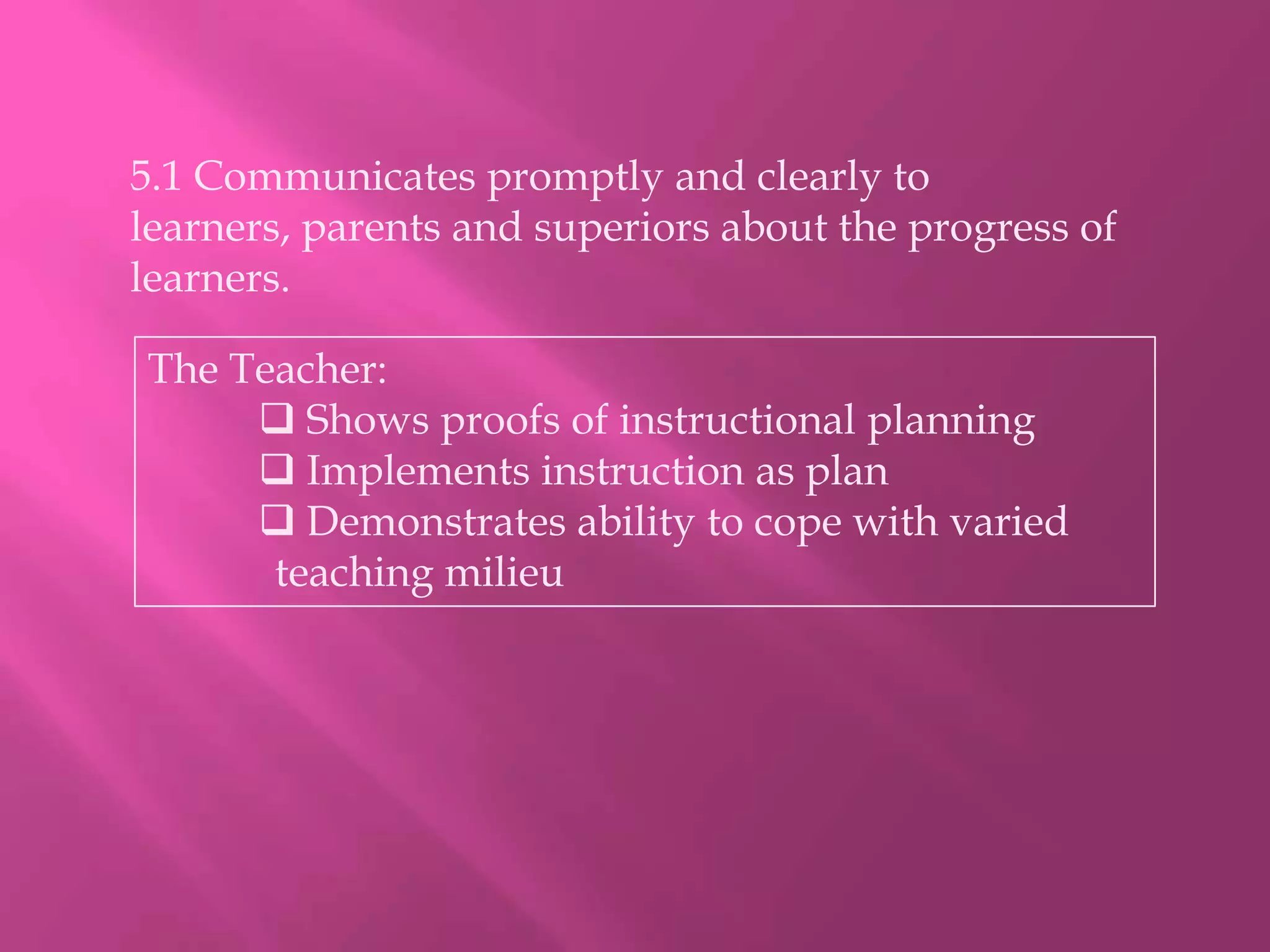
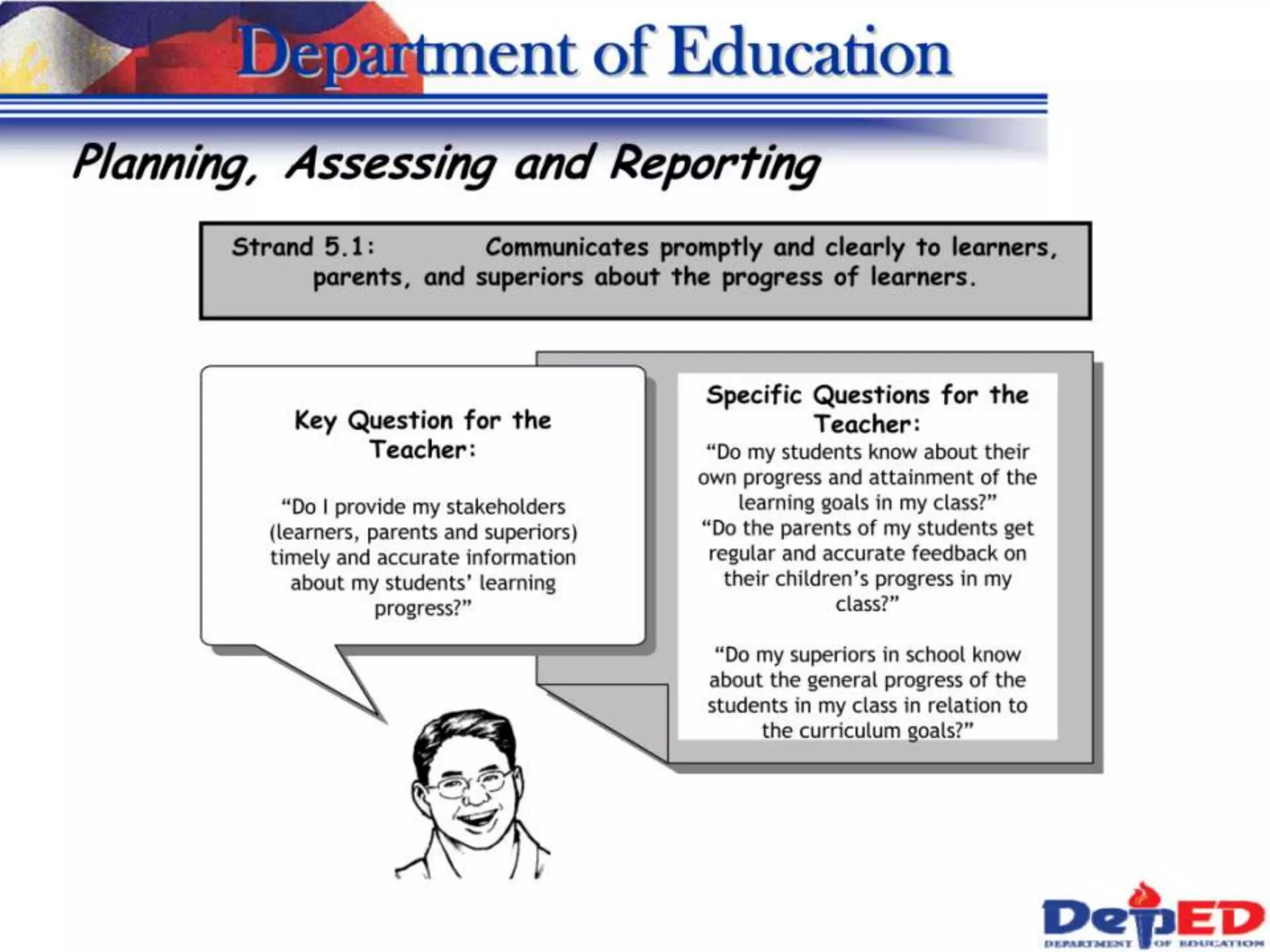
5.1 Communicates promptly and clearly to
learners, parents and superiors about the progress of
learners.
The Teacher:
 Shows proofs of instructional planning
 Implements instruction as plan
 Demonstrates ability to cope with varied
teaching milieu
The Teacher:
 Prepares formative and summative tests in
line with the curriculum
 employs non-traditional assessment
techniques (portfolio, journals, rubrics, etc.)
 interprets and uses assessment results to
improve teaching and learning
 Identifies teaching-learning difficulties and
possible causes and takes appropriate action
to address them
 uses tools for assessing authentic learning
5.2 Develops and uses a variety of appropriate
assessment strategies to monitor and evaluate
learning.
5.3 Monitors regularly and provides feedback on
learners’ understanding of content.
The Teacher:
 provides timely and accurate feedback to
learners to encourage them to reflect on and
monitor their own learning growth
 keeps accurate records of grades
performance levels of learners
 conducts regular meetings with learners
and parents to report learners’ progress
 involves parents to participate in school
activities that promote learning
6. Community Linkages (CL)
 refers to the ideal that classroom activities are
meaningfully linked to the experiences and
aspirations of the learners in their homes and
communities.
6.1 Establishes learning environments that respond to
the aspirations of the community.
The Teacher:
 involves community in sharing accountability
for the learners’ achievement
 uses community resources (human, material) to
support learning
Uses the community as a laboratory for learning
 participates in community activities that
promote learning
Uses community networks to publicize school
events and achievements
7. Personal Growth & Professional Development
(PGPD)
 It emphasizes the ideal that teachers value
having a high personal regard for the
teaching profession, concern for professional
development, and continuous improvement
as teachers.
7.1 Takes pride in the nobility of teaching as a
profession.
The Teacher:
 Maintains stature and behavior that upholds
the dignity of teaching
Allocates time for personal and professional
development through
 participation in educational seminars and
workshops
Reading educational materials regularly
Engaging in educational research
 manifests personal qualities such as
enthusiasm, flexibility and caring
 articulates and demonstrates one’s personal
philosophy of teaching
7.2 Builds professional links with colleagues to enrich
teaching practice.
The Teacher:
 Keeps abreast with recent developments in
education
 Links with other institutions, organizations for
sharing best practices
7.3 Reflects on the extent of the attainment of
professional development goals.
The Teacher:
 Reflects on the quality of his/her own teaching
 Improves teaching performance based on
feedback from students, peers and superior and
cooperating teachers
 Accepts personal accountability to learners’
achievement and performance
 Uses self-evaluation to recognize and enhance
one’s strengths and correct one’s weaknesses.
SUMMARY OF LESSON 1
The NCBTS are the standards of good teaching in the Philippines. It consists of 7
domains, 21 strands and 80 performance indicators.
The ideal teacher functions well in the classroom as well as in the community.
He/she does the following:
 serves as a positive and powerful model of learning and living;
 provides a social, psychological, and physical environment that is conducive for
learning because students from varied backgrounds are treated with
respect, engaged in different learning activities and are motivated to work towards
high standards of learning;
facilitates the learning process by considering diversity of learners;
 implements curriculum effectively by making students understand curriculum goals
and standards, by his/her mastery of subject matter and skillful use of teaching-
learning strategies and activities and learning resources;
 aligns assessment to curricular goals, objectives and standards, uses assessment
results to improve teaching-learning, and report assessment results to those
concerned;
 links with communities to help attain curricular goals; and
 demonstrates a high regard for the teaching profession and embarks in a continuing
professional development.
The Code of Ethics for Professional Teachers comprising of a Preamble and 13
Articles spells out how the teacher should relate to the state, the community, the teaching
profession itself, the teaching community, higher authorities in the Philippines, school
officials, fellow teachers and other personnel, the learners, and the parents. It also states how
the teacher should conduct himself/herself as a person at all places at all times including
his/her business and financial matters.
You are a Teacher
If I speak interestingly , effectively, and well,
But do not understand my students
I am a noisy gong or a clanging cymbal.
If I know all of the methods and techniques of teaching,
If I have complete faith that they will work,
So that I use the completely.
But think only of materials or techniques
Instead of how they ca8n help my students,
IU0 count for nothing.
If I go the second mile in my teaching,
Give up many activities,
But do not it without understanding,
It does no good
Love is very patient, very kind;
Love is not jealous, it does not put on airs;
It is never tyrannic, never;
Yet does insist on truth;
It does not become angry;
It is not resentful.
Love always expects the best of others;
It is gladdened when they live up to these expectations,
Slow to lose faith when they do not.
It will bear anything,
Hope for anything,
Endure anything.
This kind of love will never fail
If there are teaching methods, they will change;
If there are curricula, they will be revised.
For our knowledge is imperfect,
And we are always looking for the better ways
Which an infinite God has placed ahead of us.
When I began to teach, I fumbled and failed;
Now I have put away some of my childish ways.
At present I am learning bit by bit;
But if I keep on seeking, I shall at last understand
As all long I myself have been understood.
So faith, hope and love endure.
These are the great three
But the greatest of them is love.
LESSON 3
School and Community Relations
“It takes a village to raise a child.”
-African proverb-
A.The Teachers, Parents and the Community
 Parents are the first teachers in the home.
 Teachers in the school continue to enrich the
students’ experiences at home, thus
strengthening the valuable, personal traits
and characteristics initially developed.
 The members of the community, in addition
to the parents, include the local government
units, the non-government agencies, civic
organizations and all residents.
1. Difficulties
Teachers are endowed with a caring and compassionate
attitude that are expressed in their love and unending
sacrifice in guiding the young.
Despite conscious effort, children experience difficulties
and problems regarding:
 ability to accomplish assignments,
 irregular attendance,
Study habits in school,
 negative attitudes, and
 problem with self-discipline
2. Solutions
The best way to thresh out causes and come
up with solutions is to conduct a dialogue wherein
parents may be invited to drop by the school or the
teacher may pay a visit to their home.
A calm and friendly face-to-face exchange of
observations.
 Positive attitudes of kindheartedness and
patience are developed through modeling.
 Regularity in attendance and doing daily
assignments.
 Letters and praises to parents for
outstanding performances.
 Interesting lessons
 Extremes of behavior
3. Values Developed
 respect for elders and for the rights of others,
 cooperation,
Willingness to share,
 deep sense of responsibility, and
 persistence.
Students exhibiting exemplary traits must be
given due recognition.

The teacher in the classroom and community

  • 1.
    CHAPTER II “The teacheris a diplomat and ambassador of tact and sensitivity, as he/she facilitates productive, positive interactions among the multiplicity of personalities, cultures, beliefs and ideals”. -Unknown- A teacher is a facilitator of learning and of the development of the youth; he shall, therefore, render the best services by providing an environment conducive to such learning and growth. -Code of Ethics for Professional Teachers, Article III-
  • 2.
    INTRODUCTION  The teacherhas two communities.  Teaching community  consists of his/her fellow teachers, colleagues and superiors  Community outside the school  Includes the parents of his/her learners, local officials, alumni/alumnae and other members of the society in which the school is located  To function well in the classroom and in the community, he/she must be equipped with competencies.  knowledge  skills  attitudes
  • 3.
    Along with the: •Commission on Higher education (CHED), • Teacher Education Institutes (TEIs), • Philippine Regulatory Commission (PRC), • Department of Education (DepEd) and the • Civil Service Commission (CSC) in partnership with the • different academic institution, National Competency-Based Teacher Standards (NCBTS) was born.
  • 4.
    What is NationalCompetency-Based Teacher Standards (NCBTS) ? • It is an integrated theoretical framework that defines the different dimensions of effective teaching • result of the societal change, a reflection of what is happening in the society and adopting our curriculum into the 21st century globally competent education. • A set of competencies (behaviors, attitudes, and skills) • “The core values of Filipino teachers and on the principles of effective teaching learning.” LESSON 1
  • 5.
     Provides asingle framework that define effective teaching in all aspects of a teacher’s professional life and in all phases of teacher development.  Minimize confusion about what effective teaching is.  Provides a better guide for all teacher development programs and projects form the school-level up to the national level. Why do we need the NCBTS?
  • 14.
    1. Social Regardfor Learning (SRFL) • It focuses on the ideal that teachers serve as positive and powerful role models. • Teacher’s actions demonstrate value for learning. The Teacher:  implements school policies and procedures;  demonstrates punctuality;  maintains appropriate appearance; and  is careful about the effects of one’s behavior on the students
  • 16.
    2. Learning Environment(LE) • It focuses on importance of providing a social, psychological and physical environment 2.1 The Teacher creates an environment that promotes fairness. The Teacher:  maintains an environment of courtesy and respect for different learners’ abilities, culture, and gender;  provides a gender-fair opportunities for learning; and  recognizes that every learner has strengths.
  • 18.
    2.2 The Teachermakes the classroom environment conducive to learning. The Teacher:  maintains a safe, clean and orderly clean classroom free from distractions; and  arranges challenging activities given the physical environment.
  • 20.
    2.3 The Teachercommunicates higher learning expectations to each learner. The Teacher:  uses individual and cooperative learning activities to improve capacities of learner’s for higher learning;  encourages learners to ask questions; and  provides learners of variety of learning experiences.
  • 22.
    2.4 The Teacherestablishes and maintains consistent standards learners’ behavior. The Teacher:  handles behavior problems quickly and with due respect to children’s rights;  gives timely feedback to reinforce appropriate to learners behavior;  guides individual learner requiring development of appropriate social and learning behavior; and  communicates school policies and procedures for classroom behavior and see to it that they are followed.
  • 24.
    3. Diversity ofLearners (DOL) • It emphasizes the ideal that teachers can facilitate the learning process even with diverse learners. 3.1 The Teacher is familiar with the children’s background knowledge and experiences. The Teacher:  uses information on the learning styles and needs of the learners to design and select learning experiences;  establishes goals that define appropriate expectations for all learners;  paces lessons appropriate to needs and/ or abilities of learners;  provides differentiated activities for learners.  initiates other learning approaches for learners whose needs have not been met by usual approaches; and  shows sensitivity to multi-cultural backgrounds of the learners.
  • 26.
    3.2 The Teacherdemonstrates concern for holistic development of learners. The Teacher: sets clear, challenging and achievable expectations on the holistic development of all learners; identifies learning gaps and takes action to enable learners to catch up; employs integrative and interactive strategies for meaningful and holistic development of learners; is sensitive to unusual behavior of learners and takes appropriate action; and provides opportunities to enhance learners growth in all aspects.
  • 28.
    4. Curriculum (Curr.) •It refers to all elements of the teaching-learning process that work in convergence. • These elements include the teacher’s knowledge of subject matter and the learning process, teaching-learning approaches and activities, instructional materials and learning resources. 4.1 The Teacher demonstrates mastery on the subject.
  • 29.
    The Teacher:  deliversaccurate and updated content knowledge using appropriate methodologies, approaches and strategies;  Integrates language, literacy and quantitative skill development and values in his/her subject area;  Explains learning goals, instructional procedures and content clearly and accurately to students Links the current content with past and future lessons Aligns with lesson objectives the teaching methods, learning activities and instructional materials or resources appropriate to learners
  • 30.
     Creates situationsthat encourages learners to use high order thinking skills Engages and sustains learners’ interest in the subject by making content meaningful and relevant to them Integrates relevant scholarly works and ideas to enrich the lesson as needed Integrates content of subject area with other disciplines .
  • 32.
    4.2 Communicates clearlearning goals for the lessons that are appropriate for learners The Teacher:  Sets appropriate learning goals  Understands the learning goals
  • 34.
    4.3 Makes gooduse of allotted instructions time. The Teacher:  establishes routines and procedures to maximize instructional time  plans lessons to fit within available instructional time
  • 36.
    4.4 Selects teachingmethods, learning activities and instructional materials or resources appropriate to learners and aligned materials or to the objectives if the lesson. The Teacher:  Translates learning competencies to instructional objectives  selects, prepares and utilizes instructional materials appropriate to the learners and to the learning objectives  provides activities and uses materials which fit the learners’ learning styles, goals and culture
  • 37.
     uses avariety of teaching approaches and techniques appropriate to the subject matter and the learners  utilizes information derived from assessment to improve teaching and learning Provides activities and uses materials which involve students in meaningful learning
  • 39.
    4.5 Teacher recognizesgeneral learning processes as well as unique processes of individual learners. The Teacher:  Design and utilizes teaching methods that take into account the learning process
  • 40.
    4.6 Teacher promotespurposive study. The Teacher:  Cultivates good study habits through appropriate activities and projects. 4.7 Teacher demonstrates skills in the use of information and Communication Technology in teaching and learning. The Teacher:  Utilizes Information and Communication Technology to enhance teaching and learning
  • 41.
    5. Planning, AssessingReporting (PAR) • It refers to the alignment of assessment and planning activities. • It focuses on the : (1) use of assessment data to plan and revise teaching-learning plans; (2) integration of assessment procedures in the plan and implementation of teaching-learning activities, and (3) reporting of the learners’ actual achievement and behaviour.
  • 42.
    5.1 Communicates promptlyand clearly to learners, parents and superiors about the progress of learners. The Teacher:  Shows proofs of instructional planning  Implements instruction as plan  Demonstrates ability to cope with varied teaching milieu
  • 44.
    The Teacher:  Preparesformative and summative tests in line with the curriculum  employs non-traditional assessment techniques (portfolio, journals, rubrics, etc.)  interprets and uses assessment results to improve teaching and learning  Identifies teaching-learning difficulties and possible causes and takes appropriate action to address them  uses tools for assessing authentic learning 5.2 Develops and uses a variety of appropriate assessment strategies to monitor and evaluate learning.
  • 46.
    5.3 Monitors regularlyand provides feedback on learners’ understanding of content. The Teacher:  provides timely and accurate feedback to learners to encourage them to reflect on and monitor their own learning growth  keeps accurate records of grades performance levels of learners  conducts regular meetings with learners and parents to report learners’ progress  involves parents to participate in school activities that promote learning
  • 48.
    6. Community Linkages(CL)  refers to the ideal that classroom activities are meaningfully linked to the experiences and aspirations of the learners in their homes and communities.
  • 49.
    6.1 Establishes learningenvironments that respond to the aspirations of the community. The Teacher:  involves community in sharing accountability for the learners’ achievement  uses community resources (human, material) to support learning Uses the community as a laboratory for learning  participates in community activities that promote learning Uses community networks to publicize school events and achievements
  • 51.
    7. Personal Growth& Professional Development (PGPD)  It emphasizes the ideal that teachers value having a high personal regard for the teaching profession, concern for professional development, and continuous improvement as teachers.
  • 52.
    7.1 Takes pridein the nobility of teaching as a profession. The Teacher:  Maintains stature and behavior that upholds the dignity of teaching Allocates time for personal and professional development through  participation in educational seminars and workshops Reading educational materials regularly Engaging in educational research  manifests personal qualities such as enthusiasm, flexibility and caring  articulates and demonstrates one’s personal philosophy of teaching
  • 54.
    7.2 Builds professionallinks with colleagues to enrich teaching practice. The Teacher:  Keeps abreast with recent developments in education  Links with other institutions, organizations for sharing best practices
  • 56.
    7.3 Reflects onthe extent of the attainment of professional development goals. The Teacher:  Reflects on the quality of his/her own teaching  Improves teaching performance based on feedback from students, peers and superior and cooperating teachers  Accepts personal accountability to learners’ achievement and performance  Uses self-evaluation to recognize and enhance one’s strengths and correct one’s weaknesses.
  • 58.
    SUMMARY OF LESSON1 The NCBTS are the standards of good teaching in the Philippines. It consists of 7 domains, 21 strands and 80 performance indicators. The ideal teacher functions well in the classroom as well as in the community. He/she does the following:  serves as a positive and powerful model of learning and living;  provides a social, psychological, and physical environment that is conducive for learning because students from varied backgrounds are treated with respect, engaged in different learning activities and are motivated to work towards high standards of learning; facilitates the learning process by considering diversity of learners;  implements curriculum effectively by making students understand curriculum goals and standards, by his/her mastery of subject matter and skillful use of teaching- learning strategies and activities and learning resources;  aligns assessment to curricular goals, objectives and standards, uses assessment results to improve teaching-learning, and report assessment results to those concerned;  links with communities to help attain curricular goals; and  demonstrates a high regard for the teaching profession and embarks in a continuing professional development. The Code of Ethics for Professional Teachers comprising of a Preamble and 13 Articles spells out how the teacher should relate to the state, the community, the teaching profession itself, the teaching community, higher authorities in the Philippines, school officials, fellow teachers and other personnel, the learners, and the parents. It also states how the teacher should conduct himself/herself as a person at all places at all times including his/her business and financial matters.
  • 60.
    You are aTeacher If I speak interestingly , effectively, and well, But do not understand my students I am a noisy gong or a clanging cymbal. If I know all of the methods and techniques of teaching, If I have complete faith that they will work, So that I use the completely. But think only of materials or techniques Instead of how they ca8n help my students, IU0 count for nothing. If I go the second mile in my teaching, Give up many activities, But do not it without understanding, It does no good Love is very patient, very kind; Love is not jealous, it does not put on airs; It is never tyrannic, never; Yet does insist on truth; It does not become angry; It is not resentful.
  • 61.
    Love always expectsthe best of others; It is gladdened when they live up to these expectations, Slow to lose faith when they do not. It will bear anything, Hope for anything, Endure anything. This kind of love will never fail If there are teaching methods, they will change; If there are curricula, they will be revised. For our knowledge is imperfect, And we are always looking for the better ways Which an infinite God has placed ahead of us. When I began to teach, I fumbled and failed; Now I have put away some of my childish ways. At present I am learning bit by bit; But if I keep on seeking, I shall at last understand As all long I myself have been understood. So faith, hope and love endure. These are the great three But the greatest of them is love.
  • 63.
    LESSON 3 School andCommunity Relations “It takes a village to raise a child.” -African proverb-
  • 64.
    A.The Teachers, Parentsand the Community  Parents are the first teachers in the home.  Teachers in the school continue to enrich the students’ experiences at home, thus strengthening the valuable, personal traits and characteristics initially developed.  The members of the community, in addition to the parents, include the local government units, the non-government agencies, civic organizations and all residents.
  • 65.
    1. Difficulties Teachers areendowed with a caring and compassionate attitude that are expressed in their love and unending sacrifice in guiding the young. Despite conscious effort, children experience difficulties and problems regarding:  ability to accomplish assignments,  irregular attendance, Study habits in school,  negative attitudes, and  problem with self-discipline
  • 66.
    2. Solutions The bestway to thresh out causes and come up with solutions is to conduct a dialogue wherein parents may be invited to drop by the school or the teacher may pay a visit to their home. A calm and friendly face-to-face exchange of observations.  Positive attitudes of kindheartedness and patience are developed through modeling.  Regularity in attendance and doing daily assignments.  Letters and praises to parents for outstanding performances.  Interesting lessons  Extremes of behavior
  • 67.
    3. Values Developed respect for elders and for the rights of others,  cooperation, Willingness to share,  deep sense of responsibility, and  persistence. Students exhibiting exemplary traits must be given due recognition.