PRACTICAL
RESEARCH
1
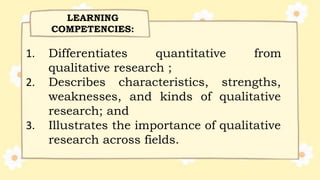
LEARNING
COMPETENCIES:
1. Differentiates quantitative from
qualitative research ;
2. Describes characteristics, strengths,
weaknesses, and kinds of qualitative
research; and
3. Illustrates the importance of qualitative
research across fields.
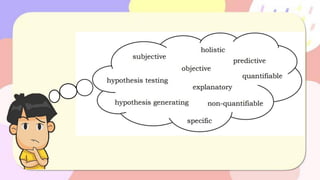
QUANTITATIVE
RESEARCH
QUALITATIVE
RESEARCH
1. specific 1. subjective
2. predictive 2. hypothesis generating
3. quantifiable 3. holistic
4. objective 4. explanatory
5. hypothesis testing 5. non-quantifiable
Qualitative
Research
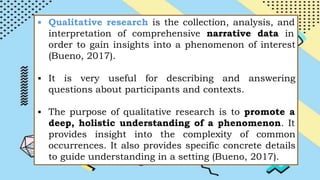
▪ Qualitative research is the collection, analysis, and
interpretation of comprehensive narrative data in
order to gain insights into a phenomenon of interest
(Bueno, 2017).
▪ It is very useful for describing and answering
questions about participants and contexts.
▪ The purpose of qualitative research is to promote a
deep, holistic understanding of a phenomenon. It
provides insight into the complexity of common
occurrences. It also provides specific concrete details
to guide understanding in a setting (Bueno, 2017).
Characteristics
of Qualitative
Research
1. Qualitative research is naturalistic.
▪ A study to be conducted by the researcher should be
based on real-life situations.
▪ Likewise, the researcher should also unfold the
study in a natural manner, that is, the findings are
derived from the analysis of authentic data
gathered from the participants. Such a concept
makes qualitative research known for its
non-controlling characteristic.
2. Qualitative research is purposeful.
▪ the researcher should select the participants
in a purposive manner, that is, they will be
selected because they either have easy access
to the information needed or simply have the
knowledge to provide a great deal of
information needed to the study.
3. Qualitative research is detailed.
▪ A thick description of gathered data from
the participants makes this type of study a
detailed one. It is important that the
researcher should capture the direct
quotations of the responses of the
participant/s from the conducted interview
or observation.
4. Qualitative research requires engagement
and neutrality.
▪ the researcher should be neutral in the
responses and observations he/she may get
while engaging with the participant/s.
▪ The researcher should likewise show
openness, sensitivity, and respect.
5. Qualitative research follows an inductive
procedure.
▪ Following an inductive procedure, the
researcher will start from exploring the
phenomenon and will end to confirming
findings of the works.
Strengths and
Weaknesses of
Qualitative
Research
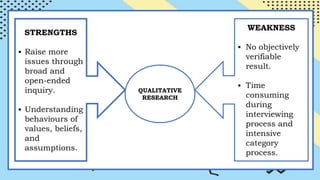
QUALITATIVE
RESEARCH
STRENGTHS
▪ Raise more
issues through
broad and
open-ended
inquiry.
▪ Understanding
behaviours of
values, beliefs,
and
assumptions.
WEAKNESS
▪ No objectively
verifiable
result.
▪ Time
consuming
during
interviewing
process and
intensive
category
process.
Kinds of
Qualitative
Research
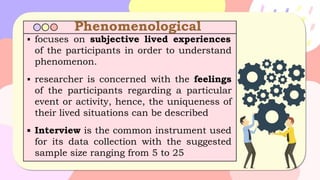
Phenomenological
▪ focuses on subjective lived experiences
of the participants in order to understand
phenomenon.
▪ researcher is concerned with the feelings
of the participants regarding a particular
event or activity, hence, the uniqueness of
their lived situations can be described
▪ Interview is the common instrument used
for its data collection with the suggested
sample size ranging from 5 to 25
Examples:
o A researcher aims to determine
the challenges and coping
mechanisms of senior high school
working students in
RMDSF-STEC.
o A researcher aims to explain the
lived experiences of the COVID-19
survivors in the province of Cebu.
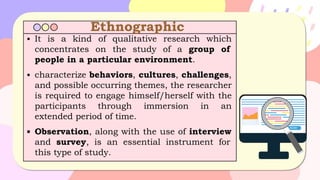
Ethnographic
▪ It is a kind of qualitative research which
concentrates on the study of a group of
people in a particular environment.
▪ characterize behaviors, cultures, challenges,
and possible occurring themes, the researcher
is required to engage himself/herself with the
participants through immersion in an
extended period of time.
▪ Observation, along with the use of interview
and survey, is an essential instrument for
this type of study.
Examples:
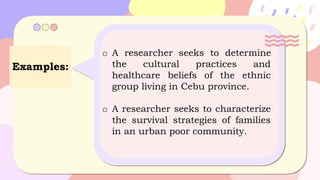
o A researcher seeks to determine
the cultural practices and
healthcare beliefs of the ethnic
group living in Cebu province.
o A researcher seeks to characterize
the survival strategies of families
in an urban poor community.
Grounded Theory
▪ intends to explain a phenomenon through
developing a theory
▪ In comparison with phenomenological study
that primarily describes lived experiences,
grounded theory aims to provide explanation
and theory behind those lived experiences.
▪ Interview and supporting documents are
the commonly used data collection
instrument for its participants approximately
ranging from 20 to 30 or until data achieve
saturation.
Examples:
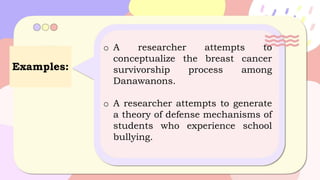
o A researcher attempts to
conceptualize the breast cancer
survivorship process among
Danawanons.
o A researcher attempts to generate
a theory of defense mechanisms of
students who experience school
bullying.
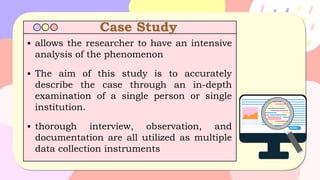
Case Study
▪ allows the researcher to have an intensive
analysis of the phenomenon
▪ The aim of this study is to accurately
describe the case through an in-depth
examination of a single person or single
institution.
▪ thorough interview, observation, and
documentation are all utilized as multiple
data collection instruments
Examples:
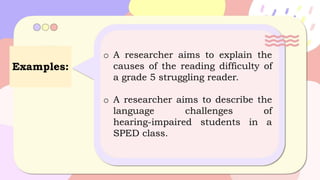
o A researcher aims to explain the
causes of the reading difficulty of
a grade 5 struggling reader.
o A researcher aims to describe the
language challenges of
hearing-impaired students in a
SPED class.
Historical
▪ concerned with the identification,
evaluation, and synthesis of past event
data
▪ it aims to understand present patterns
and to anticipate future choices through
clearly relating the past event data which
are obtained from sources such as
documents, relics and artifacts, and oral
reports
Examples:
o A researcher attempts to explore
the nature and context of the
political leadership of Cebu
governors.
o A researcher seeks to explore the
development in the courtship
letter writing style among
Cebuanos.
Narrative
▪ primary objective of the study is to extract
meaningful context based on the
documented experiences
▪ focuses merely on the nature of the story
told by the participants
▪ phenomenological research may use
narrative, but narrative research does not
necessarily need phenomenological
Examples:
o A researcher seeks to characterize
the struggles faced by
student-athletes.
o A researcher seeks to describe the
daily teaching experiences of
millennial teachers in the Schools
Division of Danao City.
Importance
of
Qualitative
Research
Qualitative research mainly investigates the
relationships between individuals and the
institutions and society in which they live using
a diverse range of approaches (Islam & Faruque,
2016).
The development in any fields such as in
education, business, medical and health allied
services, etc. is made possible by means of
qualitative research.
▪ It helps develop hypotheses for further testing
and for qualitative questionnaire development.
▪ It helps understand the feelings, values, and
perceptions that underlie and influence
behavior.
▪ It helps identify customer needs.
▪ It helps capture the language and imagery that
customers use to describe and relate to a
product, service, brand, etc.
▪ It helps to perceive marketing/communication
messages.
▪ It helps to obtain information in quantitative
study and to better understand the
context/meaning of the data.
▪ It helps generate ideas for improvements
and/or extensions of a product, line, or brand.
▪ It helps uncover potential strategic directions
for branding or communications programs.
Title
Proposal
February 28 – 29, 2024
Prepare for a
QUIZ
TOMORROW!
Coverage:
Lessons 1 & 2

Lesson 2- Qualitative Research..pptx.pdf

  • 1.
  • 2.
    LEARNING COMPETENCIES: 1. Differentiates quantitativefrom qualitative research ; 2. Describes characteristics, strengths, weaknesses, and kinds of qualitative research; and 3. Illustrates the importance of qualitative research across fields.
  • 4.
    QUANTITATIVE RESEARCH QUALITATIVE RESEARCH 1. specific 1.subjective 2. predictive 2. hypothesis generating 3. quantifiable 3. holistic 4. objective 4. explanatory 5. hypothesis testing 5. non-quantifiable
  • 7.
  • 8.
    ▪ Qualitative researchis the collection, analysis, and interpretation of comprehensive narrative data in order to gain insights into a phenomenon of interest (Bueno, 2017). ▪ It is very useful for describing and answering questions about participants and contexts. ▪ The purpose of qualitative research is to promote a deep, holistic understanding of a phenomenon. It provides insight into the complexity of common occurrences. It also provides specific concrete details to guide understanding in a setting (Bueno, 2017).
  • 9.
  • 10.
    1. Qualitative researchis naturalistic. ▪ A study to be conducted by the researcher should be based on real-life situations. ▪ Likewise, the researcher should also unfold the study in a natural manner, that is, the findings are derived from the analysis of authentic data gathered from the participants. Such a concept makes qualitative research known for its non-controlling characteristic.
  • 11.
    2. Qualitative researchis purposeful. ▪ the researcher should select the participants in a purposive manner, that is, they will be selected because they either have easy access to the information needed or simply have the knowledge to provide a great deal of information needed to the study.
  • 12.
    3. Qualitative researchis detailed. ▪ A thick description of gathered data from the participants makes this type of study a detailed one. It is important that the researcher should capture the direct quotations of the responses of the participant/s from the conducted interview or observation.
  • 13.
    4. Qualitative researchrequires engagement and neutrality. ▪ the researcher should be neutral in the responses and observations he/she may get while engaging with the participant/s. ▪ The researcher should likewise show openness, sensitivity, and respect.
  • 14.
    5. Qualitative researchfollows an inductive procedure. ▪ Following an inductive procedure, the researcher will start from exploring the phenomenon and will end to confirming findings of the works.
  • 15.
  • 16.
    QUALITATIVE RESEARCH STRENGTHS ▪ Raise more issuesthrough broad and open-ended inquiry. ▪ Understanding behaviours of values, beliefs, and assumptions. WEAKNESS ▪ No objectively verifiable result. ▪ Time consuming during interviewing process and intensive category process.
  • 17.
  • 18.
    Phenomenological ▪ focuses onsubjective lived experiences of the participants in order to understand phenomenon. ▪ researcher is concerned with the feelings of the participants regarding a particular event or activity, hence, the uniqueness of their lived situations can be described ▪ Interview is the common instrument used for its data collection with the suggested sample size ranging from 5 to 25
  • 19.
    Examples: o A researcheraims to determine the challenges and coping mechanisms of senior high school working students in RMDSF-STEC. o A researcher aims to explain the lived experiences of the COVID-19 survivors in the province of Cebu.
  • 20.
    Ethnographic ▪ It isa kind of qualitative research which concentrates on the study of a group of people in a particular environment. ▪ characterize behaviors, cultures, challenges, and possible occurring themes, the researcher is required to engage himself/herself with the participants through immersion in an extended period of time. ▪ Observation, along with the use of interview and survey, is an essential instrument for this type of study.
  • 21.
    Examples: o A researcherseeks to determine the cultural practices and healthcare beliefs of the ethnic group living in Cebu province. o A researcher seeks to characterize the survival strategies of families in an urban poor community.
  • 22.
    Grounded Theory ▪ intendsto explain a phenomenon through developing a theory ▪ In comparison with phenomenological study that primarily describes lived experiences, grounded theory aims to provide explanation and theory behind those lived experiences. ▪ Interview and supporting documents are the commonly used data collection instrument for its participants approximately ranging from 20 to 30 or until data achieve saturation.
  • 23.
    Examples: o A researcherattempts to conceptualize the breast cancer survivorship process among Danawanons. o A researcher attempts to generate a theory of defense mechanisms of students who experience school bullying.
  • 24.
    Case Study ▪ allowsthe researcher to have an intensive analysis of the phenomenon ▪ The aim of this study is to accurately describe the case through an in-depth examination of a single person or single institution. ▪ thorough interview, observation, and documentation are all utilized as multiple data collection instruments
  • 25.
    Examples: o A researcheraims to explain the causes of the reading difficulty of a grade 5 struggling reader. o A researcher aims to describe the language challenges of hearing-impaired students in a SPED class.
  • 26.
    Historical ▪ concerned withthe identification, evaluation, and synthesis of past event data ▪ it aims to understand present patterns and to anticipate future choices through clearly relating the past event data which are obtained from sources such as documents, relics and artifacts, and oral reports
  • 27.
    Examples: o A researcherattempts to explore the nature and context of the political leadership of Cebu governors. o A researcher seeks to explore the development in the courtship letter writing style among Cebuanos.
  • 28.
    Narrative ▪ primary objectiveof the study is to extract meaningful context based on the documented experiences ▪ focuses merely on the nature of the story told by the participants ▪ phenomenological research may use narrative, but narrative research does not necessarily need phenomenological
  • 29.
    Examples: o A researcherseeks to characterize the struggles faced by student-athletes. o A researcher seeks to describe the daily teaching experiences of millennial teachers in the Schools Division of Danao City.
  • 30.
  • 31.
    Qualitative research mainlyinvestigates the relationships between individuals and the institutions and society in which they live using a diverse range of approaches (Islam & Faruque, 2016). The development in any fields such as in education, business, medical and health allied services, etc. is made possible by means of qualitative research.
  • 32.
    ▪ It helpsdevelop hypotheses for further testing and for qualitative questionnaire development. ▪ It helps understand the feelings, values, and perceptions that underlie and influence behavior. ▪ It helps identify customer needs. ▪ It helps capture the language and imagery that customers use to describe and relate to a product, service, brand, etc.
  • 33.
    ▪ It helpsto perceive marketing/communication messages. ▪ It helps to obtain information in quantitative study and to better understand the context/meaning of the data. ▪ It helps generate ideas for improvements and/or extensions of a product, line, or brand. ▪ It helps uncover potential strategic directions for branding or communications programs.
  • 34.
  • 35.