ETHICAL
PROTOCOL
Ethical considerations in research
are a set of principles that guide
your research designs and
practices. These principles include
voluntary participation, informed
consent, anonymity, confidentiality,
potential for harm, and results
communication.
Ethical Issues
To whom did you ask permission for the
conduct of your research? How did you do
it?
Were the participants of your research
informed that they are going to be part of a
research? If Yes, how did you inform them?
If the respondents are children, the parents
should also be informed that their children
will be part of your study.
Did you use any literature? If yes, did you
acknowledge them properly? How?
Common mistakes
Completely missed to include this section
Concentrated on the process of submitting
the proposal, not on the plan to uphold
ethical standard during data collection
Does not acknowledge references
Example of a well written ethical
concerns section
Since the study will elicit personal
information from the participants, the
researchers chose to adhere with the Data
Privacy Act of 2012.
The researchers will seek permission from the School
Principal regarding the approval of the study.
Participants will have their rights read to them before
the experiment and the interviews will begin. A
participant has the right to leave the study at anytime.
The researchers will be taking photos as well without
discernable faces of the participants.
Students who will undergo the experiment will
remain anonymous. Codes, not names, will be
used in analyzing results to safeguard
confidentiality of data.
Key informants who will participate in the
interviews will not be revealed in the study.
Codes will also be used to maintain anonymity of
the subjects. Recordings will be destroyed after
transcription of the interviews. No information in
the study will be directly associated to the key
informants name to protect their identities.
This study will consider three ethical issues
into account. These will include, informing the
consent, information confidentiality as defined by
the Data Privacy Act of 2012, and the researcher’s
role and responsibilities.
In order to build trust and confidence
between the researcher and the respondents, the
researchers will inform the respondents.
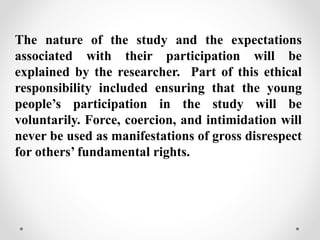
The nature of the study and the expectations
associated with their participation will be
explained by the researcher. Part of this ethical
responsibility included ensuring that the young
people’s participation in the study will be
voluntarily. Force, coercion, and intimidation will
never be used as manifestations of gross disrespect
for others’ fundamental rights.
Validity
•Extent to which a research tool measures what it is ought to measure.
When the research tool is made by the researcher, validity test is required.
Table 1. Levels of Validity (Ragma, 2016)
Points Statistical Range Descriptive Equivalent Rating
5 4.21-5.00 Very High Validity (VHV)
4 3.41-4.20 High Validity (HV)
3 2.61-3.40 Moderate Validity (MV)
2 1.81-2.60 Poor Validity (PV)
1 1.00-1.80 Very Poor Validity (VPV)
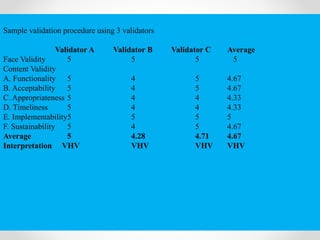
Sample validation procedure using 3 validators
Validator A Validator B Validator C Average
Face Validity 5 5 5 5
Content Validity
A. Functionality 5 4 5 4.67
B. Acceptability 5 4 5 4.67
C. Appropriateness 5 4 4 4.33
D. Timeliness 5 4 4 4.33
E. Implementability5 5 5 5
F. Sustainability 5 4 5 4.67
Average 5 4.28 4.71 4.67
Interpretation VHV VHV VHV VHV
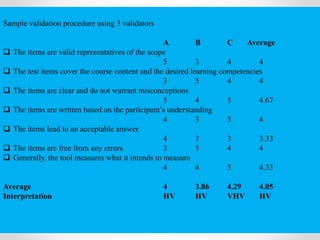
Sample validation procedure using 3 validators
A B C Average
 The items are valid representatives of the scope
5 3 4 4
 The test items cover the course content and the desired learning competencies
3 5 4 4
 The items are clear and do not warrant misconceptions
5 4 5 4.67
 The items are written based on the participant’s understanding
4 3 5 4
 The items lead to an acceptable answer
4 3 3 3.33
 The items are free from any errors 3 5 4 4
 Generally, the tool measures what it intends to measure
4 4 5 4.33
Average 4 3.86 4.29 4.05
Interpretation HV HV VHV HV
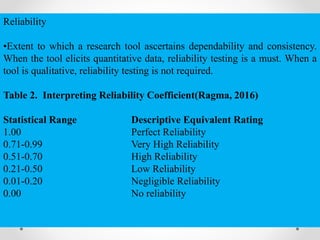
Reliability
•Extent to which a research tool ascertains dependability and consistency.
When the tool elicits quantitative data, reliability testing is a must. When a
tool is qualitative, reliability testing is not required.
Table 2. Interpreting Reliability Coefficient(Ragma, 2016)
Statistical Range Descriptive Equivalent Rating
1.00 Perfect Reliability
0.71-0.99 Very High Reliability
0.51-0.70 High Reliability
0.21-0.50 Low Reliability
0.01-0.20 Negligible Reliability
0.00 No reliability
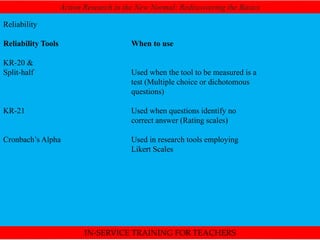
Reliability
Reliability Tools When to use
KR-20 &
Split-half Used when the tool to be measured is a
test (Multiple choice or dichotomous
questions)
KR-21 Used when questions identify no
correct answer (Rating scales)
Cronbach’s Alpha Used in research tools employing
Likert Scales
IN-SERVICE TRAINING FOR TEACHERS
Action Research in the New Normal: Rediscovering the Basics

ETHICAL CONSIDERATIONS IN RESEARCH.pptx

  • 1.
  • 2.
    Ethical considerations inresearch are a set of principles that guide your research designs and practices. These principles include voluntary participation, informed consent, anonymity, confidentiality, potential for harm, and results communication.
  • 3.
    Ethical Issues To whomdid you ask permission for the conduct of your research? How did you do it? Were the participants of your research informed that they are going to be part of a research? If Yes, how did you inform them?
  • 4.
    If the respondentsare children, the parents should also be informed that their children will be part of your study. Did you use any literature? If yes, did you acknowledge them properly? How?
  • 5.
    Common mistakes Completely missedto include this section Concentrated on the process of submitting the proposal, not on the plan to uphold ethical standard during data collection Does not acknowledge references
  • 6.
    Example of awell written ethical concerns section Since the study will elicit personal information from the participants, the researchers chose to adhere with the Data Privacy Act of 2012.
  • 7.
    The researchers willseek permission from the School Principal regarding the approval of the study. Participants will have their rights read to them before the experiment and the interviews will begin. A participant has the right to leave the study at anytime. The researchers will be taking photos as well without discernable faces of the participants.
  • 8.
    Students who willundergo the experiment will remain anonymous. Codes, not names, will be used in analyzing results to safeguard confidentiality of data. Key informants who will participate in the interviews will not be revealed in the study. Codes will also be used to maintain anonymity of the subjects. Recordings will be destroyed after transcription of the interviews. No information in the study will be directly associated to the key informants name to protect their identities.
  • 9.
    This study willconsider three ethical issues into account. These will include, informing the consent, information confidentiality as defined by the Data Privacy Act of 2012, and the researcher’s role and responsibilities. In order to build trust and confidence between the researcher and the respondents, the researchers will inform the respondents.
  • 10.
    The nature ofthe study and the expectations associated with their participation will be explained by the researcher. Part of this ethical responsibility included ensuring that the young people’s participation in the study will be voluntarily. Force, coercion, and intimidation will never be used as manifestations of gross disrespect for others’ fundamental rights.
  • 11.
    Validity •Extent to whicha research tool measures what it is ought to measure. When the research tool is made by the researcher, validity test is required. Table 1. Levels of Validity (Ragma, 2016) Points Statistical Range Descriptive Equivalent Rating 5 4.21-5.00 Very High Validity (VHV) 4 3.41-4.20 High Validity (HV) 3 2.61-3.40 Moderate Validity (MV) 2 1.81-2.60 Poor Validity (PV) 1 1.00-1.80 Very Poor Validity (VPV)
  • 12.
    Sample validation procedureusing 3 validators Validator A Validator B Validator C Average Face Validity 5 5 5 5 Content Validity A. Functionality 5 4 5 4.67 B. Acceptability 5 4 5 4.67 C. Appropriateness 5 4 4 4.33 D. Timeliness 5 4 4 4.33 E. Implementability5 5 5 5 F. Sustainability 5 4 5 4.67 Average 5 4.28 4.71 4.67 Interpretation VHV VHV VHV VHV
  • 13.
    Sample validation procedureusing 3 validators A B C Average  The items are valid representatives of the scope 5 3 4 4  The test items cover the course content and the desired learning competencies 3 5 4 4  The items are clear and do not warrant misconceptions 5 4 5 4.67  The items are written based on the participant’s understanding 4 3 5 4  The items lead to an acceptable answer 4 3 3 3.33  The items are free from any errors 3 5 4 4  Generally, the tool measures what it intends to measure 4 4 5 4.33 Average 4 3.86 4.29 4.05 Interpretation HV HV VHV HV
  • 14.
    Reliability •Extent to whicha research tool ascertains dependability and consistency. When the tool elicits quantitative data, reliability testing is a must. When a tool is qualitative, reliability testing is not required. Table 2. Interpreting Reliability Coefficient(Ragma, 2016) Statistical Range Descriptive Equivalent Rating 1.00 Perfect Reliability 0.71-0.99 Very High Reliability 0.51-0.70 High Reliability 0.21-0.50 Low Reliability 0.01-0.20 Negligible Reliability 0.00 No reliability
  • 15.
    Reliability Reliability Tools Whento use KR-20 & Split-half Used when the tool to be measured is a test (Multiple choice or dichotomous questions) KR-21 Used when questions identify no correct answer (Rating scales) Cronbach’s Alpha Used in research tools employing Likert Scales IN-SERVICE TRAINING FOR TEACHERS Action Research in the New Normal: Rediscovering the Basics