Antifungal Treatment
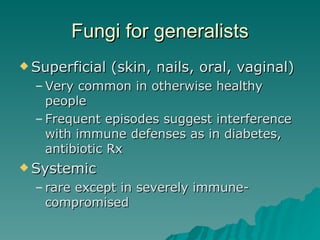
Fungi for generalists Superficial (skin, nails, oral, vaginal) Very common in otherwise healthy people Frequent episodes suggest interference with immune defenses as in diabetes, antibiotic Rx Systemic  rare except in severely immune- compromised
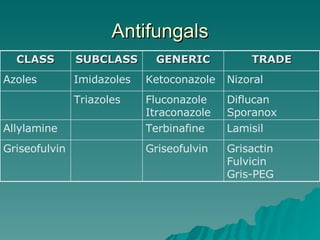
Antifungals Lamisil Terbinafine Allylamine Triazoles Imidazoles SUBCLASS Griseofulvin Fluconazole Itraconazole Ketoconazole GENERIC Grisactin Fulvicin Gris-PEG Griseofulvin Diflucan Sporanox Nizoral Azoles TRADE CLASS
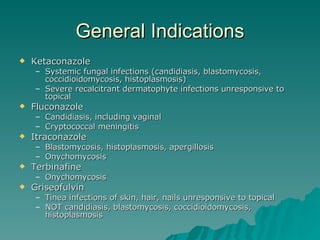
General Indications Ketaconazole Systemic fungal infections (candidiasis, blastomycosis, coccidioidomycosis, histoplasmosis) Severe recalcitrant dermatophyte infections unresponsive to topical Fluconazole Candidiasis, including vaginal Cryptococcal meningitis Itraconazole Blastomycosis, histoplasmosis, apergillosis Onychomycosis Terbinafine Onychomycosis Griseofulvin Tinea infections of skin, hair, nails unresponsive to topical NOT candidiasis, blastomycosis, coccidioidomycosis, histoplasmosis
Azoles: Patient Variables Geriatrics More susceptible to hepatotoxicity Require lower dosing in reduced renal function Pediatrics S&E NOT established Pregnancy Category C: Benefit > risk to fetus Lactation Excreted in breast milk. Do NOT use in nursing women.
Azoles: Monitoring Assess LFTs prior to initiating Tx and periodically (baseline & Q2wk x 2 mo, then Q1-2 mo) Assess for s/s of hepatitis Fatigue, anorexia, N/V, jaundice, dark urine, pale stools Assess for interference with steroidgenesis High-dose ketoconazole: adrenal suppression High-dose itraconazole: hypokalemia & secondary V-fib Assess response to Tx with repeat cultures
Azoles: Patient Education Food enhances absorption of itraconazole, variably affects ketoconazole, no effect on fluconazole Administer antacids, H2-blockers, proton pump inhibitors, or anticholinergics at least 2 hours after ketoconazole or itraconazole Immediately report any s/s of hepatitis Fatigue, anorexia, N/V, jaundice, dark urine, pale stools Take as prescribed. Inadequate treatment    poor response or early recurrence of symptoms Women of childbearing age: USE CONTRACEPTION OR ABSTINENCE
Ketoconazole Contraindications Hypersensitivity Fungal meningitis (poor CNS penetration) Use with Propulsid    serious cardiac arrhythmias Warnings / Precautions Hepatic toxicity: clinically significant / fatal hepatitis    D/C immediately if s/s, effects usually reversible may take weeks to months Steroidgenesis: directly inhibit adrenal cortisol and testosterone synthesis    low sperm counts, decreased libido, impotence, gynecomastia, menstrual irregularities Hypersensitivity & anaphylaxis Weak bases require gastric acidity for dissolution/absorption    do NOT take with antacids, anticholinergics, or H2-blockers
Ketoconazole: Pharmacokinetics Bioavailability varies depending on gastric pH Ketoconazole absorption variable with food Itraconazole 2-3 x greater bioavailability with food esp lipids Hypochlohydria in AIDS    decreased bioavailability
Ketoconazole Adverse Effects Mild / transient – don’t require D/C Most common: N/V Drug Interactions Least favorable toxicity profile Inhibits P450 3A4, also inhibits 1A2, 2C, 3A4 Propulsid    serious cardiac arrhythmias Do NOT take with antacids, anticholinergics, or H2-blockers    decreases bioavailability
Triazole Indications Oropharyngeal & esophogeal candidiasis Single dose Tx of vulvovaginal candidiasis Contraindications Hypersensitivity Warnings / Precautions Hepatotoxicity Allergic / Dermatologic reaction – anaphylaxis & exfoliative dermatitis (rare) Dose reduction for renal dysfunction Use care in use with elderly
Triazoles: Pharmacokinetics Absorption & bioavailability NOT affected by food or gastric pH Excreted renally with therapeutic concentrations achieved in urine UNIQUE among azoles in that it crosses the blood-brain barrier & has good CSF penetration
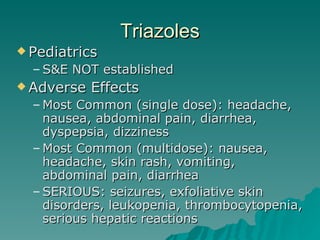
Triazoles Pediatrics S&E NOT established Adverse Effects Most Common (single dose): headache, nausea, abdominal pain, diarrhea, dyspepsia, dizziness Most Common (multidose): nausea, headache, skin rash, vomiting, abdominal pain, diarrhea SERIOUS: seizures, exfoliative skin disorders, leukopenia, thrombocytopenia, serious hepatic reactions
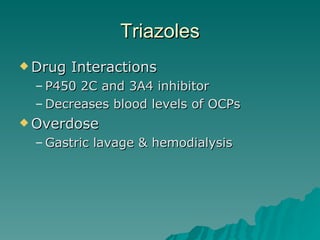
Triazoles Drug Interactions P450 2C and 3A4 inhibitor Decreases blood levels of OCPs Overdose Gastric lavage & hemodialysis
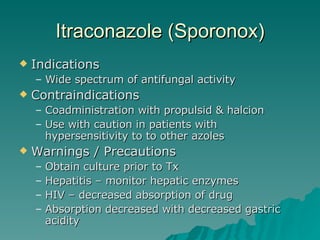
Itraconazole (Sporonox) Indications Wide spectrum of antifungal activity Contraindications Coadministration with propulsid & halcion Use with caution in patients with hypersensitivity to to other azoles Warnings / Precautions Obtain culture prior to Tx Hepatitis – monitor hepatic enzymes HIV – decreased absorption of drug Absorption decreased with decreased gastric acidity
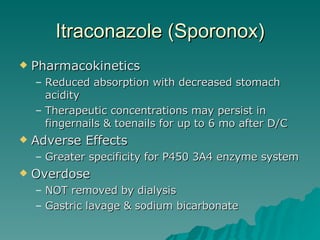
Itraconazole (Sporonox) Pharmacokinetics Reduced absorption with decreased stomach acidity Therapeutic concentrations may persist in fingernails & toenails for up to 6 mo after D/C Adverse Effects Greater specificity for P450 3A4 enzyme system Overdose NOT removed by dialysis Gastric lavage & sodium bicarbonate
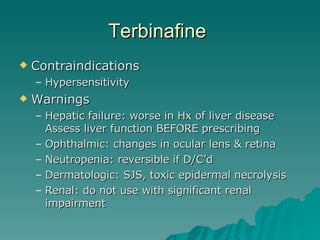
Terbinafine  Contraindications Hypersensitivity Warnings Hepatic failure: worse in Hx of liver disease Assess liver function BEFORE prescribing Ophthalmic: changes in ocular lens & retina Neutropenia: reversible if D/C’d Dermatologic: SJS, toxic epidermal necrolysis Renal: do not use with significant renal impairment
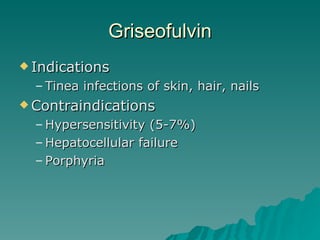
Griseofulvin Indications Tinea infections of skin, hair, nails Contraindications Hypersensitivity (5-7%) Hepatocellular failure Porphyria
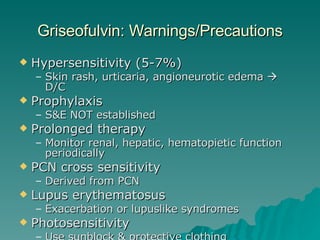
Griseofulvin: Warnings/Precautions Hypersensitivity (5-7%) Skin rash, urticaria, angioneurotic edema    D/C Prophylaxis S&E NOT established Prolonged therapy Monitor renal, hepatic, hematopietic function periodically PCN cross sensitivity Derived from PCN Lupus erythematosus Exacerbation or lupuslike syndromes Photosensitivity Use sunblock & protective clothing
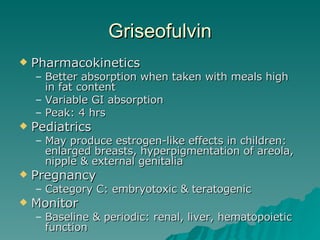
Griseofulvin Pharmacokinetics Better absorption when taken with meals high in fat content Variable GI absorption Peak: 4 hrs Pediatrics May produce estrogen-like effects in children: enlarged breasts, hyperpigmentation of areola, nipple & external genitalia Pregnancy Category C: embryotoxic & teratogenic Monitor Baseline & periodic: renal, liver, hematopoietic function
Griseofulvin Adverse Effects Common: hypersensitivity – skin rashes, urticaria, angioneurotic edema (rare) Oral thrush, N/V, epigastric distress, diarrhea, headache, fatigue, dizziness, insomnia, mental confusion, impairment of performance of routine acitivities High dose or prolonged Tx: interference with porphyrin metabolism, proteinuria, leukopenia, hepatic toxicity, GI bleed, menstrual irregularities, paresthesias of hands and feet, granulocytopenia Drug Interactions NOT metabolized by P450 Decreases activity of OCPs & anticoagulants
Griseofulvin: Pt Education Bioavailability improves when given with food Headaches disappear with continued Tx or taken with food Continue for entire course of Tx – effects not immediately noticeable Photosensitivity – avoid prolonged exposure to sunlight or sunlamps; use sun block and protective clothing Notify provider of rash or sore throat May potentiate effects of alcohol
Fungi Morphology Yeast Unicellular fungi  Typically round or oval Reproduce by budding May form pseudohyphae (long chains) Molds Multicellular colonies composed of tubular structures (hyphae) Grow by branching & longitudinal extension Dimorphism Fungi may be yeast or mold depending on env conditions
Mycosis Presence of parasitic fungi in or on the body Most pathogenic fungi are yeast, are nonmotile, and are nontransmissible May be superficial, subcutaneous, or deeply invasive Fungi are eukaryocytes like mammalian cells Key difference b/w is the sterol used to make the cell membrane  Fungi: ergosterol VS. Mammals: cholesterol Mechanism of action = interaction with / inhibition of ergosterol synthesis
Mechanisms of Action Azoles Fungistatic (vs. fungicidal)  Inhibition of ergosterol synthesis    cell membranes becomes more permeable & leak cell contents    inhibits cell growth & replication Griseofulvin Deposited in keratin of diseased tissue making it resistant to fungal infection Diseased tissue gradually exfoliated & replaced with healthy tissue

Antifungal Treatment

  • 1.
  • 2.
    Fungi for generalistsSuperficial (skin, nails, oral, vaginal) Very common in otherwise healthy people Frequent episodes suggest interference with immune defenses as in diabetes, antibiotic Rx Systemic rare except in severely immune- compromised
  • 3.
    Antifungals Lamisil TerbinafineAllylamine Triazoles Imidazoles SUBCLASS Griseofulvin Fluconazole Itraconazole Ketoconazole GENERIC Grisactin Fulvicin Gris-PEG Griseofulvin Diflucan Sporanox Nizoral Azoles TRADE CLASS
  • 4.
    General Indications KetaconazoleSystemic fungal infections (candidiasis, blastomycosis, coccidioidomycosis, histoplasmosis) Severe recalcitrant dermatophyte infections unresponsive to topical Fluconazole Candidiasis, including vaginal Cryptococcal meningitis Itraconazole Blastomycosis, histoplasmosis, apergillosis Onychomycosis Terbinafine Onychomycosis Griseofulvin Tinea infections of skin, hair, nails unresponsive to topical NOT candidiasis, blastomycosis, coccidioidomycosis, histoplasmosis
  • 5.
    Azoles: Patient VariablesGeriatrics More susceptible to hepatotoxicity Require lower dosing in reduced renal function Pediatrics S&E NOT established Pregnancy Category C: Benefit > risk to fetus Lactation Excreted in breast milk. Do NOT use in nursing women.
  • 6.
    Azoles: Monitoring AssessLFTs prior to initiating Tx and periodically (baseline & Q2wk x 2 mo, then Q1-2 mo) Assess for s/s of hepatitis Fatigue, anorexia, N/V, jaundice, dark urine, pale stools Assess for interference with steroidgenesis High-dose ketoconazole: adrenal suppression High-dose itraconazole: hypokalemia & secondary V-fib Assess response to Tx with repeat cultures
  • 7.
    Azoles: Patient EducationFood enhances absorption of itraconazole, variably affects ketoconazole, no effect on fluconazole Administer antacids, H2-blockers, proton pump inhibitors, or anticholinergics at least 2 hours after ketoconazole or itraconazole Immediately report any s/s of hepatitis Fatigue, anorexia, N/V, jaundice, dark urine, pale stools Take as prescribed. Inadequate treatment  poor response or early recurrence of symptoms Women of childbearing age: USE CONTRACEPTION OR ABSTINENCE
  • 8.
    Ketoconazole Contraindications HypersensitivityFungal meningitis (poor CNS penetration) Use with Propulsid  serious cardiac arrhythmias Warnings / Precautions Hepatic toxicity: clinically significant / fatal hepatitis  D/C immediately if s/s, effects usually reversible may take weeks to months Steroidgenesis: directly inhibit adrenal cortisol and testosterone synthesis  low sperm counts, decreased libido, impotence, gynecomastia, menstrual irregularities Hypersensitivity & anaphylaxis Weak bases require gastric acidity for dissolution/absorption  do NOT take with antacids, anticholinergics, or H2-blockers
  • 9.
    Ketoconazole: Pharmacokinetics Bioavailabilityvaries depending on gastric pH Ketoconazole absorption variable with food Itraconazole 2-3 x greater bioavailability with food esp lipids Hypochlohydria in AIDS  decreased bioavailability
  • 10.
    Ketoconazole Adverse EffectsMild / transient – don’t require D/C Most common: N/V Drug Interactions Least favorable toxicity profile Inhibits P450 3A4, also inhibits 1A2, 2C, 3A4 Propulsid  serious cardiac arrhythmias Do NOT take with antacids, anticholinergics, or H2-blockers  decreases bioavailability
  • 11.
    Triazole Indications Oropharyngeal& esophogeal candidiasis Single dose Tx of vulvovaginal candidiasis Contraindications Hypersensitivity Warnings / Precautions Hepatotoxicity Allergic / Dermatologic reaction – anaphylaxis & exfoliative dermatitis (rare) Dose reduction for renal dysfunction Use care in use with elderly
  • 12.
    Triazoles: Pharmacokinetics Absorption& bioavailability NOT affected by food or gastric pH Excreted renally with therapeutic concentrations achieved in urine UNIQUE among azoles in that it crosses the blood-brain barrier & has good CSF penetration
  • 13.
    Triazoles Pediatrics S&ENOT established Adverse Effects Most Common (single dose): headache, nausea, abdominal pain, diarrhea, dyspepsia, dizziness Most Common (multidose): nausea, headache, skin rash, vomiting, abdominal pain, diarrhea SERIOUS: seizures, exfoliative skin disorders, leukopenia, thrombocytopenia, serious hepatic reactions
  • 14.
    Triazoles Drug InteractionsP450 2C and 3A4 inhibitor Decreases blood levels of OCPs Overdose Gastric lavage & hemodialysis
  • 15.
    Itraconazole (Sporonox) IndicationsWide spectrum of antifungal activity Contraindications Coadministration with propulsid & halcion Use with caution in patients with hypersensitivity to to other azoles Warnings / Precautions Obtain culture prior to Tx Hepatitis – monitor hepatic enzymes HIV – decreased absorption of drug Absorption decreased with decreased gastric acidity
  • 16.
    Itraconazole (Sporonox) PharmacokineticsReduced absorption with decreased stomach acidity Therapeutic concentrations may persist in fingernails & toenails for up to 6 mo after D/C Adverse Effects Greater specificity for P450 3A4 enzyme system Overdose NOT removed by dialysis Gastric lavage & sodium bicarbonate
  • 17.
    Terbinafine ContraindicationsHypersensitivity Warnings Hepatic failure: worse in Hx of liver disease Assess liver function BEFORE prescribing Ophthalmic: changes in ocular lens & retina Neutropenia: reversible if D/C’d Dermatologic: SJS, toxic epidermal necrolysis Renal: do not use with significant renal impairment
  • 18.
    Griseofulvin Indications Tineainfections of skin, hair, nails Contraindications Hypersensitivity (5-7%) Hepatocellular failure Porphyria
  • 19.
    Griseofulvin: Warnings/Precautions Hypersensitivity(5-7%) Skin rash, urticaria, angioneurotic edema  D/C Prophylaxis S&E NOT established Prolonged therapy Monitor renal, hepatic, hematopietic function periodically PCN cross sensitivity Derived from PCN Lupus erythematosus Exacerbation or lupuslike syndromes Photosensitivity Use sunblock & protective clothing
  • 20.
    Griseofulvin Pharmacokinetics Betterabsorption when taken with meals high in fat content Variable GI absorption Peak: 4 hrs Pediatrics May produce estrogen-like effects in children: enlarged breasts, hyperpigmentation of areola, nipple & external genitalia Pregnancy Category C: embryotoxic & teratogenic Monitor Baseline & periodic: renal, liver, hematopoietic function
  • 21.
    Griseofulvin Adverse EffectsCommon: hypersensitivity – skin rashes, urticaria, angioneurotic edema (rare) Oral thrush, N/V, epigastric distress, diarrhea, headache, fatigue, dizziness, insomnia, mental confusion, impairment of performance of routine acitivities High dose or prolonged Tx: interference with porphyrin metabolism, proteinuria, leukopenia, hepatic toxicity, GI bleed, menstrual irregularities, paresthesias of hands and feet, granulocytopenia Drug Interactions NOT metabolized by P450 Decreases activity of OCPs & anticoagulants
  • 22.
    Griseofulvin: Pt EducationBioavailability improves when given with food Headaches disappear with continued Tx or taken with food Continue for entire course of Tx – effects not immediately noticeable Photosensitivity – avoid prolonged exposure to sunlight or sunlamps; use sun block and protective clothing Notify provider of rash or sore throat May potentiate effects of alcohol
  • 23.
    Fungi Morphology YeastUnicellular fungi Typically round or oval Reproduce by budding May form pseudohyphae (long chains) Molds Multicellular colonies composed of tubular structures (hyphae) Grow by branching & longitudinal extension Dimorphism Fungi may be yeast or mold depending on env conditions
  • 24.
    Mycosis Presence ofparasitic fungi in or on the body Most pathogenic fungi are yeast, are nonmotile, and are nontransmissible May be superficial, subcutaneous, or deeply invasive Fungi are eukaryocytes like mammalian cells Key difference b/w is the sterol used to make the cell membrane Fungi: ergosterol VS. Mammals: cholesterol Mechanism of action = interaction with / inhibition of ergosterol synthesis
  • 25.
    Mechanisms of ActionAzoles Fungistatic (vs. fungicidal) Inhibition of ergosterol synthesis  cell membranes becomes more permeable & leak cell contents  inhibits cell growth & replication Griseofulvin Deposited in keratin of diseased tissue making it resistant to fungal infection Diseased tissue gradually exfoliated & replaced with healthy tissue