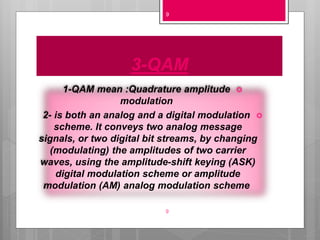
This document discusses quadrature amplitude modulation (QAM). It begins by defining modulation and listing the main types: analog, digital, and pulse modulation. It then focuses on QAM, explaining that it conveys two analog or digital signals by changing the amplitudes of two carrier waves that are 90 degrees out of phase. QAM has advantages like efficiently transmitting two messages with the same bandwidth but also has disadvantages like being more susceptible to noise at higher modulation levels. Applications of QAM include digital cable television and cable modems where it is used to transmit multiple bits per symbol.