QUALITY RISK MANAGEMENT
Q9
INTRODUCTION
Risk: The combination of the probability of occurrence of harm and the
severity of that harm
Quality: The degree to which a set of inherent properties of a product,
system or process fulfills requirements.
Quality Risk Management: A systematic process for the assessment,
control, communication and review of risks to the quality of the drug
(medicinal) product across the product lifecycle.
๏ƒ˜ It is important to understand that product quality should be
maintained throughout the product lifecycle such that the attributes that
are important to the quality of the drug (medicinal) product remain
consistent with those used in the clinical studies.
PRINCIPLES OF QUALITY RISK MANAGEMENT
Two primary principles of quality risk management are:
โ€ข The evaluation of the risk to quality should be based on scientific
knowledge and ultimately link to the protection of the patient; and
โ€ข The level of effort, formality and documentation of the quality risk
management process should be commensurate with the level of risk.
๏ƒ˜ An effective quality risk management approach can further ensure the
high quality of the drug (medicinal) product to the patient by providing a
proactive means to identify and control potential quality issues during
development and manufacturing.
QUALITY RISK MANAGEMENT PROCESS
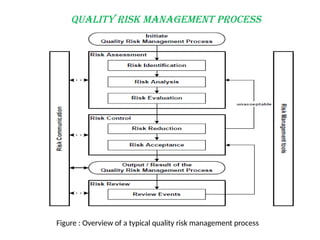
Figure : Overview of a typical quality risk management process
Initiating a Quality Risk Management Process
Quality risk management should include systematic processes designed to
coordinate, facilitate and improve science-based decision making with
respect to risk. Possible steps used to initiate and plan a quality risk
management process might include the following:
โ€ข Define the problem and/or risk question, including pertinent
assumptions identifying the potential for risk;
โ€ข Assemble background information and/ or data on the potential
hazard, harm or human health impact relevant to the risk assessment;
โ€ข Identify a leader and necessary resources;
โ€ข Specify a timeline, deliverables and appropriate level of decision
making for the risk management process.
Risk Assessment
Risk assessment consists of the identification of hazards and the analysis and
evaluation of risks associated with exposure to those hazards. The risk(s) for risk
assessment purposes, three fundamental questions are often helpful:
1. What might go wrong?
2. What is the likelihood (probability) it will go wrong?
3. What are the consequences (severity)?
Risk identification is a systematic use of information to identify hazards referring to
the risk question or problem description. Information can include historical data,
theoretical analysis, informed opinions, and the concerns of stakeholders.
Risk analysis is the estimation of the risk associated with the identified hazards. It
is the qualitative or quantitative process of linking the likelihood of occurrence and
severity of harms.
Risk evaluation compares the identified and analyzed risk against given risk
criteria. Risk evaluations consider the strength of evidence for all three of the
fundamental questions.
Risk Control
Risk control includes decision making to reduce and/or accept risks. The purpose
of risk control is to reduce the risk to an acceptable level. For understanding the
optimal level of risk control. Risk control might focus on the following questions:
โ€ข Is the risk above an acceptable level?
โ€ข What can be done to reduce or eliminate risks?
โ€ข What is the appropriate balance among benefits, risks and resources?
โ€ข Are new risks introduced as a result of the identified risks being controlled?
Risk reduction focuses on processes for mitigation or avoidance of quality risk when
it exceeds an acceptable level. Risk reduction might include actions taken to
mitigate the severity and probability of harm. Processes that improve the
detectability of hazards and quality risks might also be used as part of a risk control
strategy.
Risk acceptance is a decision to accept risk. Risk acceptance can be a formal
decision to accept the residual risk or it can be a passive decision in which residual
risks are not specified.
Risk Communication
Risk communication is the sharing of information about risk and risk management
between the decision makers and others. Parties can communicate at any stage of
the risk management process.
The output/result of the quality risk management process should be appropriately
communicated and documented.
Between the industry and regulatory authorities, communication concerning
quality risk management decisions might be effected through existing channels as
specified in regulations and guidance.
The communication information might relate to the existence, nature, form,
probability, severity, acceptability, control, treatment, detectability or other
aspects of risks to quality.
Risk Review
The output/results of the risk management process should be reviewed to take
into account new knowledge and experience.
Once a quality risk management process has been initiated, that process should
continue to be utilized for events that might impact the original quality risk
management decision
The frequency of any review should be based upon the level of risk. Risk review
might include reconsideration of risk acceptance decisions
RISK MANAGEMENT METHODOLOGY
Quality risk management supports a scientific and practical approach to decision-
making.
It provides documented, transparent and reproducible methods to accomplish steps
of the quality risk management process based on current knowledge about
assessing the probability, severity and sometimes detectability of the risk.
Below is a non-exhaustive list of some of these tools:
โ€ข Basic risk management facilitation methods (flowcharts, check sheets etc.);
โ€ข Failure Mode Effects Analysis (FMEA);
โ€ข Failure Mode, Effects and Criticality Analysis (FMECA);
โ€ข Fault Tree Analysis (FTA);
โ€ข Hazard Analysis and Critical Control Points (HACCP);
โ€ข Hazard Operability Analysis (HAZOP);
โ€ข Preliminary Hazard Analysis (PHA);
โ€ข Risk ranking and filtering;
โ€ข Supporting statistical tools.
INTEGRATION OF QRM INTO INDUSTRY
AND
REGULATORY OPERATIONS
Quality risk management is a process that supports science-based and practical
decisions when integrated into quality systems
Training of both industry and regulatory personnel in quality risk management
processes provides for greater understanding of decision-making processes and
builds confidence in quality risk management outcomes.
Quality risk management should be integrated into existing operations and
documented appropriately.
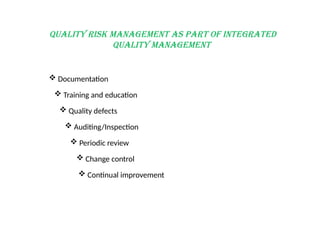
Quality Risk Management as Part of Integrated
Quality Management
๏ถ Documentation
๏ถ Training and education
๏ถ Quality defects
๏ถ Auditing/Inspection
๏ถ Periodic review
๏ถ Change control
๏ถ Continual improvement
Quality Risk Management for Facilities,
Equipment and Utilities
Design of facility / equipment
To determine appropriate zones when designing buildings and facilities, e.g.,
โ€ข flow of material and personnel;
โ€ข minimize contamination;
โ€ข pest control measures;
โ€ข prevention of mix-ups;
โ€ข open versus closed equipment;
โ€ข clean rooms versus isolator technologies;
โ€ข dedicated or segregated facilities / equipment.
Hygiene aspects in facilities
Qualification of facility/equipment/utilities
Cleaning of equipment and environmental control
Calibration/preventive maintenance
Computer systems and computer controlled equipment

ICH Q9 presentation required for pharmaceuticals .pptx

  • 1.
  • 2.
    INTRODUCTION Risk: The combinationof the probability of occurrence of harm and the severity of that harm Quality: The degree to which a set of inherent properties of a product, system or process fulfills requirements. Quality Risk Management: A systematic process for the assessment, control, communication and review of risks to the quality of the drug (medicinal) product across the product lifecycle. ๏ƒ˜ It is important to understand that product quality should be maintained throughout the product lifecycle such that the attributes that are important to the quality of the drug (medicinal) product remain consistent with those used in the clinical studies.
  • 3.
    PRINCIPLES OF QUALITYRISK MANAGEMENT Two primary principles of quality risk management are: โ€ข The evaluation of the risk to quality should be based on scientific knowledge and ultimately link to the protection of the patient; and โ€ข The level of effort, formality and documentation of the quality risk management process should be commensurate with the level of risk. ๏ƒ˜ An effective quality risk management approach can further ensure the high quality of the drug (medicinal) product to the patient by providing a proactive means to identify and control potential quality issues during development and manufacturing.
  • 4.
    QUALITY RISK MANAGEMENTPROCESS Figure : Overview of a typical quality risk management process
  • 5.
    Initiating a QualityRisk Management Process Quality risk management should include systematic processes designed to coordinate, facilitate and improve science-based decision making with respect to risk. Possible steps used to initiate and plan a quality risk management process might include the following: โ€ข Define the problem and/or risk question, including pertinent assumptions identifying the potential for risk; โ€ข Assemble background information and/ or data on the potential hazard, harm or human health impact relevant to the risk assessment; โ€ข Identify a leader and necessary resources; โ€ข Specify a timeline, deliverables and appropriate level of decision making for the risk management process.
  • 6.
    Risk Assessment Risk assessmentconsists of the identification of hazards and the analysis and evaluation of risks associated with exposure to those hazards. The risk(s) for risk assessment purposes, three fundamental questions are often helpful: 1. What might go wrong? 2. What is the likelihood (probability) it will go wrong? 3. What are the consequences (severity)? Risk identification is a systematic use of information to identify hazards referring to the risk question or problem description. Information can include historical data, theoretical analysis, informed opinions, and the concerns of stakeholders. Risk analysis is the estimation of the risk associated with the identified hazards. It is the qualitative or quantitative process of linking the likelihood of occurrence and severity of harms. Risk evaluation compares the identified and analyzed risk against given risk criteria. Risk evaluations consider the strength of evidence for all three of the fundamental questions.
  • 7.
    Risk Control Risk controlincludes decision making to reduce and/or accept risks. The purpose of risk control is to reduce the risk to an acceptable level. For understanding the optimal level of risk control. Risk control might focus on the following questions: โ€ข Is the risk above an acceptable level? โ€ข What can be done to reduce or eliminate risks? โ€ข What is the appropriate balance among benefits, risks and resources? โ€ข Are new risks introduced as a result of the identified risks being controlled? Risk reduction focuses on processes for mitigation or avoidance of quality risk when it exceeds an acceptable level. Risk reduction might include actions taken to mitigate the severity and probability of harm. Processes that improve the detectability of hazards and quality risks might also be used as part of a risk control strategy. Risk acceptance is a decision to accept risk. Risk acceptance can be a formal decision to accept the residual risk or it can be a passive decision in which residual risks are not specified.
  • 8.
    Risk Communication Risk communicationis the sharing of information about risk and risk management between the decision makers and others. Parties can communicate at any stage of the risk management process. The output/result of the quality risk management process should be appropriately communicated and documented. Between the industry and regulatory authorities, communication concerning quality risk management decisions might be effected through existing channels as specified in regulations and guidance. The communication information might relate to the existence, nature, form, probability, severity, acceptability, control, treatment, detectability or other aspects of risks to quality.
  • 9.
    Risk Review The output/resultsof the risk management process should be reviewed to take into account new knowledge and experience. Once a quality risk management process has been initiated, that process should continue to be utilized for events that might impact the original quality risk management decision The frequency of any review should be based upon the level of risk. Risk review might include reconsideration of risk acceptance decisions
  • 10.
    RISK MANAGEMENT METHODOLOGY Qualityrisk management supports a scientific and practical approach to decision- making. It provides documented, transparent and reproducible methods to accomplish steps of the quality risk management process based on current knowledge about assessing the probability, severity and sometimes detectability of the risk. Below is a non-exhaustive list of some of these tools: โ€ข Basic risk management facilitation methods (flowcharts, check sheets etc.); โ€ข Failure Mode Effects Analysis (FMEA); โ€ข Failure Mode, Effects and Criticality Analysis (FMECA); โ€ข Fault Tree Analysis (FTA); โ€ข Hazard Analysis and Critical Control Points (HACCP); โ€ข Hazard Operability Analysis (HAZOP); โ€ข Preliminary Hazard Analysis (PHA); โ€ข Risk ranking and filtering; โ€ข Supporting statistical tools.
  • 11.
    INTEGRATION OF QRMINTO INDUSTRY AND REGULATORY OPERATIONS Quality risk management is a process that supports science-based and practical decisions when integrated into quality systems Training of both industry and regulatory personnel in quality risk management processes provides for greater understanding of decision-making processes and builds confidence in quality risk management outcomes. Quality risk management should be integrated into existing operations and documented appropriately.
  • 12.
    Quality Risk Managementas Part of Integrated Quality Management ๏ถ Documentation ๏ถ Training and education ๏ถ Quality defects ๏ถ Auditing/Inspection ๏ถ Periodic review ๏ถ Change control ๏ถ Continual improvement
  • 13.
    Quality Risk Managementfor Facilities, Equipment and Utilities Design of facility / equipment To determine appropriate zones when designing buildings and facilities, e.g., โ€ข flow of material and personnel; โ€ข minimize contamination; โ€ข pest control measures; โ€ข prevention of mix-ups; โ€ข open versus closed equipment; โ€ข clean rooms versus isolator technologies; โ€ข dedicated or segregated facilities / equipment. Hygiene aspects in facilities Qualification of facility/equipment/utilities Cleaning of equipment and environmental control Calibration/preventive maintenance Computer systems and computer controlled equipment