QUALITY CIRCLE
Presented by- Parth Patel (19080119094)
INDEX:
1. Quality circle
2. History of Quality circle
3. Need of Quality circle
4. Definition
5. Purpose of Quality circle
6. Structure of Quality circle
7. OperationQuality circle
8. Benefits of Quality circle
9. Failure of Quality circle
QUALITY CIRCLE
• Quality circle is a volunteer group composed of workers, usually
under the leadership of their supervisor, who are trained to
identify, analyze and solve work related problems and present
their solutions to management in order to improve the
performance of the organization, and motivate and enrich the
work of employees.
History of Quality Circle
• Quality circles were first established in Japan in 1962, and Kaoru
Ishikawa has been credited with their creation.
• The movement in Japan was coordinated by the Japanese Union
of Scientists and Engineers (JUSE).
• The use of quality circles then spread beyond Japan Quality
circles have been implemented even in educational sectors in
India and QCFI (Quality Circle Forum of India) is promoting such
activities
Need of Quality Circle
• The need for public and private businesses to improve quality of
services is no longer an option but a necessity. Since the early
1960'sbusinesses across the Globe have been searching for ways to
improve overall operational efficiency
• This trend has been more heightened with the onset of free open
tradeAnd Customers demanding so much more for their dollars.
• Some organizations have successfully implemented the use of quality
circles as part of an ongoing improvement program. Others have
experimented with quality circles with the best intentions and faced
several obstacle, but what is true is that this type of participatory
management brings several benefits to all concerned.
DEFINITION
• A Quality Circle is volunteer group composed of members who
meet to talk about workplace and service improvements and
make presentation to their management with their ideas.
Purpose of quality circle
1. To respect humanity worthy and to build a happy
workplace worthwhile.
2.To display human capability totally and in a long run to draw out
of the incite possibilities.
3. To improve competence, which is one of the goals of all
organizations.
4.For customer satisfaction.
5.To reduce cost and redundant efforts in long run.
6.With improved efficiency, the lead time on convene of
information and its subassemblies is reduced.
7. To improve the quality products and services.
8.To contribute towards the improvement and development of
the organization or a department
9.To develop a positive attitude and a sense of involvement in the
decision making process of the service offered.
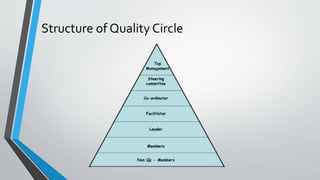
Structure of Quality Circle
Roles and Responsibilities
1. Non QC member-Non members are those who are not
members of the quality circle but may be involved in the quality
circle recommendations.
2.Circle member- They should attend all meetings as far as
possible, offer suggestions and ideas, participate actively in
group processes and attain training seriously.
3. Circle leader- Circle leaders may be from the lowest level of
supervisors. A circle leader organizes and conducts circle
activities
4.Facilitator-He may be a senior supervisory officer, who co-
ordinates the works of several quality circles through the circle
leaders
5.Coordinator- He may be a personnel or administrative officer
who coordinates, supervises the work of the facilitators and
administers the programmed.
6.Steering Committee-Steering committees, consisting of
middle management, also play a positive role in quality circle
activities for its success.
7.Top Management -Being at the top of the structure, it is
headed by a senior executive and includes representatives from
the top management personnel, human resources development
people and employees' union.
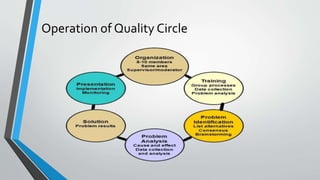
Operation of Quality Circle
1.Problem identification and prioritization: The circle selects
one problem from a list contributed by its members. This
problem is then discussed in depth to ensure that all circle
members understand the nature of the problem and can
contribute to its solution
2.Investigation and analysis: Established problem solving
techniques are used to analyze and determine the true cause of
the problem. . From this analysis, several possible solutions
suggested
3.Solution selection: The circle considers all the suggestions and
selects one as worthy of presenting When the circle has decided
on the best or most feasible solution, the members decide how
their case should be presented for Approval and
Implementation.
4.Action Plan: Before preparing their formal presentation, the
circle obtains information, with the help of management, on the
cost of implementation, estimated savings, ensuing benefits
and any effects on the work of other departments.
5.Presentation to the management and implementation: A
clear presentation is made explaining the reasons, departments
needed and timing of the proposed solution to be implemented.
Benefits of Q.C
• Reduce errors and enhance quality and productivity.
• Inspire more effective teamwork.
• Promote job involvement, participation and employee
motivation.
• Build an attitude of problem prevention / problem.
• Improve communication in the organization.
• Develop worker relationship.
• cost reduction.
Failure of Quality Circle
• Inadequate training leads to an inactive quality circle.
• It is often seen that a quality circle is often unsure of its purpose which leads
to instability.
• It is of no use, when it is not truly voluntary.
• Lack of management interest leads to a non functioning quality circle or its
disbandment.
• Too many suggestions lead to confusion in the quality circle.
Thank you

QUALITY CIRCLE PPT.pptx

  • 1.
    QUALITY CIRCLE Presented by-Parth Patel (19080119094)
  • 2.
    INDEX: 1. Quality circle 2.History of Quality circle 3. Need of Quality circle 4. Definition 5. Purpose of Quality circle 6. Structure of Quality circle 7. OperationQuality circle 8. Benefits of Quality circle 9. Failure of Quality circle
  • 3.
    QUALITY CIRCLE • Qualitycircle is a volunteer group composed of workers, usually under the leadership of their supervisor, who are trained to identify, analyze and solve work related problems and present their solutions to management in order to improve the performance of the organization, and motivate and enrich the work of employees.
  • 4.
    History of QualityCircle • Quality circles were first established in Japan in 1962, and Kaoru Ishikawa has been credited with their creation. • The movement in Japan was coordinated by the Japanese Union of Scientists and Engineers (JUSE). • The use of quality circles then spread beyond Japan Quality circles have been implemented even in educational sectors in India and QCFI (Quality Circle Forum of India) is promoting such activities
  • 5.
    Need of QualityCircle • The need for public and private businesses to improve quality of services is no longer an option but a necessity. Since the early 1960'sbusinesses across the Globe have been searching for ways to improve overall operational efficiency • This trend has been more heightened with the onset of free open tradeAnd Customers demanding so much more for their dollars. • Some organizations have successfully implemented the use of quality circles as part of an ongoing improvement program. Others have experimented with quality circles with the best intentions and faced several obstacle, but what is true is that this type of participatory management brings several benefits to all concerned.
  • 6.
    DEFINITION • A QualityCircle is volunteer group composed of members who meet to talk about workplace and service improvements and make presentation to their management with their ideas.
  • 7.
    Purpose of qualitycircle 1. To respect humanity worthy and to build a happy workplace worthwhile. 2.To display human capability totally and in a long run to draw out of the incite possibilities. 3. To improve competence, which is one of the goals of all organizations. 4.For customer satisfaction.
  • 8.
    5.To reduce costand redundant efforts in long run. 6.With improved efficiency, the lead time on convene of information and its subassemblies is reduced. 7. To improve the quality products and services. 8.To contribute towards the improvement and development of the organization or a department 9.To develop a positive attitude and a sense of involvement in the decision making process of the service offered.
  • 9.
  • 10.
    Roles and Responsibilities 1.Non QC member-Non members are those who are not members of the quality circle but may be involved in the quality circle recommendations. 2.Circle member- They should attend all meetings as far as possible, offer suggestions and ideas, participate actively in group processes and attain training seriously.
  • 11.
    3. Circle leader-Circle leaders may be from the lowest level of supervisors. A circle leader organizes and conducts circle activities 4.Facilitator-He may be a senior supervisory officer, who co- ordinates the works of several quality circles through the circle leaders 5.Coordinator- He may be a personnel or administrative officer who coordinates, supervises the work of the facilitators and administers the programmed.
  • 12.
    6.Steering Committee-Steering committees,consisting of middle management, also play a positive role in quality circle activities for its success. 7.Top Management -Being at the top of the structure, it is headed by a senior executive and includes representatives from the top management personnel, human resources development people and employees' union.
  • 13.
  • 14.
    1.Problem identification andprioritization: The circle selects one problem from a list contributed by its members. This problem is then discussed in depth to ensure that all circle members understand the nature of the problem and can contribute to its solution 2.Investigation and analysis: Established problem solving techniques are used to analyze and determine the true cause of the problem. . From this analysis, several possible solutions suggested
  • 15.
    3.Solution selection: Thecircle considers all the suggestions and selects one as worthy of presenting When the circle has decided on the best or most feasible solution, the members decide how their case should be presented for Approval and Implementation. 4.Action Plan: Before preparing their formal presentation, the circle obtains information, with the help of management, on the cost of implementation, estimated savings, ensuing benefits and any effects on the work of other departments. 5.Presentation to the management and implementation: A clear presentation is made explaining the reasons, departments needed and timing of the proposed solution to be implemented.
  • 16.
    Benefits of Q.C •Reduce errors and enhance quality and productivity. • Inspire more effective teamwork. • Promote job involvement, participation and employee motivation. • Build an attitude of problem prevention / problem. • Improve communication in the organization. • Develop worker relationship. • cost reduction.
  • 17.
    Failure of QualityCircle • Inadequate training leads to an inactive quality circle. • It is often seen that a quality circle is often unsure of its purpose which leads to instability. • It is of no use, when it is not truly voluntary. • Lack of management interest leads to a non functioning quality circle or its disbandment. • Too many suggestions lead to confusion in the quality circle.
  • 18.