A
Presentation on
QUALITY CIRCLE
INTRODUCTION
People are the greatest assets of an
organization, because, through people all other
resources are converted into utilities. However,
management of ‘People Resources’ has always been
a vexed problem ever since the beginning of
organized human activities. A number of
managerial responses have been developed to
answer this question.
Quality Circle -A way to Quality
Improvement
Quality Circle is a small group of 6 to 12 employees
doing similar work who voluntarily meet together
on a regular basis to identify improvements in their
respective work areas using various techniques for
analyzing and solving work related problems
coming in the way of achieving and sustaining
excellence leading to mutual upliftment of
employees as well as the organization. It is "a way
of capturing the creative and innovative power that
lies within the work force“
DEFINITION
After the Second World War Japanese economy was in
the doldrums, Americans decided to help Japan in
improving the quality standards of their products.
General Douglas Mac Arthur who, at that time, was the
commander of the occupational forces in Japan took up
the task of imparting quality awareness among Japanese
to help them improve their products and the reliability of
manufacturing systems including men, machine and
materials. Thus, by 1975, they were topping the world in
quality and productivity. This astonishing and unique
achievement in modern history became an eye – opener
to the world. Industrialists and politicians from all over
the world started visiting Japan to know how they have
achieved such magical results in such a short span. The
answer to this was painstaking and persevering efforts of
the Japanese leaders and workers and the development
and growth of the philosophy of small working groups.
GENESIS OF QUALITY CIRCLES
Characteristics of Quality
Circle Quality circle are small primary groups of employee
whose lower limit is three and upper limit twelve.
 The membership of quality circle is most voluntary .
 Each circle is lead by area supervisor .
 The member meet regularly every week or according
to an agreed schedule.
 The circle members are specially trained in
techniques of analysis and problem solving.
 The basic role of circles to identify and solve work
related problems for improving quality and
productivity.
 Quality circle enable their member to exercise their
hidden talents for tackling challenging tasks.
The concept of Quality Circle is primarily based upon
recognition of the value of the worker as a human
being, as someone who willingly activates on his job,
intelligence, experience, attitude and feelings. It is
based upon the human resource management
considered as one of the key factors in the
improvement of product quality & productivity.
Quality Circle concept has three major attributes:
Quality Circle is a form of participation management.
Quality Circle is a human resource development
technique.
Quality Circle is a problem solving technique.
CONCEPT
The objectives of Quality Circles are multi-faced.
a) Change in Attitude.
From "I don’t care" to "I do care"
Continuous improvement in quality of work life
through humanization of work
b) Self Development
Bring out ‘Hidden Potential’ of people
People get to learn additional skills.
c) Development of Team Spirit
Eliminate inter departmental conflicts.
d) Improved Organizational Culture
Positive working environment.
Higher motivational level.
OBJECTIVE
How Do Quality Circles Work?
 All members of a Circle need to receive training
 Members need to be empowered
 Members need to have the support of Senior
Management
 Characteristics
◦ Volunteers
◦ Set Rules and Priorities
◦ Decisions made by Consensus
◦ Use of organized approaches to Problem-
Solving
The Japanese description of the
effectiveness of a quality circle is
expressed as:
 It is better for one hundred people to take one step
than for one person to take a hundred
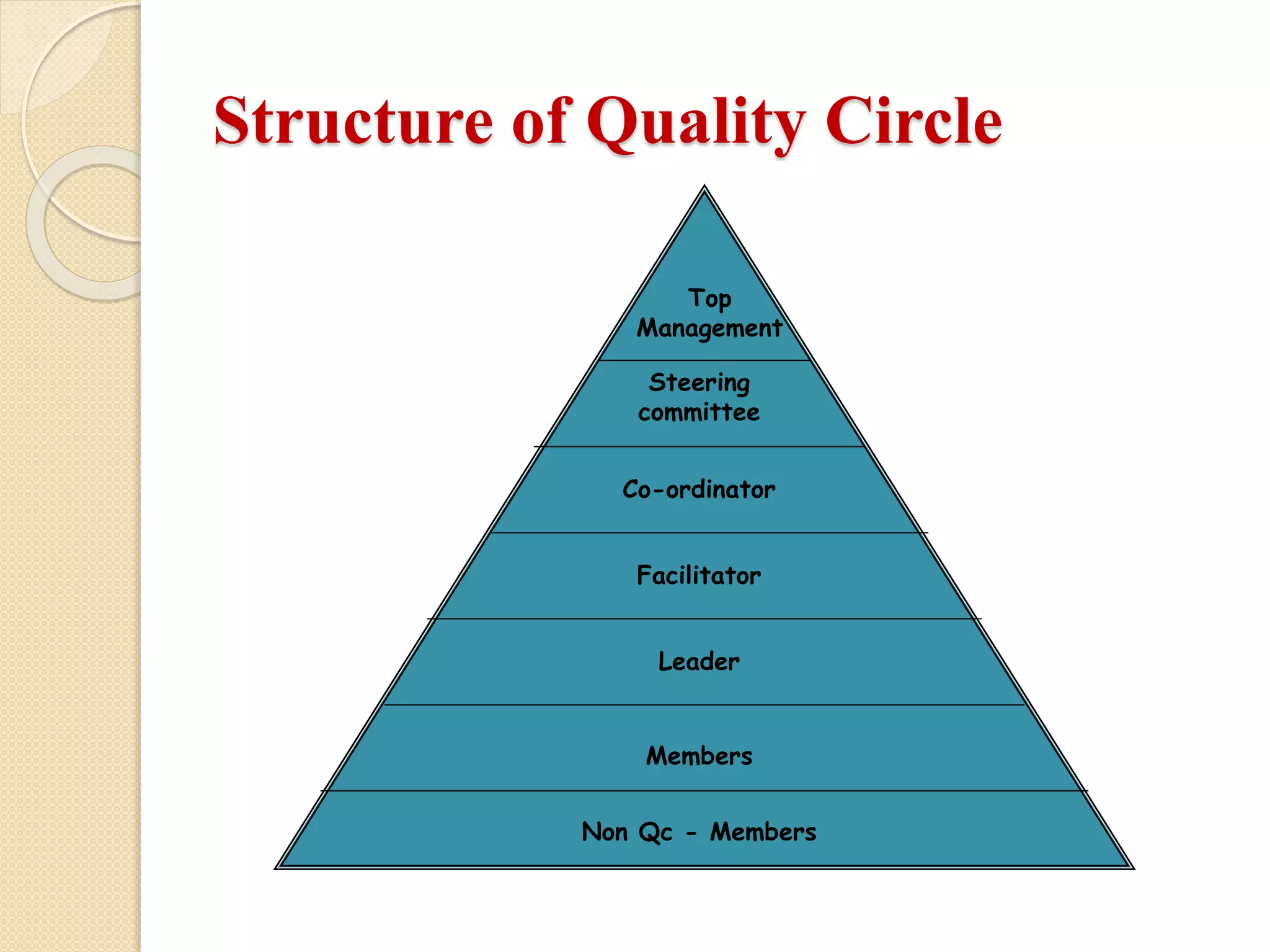
A steering committee: This is at the top of the
structure. It is headed by a senior executive and
includes representatives from the top management
personnel and human resources development
people. It establishes policy, plans and directs the
program and meets usually once in a month.
Co-ordinator: He may be a Personnel or
Administrative officer who co-ordinates and
supervises the work of the facilitators and
administers the program.
Who works for Quality
Circles?
Advantages:
 Product improvement
 Customer satisfaction
 efficiency savings
 financial savings
 improved company performance
 reduced customer complaints
 reduced wasted
 reduced error
 increased accuracy
.
Who works for Quality Circles?
Cont….
Circle leader : Circle leader may be from lowest
level supervisors. A circle leader organize and
conduct circle activities.
Circle members : They may be staff workers.
Without circle members the program cannot exist.
They are the lifeblood of quality circles. They should
attend all meetings as far as possible, offer
suggestions and ideas, participate actively in group
process.The roles of Steering Committee and Circle
members are well defined.
Limitations:
 The overall productivity may decrease initially.
 A large investment and time is required for a
concept that is essentially new .
 The chances of error increase initially .
 After circle implementation a period of confusion
may arise. This is because people experiment
with new ideas , new skill and new roll.
1- Problem identification: Identify a number of
problems.
2- Problem selection : Decide the priority and select
the problem to be taken up first.
3- Problem Analysis : Problem is clarified and
analyzed by basic problem solving methods.
4- Generate alternative solutions : Identify and
evaluate causes and generate number of possible
alternative solutions.
5- Select the most appropriate solution : Discuss and
evaluate the alternative solutions by comparisons.
This enables to select the most appropriate solution
PROCESS OF OPERATION
cont….
6- Prepare plan of action : Prepare plan of action
for converting the solution into reality which
includes the considerations "who, what, when,
where, why and how" of solving problems.
7 -Present solution to management circle:
Members present solution to management fore
approval.
8- Implementation of solution : The management
evaluates the recommended solution. Then it is
tested and if successful, implemented on a full
scale .
The following techniques are most commonly
used to analyze and solve work related
problems.
lBrain storming
lPareto analysis
l Cause & Effect Analysis
l Data Collection & Analysis
BASIC PROBLEM SOLVING
TECHNIQUES
Inadequate Training
Unsure of Purpose
Not truly Voluntary
Lack of Management Interest
Quality Circles are not really empowered to make
decisions
Problems with Quality Circles
Formation of Quality Circle
The quality circle under consideration has a leader, a
facilitator, a coordinator and four members. The
object of the present quality circle is ‘reduction of
material wastage’. This problem was so chosen for
solution because of following facts :
a) Whether there was any reduction in material
wastage.
b) Whether there were any saving and financial
losses that should be minimized.
c) Whether it had any effect on the working of the
workers and relationship between workman and
management.
Structure of Quality Circle
Non Qc - Members
Members
Leader
Facilitator
Co-ordinator
Steering
committee
Top
Management
DISCUSSION AND
CONCLUSION
Following observation were achieved after
implementation of quality circle.
 Improvement of internal personal relationship
 Self-confidence was developed in solving more
complex problem related to production.
 A good teamwork was achieved among the
workman
 Material wastage was minimized as a result
heavy monetary gain was obtained.
DISCUSSION AND
CONCLUSION cont…
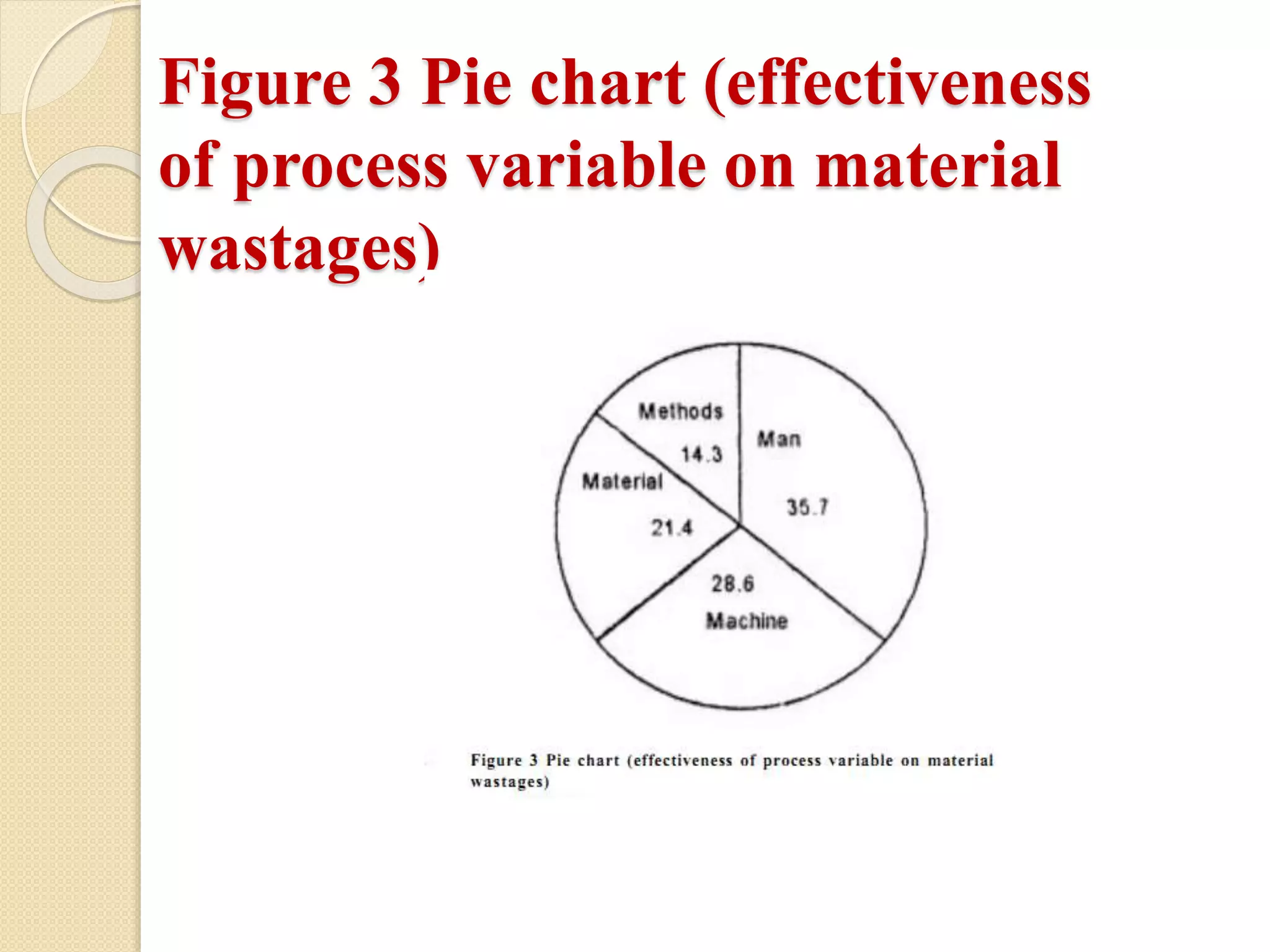
 Table 4 shows a percentage of contribution of
various factors that led to material loss in the given
order.
 The various reason or causes of each factor were
determined and shown in Ishikawa diagram
(Fishbone diagram).
 The causes and effect were obtained by calling
various quality circle meetings (ten) through
brainstorming session and discussion. And hence
these factors led to the result of the present study
in the following order:
Man, Machine, Method, Material
DISCUSSION AND
CONCLUSION cont…
 Quality Circles are not limited to
manufacturing firms only.
 They are applicable for variety of
organizations where there is scope for group
based solution of work related problems.
 Quality Circles are relevant for factories, firms,
schools, hospitals, universities, research
institutes, banks, government offices etc.
DISCUSSION AND
CONCLUSION cont…
 Further this quality circle approach for quality
improvement in University Polytechnic workshop
may bring new dimension, shifting dependence for
decisions and actions towards existing system.
 This change revealed that quest for quality service
is in the hand of all employees.
 The sustenance of success will lead to total quality
improvement emerging as a centre of excellence of
its own in any small enterprise.
Pareto diagram
Figure 3 Pie chart (effectiveness
of process variable on material
wastages)
Ishikawa Diagram (Fishbone
Diagram)
References
 Statistical Quality Control : M.Mahajan
 Employer-Employee Based Quality Circles in
Japan: Human Resource Policy Implications for
American Firms Author(s): George Munchus, III
 Quality Circle as an Effective Management Tool
:A Case Study of Indira College of Engineering
& Management Library
Thank You
Prepared by :-
 NAZAR ABDALLAH MOHAMMED
 ELHINDI HATIM ABDALLAH
 MOIZ SIDDIG HAMZA

Qualitycircle

  • 1.
  • 2.
    INTRODUCTION People are thegreatest assets of an organization, because, through people all other resources are converted into utilities. However, management of ‘People Resources’ has always been a vexed problem ever since the beginning of organized human activities. A number of managerial responses have been developed to answer this question. Quality Circle -A way to Quality Improvement
  • 3.
    Quality Circle isa small group of 6 to 12 employees doing similar work who voluntarily meet together on a regular basis to identify improvements in their respective work areas using various techniques for analyzing and solving work related problems coming in the way of achieving and sustaining excellence leading to mutual upliftment of employees as well as the organization. It is "a way of capturing the creative and innovative power that lies within the work force“ DEFINITION
  • 4.
    After the SecondWorld War Japanese economy was in the doldrums, Americans decided to help Japan in improving the quality standards of their products. General Douglas Mac Arthur who, at that time, was the commander of the occupational forces in Japan took up the task of imparting quality awareness among Japanese to help them improve their products and the reliability of manufacturing systems including men, machine and materials. Thus, by 1975, they were topping the world in quality and productivity. This astonishing and unique achievement in modern history became an eye – opener to the world. Industrialists and politicians from all over the world started visiting Japan to know how they have achieved such magical results in such a short span. The answer to this was painstaking and persevering efforts of the Japanese leaders and workers and the development and growth of the philosophy of small working groups. GENESIS OF QUALITY CIRCLES
  • 5.
    Characteristics of Quality CircleQuality circle are small primary groups of employee whose lower limit is three and upper limit twelve.  The membership of quality circle is most voluntary .  Each circle is lead by area supervisor .  The member meet regularly every week or according to an agreed schedule.  The circle members are specially trained in techniques of analysis and problem solving.  The basic role of circles to identify and solve work related problems for improving quality and productivity.  Quality circle enable their member to exercise their hidden talents for tackling challenging tasks.
  • 6.
    The concept ofQuality Circle is primarily based upon recognition of the value of the worker as a human being, as someone who willingly activates on his job, intelligence, experience, attitude and feelings. It is based upon the human resource management considered as one of the key factors in the improvement of product quality & productivity. Quality Circle concept has three major attributes: Quality Circle is a form of participation management. Quality Circle is a human resource development technique. Quality Circle is a problem solving technique. CONCEPT
  • 7.
    The objectives ofQuality Circles are multi-faced. a) Change in Attitude. From "I don’t care" to "I do care" Continuous improvement in quality of work life through humanization of work b) Self Development Bring out ‘Hidden Potential’ of people People get to learn additional skills. c) Development of Team Spirit Eliminate inter departmental conflicts. d) Improved Organizational Culture Positive working environment. Higher motivational level. OBJECTIVE
  • 8.
    How Do QualityCircles Work?  All members of a Circle need to receive training  Members need to be empowered  Members need to have the support of Senior Management  Characteristics ◦ Volunteers ◦ Set Rules and Priorities ◦ Decisions made by Consensus ◦ Use of organized approaches to Problem- Solving
  • 9.
    The Japanese descriptionof the effectiveness of a quality circle is expressed as:  It is better for one hundred people to take one step than for one person to take a hundred
  • 10.
    A steering committee:This is at the top of the structure. It is headed by a senior executive and includes representatives from the top management personnel and human resources development people. It establishes policy, plans and directs the program and meets usually once in a month. Co-ordinator: He may be a Personnel or Administrative officer who co-ordinates and supervises the work of the facilitators and administers the program. Who works for Quality Circles?
  • 11.
    Advantages:  Product improvement Customer satisfaction  efficiency savings  financial savings  improved company performance  reduced customer complaints  reduced wasted  reduced error  increased accuracy
  • 12.
    . Who works forQuality Circles? Cont…. Circle leader : Circle leader may be from lowest level supervisors. A circle leader organize and conduct circle activities. Circle members : They may be staff workers. Without circle members the program cannot exist. They are the lifeblood of quality circles. They should attend all meetings as far as possible, offer suggestions and ideas, participate actively in group process.The roles of Steering Committee and Circle members are well defined.
  • 13.
    Limitations:  The overallproductivity may decrease initially.  A large investment and time is required for a concept that is essentially new .  The chances of error increase initially .  After circle implementation a period of confusion may arise. This is because people experiment with new ideas , new skill and new roll.
  • 14.
    1- Problem identification:Identify a number of problems. 2- Problem selection : Decide the priority and select the problem to be taken up first. 3- Problem Analysis : Problem is clarified and analyzed by basic problem solving methods. 4- Generate alternative solutions : Identify and evaluate causes and generate number of possible alternative solutions. 5- Select the most appropriate solution : Discuss and evaluate the alternative solutions by comparisons. This enables to select the most appropriate solution PROCESS OF OPERATION
  • 15.
    PROCESS OF OPERATION cont…. 6-Prepare plan of action : Prepare plan of action for converting the solution into reality which includes the considerations "who, what, when, where, why and how" of solving problems. 7 -Present solution to management circle: Members present solution to management fore approval. 8- Implementation of solution : The management evaluates the recommended solution. Then it is tested and if successful, implemented on a full scale .
  • 16.
    The following techniquesare most commonly used to analyze and solve work related problems. lBrain storming lPareto analysis l Cause & Effect Analysis l Data Collection & Analysis BASIC PROBLEM SOLVING TECHNIQUES
  • 17.
    Inadequate Training Unsure ofPurpose Not truly Voluntary Lack of Management Interest Quality Circles are not really empowered to make decisions Problems with Quality Circles
  • 18.
    Formation of QualityCircle The quality circle under consideration has a leader, a facilitator, a coordinator and four members. The object of the present quality circle is ‘reduction of material wastage’. This problem was so chosen for solution because of following facts : a) Whether there was any reduction in material wastage. b) Whether there were any saving and financial losses that should be minimized. c) Whether it had any effect on the working of the workers and relationship between workman and management.
  • 19.
    Structure of QualityCircle Non Qc - Members Members Leader Facilitator Co-ordinator Steering committee Top Management
  • 20.
    DISCUSSION AND CONCLUSION Following observationwere achieved after implementation of quality circle.  Improvement of internal personal relationship  Self-confidence was developed in solving more complex problem related to production.  A good teamwork was achieved among the workman  Material wastage was minimized as a result heavy monetary gain was obtained.
  • 21.
    DISCUSSION AND CONCLUSION cont… Table 4 shows a percentage of contribution of various factors that led to material loss in the given order.  The various reason or causes of each factor were determined and shown in Ishikawa diagram (Fishbone diagram).  The causes and effect were obtained by calling various quality circle meetings (ten) through brainstorming session and discussion. And hence these factors led to the result of the present study in the following order: Man, Machine, Method, Material
  • 22.
    DISCUSSION AND CONCLUSION cont… Quality Circles are not limited to manufacturing firms only.  They are applicable for variety of organizations where there is scope for group based solution of work related problems.  Quality Circles are relevant for factories, firms, schools, hospitals, universities, research institutes, banks, government offices etc.
  • 23.
    DISCUSSION AND CONCLUSION cont… Further this quality circle approach for quality improvement in University Polytechnic workshop may bring new dimension, shifting dependence for decisions and actions towards existing system.  This change revealed that quest for quality service is in the hand of all employees.  The sustenance of success will lead to total quality improvement emerging as a centre of excellence of its own in any small enterprise.
  • 24.
  • 25.
    Figure 3 Piechart (effectiveness of process variable on material wastages)
  • 26.
  • 28.
    References  Statistical QualityControl : M.Mahajan  Employer-Employee Based Quality Circles in Japan: Human Resource Policy Implications for American Firms Author(s): George Munchus, III  Quality Circle as an Effective Management Tool :A Case Study of Indira College of Engineering & Management Library
  • 29.
  • 30.
    Prepared by :- NAZAR ABDALLAH MOHAMMED  ELHINDI HATIM ABDALLAH  MOIZ SIDDIG HAMZA

Editor's Notes