Productivity Quality
   Management
Quality Control
   Circles
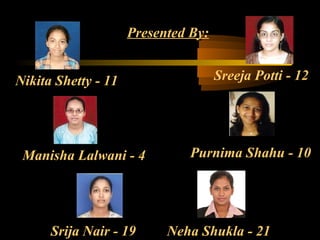
Presented By:


Nikita Shetty - 11                   Sreeja Potti - 12


 Manisha Lalwani - 4           Purnima Shahu - 10


      Srija Nair - 19      Neha Shukla - 21
INDEX
Introduction      Examples
Genesis           Benefits & Limits
Concept           Org Structure
Definition        Operation Process
Features &        Problem Solving
Objectives        Techniques
• People are the greatest assets of an
organisation, because, through people all
other resources are converted into utilities.

• However, management of ‘People
Resources’ has always been a vexed problem
ever since the beginning of organized human
activities.
• Participate methods in the workplace are
one way to improve both the work
environment for employees and
productivity and quality for the company.

• Quality Circle is one of the employee
participation methods.
It implies

The development of skills, capabilities,
confidence and creativity of the people through
cumulative process of education, training,
work experience and participation.

The creation of facilitative conditions and
environment of work, which creates and
sustains their motivation and commitment
towards work excellence.
 After the II World War Japanese economy
was in the doldrums.

 Seeing this disastrous effect of war,
Americans decided to help Japan in improving
the quality standards of their products.
 General Douglas Mac Arthur the
commander of the occupational forces in
Japan took up the task of imparting quality
awareness among Japanese to help them
improve their products and the reliability of
manufacturing systems including men,
machine and materials.
                     By 1975
 They toped the world in quality and
productivity.
 This astonishing and unique achievement was
due to painstaking and persevering efforts of
the Japanese leaders and workers and
the development and growth of the
philosophy of small working groups.

 This resulted in the Quality Circle concept
being accepted all over the world as a very
effective technique to improve the total quality of
work life.
Participative Management Technique

Suggestion Effecting Workplace

Performance Related Problems

Organizes
Concept (contd.)

    It is based upon recognition of the value of
  the worker.

    As a human being.

     As someone who willingly activises on his
  job, his wisdom, intelligence, experience,
  attitude and feelings.
3 Major Attributes:
• Quality Circle is a form of participation
    management.

• Quality Circle is a human resource
development technique.

• Quality Circle is a problem solving technique.
Professor John Oakland define a quality circle as a
group of workers who do similar work and who meet:

1.Voluntarily
2.Regularly
3.In normal working time
4.Under the leadership of their supervisor
5.To identify, analyze and solve "work-
  related" problems
6.To recommend solutions to management
Voluntary


Problems.


Approach.
Features (contd.)

     Homogenous group.


      Participative.


     Belief.
Features (contd.)

     Rules and priorities.

     Decisions.

     Communication.

     Organized approach.
Features (contd.)
      Criticism.

      Objectives.

      Creativity.

      Participation of management.

      Stress on group efforts.
Getting grass root people involved in
Continuous improvement.


  Self-development of Employees.
Objectives (contd.)

   Problem solving and Team
 building opportunity through
 improved participation.

   Improvement in Quality, Product &
 Communication.
• Change in Attitude.
       From "I don’t care" to "I do
      care”.
       Continuous improvement in
      quality of work life through
      humanisation of work.
• Self Development

        Bring out ‘Hidden
       Potential’ of people.

        People get to learn
       additional skills.
• Development of Team Spirit

          Individual Vs Team –
         "I could not do but we did it"

          Eliminate inter departmental
         conflicts.
• Improved Organisational Culture

      Positive working environment.

      Total involvement of people
     at all levels.
      Higher motivational level.

      Participate Management process.
Brain storming
Pareto Diagram
Cause & Effect Analysis
 Data Collection
 Data Analysis
Process
   Of
Operation
PROBLEM
                  IDENTIFICATION


 PROBLEM                              PROBLEM
SELECTION                             ANALYSIS


               GENERATE ALTERNATIVE
                    SOLUTIONS


              SELECT THE MOST
            APPROPRIATE SOLUTION


PREPARE PLAN                       IMPLEMENTATION
  OF ACTION                        OF THE SOLUTION
A Quality Circle has an appropriate
organisational structure for its effective
and efficient performance. It varies
from industry to industry, organisation
to organisation.
Organizational
                  Structure
                   Top mgt
                Steering committee
                    Facilitator
Co-ordinating
  Agency             Leader
                     Member
                  Non member
Top management

A steering committee


Facilitator
(contd.)


       Leader

       Circle Members

       Co-ordinating Agency

      Non-member Employees
Internal leadership, worker morale, motivation
and teamwork.
           Results in higher quality.
                  Productivity

            Flow of information

   Broader continuous improvement.
Systematic style of education.

Freedom to modify work habits.

Opportunity to use their brain.

Teamwork.
Unrealistic expectation.
      Lack of commitment
          Resistance by middle management
               Resentment by non-
                  participants
(contd.)

       Inadequate training.

           Lack of clear objectives.
              Failure to get solutions
            implemented.
                    Lethargy towards effort.
The Public Works Department of Government of
Maharashtra is responsible for the construction
and maintenance of about 2.00 lakhs km. of road
net work in the state and a large number of
Government-owned buildings.

The concept of Quality Circle was launched
in the Public Works Department of Govt. of
Maharashtra on 18-11-1997
• Quality Circles formed -


17 in Mumbai Region wherein 22
problems have been solved.

48 in Pune Region wherein, 8 problems have
been solved.

9 in Nashik Region wherein 3 problems have
been solved.
Problems solved by the Quality Circles in P.W.D


   Eliminating delay in issuing observation
   memos after inspection of site.

   Preventing accidents on highways.


   Reducing electricity bill in office.
(contd.)


   Avoiding duplication of work.

   Speeding up pot-hole filling on roads
   during monsoon

   Upkeeping of service records of employees
OTHER EXAMPLES OF IMPLIMENTATION
TATA MEMORIAL HOSPITAL
TOYOTA
VODAFONE
OTHER EXAMPLES

 Florida Power & Light (FPL) reduced
customer complaints by 60% and improved
reliability of electric services to customers by
40% in 1983. In 1987, the firm was rated by 156
utility CEO's as the best managed utility in the
nation
In its remittance banking or lock-box business,
First Chicago's accuracy rate is nearly three times
the industry average.
Xerox has started to regain its market
share in copiers from the Japanese.

Ford now has one of the most popular cars
purchased by Americans, the Taurus.
ANY QUESTION PLEASE
        ???

Quality Control Circle

  • 1.
  • 2.
  • 3.
    Presented By: Nikita Shetty- 11 Sreeja Potti - 12 Manisha Lalwani - 4 Purnima Shahu - 10 Srija Nair - 19 Neha Shukla - 21
  • 4.
    INDEX Introduction Examples Genesis Benefits & Limits Concept Org Structure Definition Operation Process Features & Problem Solving Objectives Techniques
  • 5.
    • People arethe greatest assets of an organisation, because, through people all other resources are converted into utilities. • However, management of ‘People Resources’ has always been a vexed problem ever since the beginning of organized human activities.
  • 6.
    • Participate methodsin the workplace are one way to improve both the work environment for employees and productivity and quality for the company. • Quality Circle is one of the employee participation methods.
  • 7.
    It implies The developmentof skills, capabilities, confidence and creativity of the people through cumulative process of education, training, work experience and participation. The creation of facilitative conditions and environment of work, which creates and sustains their motivation and commitment towards work excellence.
  • 8.
     After theII World War Japanese economy was in the doldrums.  Seeing this disastrous effect of war, Americans decided to help Japan in improving the quality standards of their products.
  • 9.
     General DouglasMac Arthur the commander of the occupational forces in Japan took up the task of imparting quality awareness among Japanese to help them improve their products and the reliability of manufacturing systems including men, machine and materials. By 1975  They toped the world in quality and productivity.
  • 10.
     This astonishingand unique achievement was due to painstaking and persevering efforts of the Japanese leaders and workers and the development and growth of the philosophy of small working groups.  This resulted in the Quality Circle concept being accepted all over the world as a very effective technique to improve the total quality of work life.
  • 11.
    Participative Management Technique SuggestionEffecting Workplace Performance Related Problems Organizes
  • 12.
    Concept (contd.) It is based upon recognition of the value of the worker. As a human being. As someone who willingly activises on his job, his wisdom, intelligence, experience, attitude and feelings.
  • 13.
    3 Major Attributes: •Quality Circle is a form of participation management. • Quality Circle is a human resource development technique. • Quality Circle is a problem solving technique.
  • 14.
    Professor John Oaklanddefine a quality circle as a group of workers who do similar work and who meet: 1.Voluntarily 2.Regularly 3.In normal working time 4.Under the leadership of their supervisor 5.To identify, analyze and solve "work- related" problems 6.To recommend solutions to management
  • 15.
  • 16.
    Features (contd.) Homogenous group. Participative. Belief.
  • 17.
    Features (contd.) Rules and priorities. Decisions. Communication. Organized approach.
  • 18.
    Features (contd.) Criticism. Objectives. Creativity. Participation of management. Stress on group efforts.
  • 19.
    Getting grass rootpeople involved in Continuous improvement. Self-development of Employees.
  • 20.
    Objectives (contd.) Problem solving and Team building opportunity through improved participation. Improvement in Quality, Product & Communication.
  • 21.
    • Change inAttitude.  From "I don’t care" to "I do care”.  Continuous improvement in quality of work life through humanisation of work.
  • 22.
    • Self Development  Bring out ‘Hidden Potential’ of people.  People get to learn additional skills.
  • 23.
    • Development ofTeam Spirit  Individual Vs Team – "I could not do but we did it"  Eliminate inter departmental conflicts.
  • 24.
    • Improved OrganisationalCulture  Positive working environment.  Total involvement of people at all levels.  Higher motivational level.  Participate Management process.
  • 25.
    Brain storming Pareto Diagram Cause& Effect Analysis  Data Collection  Data Analysis
  • 26.
    Process Of Operation
  • 27.
    PROBLEM IDENTIFICATION PROBLEM PROBLEM SELECTION ANALYSIS GENERATE ALTERNATIVE SOLUTIONS SELECT THE MOST APPROPRIATE SOLUTION PREPARE PLAN IMPLEMENTATION OF ACTION OF THE SOLUTION
  • 28.
    A Quality Circlehas an appropriate organisational structure for its effective and efficient performance. It varies from industry to industry, organisation to organisation.
  • 29.
    Organizational Structure Top mgt Steering committee Facilitator Co-ordinating Agency Leader Member Non member
  • 30.
    Top management A steeringcommittee Facilitator
  • 31.
    (contd.) Leader Circle Members Co-ordinating Agency Non-member Employees
  • 32.
    Internal leadership, workermorale, motivation and teamwork. Results in higher quality. Productivity Flow of information Broader continuous improvement.
  • 33.
    Systematic style ofeducation. Freedom to modify work habits. Opportunity to use their brain. Teamwork.
  • 34.
    Unrealistic expectation. Lack of commitment Resistance by middle management Resentment by non- participants
  • 35.
    (contd.) Inadequate training. Lack of clear objectives. Failure to get solutions implemented. Lethargy towards effort.
  • 36.
    The Public WorksDepartment of Government of Maharashtra is responsible for the construction and maintenance of about 2.00 lakhs km. of road net work in the state and a large number of Government-owned buildings. The concept of Quality Circle was launched in the Public Works Department of Govt. of Maharashtra on 18-11-1997
  • 37.
    • Quality Circlesformed - 17 in Mumbai Region wherein 22 problems have been solved. 48 in Pune Region wherein, 8 problems have been solved. 9 in Nashik Region wherein 3 problems have been solved.
  • 38.
    Problems solved bythe Quality Circles in P.W.D Eliminating delay in issuing observation memos after inspection of site. Preventing accidents on highways. Reducing electricity bill in office.
  • 39.
    (contd.) Avoiding duplication of work. Speeding up pot-hole filling on roads during monsoon Upkeeping of service records of employees
  • 40.
    OTHER EXAMPLES OFIMPLIMENTATION
  • 41.
  • 42.
  • 43.
  • 44.
    OTHER EXAMPLES  FloridaPower & Light (FPL) reduced customer complaints by 60% and improved reliability of electric services to customers by 40% in 1983. In 1987, the firm was rated by 156 utility CEO's as the best managed utility in the nation
  • 45.
    In its remittancebanking or lock-box business, First Chicago's accuracy rate is nearly three times the industry average. Xerox has started to regain its market share in copiers from the Japanese. Ford now has one of the most popular cars purchased by Americans, the Taurus.
  • 48.