QC TESTS FOR TABLETS
G.PAVANI,
Y17MPHPA426,
I/II M.PHARMACY,
Dept. of Pharm. Analysis,
CLPT
07/13/18
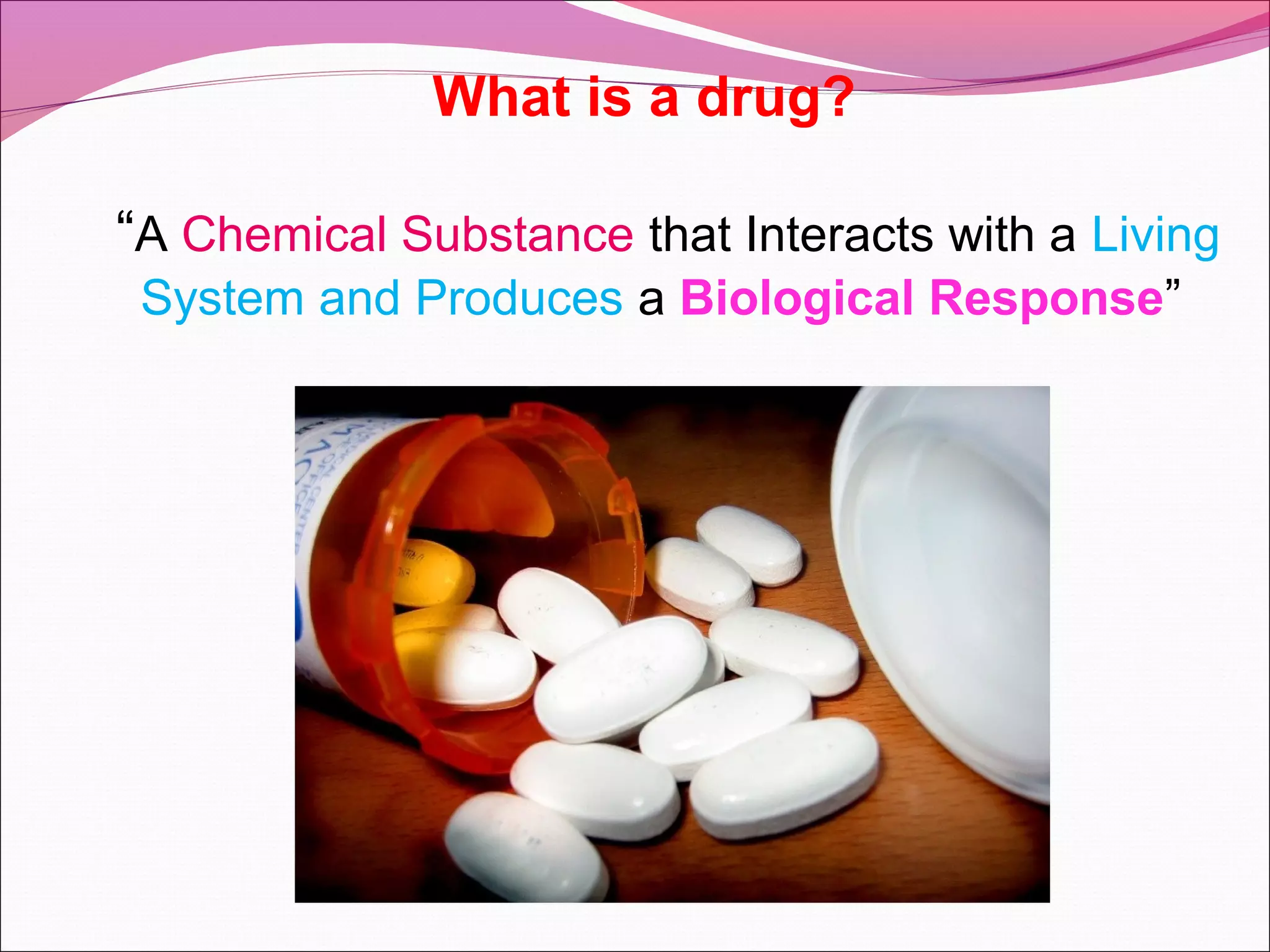
What is a drug?
“A Chemical Substance that Interacts with a Living
System and Produces a Biological Response”
Dosage Forms
 Dosage forms are the carriers through which drug
molecules are delivered to sites of action within the
body.
 Every dosage forms is a combination of the drug and
different kinds of non – drug components called as
Excipients or additives.
 The additives are used to give a, particular shape to the
formulation and to increase stability, palatability &
elegance to preparations.
07/13/18
Need For Dosage Forms
 Accurate dose.
 Protection against environmental (coated tablets, sealed
ampoules).
 Protection from gastric juice, e.g. enteric coated tablets.
 Masking unpleasant taste and odor.
 Introduce through blood stream.
 Sustained release medication.
 Facilation of Insertion of drugs into body cavities (rectal, vaginal).
 Provide optimum drug action through inhalation .
 Provide drug action through topical administration at local area of
body. e.g. creams, ointment, emulsion, lotions etc.07/13/18
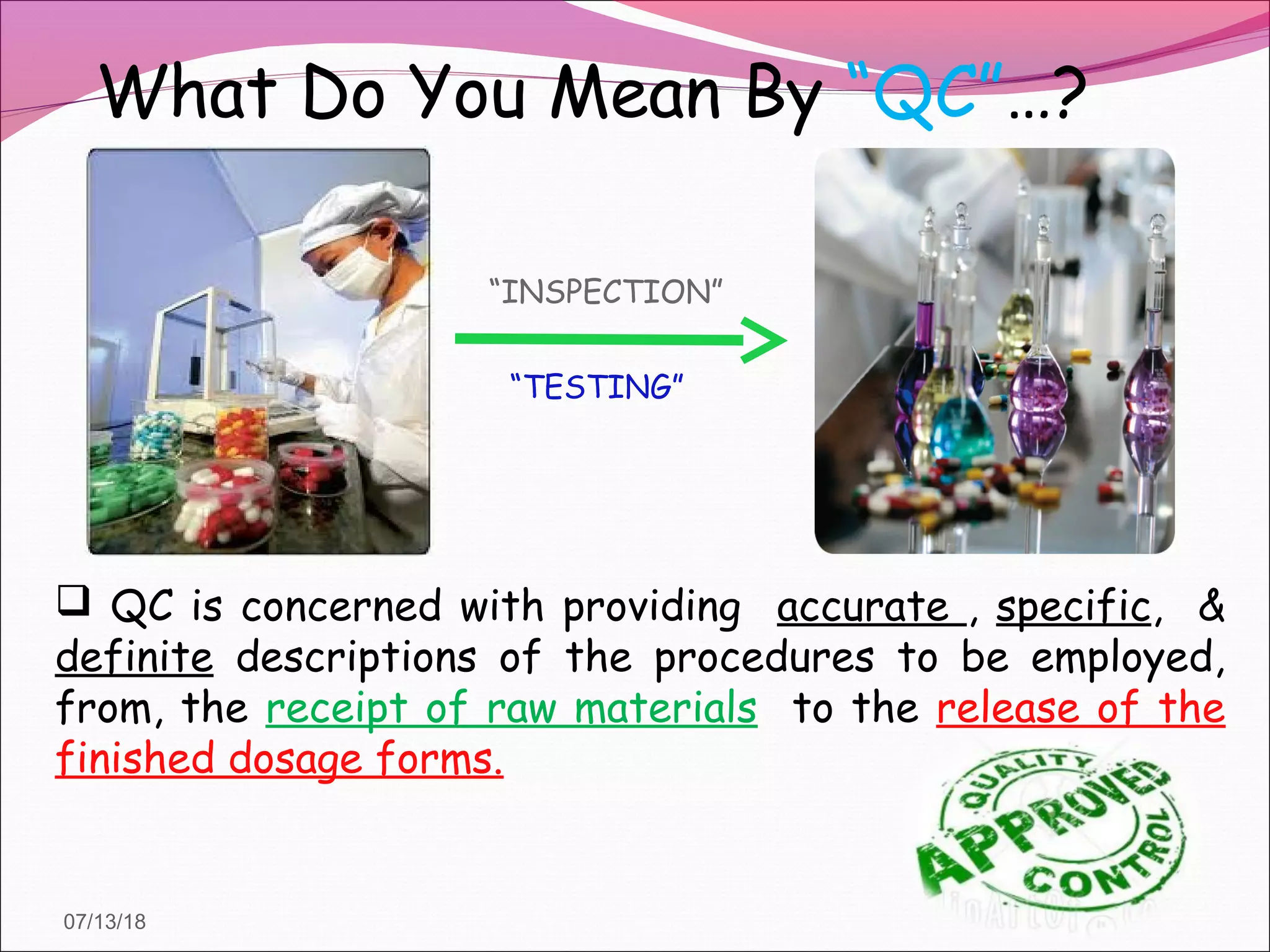
What Do You Mean By “QC”…?
 QC is concerned with providing accurate , specific, &
definite descriptions of the procedures to be employed,
from, the receipt of raw materials to the release of the
finished dosage forms.
“INSPECTION”
“TESTING”
07/13/18
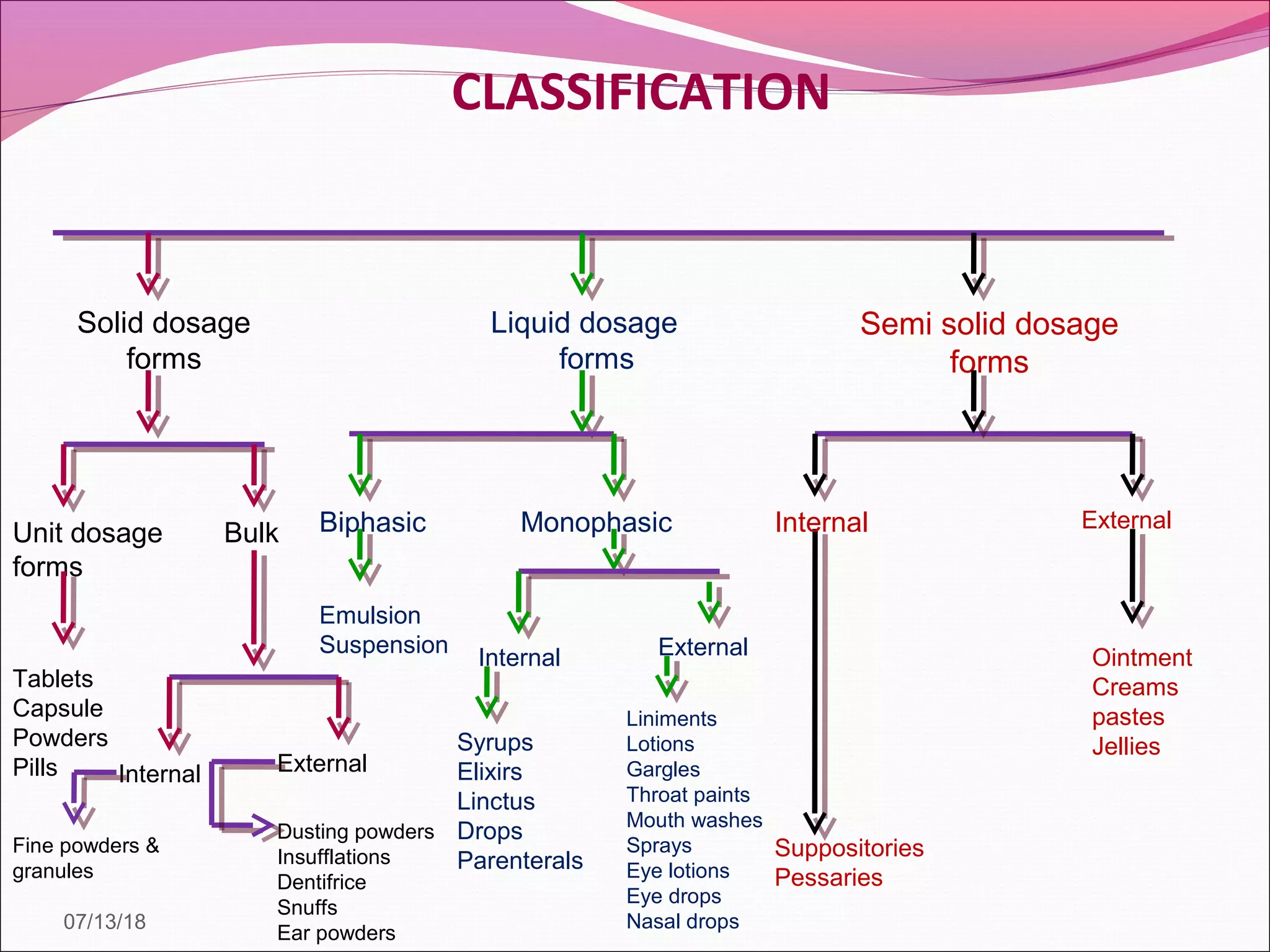
CLASSIFICATION
Solid dosage
forms
Unit dosage
forms
Tablets
Capsule
Powders
Pills
Bulk
Internal
Fine powders &
granules
External
Dusting powders
Insufflations
Dentifrice
Snuffs
Ear powders
Liquid dosage
forms
Biphasic
Emulsion
Suspension
Monophasic
Internal External
Syrups
Elixirs
Linctus
Drops
Parenterals
Liniments
Lotions
Gargles
Throat paints
Mouth washes
Sprays
Eye lotions
Eye drops
Nasal drops
Semi solid dosage
forms
Internal External
Suppositories
Pessaries
Ointment
Creams
pastes
Jellies
07/13/18
Solid dosage forms
Tablets Pills
Dusting Powders
Capsules
Granules
07/13/18
Tablets
These are solid dosage forms of medicaments which are
prepared by moulding or by compression with or
without Excipients.
The tablets can be prepared by two methods namely as a
I) Dry granulation, II) Wet Granulation
07/13/18
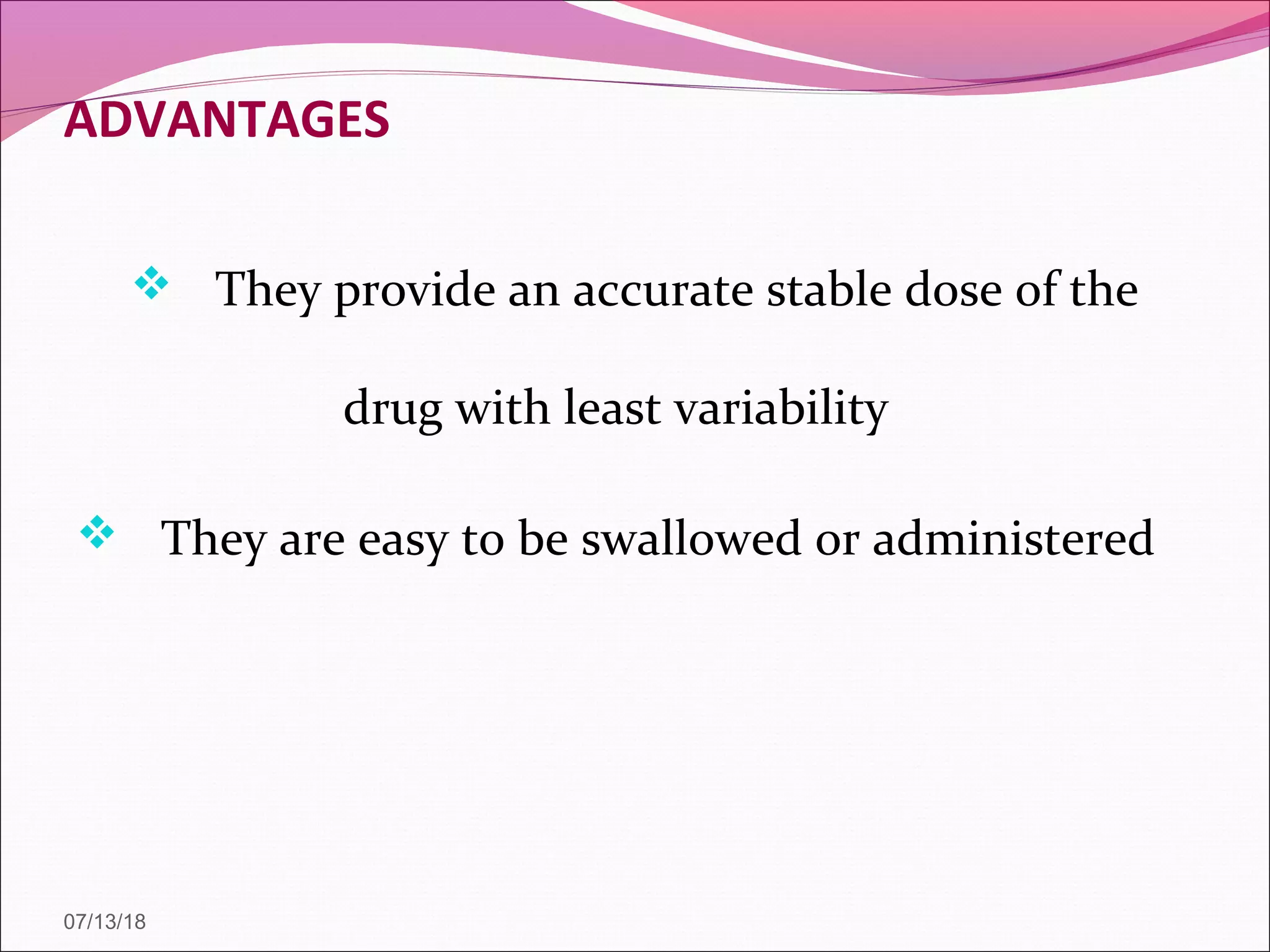
ADVANTAGES
 They provide an accurate stable dose of the
drug with least variability
 They are easy to be swallowed or administered
07/13/18
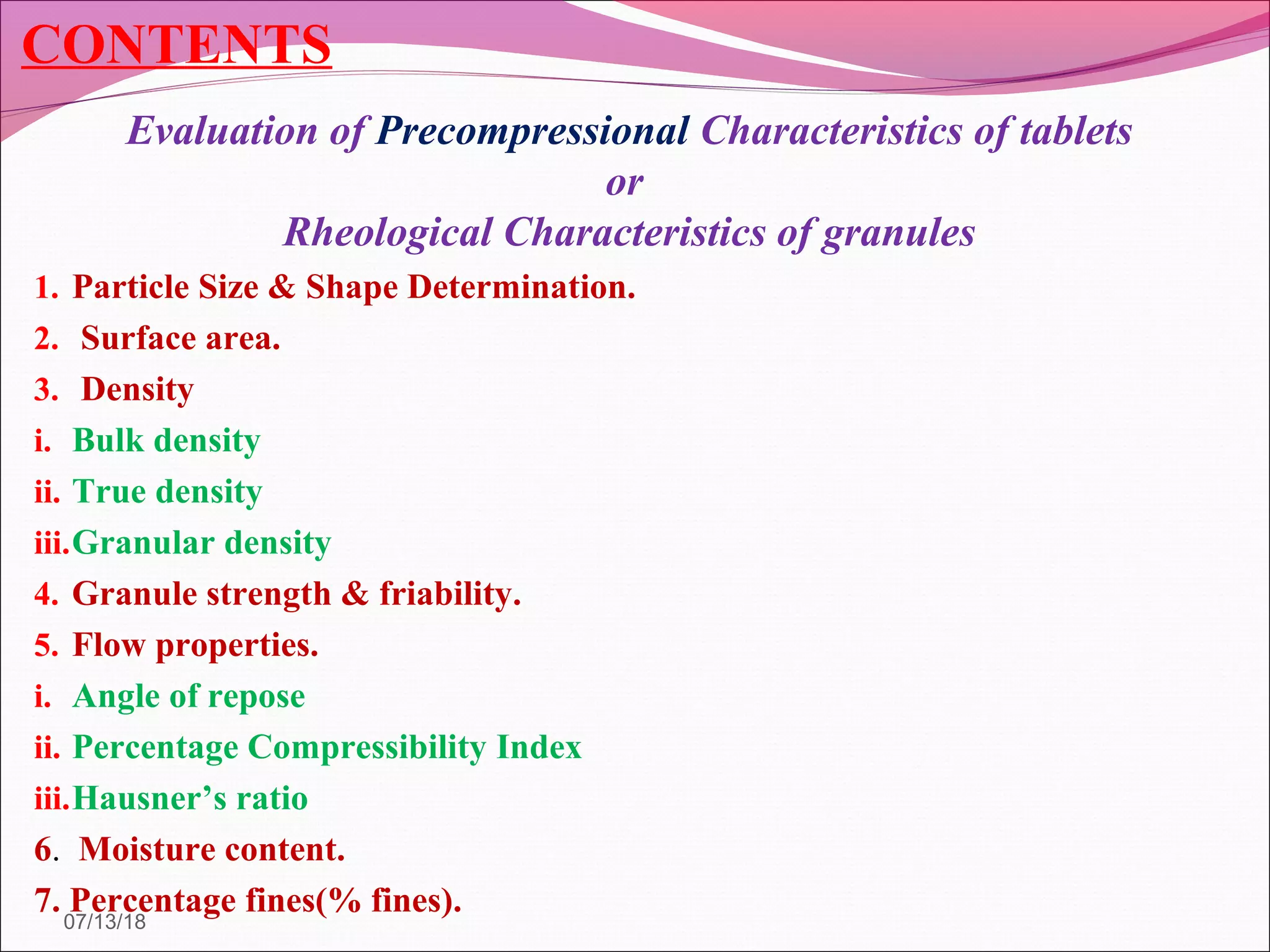
CONTENTS
Evaluation of Precompressional Characteristics of tablets
or
Rheological Characteristics of granules
1. Particle Size & Shape Determination.
2. Surface area.
3. Density
i. Bulk density
ii. True density
iii.Granular density
4. Granule strength & friability.
5. Flow properties.
i. Angle of repose
ii. Percentage Compressibility Index
iii.Hausner’s ratio
6. Moisture content.
7. Percentage fines(% fines).07/13/18
Evaluation of Compressional Characteristics of tablets
1. General Appearance
2. Size & Shape
3. Unique identification marking
4. Organoleptic properties
5. Hardness test
6. Friability.
7. Thickness test
8. Weight variation.
9. Disintegration test.
10.Drug Content Uniformity
11.Dissolution test.
07/13/18
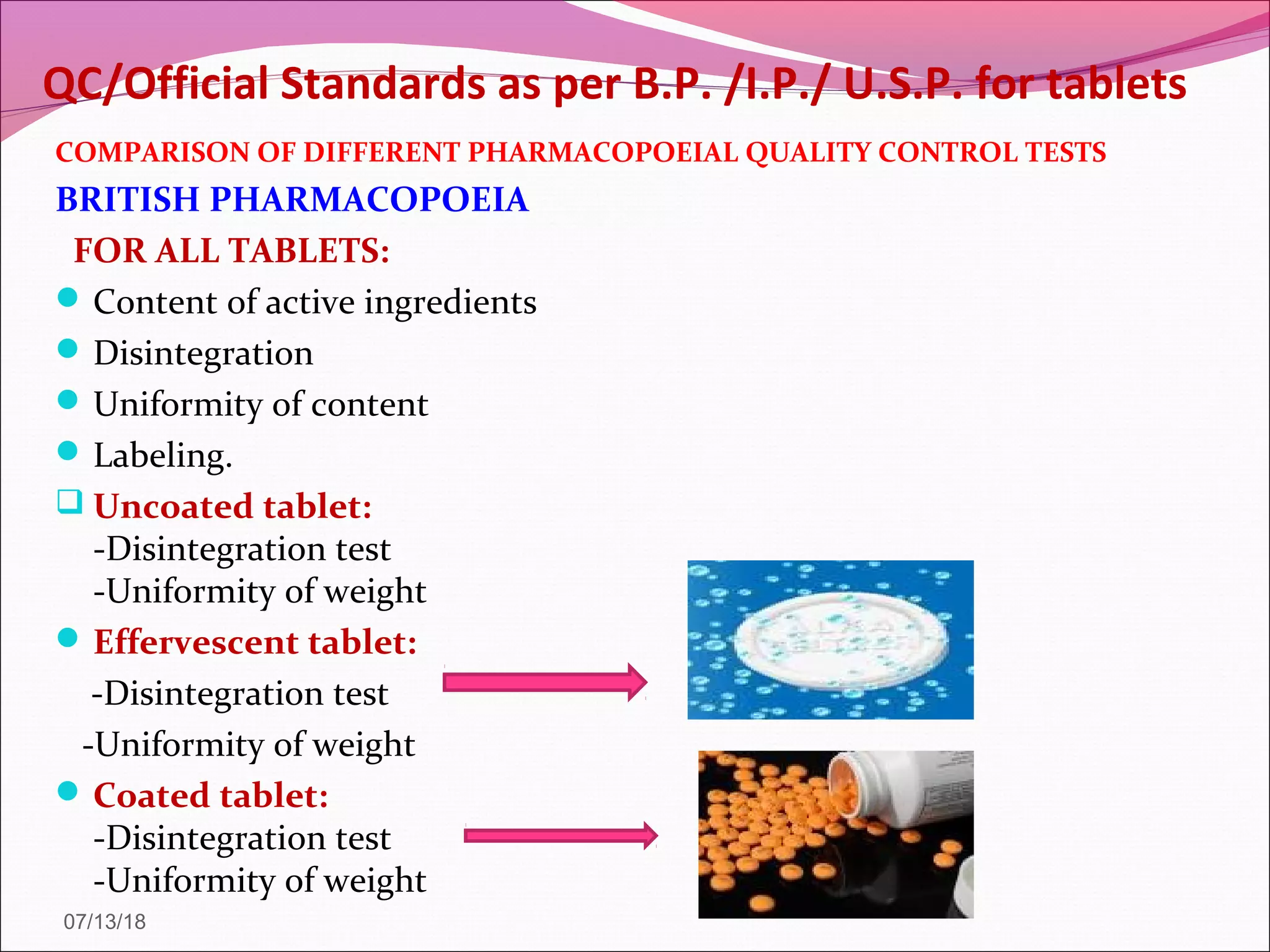
QC/Official Standards as per B.P. /I.P./ U.S.P. for tablets
COMPARISON OF DIFFERENT PHARMACOPOEIAL QUALITY CONTROL TESTS
BRITISH PHARMACOPOEIA
FOR ALL TABLETS:
Content of active ingredients
Disintegration
Uniformity of content
Labeling.
 Uncoated tablet:
-Disintegration test
-Uniformity of weight
Effervescent tablet:
-Disintegration test
-Uniformity of weight
Coated tablet:
-Disintegration test
-Uniformity of weight
07/13/18
Gastro resistant tablet:
-Disintegration test
Modified release tablet:
-Uniformity of weight.
Dispersible tablet:
-Disintegration test
-Uniformity of dispersion
-Uniformity of weight
07/13/18
INDIAN & BRITISH PHARMACOPOEIA
Uncoated tablet:
-Uniformity of container content
-Content of active ingredient
-Uniformity of weight
-Uniformity of content
-Disintegration test
Enteric coated tablet:
-Disintegration test
Dispersible tablet:
-Uniformity of dispersion
-Disintegration
Soluble tablet:
-Disintegration test
Effervescent tablet:
-Disintegration/ Dissolution / Dispersion test.07/13/18
UNITED STATES PHARMACOPOEIA
Physical tests applicable to tablet formulation:
-Bulk density / Tapped density of powder
-Powder fineness
-Loss on drying
-Disintegration test
-Tablet friability
-Dissolution test
-Drug release testing
-Uniformity of dosage form
-Container permeation test
-Labeling of inactive ingredients
07/13/18
Official and unofficial tests for evaluation of tablets
 Official Tests:
1. Weight variation
2. Disintegration
3. Dissolution
4. Drug content /Assay
 Non-Official Tests:
1. Hardness
2. friability
Evaluation of TabletEvaluation of Tablet
07/13/18
07/13/18
1. The tablet should include the correct dose of the drug(Weight
uniformity and content uniformity test)
2. The drug should be released from the tablet in a controlled and
reproducible way (Dissolution test)
3. The tablet should show sufficient mechanical strength to withstand
fracture and erosion during manufacturing and handling(Hardness and
friability test)
4. The appearance of the tablet should be elegant and its weight, size
and appearance should be consistent(Visual observation, weight
variation, thickness and diameter of the tablet)
5. The tablet should be packed in a safe manner.
1.1.General Appearance:General Appearance:
The general appearance of a tablet, its identity and general elegance is
essential for consumer acceptance, for control of lot-to-lot uniformity and tablet-
to-tablet uniformity. The control of general appearance involves the
measurement of size, shape, color, presence or absence of odor, taste etc.
2.2.Size & Shape:Size & Shape:
It can be dimensionally described & controlled. The thickness of a tablet is
only variables. Tablet thickness can be measured by micrometer or by other
device. Tablet thickness should be controlled within a ± 5 % variation of
standard value.
07/13/18
3.3. Unique identification marking:Unique identification marking:
These marking utilize some form of embossing, engraving or printing. These
markings include company name or symbol, product code, product name
etc.
4.4. Organoleptic properties:Organoleptic properties:
Color distribution must be uniform with no mottling. For visual color
comparison compare the color of sample against standard color.
5.5. Hardness :Hardness :
Tablet requires a certain amount of strength or hardness and resistance to
friability to withstand mechanical shocks of handling in manufacture, packaging
and shipping. Hardness generally measures the tablet crushing strength.
07/13/18
Hardness (crushing strength):
It is the load required to crush the tablet when placed on its edge.
Why do we measure hardness?
 To determine the need for pressure adjustments on the tableting machine.
 Hardness can affect the disintegration.
 So if the tablet is too hard, it may not disintegrate in the required period of
time. And if the tablet is too soft, it will not withstand the handling during
subsequent processing such as coating or packaging.
 In general, if the tablet hardness is too high, we first check its disintegration
before rejecting the batch.
 If the disintegration is within limit, we accept the batch.
 If Hardness is high + disintegration is within a time accept the batch.
Factors Affecting the Hardness:
• Compression of the tablet and compressive force.
• Amount of binder. (More binder à more hardness)
• Method of granulation in preparing the tablet (wet method gives more hardness
than direct method, Slugging method gives the best hardness).
Limits: 5 kilograms minimum and 8 kilograms maximum.
Make hardness test on 5 tablets and then take the average hardness.
07/13/18
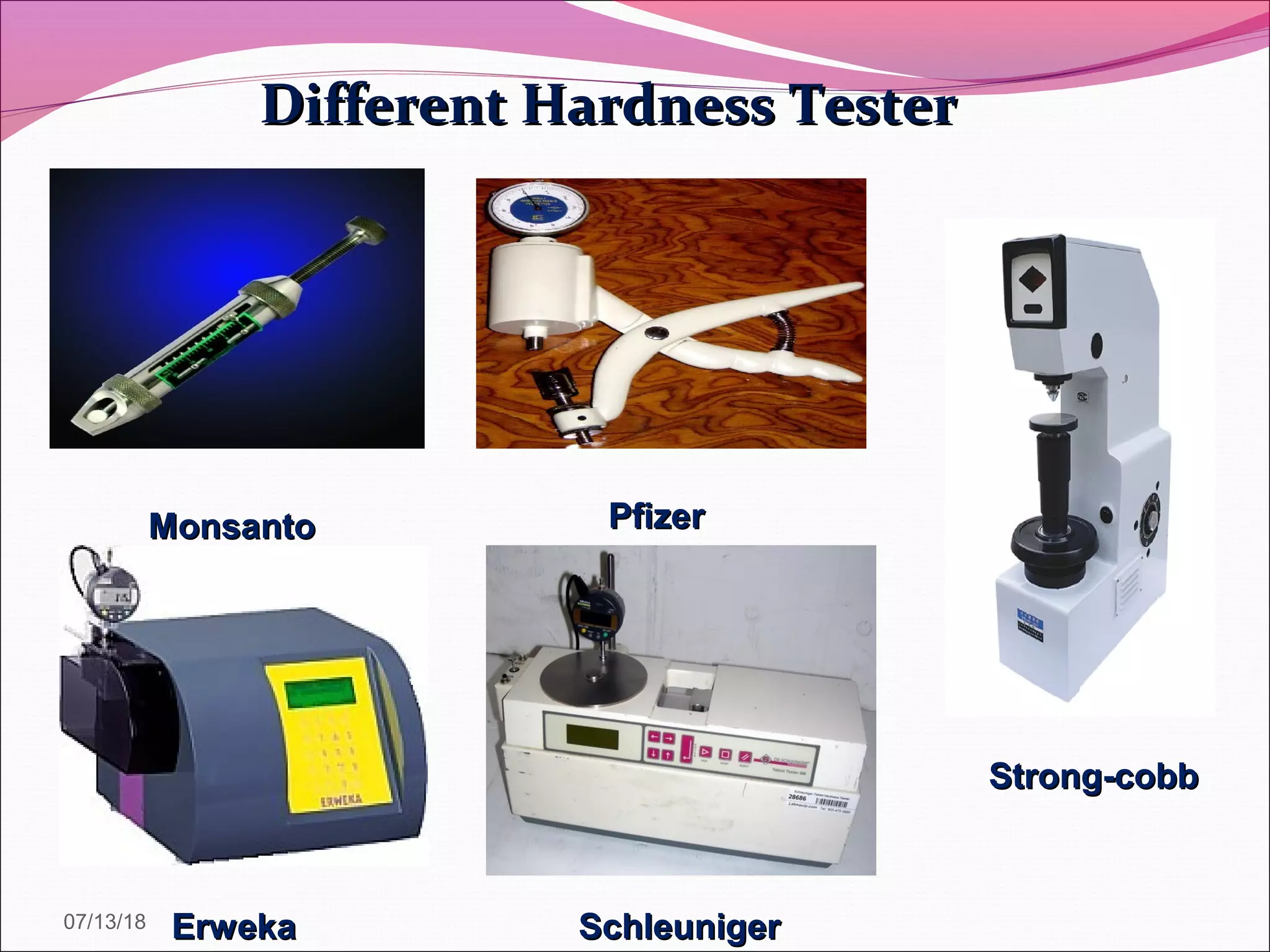
Different Hardness TesterDifferent Hardness Tester
ErwekaErweka
PfizerPfizer
SchleunigerSchleuniger
MonsantoMonsanto
Strong-cobbStrong-cobb
07/13/18
6.Friability:6.Friability:
Friability of a tablet can determine in laboratory by Roche friabilator. This
consist of a plastic chamber that revolves at 25 rpm, dropping the tablets
through a Distance of six inches in the friabilator, which is then operate for
100 revolutions. The tablets are reweighed. Compress tablet that lose less
than 0.5 to 1.0 % of the Tablet weigh are consider acceptable.
07/13/18
It is the tendency of tablets to powder, chip, or fragment and this can affect the
elegance appearance, consumer acceptance of the tablet, and also add to
tablet’s weight variation or content uniformity problems.
Friability is a property that is related to the hardness of the tablet.
An instrument called Rouch friabilator is used to evaluate the ability of the
tablet to withstand abrasion in packaging, handling, and shipping.
Procedure:
1. Weigh 20 tablets together = W1
2. Put these tablets in the friabilator and adjust the instrument at 100 rpm (i.e. =
25 rpm for 4 min)
3. Weigh the 20 tablets (only the intact ones) = W2
Friability (% loss) = W1 - W2/100
It must be less than or equal to1 % but if more we do not reject the tablets as
this test is non-official.
07/13/18
7. Thickness test
Thickness is an unofficial test .
Thickness of the tablet is inversely proportional to hardness i.e.
increase in hardness decrease the thickness & vice versa.
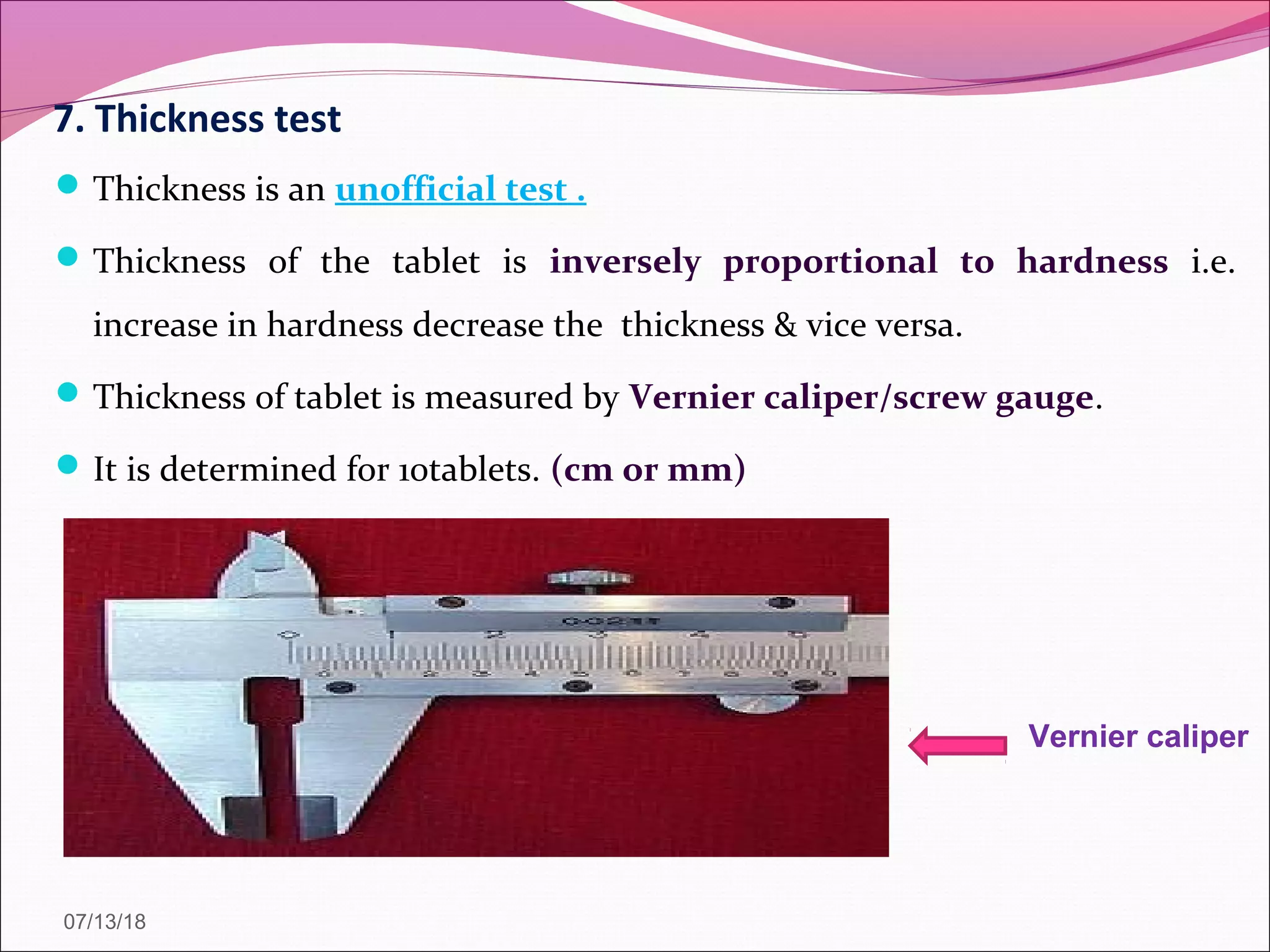
Thickness of tablet is measured by Vernier caliper/screw gauge.
It is determined for 10tablets. (cm or mm)
Vernier caliper
07/13/18
8.Weight variation test (uniformity of weight)
Weigh 20 tablet selected at random, each one individually . X1, X2,
X3… Xz
Determine the average weight. X= (X1+X2 +X3+…+ Xz)/20
Limit:
Upper limit = average weight + (average weight * % error)
Lower limit = average weight - (average weight * % error)
The individual weights are compared with the upper and lower
limits.
Not more than two of the tablets differ from the average
weight by more than the % error listed, and no tablet differs by
more than double that percentage.
07/13/18
UNIFORMITY OF WEIGHT
It is performed to check whether the manufactured tablets have an
uniform weight or not.
This test is performed for uncoated and film-coated tablets
METHOD:
Take 20 tablets
Weigh individually
Determine the average weight of 20 tablets
Compare the individual tablet weight to average weight
26
Sr.
No
Average wt. of tablet(mg) Max. % difference
allowed
1 130 or Less 10%
2 130-324 7.5%
3 More than 324 5%
WEIGHT VARIATION TOLERANCES FOR UNCOATED TABLETS
USP-NF standards
IP & BP standards
Sr.
No
Average wt. of tablet(mg) Max. % difference
allowed
1 84 or Less 10%
2 84- 250 7.5%
3 More than 250 5%
07/13/18
9.UNIFORMITY OF CONTENT
The test for uniformity of content is based on the assay of
the individual contents of active substance(s) to determine
whether the individual contents are within limits set with
reference to the average content of the sample.
METHOD
30 tablets are kept aside.
10 tablets are assayed.
9 tablets should have % limit of 85-115%
if more than 1 tablet has 85-115%
then,
20 tablets are assayed
not more than one tablet should have 75-125%.
28
10. Disintegration test (U.S.P.) :
Disintegration test is an official test.
It is the time required for the tablet to break into particles, the disintegration test
is a measure only of the time required under a given set of conditions for a group
of tablets to disintegrate into particles
It is performed to identify the disintegration of tablet in particular time period.
Disintegration test is not performed for controlled & sustained release tablets.
07/13/18
DISINTEGRATION TEST
For most tablets, the first important step towards formation of
solution is breakdown of the tablets in to smaller particles or
granules, the process is know as disintegration.
APPARATUS:
6 glass tubes- 3inch length
10 mesh screen at the bottom
Temperature: 37±2°C
Speed :28-32 rpm
30
Floating of the tablets can be prevented by placing perforated plastic discs on
each tablet. tablet remain 2.5 cm below the surface of liquid on their upward
movement and not closer than 2.5 cm from the bottom of the beaker in their
downward movement.
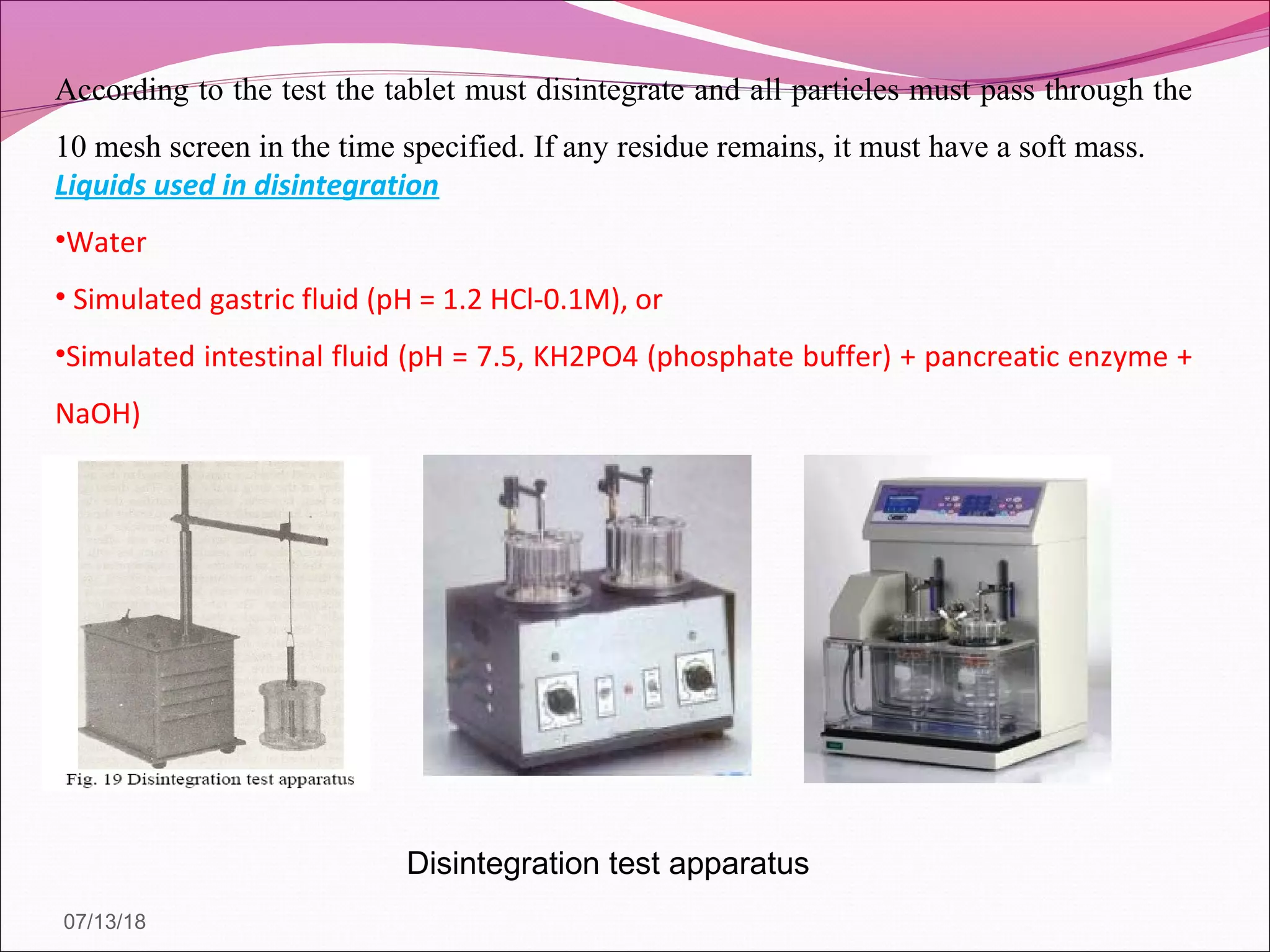
According to the test the tablet must disintegrate and all particles must pass through the
10 mesh screen in the time specified. If any residue remains, it must have a soft mass.
Liquids used in disintegration
•Water
• Simulated gastric fluid (pH = 1.2 HCl-0.1M), or
•Simulated intestinal fluid (pH = 7.5, KH2PO4 (phosphate buffer) + pancreatic enzyme +
NaOH)
Disintegration test apparatus
07/13/18
ACCEPTANCE CRITERIA:
The tablets pass the test if all of them have disintegrated.
If (6tablets)1 or 2 tablets fail to disintegrate, repeat the
test on 12 additional tablets; not less than 16 of the total
of 18 tablets tested disintegrate.
If the tablets adhere to the disc, repeat the test omitting
the disc.
32
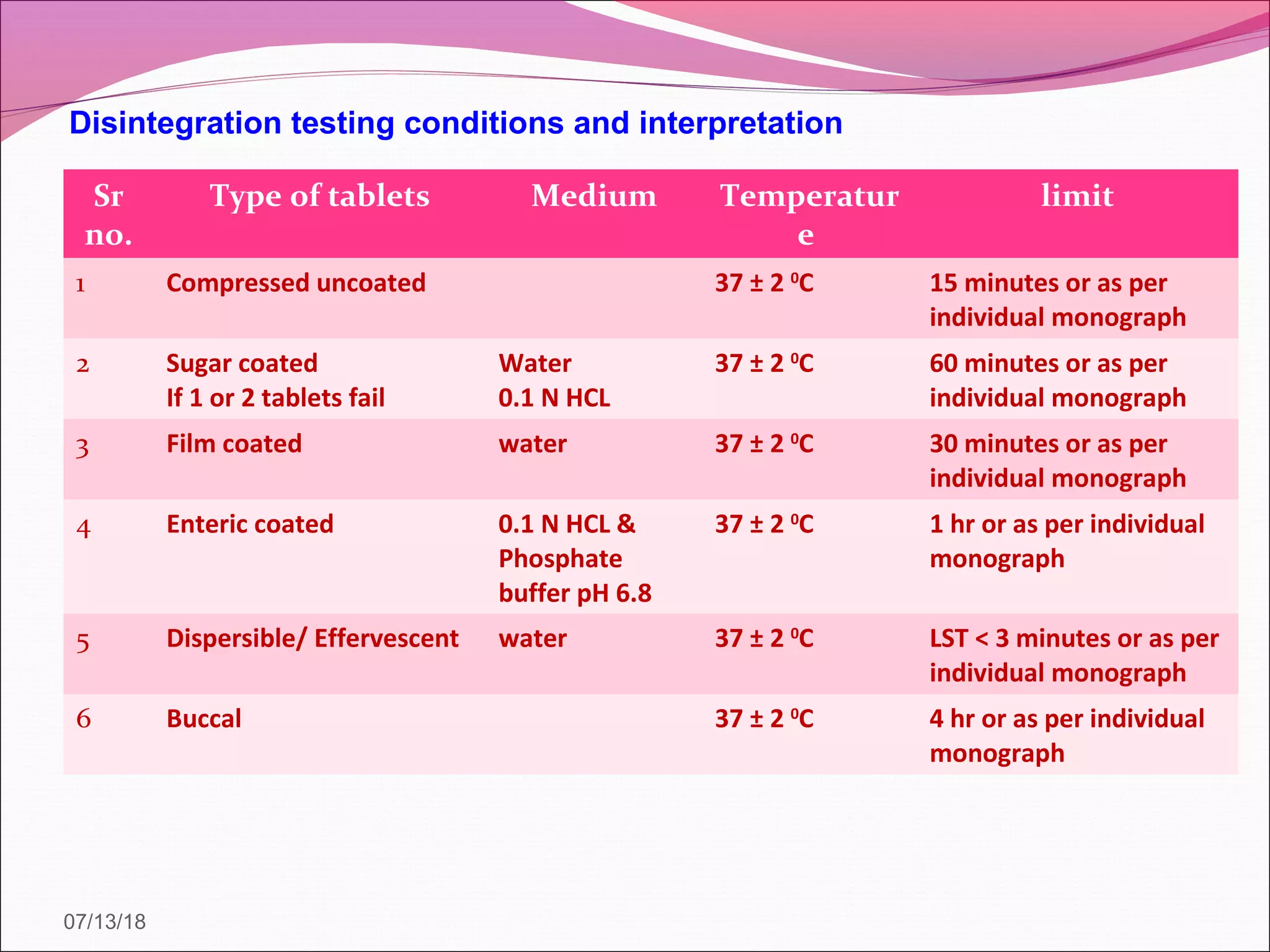
Sr
no.
Type of tablets Medium Temperatur
e
limit
1 Compressed uncoated 37 ± 2 0
C 15 minutes or as per
individual monograph
2 Sugar coated
If 1 or 2 tablets fail
Water
0.1 N HCL
37 ± 2 0
C 60 minutes or as per
individual monograph
3 Film coated water 37 ± 2 0
C 30 minutes or as per
individual monograph
4 Enteric coated 0.1 N HCL &
Phosphate
buffer pH 6.8
37 ± 2 0
C 1 hr or as per individual
monograph
5 Dispersible/ Effervescent water 37 ± 2 0
C LST < 3 minutes or as per
individual monograph
6 Buccal 37 ± 2 0
C 4 hr or as per individual
monograph
Disintegration testing conditions and interpretation
07/13/18
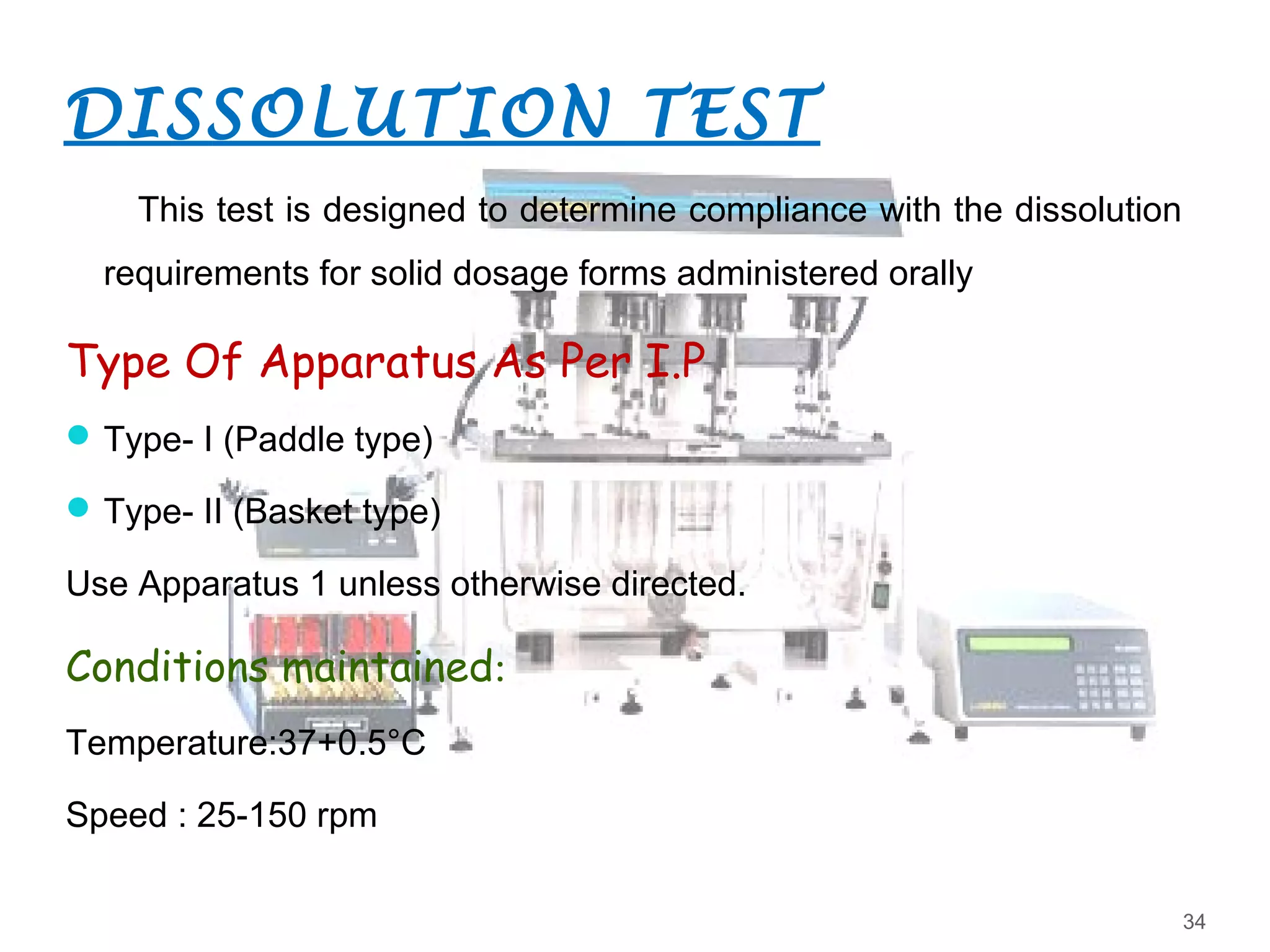
DISSOLUTION TEST
This test is designed to determine compliance with the dissolution
requirements for solid dosage forms administered orally
Type Of Apparatus As Per I.P
Type- I (Paddle type)
Type- II (Basket type)
Use Apparatus 1 unless otherwise directed.
Conditions maintained:
Temperature:37+0.5°C
Speed : 25-150 rpm
34
11. Dissolution Test11. Dissolution Test
Dissolution is an official test.
Dissolution is performed to check the percentage release from the dosage forms.i.e.tablet.
Tablet breaks down into small particles which offers a greater surface area to the
dissolving media.
Disintegration test does not give assurance that particles will release drug in solution at an
appropriate rate, that’s why dissolution tests & it’s specifications developed for all tablet
products.
1. USP Dissolution apparatus I ( Basket method)1. USP Dissolution apparatus I ( Basket method)
A single tablet is placed in a small wire mesh basket attached to the bottom of
the shaft connected to a variable speed motor. The basket is immersed in a
dissolution medium (as specified in monograph) contained in a 1000 ml flask. The
flask is cylindrical with a hemispherical bottom. The flask is maintained at 37 ± 0.50
C
by a constant temperature bath. The motor is adjusted to turn at the specified speed
and sample of the fluid are withdrawn at intervals to determine the amount of drug
07/13/18
2. USP Dissolution apparatus II ( Paddle method)2. USP Dissolution apparatus II ( Paddle method)
It is same as apparatus-1, except the basket is replaced by a paddle. The dosage form is
allowed to sink to the bottom of the flask before stirring. For dissolution test U.S.P.
specifies the dissolution test medium and volume, type of apparatus to be used, rpm
of the shaft, time limit of the test and assay procedure for. The test tolerance is
expressed as a % of the labeled amount of drug dissolved in the time limit.
07/13/18
07/13/18
Amount present = conc x DF X 900 / 1000
D or %DRUG ABSORBED or RELEASE = AMOUNT PRESENT / LC X 100
Sr.
no.
Quantity
Stage/level
Number of
tablets tested
Acceptance criteria
1 S1 6 Each unit is not < D + 5 percent
2 S2 6 Average of 12 units (S1 +S2) is equal to
or greater than (> )D, and no unit is less
than D - 15 percent
3 S3 12 Average of 24 units (S1+S2+S3) is equal
to or greater than (> )D, not more
than 2 units are less than d-15 percent
and no unit is less than d-25 percent
Dissolution testing and interpretation IP standards
07/13/18
Various instruments of Dissolution test apparatus
07/13/18
07/13/18
BIBILOGRAPHY
1. Leon Lachman, The theory and practice of Industrial pharmacy,3rd
edition,
Varghese publishing house, page no.67-68,77-78,315-317,296-303.
2. Indian Pharmacopoeia-2010,Govt.Of India ministry of health & family
welfare,6th
edition, page no.187-198.
07/13/18

Qc tets for tablets final

  • 1.
    QC TESTS FORTABLETS G.PAVANI, Y17MPHPA426, I/II M.PHARMACY, Dept. of Pharm. Analysis, CLPT 07/13/18
  • 2.
    What is adrug? “A Chemical Substance that Interacts with a Living System and Produces a Biological Response”
  • 3.
    Dosage Forms  Dosageforms are the carriers through which drug molecules are delivered to sites of action within the body.  Every dosage forms is a combination of the drug and different kinds of non – drug components called as Excipients or additives.  The additives are used to give a, particular shape to the formulation and to increase stability, palatability & elegance to preparations. 07/13/18
  • 4.
    Need For DosageForms  Accurate dose.  Protection against environmental (coated tablets, sealed ampoules).  Protection from gastric juice, e.g. enteric coated tablets.  Masking unpleasant taste and odor.  Introduce through blood stream.  Sustained release medication.  Facilation of Insertion of drugs into body cavities (rectal, vaginal).  Provide optimum drug action through inhalation .  Provide drug action through topical administration at local area of body. e.g. creams, ointment, emulsion, lotions etc.07/13/18
  • 5.
    What Do YouMean By “QC”…?  QC is concerned with providing accurate , specific, & definite descriptions of the procedures to be employed, from, the receipt of raw materials to the release of the finished dosage forms. “INSPECTION” “TESTING” 07/13/18
  • 6.
    CLASSIFICATION Solid dosage forms Unit dosage forms Tablets Capsule Powders Pills Bulk Internal Finepowders & granules External Dusting powders Insufflations Dentifrice Snuffs Ear powders Liquid dosage forms Biphasic Emulsion Suspension Monophasic Internal External Syrups Elixirs Linctus Drops Parenterals Liniments Lotions Gargles Throat paints Mouth washes Sprays Eye lotions Eye drops Nasal drops Semi solid dosage forms Internal External Suppositories Pessaries Ointment Creams pastes Jellies 07/13/18
  • 7.
    Solid dosage forms TabletsPills Dusting Powders Capsules Granules 07/13/18
  • 8.
    Tablets These are soliddosage forms of medicaments which are prepared by moulding or by compression with or without Excipients. The tablets can be prepared by two methods namely as a I) Dry granulation, II) Wet Granulation 07/13/18
  • 9.
    ADVANTAGES  They providean accurate stable dose of the drug with least variability  They are easy to be swallowed or administered 07/13/18
  • 10.
    CONTENTS Evaluation of PrecompressionalCharacteristics of tablets or Rheological Characteristics of granules 1. Particle Size & Shape Determination. 2. Surface area. 3. Density i. Bulk density ii. True density iii.Granular density 4. Granule strength & friability. 5. Flow properties. i. Angle of repose ii. Percentage Compressibility Index iii.Hausner’s ratio 6. Moisture content. 7. Percentage fines(% fines).07/13/18
  • 11.
    Evaluation of CompressionalCharacteristics of tablets 1. General Appearance 2. Size & Shape 3. Unique identification marking 4. Organoleptic properties 5. Hardness test 6. Friability. 7. Thickness test 8. Weight variation. 9. Disintegration test. 10.Drug Content Uniformity 11.Dissolution test. 07/13/18
  • 12.
    QC/Official Standards asper B.P. /I.P./ U.S.P. for tablets COMPARISON OF DIFFERENT PHARMACOPOEIAL QUALITY CONTROL TESTS BRITISH PHARMACOPOEIA FOR ALL TABLETS: Content of active ingredients Disintegration Uniformity of content Labeling.  Uncoated tablet: -Disintegration test -Uniformity of weight Effervescent tablet: -Disintegration test -Uniformity of weight Coated tablet: -Disintegration test -Uniformity of weight 07/13/18
  • 13.
    Gastro resistant tablet: -Disintegrationtest Modified release tablet: -Uniformity of weight. Dispersible tablet: -Disintegration test -Uniformity of dispersion -Uniformity of weight 07/13/18
  • 14.
    INDIAN & BRITISHPHARMACOPOEIA Uncoated tablet: -Uniformity of container content -Content of active ingredient -Uniformity of weight -Uniformity of content -Disintegration test Enteric coated tablet: -Disintegration test Dispersible tablet: -Uniformity of dispersion -Disintegration Soluble tablet: -Disintegration test Effervescent tablet: -Disintegration/ Dissolution / Dispersion test.07/13/18
  • 15.
    UNITED STATES PHARMACOPOEIA Physicaltests applicable to tablet formulation: -Bulk density / Tapped density of powder -Powder fineness -Loss on drying -Disintegration test -Tablet friability -Dissolution test -Drug release testing -Uniformity of dosage form -Container permeation test -Labeling of inactive ingredients 07/13/18
  • 16.
    Official and unofficialtests for evaluation of tablets  Official Tests: 1. Weight variation 2. Disintegration 3. Dissolution 4. Drug content /Assay  Non-Official Tests: 1. Hardness 2. friability Evaluation of TabletEvaluation of Tablet 07/13/18
  • 17.
    07/13/18 1. The tabletshould include the correct dose of the drug(Weight uniformity and content uniformity test) 2. The drug should be released from the tablet in a controlled and reproducible way (Dissolution test) 3. The tablet should show sufficient mechanical strength to withstand fracture and erosion during manufacturing and handling(Hardness and friability test) 4. The appearance of the tablet should be elegant and its weight, size and appearance should be consistent(Visual observation, weight variation, thickness and diameter of the tablet) 5. The tablet should be packed in a safe manner.
  • 18.
    1.1.General Appearance:General Appearance: Thegeneral appearance of a tablet, its identity and general elegance is essential for consumer acceptance, for control of lot-to-lot uniformity and tablet- to-tablet uniformity. The control of general appearance involves the measurement of size, shape, color, presence or absence of odor, taste etc. 2.2.Size & Shape:Size & Shape: It can be dimensionally described & controlled. The thickness of a tablet is only variables. Tablet thickness can be measured by micrometer or by other device. Tablet thickness should be controlled within a ± 5 % variation of standard value. 07/13/18
  • 19.
    3.3. Unique identificationmarking:Unique identification marking: These marking utilize some form of embossing, engraving or printing. These markings include company name or symbol, product code, product name etc. 4.4. Organoleptic properties:Organoleptic properties: Color distribution must be uniform with no mottling. For visual color comparison compare the color of sample against standard color. 5.5. Hardness :Hardness : Tablet requires a certain amount of strength or hardness and resistance to friability to withstand mechanical shocks of handling in manufacture, packaging and shipping. Hardness generally measures the tablet crushing strength. 07/13/18
  • 20.
    Hardness (crushing strength): Itis the load required to crush the tablet when placed on its edge. Why do we measure hardness?  To determine the need for pressure adjustments on the tableting machine.  Hardness can affect the disintegration.  So if the tablet is too hard, it may not disintegrate in the required period of time. And if the tablet is too soft, it will not withstand the handling during subsequent processing such as coating or packaging.  In general, if the tablet hardness is too high, we first check its disintegration before rejecting the batch.  If the disintegration is within limit, we accept the batch.  If Hardness is high + disintegration is within a time accept the batch. Factors Affecting the Hardness: • Compression of the tablet and compressive force. • Amount of binder. (More binder à more hardness) • Method of granulation in preparing the tablet (wet method gives more hardness than direct method, Slugging method gives the best hardness). Limits: 5 kilograms minimum and 8 kilograms maximum. Make hardness test on 5 tablets and then take the average hardness. 07/13/18
  • 21.
    Different Hardness TesterDifferentHardness Tester ErwekaErweka PfizerPfizer SchleunigerSchleuniger MonsantoMonsanto Strong-cobbStrong-cobb 07/13/18
  • 22.
    6.Friability:6.Friability: Friability of atablet can determine in laboratory by Roche friabilator. This consist of a plastic chamber that revolves at 25 rpm, dropping the tablets through a Distance of six inches in the friabilator, which is then operate for 100 revolutions. The tablets are reweighed. Compress tablet that lose less than 0.5 to 1.0 % of the Tablet weigh are consider acceptable. 07/13/18
  • 23.
    It is thetendency of tablets to powder, chip, or fragment and this can affect the elegance appearance, consumer acceptance of the tablet, and also add to tablet’s weight variation or content uniformity problems. Friability is a property that is related to the hardness of the tablet. An instrument called Rouch friabilator is used to evaluate the ability of the tablet to withstand abrasion in packaging, handling, and shipping. Procedure: 1. Weigh 20 tablets together = W1 2. Put these tablets in the friabilator and adjust the instrument at 100 rpm (i.e. = 25 rpm for 4 min) 3. Weigh the 20 tablets (only the intact ones) = W2 Friability (% loss) = W1 - W2/100 It must be less than or equal to1 % but if more we do not reject the tablets as this test is non-official. 07/13/18
  • 24.
    7. Thickness test Thicknessis an unofficial test . Thickness of the tablet is inversely proportional to hardness i.e. increase in hardness decrease the thickness & vice versa. Thickness of tablet is measured by Vernier caliper/screw gauge. It is determined for 10tablets. (cm or mm) Vernier caliper 07/13/18
  • 25.
    8.Weight variation test(uniformity of weight) Weigh 20 tablet selected at random, each one individually . X1, X2, X3… Xz Determine the average weight. X= (X1+X2 +X3+…+ Xz)/20 Limit: Upper limit = average weight + (average weight * % error) Lower limit = average weight - (average weight * % error) The individual weights are compared with the upper and lower limits. Not more than two of the tablets differ from the average weight by more than the % error listed, and no tablet differs by more than double that percentage. 07/13/18
  • 26.
    UNIFORMITY OF WEIGHT Itis performed to check whether the manufactured tablets have an uniform weight or not. This test is performed for uncoated and film-coated tablets METHOD: Take 20 tablets Weigh individually Determine the average weight of 20 tablets Compare the individual tablet weight to average weight 26
  • 27.
    Sr. No Average wt. oftablet(mg) Max. % difference allowed 1 130 or Less 10% 2 130-324 7.5% 3 More than 324 5% WEIGHT VARIATION TOLERANCES FOR UNCOATED TABLETS USP-NF standards IP & BP standards Sr. No Average wt. of tablet(mg) Max. % difference allowed 1 84 or Less 10% 2 84- 250 7.5% 3 More than 250 5% 07/13/18
  • 28.
    9.UNIFORMITY OF CONTENT Thetest for uniformity of content is based on the assay of the individual contents of active substance(s) to determine whether the individual contents are within limits set with reference to the average content of the sample. METHOD 30 tablets are kept aside. 10 tablets are assayed. 9 tablets should have % limit of 85-115% if more than 1 tablet has 85-115% then, 20 tablets are assayed not more than one tablet should have 75-125%. 28
  • 29.
    10. Disintegration test(U.S.P.) : Disintegration test is an official test. It is the time required for the tablet to break into particles, the disintegration test is a measure only of the time required under a given set of conditions for a group of tablets to disintegrate into particles It is performed to identify the disintegration of tablet in particular time period. Disintegration test is not performed for controlled & sustained release tablets. 07/13/18
  • 30.
    DISINTEGRATION TEST For mosttablets, the first important step towards formation of solution is breakdown of the tablets in to smaller particles or granules, the process is know as disintegration. APPARATUS: 6 glass tubes- 3inch length 10 mesh screen at the bottom Temperature: 37±2°C Speed :28-32 rpm 30 Floating of the tablets can be prevented by placing perforated plastic discs on each tablet. tablet remain 2.5 cm below the surface of liquid on their upward movement and not closer than 2.5 cm from the bottom of the beaker in their downward movement.
  • 31.
    According to thetest the tablet must disintegrate and all particles must pass through the 10 mesh screen in the time specified. If any residue remains, it must have a soft mass. Liquids used in disintegration •Water • Simulated gastric fluid (pH = 1.2 HCl-0.1M), or •Simulated intestinal fluid (pH = 7.5, KH2PO4 (phosphate buffer) + pancreatic enzyme + NaOH) Disintegration test apparatus 07/13/18
  • 32.
    ACCEPTANCE CRITERIA: The tabletspass the test if all of them have disintegrated. If (6tablets)1 or 2 tablets fail to disintegrate, repeat the test on 12 additional tablets; not less than 16 of the total of 18 tablets tested disintegrate. If the tablets adhere to the disc, repeat the test omitting the disc. 32
  • 33.
    Sr no. Type of tabletsMedium Temperatur e limit 1 Compressed uncoated 37 ± 2 0 C 15 minutes or as per individual monograph 2 Sugar coated If 1 or 2 tablets fail Water 0.1 N HCL 37 ± 2 0 C 60 minutes or as per individual monograph 3 Film coated water 37 ± 2 0 C 30 minutes or as per individual monograph 4 Enteric coated 0.1 N HCL & Phosphate buffer pH 6.8 37 ± 2 0 C 1 hr or as per individual monograph 5 Dispersible/ Effervescent water 37 ± 2 0 C LST < 3 minutes or as per individual monograph 6 Buccal 37 ± 2 0 C 4 hr or as per individual monograph Disintegration testing conditions and interpretation 07/13/18
  • 34.
    DISSOLUTION TEST This testis designed to determine compliance with the dissolution requirements for solid dosage forms administered orally Type Of Apparatus As Per I.P Type- I (Paddle type) Type- II (Basket type) Use Apparatus 1 unless otherwise directed. Conditions maintained: Temperature:37+0.5°C Speed : 25-150 rpm 34
  • 35.
    11. Dissolution Test11.Dissolution Test Dissolution is an official test. Dissolution is performed to check the percentage release from the dosage forms.i.e.tablet. Tablet breaks down into small particles which offers a greater surface area to the dissolving media. Disintegration test does not give assurance that particles will release drug in solution at an appropriate rate, that’s why dissolution tests & it’s specifications developed for all tablet products. 1. USP Dissolution apparatus I ( Basket method)1. USP Dissolution apparatus I ( Basket method) A single tablet is placed in a small wire mesh basket attached to the bottom of the shaft connected to a variable speed motor. The basket is immersed in a dissolution medium (as specified in monograph) contained in a 1000 ml flask. The flask is cylindrical with a hemispherical bottom. The flask is maintained at 37 ± 0.50 C by a constant temperature bath. The motor is adjusted to turn at the specified speed and sample of the fluid are withdrawn at intervals to determine the amount of drug 07/13/18
  • 36.
    2. USP Dissolutionapparatus II ( Paddle method)2. USP Dissolution apparatus II ( Paddle method) It is same as apparatus-1, except the basket is replaced by a paddle. The dosage form is allowed to sink to the bottom of the flask before stirring. For dissolution test U.S.P. specifies the dissolution test medium and volume, type of apparatus to be used, rpm of the shaft, time limit of the test and assay procedure for. The test tolerance is expressed as a % of the labeled amount of drug dissolved in the time limit. 07/13/18
  • 37.
    07/13/18 Amount present =conc x DF X 900 / 1000 D or %DRUG ABSORBED or RELEASE = AMOUNT PRESENT / LC X 100
  • 38.
    Sr. no. Quantity Stage/level Number of tablets tested Acceptancecriteria 1 S1 6 Each unit is not < D + 5 percent 2 S2 6 Average of 12 units (S1 +S2) is equal to or greater than (> )D, and no unit is less than D - 15 percent 3 S3 12 Average of 24 units (S1+S2+S3) is equal to or greater than (> )D, not more than 2 units are less than d-15 percent and no unit is less than d-25 percent Dissolution testing and interpretation IP standards 07/13/18
  • 39.
    Various instruments ofDissolution test apparatus 07/13/18
  • 40.
  • 41.
    BIBILOGRAPHY 1. Leon Lachman,The theory and practice of Industrial pharmacy,3rd edition, Varghese publishing house, page no.67-68,77-78,315-317,296-303. 2. Indian Pharmacopoeia-2010,Govt.Of India ministry of health & family welfare,6th edition, page no.187-198. 07/13/18