IPQCTEST
INTRODUCTION :
• IPQCstandsfor in processqualitycontrol.
• Thesearechecksthat arecarriedout beforethe
manufacturing processiscompleted.
• In-processmaterials shouldbetested for identity,
strength, quality and purity asappropriate and approved
or rejected by the quality control unit during the
productionprocess.
TESTS :
• Thickness andDiameter
• Weight variation
• Hardness
• Friability
• Drug content
• Disintegration time
• In-vitro dissolution
GENERAL
APPEARANCE :
1.SIZEAND SHAPE: The size and shape of the
tablet canbe dimensionally described monitored
and controlled. It is determined by the tooling
during the compression process.
2.COLORAND ODOUR : Colors used for rapid
identification and consumer acceptance. But it
must be uniform within asingle tablet, from tablet
to tablet and from lot to lot. The presence of an
odor in abatch of tablets could indicate astability
e.g. the characteristic odor of acetic acid in
degrading aspirin tablets .Tasteis important in
consumer acceptance ofchewable tablets
3. THICKNESS : Thickness of individual tablets may
be measured by amicrometer. Tablet thickness
should be controlled within a± 5%variation of a
standard.Thickness must be controlled to facilitate
packaging. It is expressedin mm .
CONTENT
UNIFORMITY TEST:
• Toevaluate atablet potential for efficacy, the
amount of drug per tablet needs to be monitored
from tablet to tablet and batch to batch .
• Determine the individual contents of active
substance(s)of 10tablets taken at random .
• Tablets fail to comply with test if eachindividual
content is between 85 %- 115%of the average
content or if one individual content is outside the
limits of 75percent to 125percent of the average
content.
• If one individual content is outside the limits of
85%- 115%,but within the limits of 75%- 125%,
determine the individual contents of another 20
tablets taken atrandom.
• Thetablet complies with the test if not more than
one of the individual contents of the 30tablets is
outside 85 %- 115%of the average content and
none is outside the limits of 75%- 125%of the
average content.
WEIGHT VARIATION
TEST:
• weighting 20 tablets individually calculating the
average weights and comparing the individual
tablet weights to the average.Thevalue of weight
variation test is expressed in percentage. The
following formulais used .
WeightVariation =(Iw –Aw)/Aw *100%
• Thetablet complies with the test if not more than 2
of the individual massesdeviate from the average
massby more than the percentage deviation .
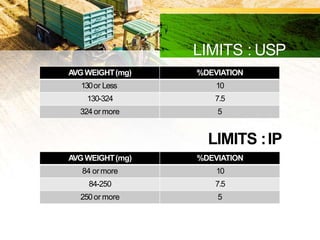
LIMITS : USP
AVGWEIGHT(mg) %DEVIATION
130or Less 10
130-324 7.5
324 or more 5
AVGWEIGHT(mg) %DEVIATION
84 ormore 10
84-250 7.5
250or more 5
LIMITS :IP
HARDNESS :
• Tablet requires acertain amount of strength or
hardnessand resistance to friability to withstand
mechanical shocks of handling in manufacture,
packaging and shipping. Hardness generally
measuresthe tablet crushing strength.
• It is the load required to crushthe tablet when
placed on itsedge.
• It is measured to ;
Todetermine the need for pressure adjustments on the
tableting machine.
Hardnesscanaffect the disintegration. Soif the tablet
is too hard, it may not disintegrate in the required
period of time. And if the tablet is too soft, it will not
withstand the handling during subsequent processing
such ascoating orpackaging.
In general, if the tablet hardnessis too high, we first
check its disintegration before rejecting the batch.
If the disintegration is within limit, we accept the batch.
If Hardness is high +disintegration is within atime
accept thebatch.
1 . FACTORSAFFECTINGHAEDNESS:
• Compression of the tablet and compressiveforce.
• Amount of binder. (More binder àmore hardness)
• Method of granulation in preparing the tablet .
2 . LIMITS : ( Take5tablets and avg out)
Oral tablets 4-10 kg
Chewabletablets 3kg
Sustained releasetablets 10-20 kg
HARDNESS TESTER :
• Monsanto
• Erweka
• Pfizer
• Schleuniger
• Strong-cobb
FRIABILITY :
• It is tendensy of tablets to powder,chip or fragment and
this canaffect the elegance appearance,consumer
acceptance,tablet weight variation or content uniformity
problems .
• Friability of atablet candetermine in laboratory by Roche
friabilator.This consist of aplastic chamber that revolves
at 25rpm, dropping the tablets through aDistance of six
inches in the friabilator, which is then operate for 100
revolutions.The tablets are reweighed.
• Compresstablet that lose lessthan 0.5to 1.0%of the
Tablet weigh are consideracceptable.
• It is determined by the following formula :
Friability =(Iw –Fw)/Iw * 100%
• Somechewable aneeffervescent tablets are highly friable
so required special packaging.
DISINTEGRATION :
• It is time required for the tablet to breck down in
particles .
• Disintegration test is an official test.
• Disintegration test is not performed for controlled
& sustained releasetablets.
• Apparatus consist of 6 glass tubes that are 3inches
long, open at the top, and held against a10-mesh
screen at the bottom end of the basket rack assembly.
• One tablet is placedin each tube and the basket rack is
positioned in specified medium at 37± 2 °C
• A standard motor driven device is used to move the
basket assembly containing the tablets up and down
through distance of 5-6 cm at afrequency of 28-32
cyclesper minute. Perforated plastic disc placedon the
top of tablets and impart an abrasive action to the
tablets andprevent floating of tablets .
• Starts disintegration with 6 tablets .
• If 1or 2 tablets fail to disintegrate completely,
repeat the test on 12additional tablets. The
requirement is met if not less than 16of the total of
18tablets tested aredisintegrated .
LIMITS : USP
Uncoated Not more than15mins
Enteric coated 60 mins
Film coated 30mins
Effervescent Lessthan 5mins
Sublingual 3mins
Dispersible 3mins
DISSOLUTION TEST
• Dissolution is processby which solid enters in a
solution .
• Thedissolution rate is defined asthe amount of
drug substancethat goes into solution per time
under standerdized condition of liquid/solid
interface,tempreture and solvent composition.
• Dissolution test is usedto predict bioavailability
and todetermine bioequivalance .
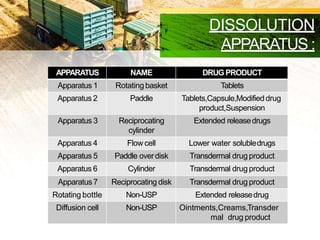
DISSOLUTION
APPARATUS :
APPARATUS NAME DRUGPRODUCT
Apparatus 1 Rotating basket Tablets
Apparatus 2 Paddle Tablets,Capsule,Modifieddrug
product,Suspension
Apparatus 3 Reciprocating
cylinder
Extended releasedrugs
Apparatus 4 Flow cell Lower water solubledrugs
Apparatus 5 Paddle overdisk Transdermal drug product
Apparatus 6 Cylinder Transdermal drug product
Apparatus7 Reciprocating disk Transdermal drug product
Rotating bottle Non-USP Extended releasedrug
Diffusion cell Non-USP Ointments,Creams,Transder
mal drug product
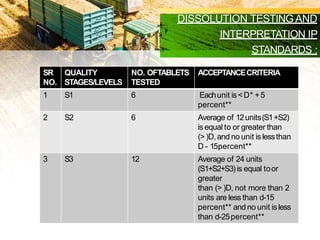
DISSOLUTION TESTINGAND
INTERPRETATION IP
STANDARDS :
SR
NO.
QUALITY
STAGES/LEVELS
NO. OFTABLETS
TESTED
ACCEPTANCECRITERIA
1 S1 6 Eachunit is<D* +5
percent**
2 S2 6 Average of 12units(S1+S2)
is equal to or greater than
(>)D, and no unit islessthan
D - 15percent**
3 S3 12 Average of 24 units
(S1+S2+S3)is equal toor
greater
than (> )D, not more than 2
units are less than d-15
percent** and no unit isless
than d-25percent**
THANK YOU
YOU

IPQC TEST

  • 1.
  • 2.
    INTRODUCTION : • IPQCstandsforin processqualitycontrol. • Thesearechecksthat arecarriedout beforethe manufacturing processiscompleted. • In-processmaterials shouldbetested for identity, strength, quality and purity asappropriate and approved or rejected by the quality control unit during the productionprocess.
  • 3.
    TESTS : • ThicknessandDiameter • Weight variation • Hardness • Friability • Drug content • Disintegration time • In-vitro dissolution
  • 4.
    GENERAL APPEARANCE : 1.SIZEAND SHAPE:The size and shape of the tablet canbe dimensionally described monitored and controlled. It is determined by the tooling during the compression process. 2.COLORAND ODOUR : Colors used for rapid identification and consumer acceptance. But it must be uniform within asingle tablet, from tablet to tablet and from lot to lot. The presence of an odor in abatch of tablets could indicate astability e.g. the characteristic odor of acetic acid in degrading aspirin tablets .Tasteis important in consumer acceptance ofchewable tablets
  • 5.
    3. THICKNESS :Thickness of individual tablets may be measured by amicrometer. Tablet thickness should be controlled within a± 5%variation of a standard.Thickness must be controlled to facilitate packaging. It is expressedin mm .
  • 6.
    CONTENT UNIFORMITY TEST: • Toevaluateatablet potential for efficacy, the amount of drug per tablet needs to be monitored from tablet to tablet and batch to batch . • Determine the individual contents of active substance(s)of 10tablets taken at random . • Tablets fail to comply with test if eachindividual content is between 85 %- 115%of the average content or if one individual content is outside the limits of 75percent to 125percent of the average content.
  • 7.
    • If oneindividual content is outside the limits of 85%- 115%,but within the limits of 75%- 125%, determine the individual contents of another 20 tablets taken atrandom. • Thetablet complies with the test if not more than one of the individual contents of the 30tablets is outside 85 %- 115%of the average content and none is outside the limits of 75%- 125%of the average content.
  • 8.
    WEIGHT VARIATION TEST: • weighting20 tablets individually calculating the average weights and comparing the individual tablet weights to the average.Thevalue of weight variation test is expressed in percentage. The following formulais used . WeightVariation =(Iw –Aw)/Aw *100% • Thetablet complies with the test if not more than 2 of the individual massesdeviate from the average massby more than the percentage deviation .
  • 9.
    LIMITS : USP AVGWEIGHT(mg)%DEVIATION 130or Less 10 130-324 7.5 324 or more 5 AVGWEIGHT(mg) %DEVIATION 84 ormore 10 84-250 7.5 250or more 5 LIMITS :IP
  • 10.
    HARDNESS : • Tabletrequires acertain amount of strength or hardnessand resistance to friability to withstand mechanical shocks of handling in manufacture, packaging and shipping. Hardness generally measuresthe tablet crushing strength. • It is the load required to crushthe tablet when placed on itsedge.
  • 11.
    • It ismeasured to ; Todetermine the need for pressure adjustments on the tableting machine. Hardnesscanaffect the disintegration. Soif the tablet is too hard, it may not disintegrate in the required period of time. And if the tablet is too soft, it will not withstand the handling during subsequent processing such ascoating orpackaging. In general, if the tablet hardnessis too high, we first check its disintegration before rejecting the batch. If the disintegration is within limit, we accept the batch. If Hardness is high +disintegration is within atime accept thebatch.
  • 12.
    1 . FACTORSAFFECTINGHAEDNESS: •Compression of the tablet and compressiveforce. • Amount of binder. (More binder àmore hardness) • Method of granulation in preparing the tablet . 2 . LIMITS : ( Take5tablets and avg out) Oral tablets 4-10 kg Chewabletablets 3kg Sustained releasetablets 10-20 kg
  • 13.
    HARDNESS TESTER : •Monsanto • Erweka • Pfizer • Schleuniger • Strong-cobb
  • 14.
    FRIABILITY : • Itis tendensy of tablets to powder,chip or fragment and this canaffect the elegance appearance,consumer acceptance,tablet weight variation or content uniformity problems . • Friability of atablet candetermine in laboratory by Roche friabilator.This consist of aplastic chamber that revolves at 25rpm, dropping the tablets through aDistance of six inches in the friabilator, which is then operate for 100 revolutions.The tablets are reweighed. • Compresstablet that lose lessthan 0.5to 1.0%of the Tablet weigh are consideracceptable. • It is determined by the following formula : Friability =(Iw –Fw)/Iw * 100% • Somechewable aneeffervescent tablets are highly friable so required special packaging.
  • 15.
    DISINTEGRATION : • Itis time required for the tablet to breck down in particles . • Disintegration test is an official test. • Disintegration test is not performed for controlled & sustained releasetablets.
  • 16.
    • Apparatus consistof 6 glass tubes that are 3inches long, open at the top, and held against a10-mesh screen at the bottom end of the basket rack assembly. • One tablet is placedin each tube and the basket rack is positioned in specified medium at 37± 2 °C • A standard motor driven device is used to move the basket assembly containing the tablets up and down through distance of 5-6 cm at afrequency of 28-32 cyclesper minute. Perforated plastic disc placedon the top of tablets and impart an abrasive action to the tablets andprevent floating of tablets .
  • 17.
    • Starts disintegrationwith 6 tablets . • If 1or 2 tablets fail to disintegrate completely, repeat the test on 12additional tablets. The requirement is met if not less than 16of the total of 18tablets tested aredisintegrated .
  • 18.
    LIMITS : USP UncoatedNot more than15mins Enteric coated 60 mins Film coated 30mins Effervescent Lessthan 5mins Sublingual 3mins Dispersible 3mins
  • 19.
    DISSOLUTION TEST • Dissolutionis processby which solid enters in a solution . • Thedissolution rate is defined asthe amount of drug substancethat goes into solution per time under standerdized condition of liquid/solid interface,tempreture and solvent composition. • Dissolution test is usedto predict bioavailability and todetermine bioequivalance .
  • 20.
    DISSOLUTION APPARATUS : APPARATUS NAMEDRUGPRODUCT Apparatus 1 Rotating basket Tablets Apparatus 2 Paddle Tablets,Capsule,Modifieddrug product,Suspension Apparatus 3 Reciprocating cylinder Extended releasedrugs Apparatus 4 Flow cell Lower water solubledrugs Apparatus 5 Paddle overdisk Transdermal drug product Apparatus 6 Cylinder Transdermal drug product Apparatus7 Reciprocating disk Transdermal drug product Rotating bottle Non-USP Extended releasedrug Diffusion cell Non-USP Ointments,Creams,Transder mal drug product
  • 21.
    DISSOLUTION TESTINGAND INTERPRETATION IP STANDARDS: SR NO. QUALITY STAGES/LEVELS NO. OFTABLETS TESTED ACCEPTANCECRITERIA 1 S1 6 Eachunit is<D* +5 percent** 2 S2 6 Average of 12units(S1+S2) is equal to or greater than (>)D, and no unit islessthan D - 15percent** 3 S3 12 Average of 24 units (S1+S2+S3)is equal toor greater than (> )D, not more than 2 units are less than d-15 percent** and no unit isless than d-25percent**
  • 22.

Editor's Notes

  • #13 1 . FACTORS AFFECTING HAEDNESS : Compression of the tablet and compressive force. Amount of binder. (More binder à more hardness) Method of granulation in preparing the tablet . 2 . LIMITS : ( Take 5 tablets and )