OPERATIONS MANAGEMENT
QUALITY
MANAGEMENT
EVOLUTION
 It was during the time when Japan faced
criticism that its citizens were largely illiterate,
and its products were known to be of low quality.
 By the end of the 1960s, Japan completely flipped
its narrative and became known as one of the
most efficient export countries, with some of the
most admired products. The effective quality
management resulted in better products that
could be produced at a cheaper price.
INTRODUCTION
Quality is the value perceived by the customer.
Quality may be defined as the totality of
features and characteristics of a product or
service that bears on its ability to satisfy the
customer i.e.
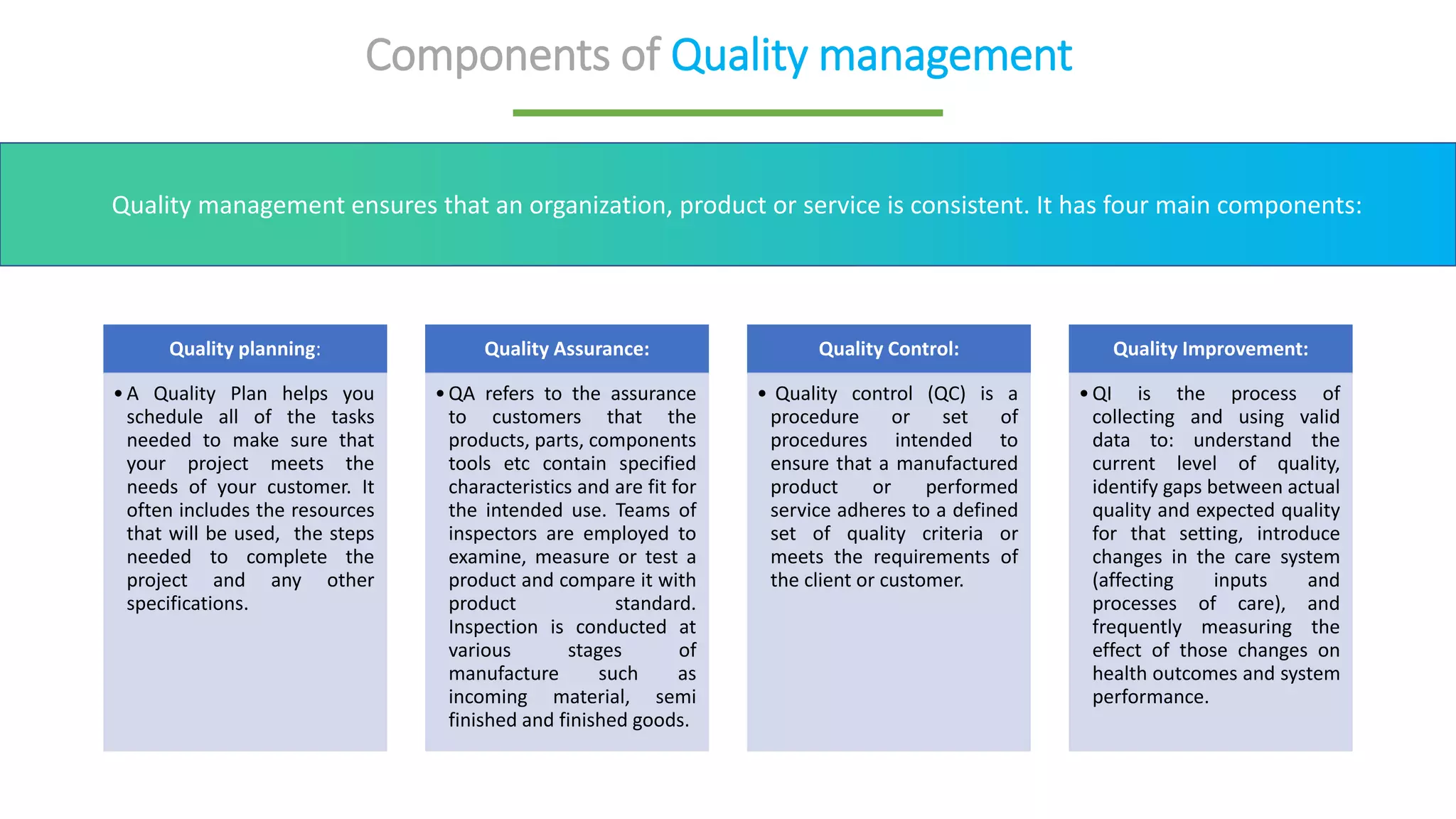
Quality management ensures that an organization, product or service is consistent. It has four main components:
Components of Quality management
Quality planning:
•A Quality Plan helps you
schedule all of the tasks
needed to make sure that
your project meets the
needs of your customer. It
often includes the resources
that will be used, the steps
needed to complete the
project and any other
specifications.
Quality Assurance:
•QA refers to the assurance
to customers that the
products, parts, components
tools etc contain specified
characteristics and are fit for
the intended use. Teams of
inspectors are employed to
examine, measure or test a
product and compare it with
product standard.
Inspection is conducted at
various stages of
manufacture such as
incoming material, semi
finished and finished goods.
Quality Control:
• Quality control (QC) is a
procedure or set of
procedures intended to
ensure that a manufactured
product or performed
service adheres to a defined
set of quality criteria or
meets the requirements of
the client or customer.
Quality Improvement:
•QI is the process of
collecting and using valid
data to: understand the
current level of quality,
identify gaps between actual
quality and expected quality
for that setting, introduce
changes in the care system
(affecting inputs and
processes of care), and
frequently measuring the
effect of those changes on
health outcomes and system
performance.
Statistical Tools used to check Quality
Statistical
Quality
tools
Control
chart
Pareto
chart
Scatter
diagram
Histogram
Check
Sheet
Flow
chart
Ishikawa
diagram
Quality using SERVQUAL
ServQual = service + quality
RATER
Reliability
Assurance
Tangibles
Empathy
Responsiveness
The 5 elements of service quality is RATER
 Reliability-The ability to deliver the promised service in a consistent
and accurate manner
 Assurance- the knowledge level and the politeness of the employees
 Tangibles- the appearance eg: building, website, equipment and
employees
 Empathy- to what extend employees care and give individual
attention
 Responsiveness- how willing the employees are to offer a speedy
service.
Quality standards ISO
The ISO 9000 family of quality management systems standards is designed to help organizations ensure that they
meet the needs of customers and other stakeholders while meeting statutory and regulatory requirements
related to a product or service
iso standard representation
8402 Standardisation of quality vocabulary
9000 Standards of quality management
system
9001 Quality management system for
contractual situation
9002 Model for quality assurance in
production and installation
9003 Quality assurance limited ot final
inspection and test
9004 Guidelines fro developing Quality
management systems
TQM
Stands for total quality management. It can effect every level, procedure and every person in a company
A core definition of total quality management (TQM) describes a management approach to long–term success
through customer satisfaction. In a TQM effort, all members of an organization participate in improving
processes, products, services, and the culture in which they work.
The 8 principles
of TQM:
Customer focus
Involvement of people
Process approach
System approach to management
Continuous improvement
Fact based decision making
Communications
Integrated system
Process Improvement
Plan
• Look at the current resources and conditions
• Look for scope of improvement
• If opportunity of improvement is there, plan the change
Do
• Implement the new process
• Supervise the change
• Test its effectiveness
Check
• Data comparisons between old and new processes
• Review the new process
• Continuous supervision for its long term effectiveness
Act
• Take the final decision after analysis
• if unsuccessful, look for the new process or new method of improvement
• If successful, bring that process into practise
Six Sigma
Analyse:
where and when do
error occur, how to
fix
Define:
define your
product or services
what work you do,
Measure:
identify potential
problematic problem
within a process and
compare an existing
flow chart with an ideal
flow
Improve:
Ensure continuous
improvement through
measurement, analysis
and control: establish
quality, cycle time
measurement and
improvement goals
Control:
how to make the
process stay fixed
OPERATIONS MANAGEMENT
THANK YOU

Quality Management

  • 1.
  • 2.
    EVOLUTION  It wasduring the time when Japan faced criticism that its citizens were largely illiterate, and its products were known to be of low quality.  By the end of the 1960s, Japan completely flipped its narrative and became known as one of the most efficient export countries, with some of the most admired products. The effective quality management resulted in better products that could be produced at a cheaper price. INTRODUCTION Quality is the value perceived by the customer. Quality may be defined as the totality of features and characteristics of a product or service that bears on its ability to satisfy the customer i.e.
  • 3.
    Quality management ensuresthat an organization, product or service is consistent. It has four main components: Components of Quality management Quality planning: •A Quality Plan helps you schedule all of the tasks needed to make sure that your project meets the needs of your customer. It often includes the resources that will be used, the steps needed to complete the project and any other specifications. Quality Assurance: •QA refers to the assurance to customers that the products, parts, components tools etc contain specified characteristics and are fit for the intended use. Teams of inspectors are employed to examine, measure or test a product and compare it with product standard. Inspection is conducted at various stages of manufacture such as incoming material, semi finished and finished goods. Quality Control: • Quality control (QC) is a procedure or set of procedures intended to ensure that a manufactured product or performed service adheres to a defined set of quality criteria or meets the requirements of the client or customer. Quality Improvement: •QI is the process of collecting and using valid data to: understand the current level of quality, identify gaps between actual quality and expected quality for that setting, introduce changes in the care system (affecting inputs and processes of care), and frequently measuring the effect of those changes on health outcomes and system performance.
  • 4.
    Statistical Tools usedto check Quality Statistical Quality tools Control chart Pareto chart Scatter diagram Histogram Check Sheet Flow chart Ishikawa diagram
  • 5.
    Quality using SERVQUAL ServQual= service + quality RATER Reliability Assurance Tangibles Empathy Responsiveness The 5 elements of service quality is RATER  Reliability-The ability to deliver the promised service in a consistent and accurate manner  Assurance- the knowledge level and the politeness of the employees  Tangibles- the appearance eg: building, website, equipment and employees  Empathy- to what extend employees care and give individual attention  Responsiveness- how willing the employees are to offer a speedy service.
  • 6.
    Quality standards ISO TheISO 9000 family of quality management systems standards is designed to help organizations ensure that they meet the needs of customers and other stakeholders while meeting statutory and regulatory requirements related to a product or service iso standard representation 8402 Standardisation of quality vocabulary 9000 Standards of quality management system 9001 Quality management system for contractual situation 9002 Model for quality assurance in production and installation 9003 Quality assurance limited ot final inspection and test 9004 Guidelines fro developing Quality management systems
  • 7.
    TQM Stands for totalquality management. It can effect every level, procedure and every person in a company A core definition of total quality management (TQM) describes a management approach to long–term success through customer satisfaction. In a TQM effort, all members of an organization participate in improving processes, products, services, and the culture in which they work. The 8 principles of TQM: Customer focus Involvement of people Process approach System approach to management Continuous improvement Fact based decision making Communications Integrated system
  • 8.
    Process Improvement Plan • Lookat the current resources and conditions • Look for scope of improvement • If opportunity of improvement is there, plan the change Do • Implement the new process • Supervise the change • Test its effectiveness Check • Data comparisons between old and new processes • Review the new process • Continuous supervision for its long term effectiveness Act • Take the final decision after analysis • if unsuccessful, look for the new process or new method of improvement • If successful, bring that process into practise
  • 9.
    Six Sigma Analyse: where andwhen do error occur, how to fix Define: define your product or services what work you do, Measure: identify potential problematic problem within a process and compare an existing flow chart with an ideal flow Improve: Ensure continuous improvement through measurement, analysis and control: establish quality, cycle time measurement and improvement goals Control: how to make the process stay fixed
  • 10.