Unit 2: Pharmaceutical Quality
Management
Dr. Vijaya Vichare
PES Modern College of Pharmacy (for
ladies), Moshi, Pune
Basics of Quality Management
• “Quality Management “It is a process that
ensures the quality of the product throughout its
life cycle.”
• If you want to make sure you are providing
consistent products or services throughout your
organization, you must implement an ironclad
quality management system, or QMS.
• Quality control management ensures that what
your company delivers and the delivery
processes it uses are cohesive and that every
business phase of the organization focuses on
the same goal.
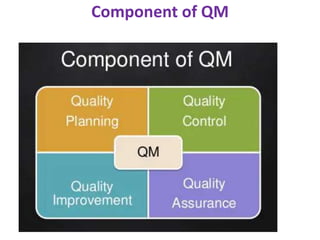
Component of QM
Quality Planning
• The first step of quality management is planning.
• You need to take the time to identify your goals
and what you want your baseline to be.
• You should determine what your quality
standards are, the requirements necessary to
meet these standards, and what procedures will
be used to check that these criteria are being
met.
• In this planning stage, you will want to
consider:
1. What your stakeholder’s expectations and
priorities are, if applicable?
2. What your company’s definition of success is ?
3. What legal standards or requirements are in
place that must be abided by ?
4. Who will handle each role in the quality
management process (supervision, testing,
etc.) ?
5. How often processes will be evaluated for
improvement?
Quality Control
• Quality control is needed to review the quality of
the product or service.
• Inspection and testing is necessary to identify
problems and defects that need correction.
• Quality Control Objectives and functions of QC
1. To establish the desired quality standards which are
acceptable to the customers?
2. To discover flaws or variations in the raw materials
and the manufacturing processes in order to
ensure smooth and uninterrupted production.
3. To evaluate the methods and processes of
production and suggest further improvements
in their functioning.
4. To study and determine the extent of quality
deviation in a product during the manufacturing
process.
5. To analyze in detail the causes responsible for
such deviation.
6. To undertake such steps which are helpful in
achieving the desired quality of the product.
Quality Assurance
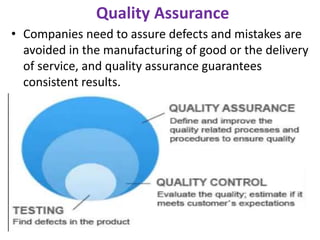
• Companies need to assure defects and mistakes are
avoided in the manufacturing of good or the delivery
of service, and quality assurance guarantees
consistent results.
Quality Assurance
• While quality control involves inspecting the actual
products or services in the field, quality assurance is
reviewing the delivery process of services or
the quality management manufacturing of goods.
• By inspecting goods or services at the source, you
can catch mistakes before they reach the customer.
• You can fine tune your processes to prevent errors in
the future.
• When reviewing your product or service during this
stage of quality control management, you will have
to follow these steps:
1. Confirm that everything is operating as it was
agreed upon during the quality planning stage
2. Measure how effective your pre-determined
processes are and confirm that all compliance
needs are being met
3. Take note of any lessons learned
4. Identify areas where there is an opportunity for
a smoother process
5. To be effective, quality assurance must be
completed regularly through independent
audits. For the best results, have the audit
completed by a third-party that is not financially
or emotionally invested in the outcome.
Quality Improvement
• There is always room for improvement. Through quality
improvement, the results can be measured and possible
improvements in products or services can be made.
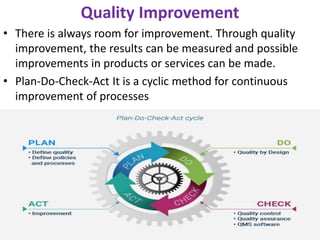
• Plan-Do-Check-Act It is a cyclic method for continuous
improvement of processes
Total Quality Management
• Total - made up of the whole
• Quality - degree of excellence a product or service provides
• Management - act, art or manner of planning, controlling,
directing,…. Therefore,
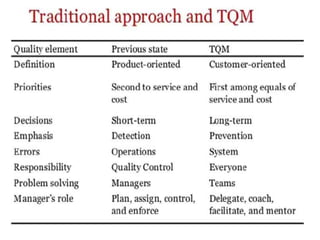
• TQM is the art of managing the whole to achieve
excellence.
The concept of TQM
• Produce quality work the first time.
• Focus on the customer.
• Have a strategic approach to improvement.
• Improve continuously.
• Encourage mutual respect and teamwork
Various Definitions
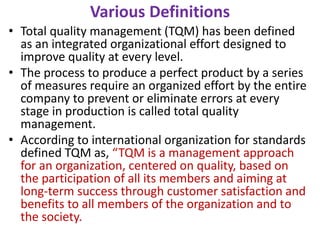
• Total quality management (TQM) has been defined
as an integrated organizational effort designed to
improve quality at every level.
• The process to produce a perfect product by a series
of measures require an organized effort by the entire
company to prevent or eliminate errors at every
stage in production is called total quality
management.
• According to international organization for standards
defined TQM as, “TQM is a management approach
for an organization, centered on quality, based on
the participation of all its members and aiming at
long-term success through customer satisfaction and
benefits to all members of the organization and to
the society.
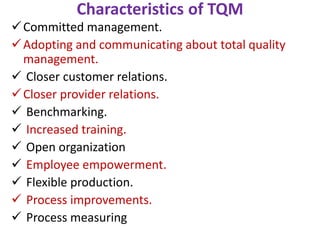
Characteristics of TQM
Committed management.
Adopting and communicating about total quality
management.
 Closer customer relations.
Closer provider relations.
 Benchmarking.
 Increased training.
 Open organization
 Employee empowerment.
 Flexible production.
 Process improvements.
 Process measuring
Principles of TQM
1. Produce quality work the first time and every
time.
2. Focus on the customer.
3. Have a strategic approach to improvement.
4. Improve continuously.
5. Encourage mutual respect and teamwork
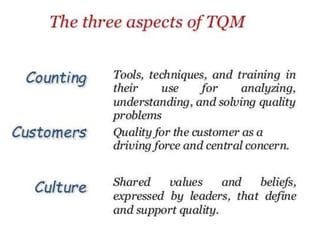
• The key elements of the TQM
• Focus on the customer.
• Employee involvement
• Continuous improvement
Focus on the customer
• It is important to identify the organization’s customers.
• External customers consume the organization’s product or
service.
• Internal customers are employees who receive the output
of other employees.
Employee involvement
• Since the quality is considered the job of all employees,
employees should be involved in quality initiatives.
• Front line employees are likely to have the closest contact
with external customers and thus can make the most
valuable contribution to quality.
• Therefore, employees must have the authority to innovate
and improve quality.
CONTINUOUS IMPROVEMENT
• The quest for quality is a never-ending process in
which people are continuously working to improve
the performance, speed and number of features of
the product or service.
• Continuous improvement means that small,
incremental improvement that occurs on a regular
basis will eventually add up to vast improvement in
quality.
• TQM is the management process used to make
continuous improvements to all functions.
• TQM represents an ongoing, continuous commitment
to improvement.
• The foundation of total quality is a management
philosophy that supports meeting customer
requirements through continuous improvement.
Continuous Process Improvement
• View all work as process – production and
business.
• Process – purchasing, design, invoicing, etc.
• Inputs – process – outputs.
• Process improvement – increased customer
satisfaction.
• Improvement – 5 ways:
reduce resources, reduce errors, meet expectations
of downstream customers, make process safer,
make process more satisfying to the person
doing
BENEFITS OF TQM
Improved
• Quality
• Employee participation
• Team work
• Working relationships
• Customer satisfaction
• Employee satisfaction
• Productivity
• Communication
• Profitability
• Market share
THANK YOU

Pharmaceutical Quality Mangement.pptx

  • 1.
    Unit 2: PharmaceuticalQuality Management Dr. Vijaya Vichare PES Modern College of Pharmacy (for ladies), Moshi, Pune
  • 2.
    Basics of QualityManagement • “Quality Management “It is a process that ensures the quality of the product throughout its life cycle.” • If you want to make sure you are providing consistent products or services throughout your organization, you must implement an ironclad quality management system, or QMS. • Quality control management ensures that what your company delivers and the delivery processes it uses are cohesive and that every business phase of the organization focuses on the same goal.
  • 3.
  • 4.
    Quality Planning • Thefirst step of quality management is planning. • You need to take the time to identify your goals and what you want your baseline to be. • You should determine what your quality standards are, the requirements necessary to meet these standards, and what procedures will be used to check that these criteria are being met.
  • 5.
    • In thisplanning stage, you will want to consider: 1. What your stakeholder’s expectations and priorities are, if applicable? 2. What your company’s definition of success is ? 3. What legal standards or requirements are in place that must be abided by ? 4. Who will handle each role in the quality management process (supervision, testing, etc.) ? 5. How often processes will be evaluated for improvement?
  • 6.
    Quality Control • Qualitycontrol is needed to review the quality of the product or service. • Inspection and testing is necessary to identify problems and defects that need correction. • Quality Control Objectives and functions of QC 1. To establish the desired quality standards which are acceptable to the customers? 2. To discover flaws or variations in the raw materials and the manufacturing processes in order to ensure smooth and uninterrupted production.
  • 7.
    3. To evaluatethe methods and processes of production and suggest further improvements in their functioning. 4. To study and determine the extent of quality deviation in a product during the manufacturing process. 5. To analyze in detail the causes responsible for such deviation. 6. To undertake such steps which are helpful in achieving the desired quality of the product.
  • 8.
    Quality Assurance • Companiesneed to assure defects and mistakes are avoided in the manufacturing of good or the delivery of service, and quality assurance guarantees consistent results.
  • 9.
    Quality Assurance • Whilequality control involves inspecting the actual products or services in the field, quality assurance is reviewing the delivery process of services or the quality management manufacturing of goods. • By inspecting goods or services at the source, you can catch mistakes before they reach the customer. • You can fine tune your processes to prevent errors in the future. • When reviewing your product or service during this stage of quality control management, you will have to follow these steps: 1. Confirm that everything is operating as it was agreed upon during the quality planning stage
  • 10.
    2. Measure howeffective your pre-determined processes are and confirm that all compliance needs are being met 3. Take note of any lessons learned 4. Identify areas where there is an opportunity for a smoother process 5. To be effective, quality assurance must be completed regularly through independent audits. For the best results, have the audit completed by a third-party that is not financially or emotionally invested in the outcome.
  • 11.
    Quality Improvement • Thereis always room for improvement. Through quality improvement, the results can be measured and possible improvements in products or services can be made. • Plan-Do-Check-Act It is a cyclic method for continuous improvement of processes
  • 12.
    Total Quality Management •Total - made up of the whole • Quality - degree of excellence a product or service provides • Management - act, art or manner of planning, controlling, directing,…. Therefore, • TQM is the art of managing the whole to achieve excellence. The concept of TQM • Produce quality work the first time. • Focus on the customer. • Have a strategic approach to improvement. • Improve continuously. • Encourage mutual respect and teamwork
  • 13.
    Various Definitions • Totalquality management (TQM) has been defined as an integrated organizational effort designed to improve quality at every level. • The process to produce a perfect product by a series of measures require an organized effort by the entire company to prevent or eliminate errors at every stage in production is called total quality management. • According to international organization for standards defined TQM as, “TQM is a management approach for an organization, centered on quality, based on the participation of all its members and aiming at long-term success through customer satisfaction and benefits to all members of the organization and to the society.
  • 14.
    Characteristics of TQM Committedmanagement. Adopting and communicating about total quality management.  Closer customer relations. Closer provider relations.  Benchmarking.  Increased training.  Open organization  Employee empowerment.  Flexible production.  Process improvements.  Process measuring
  • 17.
    Principles of TQM 1.Produce quality work the first time and every time. 2. Focus on the customer. 3. Have a strategic approach to improvement. 4. Improve continuously. 5. Encourage mutual respect and teamwork • The key elements of the TQM • Focus on the customer. • Employee involvement • Continuous improvement
  • 18.
    Focus on thecustomer • It is important to identify the organization’s customers. • External customers consume the organization’s product or service. • Internal customers are employees who receive the output of other employees. Employee involvement • Since the quality is considered the job of all employees, employees should be involved in quality initiatives. • Front line employees are likely to have the closest contact with external customers and thus can make the most valuable contribution to quality. • Therefore, employees must have the authority to innovate and improve quality.
  • 19.
    CONTINUOUS IMPROVEMENT • Thequest for quality is a never-ending process in which people are continuously working to improve the performance, speed and number of features of the product or service. • Continuous improvement means that small, incremental improvement that occurs on a regular basis will eventually add up to vast improvement in quality. • TQM is the management process used to make continuous improvements to all functions. • TQM represents an ongoing, continuous commitment to improvement. • The foundation of total quality is a management philosophy that supports meeting customer requirements through continuous improvement.
  • 20.
    Continuous Process Improvement •View all work as process – production and business. • Process – purchasing, design, invoicing, etc. • Inputs – process – outputs. • Process improvement – increased customer satisfaction. • Improvement – 5 ways: reduce resources, reduce errors, meet expectations of downstream customers, make process safer, make process more satisfying to the person doing
  • 21.
    BENEFITS OF TQM Improved •Quality • Employee participation • Team work • Working relationships • Customer satisfaction • Employee satisfaction • Productivity • Communication • Profitability • Market share
  • 22.