Reservoir Engineering 1 Course (1st Ed.)
1. Petroleum Engineering & Its Importance
2. Petroleum Formation
3. Petroleum Extraction
A. Drilling
B. Production

4. Consumption of Oil

2013 H. AlamiNia

Reservoir Engineering 1 Course: (Lec2) Petroleum Reservoirs

2
1. Reservoir Fluid Behaviors
2. Petroleum Reservoirs
A. Oil
B. Gas

3. Gas Behavior
4. Gas Properties: Z Factor

2013 H. AlamiNia

Reservoir Engineering 1 Course: (Lec2) Petroleum Reservoirs

3
Multiphase Behavior
Naturally occurring hydrocarbon systems found in
petroleum reservoirs are mixtures of organic
compounds that exhibit multiphase behavior over
wide ranges of pressures and temperatures.
These hydrocarbon accumulations may occur in the
gaseous state, the liquid state, the solid state, or in
various combinations of gas, liquid, and solid.

2013 H. AlamiNia

Reservoir Engineering 1 Course: (Lec2) Petroleum Reservoirs

5
Petroleum Engineers Task
These differences in phase behavior, coupled with
the physical properties of reservoir rock that
determine the relative ease with which gas and
liquid are transmitted or retained, result in many
diverse types of hydrocarbon reservoirs with
complex behaviors.
Frequently, petroleum engineers have the task to
study the behavior and characteristics of a
petroleum reservoir and to determine the course of
future development and production that would
maximize the profit.
2013 H. AlamiNia

Reservoir Engineering 1 Course: (Lec2) Petroleum Reservoirs

6
Classification of Reservoirs and
Reservoir Fluids
Petroleum reservoirs are broadly classified as oil or gas
reservoirs. These broad classifications are further
subdivided depending on:
The composition of the reservoir hydrocarbon mixture
Initial reservoir pressure and temperature
Pressure and temperature of the surface production

The conditions under which these phases exist are a
matter of considerable practical importance.
The experimental or the mathematical determinations
of these conditions are conveniently expressed in
different types of diagrams commonly called phase
diagrams. One such diagram is called the pressuretemperature diagram.
2013 H. AlamiNia

Reservoir Engineering 1 Course: (Lec2) Petroleum Reservoirs

7
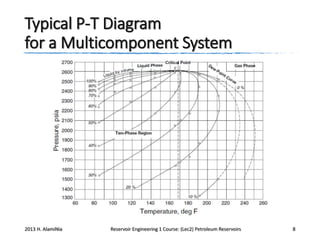
Typical P-T Diagram
for a Multicomponent System

2013 H. AlamiNia

Reservoir Engineering 1 Course: (Lec2) Petroleum Reservoirs

8
Pressure-Temperature Diagram
Although a different hydrocarbon system would have a
different phase diagram, the general configuration is
similar. These multicomponent pressure-temperature
diagrams are essentially used to:
Classify reservoirs
Classify the naturally occurring hydrocarbon systems
Describe the phase behavior of the reservoir fluid

To fully understand the significance of the pressuretemperature diagrams, it is necessary to identify and
define the following key points on these diagrams:
Cricondentherm (Tct), Cricondenbar (pcb), Critical point,
Phase envelope (two-phase region), Quality lines, Bubblepoint curve, Dew-point curve
2013 H. AlamiNia

Reservoir Engineering 1 Course: (Lec2) Petroleum Reservoirs

9
Oil Reservoirs
Depending upon initial reservoir pressure pi, oil
reservoirs can be subclassified into the following
categories:
Undersaturated oil reservoir. If the initial reservoir
pressure pi, is greater than the bubble-point pressure Pb
of the reservoir fluid
Saturated oil reservoir. When pi is equal to the bubblepoint pressure of the reservoir fluid
Gas-cap reservoir or two-phase reservoir. If pi is below
the bubble point pressure of the reservoir fluid
The appropriate quality line gives the ratio of the gas-cap
volume to reservoir oil volume.
2013 H. AlamiNia

Reservoir Engineering 1 Course: (Lec2) Petroleum Reservoirs

11
Crude Oils
Crude oils cover a wide range in physical properties and
chemical compositions, and it is often important to be
able to group them into broad categories of related oils.
In general, crude oils are commonly classified into the
following types:
Ordinary black oil
Low-shrinkage crude oil
High-shrinkage (volatile) crude oil
Near-critical crude oil

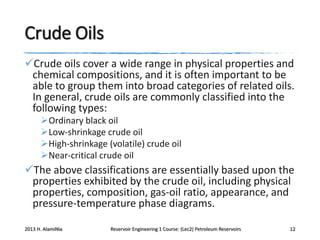
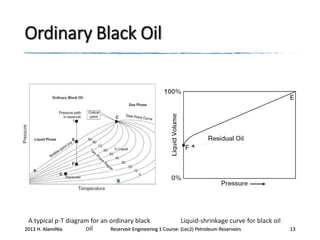
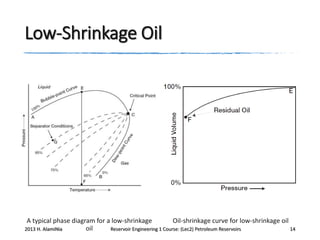
The above classifications are essentially based upon the
properties exhibited by the crude oil, including physical
properties, composition, gas-oil ratio, appearance, and
pressure-temperature phase diagrams.
2013 H. AlamiNia

Reservoir Engineering 1 Course: (Lec2) Petroleum Reservoirs

12
Ordinary Black Oil

A typical p-T diagram for an ordinary black
Liquid-shrinkage curve for black oil
oil
2013 H. AlamiNia
Reservoir Engineering 1 Course: (Lec2) Petroleum Reservoirs

13
Low-Shrinkage Oil

A typical phase diagram for a low-shrinkage
Oil-shrinkage curve for low-shrinkage oil
oil
2013 H. AlamiNia
Reservoir Engineering 1 Course: (Lec2) Petroleum Reservoirs
14
Volatile Crude Oil

A typical p-T diagram for a volatile crude oil
2013 H. AlamiNia

A typical liquid-shrinkage curve for a volatile
Reservoir Engineering 1 Course: (Lec2) Petroleum crude oil
Reservoirs
15
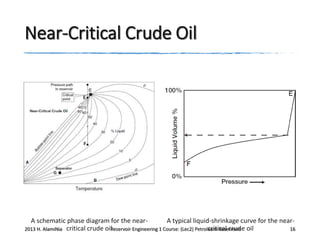
Near-Critical Crude Oil

A schematic phase diagram for the nearA typical liquid-shrinkage curve for the nearcritical crude
2013 H. AlamiNia critical crude oil
Reservoir Engineering 1 Course: (Lec2) Petroleum Reservoirs oil
16
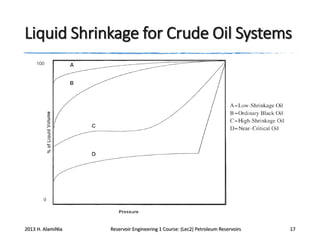
Liquid Shrinkage for Crude Oil Systems

2013 H. AlamiNia

Reservoir Engineering 1 Course: (Lec2) Petroleum Reservoirs

17
Gas Reservoirs
In general, if the reservoir temperature is above the
critical temperature of the hydrocarbon system, the
reservoir is classified as a natural gas reservoir. On
the basis of their phase diagrams and the prevailing
reservoir conditions, natural gases can be classified
into four categories:
Retrograde gas-condensate
Near-critical gas-condensate
Wet gas
Dry gas

2013 H. AlamiNia

Reservoir Engineering 1 Course: (Lec2) Petroleum Reservoirs

19
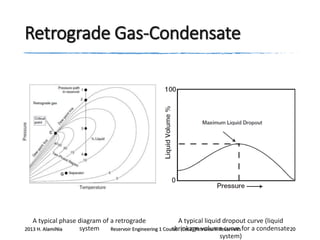
Retrograde Gas-Condensate

A typical phase diagram of a retrograde
A typical liquid dropout curve (liquid
system
shrinkage volume curve
2013 H. AlamiNia
Reservoir Engineering 1 Course: (Lec2) Petroleum Reservoirs for a condensate20
system)
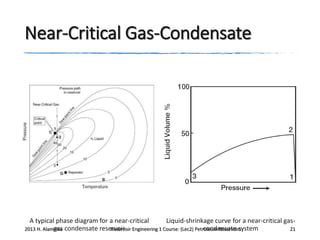
Near-Critical Gas-Condensate

A typical phase diagram for a near-critical
Liquid-shrinkage curve for a near-critical gasgas
condensate system
2013 H. AlamiNia condensate reservoir Engineering 1 Course: (Lec2) Petroleum Reservoirs
Reservoir
21
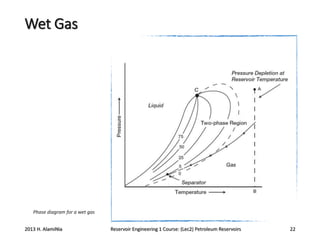
Wet Gas

Phase diagram for a wet gas

2013 H. AlamiNia

Reservoir Engineering 1 Course: (Lec2) Petroleum Reservoirs

22
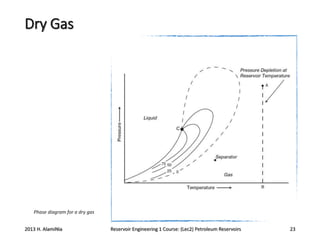
Dry Gas

Phase diagram for a dry gas

2013 H. AlamiNia

Reservoir Engineering 1 Course: (Lec2) Petroleum Reservoirs

23
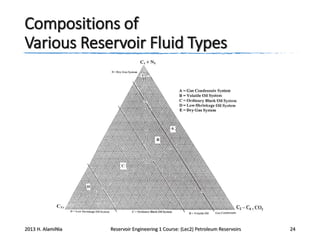
Compositions of
Various Reservoir Fluid Types

2013 H. AlamiNia

Reservoir Engineering 1 Course: (Lec2) Petroleum Reservoirs

24
Reservoir Fluid Properties
To understand and predict the volumetric behavior
of oil and gas reservoirs as a function of pressure,
knowledge of the physical properties of reservoir
fluids must be gained.
These fluid properties are usually determined by
laboratory experiments performed on samples of
actual reservoir fluids.
In the absence of experimentally measured
properties, it is necessary for the petroleum
engineer to determine the properties from
empirically derived correlations.
2013 H. AlamiNia

Reservoir Engineering 1 Course: (Lec2) Petroleum Reservoirs

27
Natural Gas Constituents
A gas is defined as a homogeneous fluid of low
viscosity and density that has no definite volume
but expands to completely fill the vessel in which it
is placed.
Generally, the natural gas is a mixture of
hydrocarbon and nonhydrocarbon gases.
The hydrocarbon gases that are normally found in a
natural gas are methanes, ethanes, propanes, butanes,
pentanes, and small amounts of hexanes and heavier.
The nonhydrocarbon gases (i.e., impurities) include
carbon dioxide, hydrogen sulfide, and nitrogen.
2013 H. AlamiNia

Reservoir Engineering 1 Course: (Lec2) Petroleum Reservoirs

28
Properties of Natural Gases
Knowledge of PVT relationships and other physical and
chemical properties of gases is essential for solving
problems in natural gas reservoir engineering. These
properties include:
 Apparent molecular weight, Ma
 Specific gravity, γg
 Compressibility factor, z
 Density, ρg
 Specific volume, v
 Isothermal gas compressibility coefficient, cg
 Gas formation volume factor, Bg
 Gas expansion factor, Eg
 Viscosity, μg

The above gas properties may be obtained from direct
laboratory measurements or by prediction from generalized
mathematical expressions.
2013 H. AlamiNia

Reservoir Engineering 1 Course: (Lec2) Petroleum Reservoirs

29
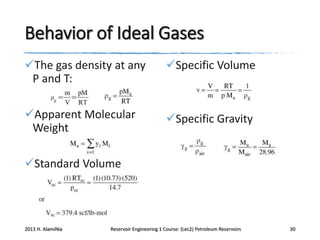
Behavior of Ideal Gases
The gas density at any
P and T:

Specific Volume

Apparent Molecular
Weight

Specific Gravity

Standard Volume

2013 H. AlamiNia

Reservoir Engineering 1 Course: (Lec2) Petroleum Reservoirs

30
Ideal Gases vs. Real Gases
In dealing with gases at a very low pressure, the
ideal gas relationship is a convenient and generally
satisfactory tool.
At higher pressures, the use of the ideal gas
equation-of-state may lead to errors as great as
500%, as compared to errors of 2–3% at
atmospheric pressure.

2013 H. AlamiNia

Reservoir Engineering 1 Course: (Lec2) Petroleum Reservoirs

31
Behavior of Real Gases
Basically, the magnitude of deviations of real gases
from the conditions of the ideal gas law increases
with increasing pressure and temperature and
varies widely with the composition of the gas.
The reason for this is that the perfect gas law was
derived under the assumption that the volume of
molecules is insignificant and that no molecular
attraction or repulsion exists between them.
Numerous equations-of-state have been developed in the
attempt to correlate the pressure-volume-temperature
variables for real gases with experimental data.

2013 H. AlamiNia

Reservoir Engineering 1 Course: (Lec2) Petroleum Reservoirs

32
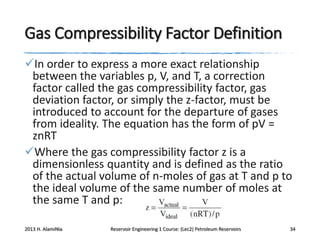
Gas Compressibility Factor Definition
In order to express a more exact relationship
between the variables p, V, and T, a correction
factor called the gas compressibility factor, gas
deviation factor, or simply the z-factor, must be
introduced to account for the departure of gases
from ideality. The equation has the form of pV =
znRT
Where the gas compressibility factor z is a
dimensionless quantity and is defined as the ratio
of the actual volume of n-moles of gas at T and p to
the ideal volume of the same number of moles at
the same T and p:
2013 H. AlamiNia

Reservoir Engineering 1 Course: (Lec2) Petroleum Reservoirs

34
Pseudo-Reduced Properties
Calculation
Studies of the gas compressibility factors for natural
gases of various compositions have shown that
compressibility factors can be generalized with
sufficient accuracies for most engineering purposes
when they are expressed in terms of the following two
dimensionless properties:
Pseudo-reduced pressure and Pseudo-reduced temperature

These dimensionless terms are defined by the following
expressions:


2013 H. AlamiNia

Reservoir Engineering 1 Course: (Lec2) Petroleum Reservoirs

35
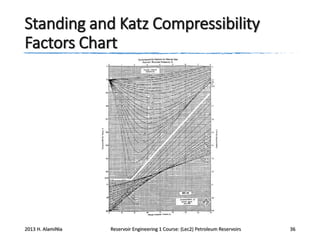
Standing and Katz Compressibility
Factors Chart

2013 H. AlamiNia

Reservoir Engineering 1 Course: (Lec2) Petroleum Reservoirs

36
Pseudo-Critical Properties Calculation
In cases where the composition of a natural gas is
not available, the pseudo-critical properties, i.e.,
Ppc and Tpc, can be predicted solely from the
specific gravity of the gas.
Standing (1977) expressed this graphical
correlation in the following mathematical forms:
Case 1: Natural Gas Systems

Case 2: Gas-Condensate Systems

2013 H. AlamiNia

Reservoir Engineering 1 Course: (Lec2) Petroleum Reservoirs

37
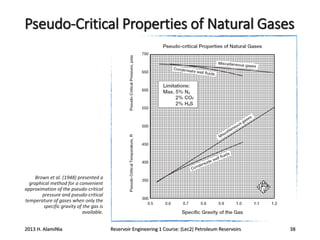
Pseudo-Critical Properties of Natural Gases

Brown et al. (1948) presented a
graphical method for a convenient
approximation of the pseudo-critical
pressure and pseudo-critical
temperature of gases when only the
specific gravity of the gas is
available.

2013 H. AlamiNia

Reservoir Engineering 1 Course: (Lec2) Petroleum Reservoirs

38
Nonhydrocarbon Components of
Natural Gases
Natural gases frequently contain materials other
than hydrocarbon components, such as nitrogen,
carbon dioxide, and hydrogen sulfide.
Hydrocarbon gases are classified as sweet or sour
depending on the hydrogen sulfide content.
Both sweet and sour gases may contain nitrogen, carbon
dioxide, or both.
A hydrocarbon gas is termed a sour gas if it contains one
grain of H2S per 100 cubic feet.

2013 H. AlamiNia

Reservoir Engineering 1 Course: (Lec2) Petroleum Reservoirs

39
Effect of Nonhydrocarbon
Components on the Z-Factor
The common occurrence of small percentages of
nitrogen and carbon dioxide is, in part, considered
in the correlations previously cited.
Concentrations of up to 5 percent of these
nonhydrocarbon components will not seriously affect
accuracy. Errors in compressibility factor calculations as
large as 10 percent may occur in higher concentrations
of nonhydrocarbon components in gas mixtures.

2013 H. AlamiNia

Reservoir Engineering 1 Course: (Lec2) Petroleum Reservoirs

40
Nonhydrocarbon Adjustment Methods
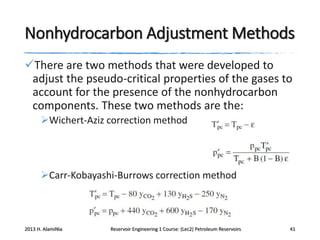
There are two methods that were developed to
adjust the pseudo-critical properties of the gases to
account for the presence of the nonhydrocarbon
components. These two methods are the:
Wichert-Aziz correction method

Carr-Kobayashi-Burrows correction method

2013 H. AlamiNia

Reservoir Engineering 1 Course: (Lec2) Petroleum Reservoirs

41
Direct Calculation of
Compressibility Factors
After four decades of existence, the Standing-Katz
z-factor chart is still widely used as a practical
source of natural gas compressibility factors.
As a result, there has been an apparent need for a
simple mathematical description of that chart.
Several empirical correlations for calculating z-factors
have been developed over the years including:
Hall-Yarborough
Dranchuk-Abu-Kassem
Dranchuk-Purvis-Robinson

2013 H. AlamiNia

Reservoir Engineering 1 Course: (Lec2) Petroleum Reservoirs

42
1. Ahmed, T. (2006). Reservoir engineering
handbook (Gulf Professional Publishing). Ch1,2

2013 H. AlamiNia

Reservoir Engineering 1 Course: (Lec2) Petroleum Reservoirs

43
1. Gas Properties:
A. Isothermal gas compressibility (Cg)
B. Gas formation volume factor (Bg)

2. Crude Oil Properties:
A.
B.
C.
D.
E.

Density
Solution gas
Bubble-point pressure
Oil formation volume factor (Bo)
Total formation volume factor (Bt)

2013 H. AlamiNia

Reservoir Engineering 1 Course: (Lec2) Petroleum Reservoirs

44
Q913 re1 w1 lec 2

Q913 re1 w1 lec 2

  • 1.
    Reservoir Engineering 1Course (1st Ed.)
  • 2.
    1. Petroleum Engineering& Its Importance 2. Petroleum Formation 3. Petroleum Extraction A. Drilling B. Production 4. Consumption of Oil 2013 H. AlamiNia Reservoir Engineering 1 Course: (Lec2) Petroleum Reservoirs 2
  • 3.
    1. Reservoir FluidBehaviors 2. Petroleum Reservoirs A. Oil B. Gas 3. Gas Behavior 4. Gas Properties: Z Factor 2013 H. AlamiNia Reservoir Engineering 1 Course: (Lec2) Petroleum Reservoirs 3
  • 5.
    Multiphase Behavior Naturally occurringhydrocarbon systems found in petroleum reservoirs are mixtures of organic compounds that exhibit multiphase behavior over wide ranges of pressures and temperatures. These hydrocarbon accumulations may occur in the gaseous state, the liquid state, the solid state, or in various combinations of gas, liquid, and solid. 2013 H. AlamiNia Reservoir Engineering 1 Course: (Lec2) Petroleum Reservoirs 5
  • 6.
    Petroleum Engineers Task Thesedifferences in phase behavior, coupled with the physical properties of reservoir rock that determine the relative ease with which gas and liquid are transmitted or retained, result in many diverse types of hydrocarbon reservoirs with complex behaviors. Frequently, petroleum engineers have the task to study the behavior and characteristics of a petroleum reservoir and to determine the course of future development and production that would maximize the profit. 2013 H. AlamiNia Reservoir Engineering 1 Course: (Lec2) Petroleum Reservoirs 6
  • 7.
    Classification of Reservoirsand Reservoir Fluids Petroleum reservoirs are broadly classified as oil or gas reservoirs. These broad classifications are further subdivided depending on: The composition of the reservoir hydrocarbon mixture Initial reservoir pressure and temperature Pressure and temperature of the surface production The conditions under which these phases exist are a matter of considerable practical importance. The experimental or the mathematical determinations of these conditions are conveniently expressed in different types of diagrams commonly called phase diagrams. One such diagram is called the pressuretemperature diagram. 2013 H. AlamiNia Reservoir Engineering 1 Course: (Lec2) Petroleum Reservoirs 7
  • 8.
    Typical P-T Diagram fora Multicomponent System 2013 H. AlamiNia Reservoir Engineering 1 Course: (Lec2) Petroleum Reservoirs 8
  • 9.
    Pressure-Temperature Diagram Although adifferent hydrocarbon system would have a different phase diagram, the general configuration is similar. These multicomponent pressure-temperature diagrams are essentially used to: Classify reservoirs Classify the naturally occurring hydrocarbon systems Describe the phase behavior of the reservoir fluid To fully understand the significance of the pressuretemperature diagrams, it is necessary to identify and define the following key points on these diagrams: Cricondentherm (Tct), Cricondenbar (pcb), Critical point, Phase envelope (two-phase region), Quality lines, Bubblepoint curve, Dew-point curve 2013 H. AlamiNia Reservoir Engineering 1 Course: (Lec2) Petroleum Reservoirs 9
  • 11.
    Oil Reservoirs Depending uponinitial reservoir pressure pi, oil reservoirs can be subclassified into the following categories: Undersaturated oil reservoir. If the initial reservoir pressure pi, is greater than the bubble-point pressure Pb of the reservoir fluid Saturated oil reservoir. When pi is equal to the bubblepoint pressure of the reservoir fluid Gas-cap reservoir or two-phase reservoir. If pi is below the bubble point pressure of the reservoir fluid The appropriate quality line gives the ratio of the gas-cap volume to reservoir oil volume. 2013 H. AlamiNia Reservoir Engineering 1 Course: (Lec2) Petroleum Reservoirs 11
  • 12.
    Crude Oils Crude oilscover a wide range in physical properties and chemical compositions, and it is often important to be able to group them into broad categories of related oils. In general, crude oils are commonly classified into the following types: Ordinary black oil Low-shrinkage crude oil High-shrinkage (volatile) crude oil Near-critical crude oil The above classifications are essentially based upon the properties exhibited by the crude oil, including physical properties, composition, gas-oil ratio, appearance, and pressure-temperature phase diagrams. 2013 H. AlamiNia Reservoir Engineering 1 Course: (Lec2) Petroleum Reservoirs 12
  • 13.
    Ordinary Black Oil Atypical p-T diagram for an ordinary black Liquid-shrinkage curve for black oil oil 2013 H. AlamiNia Reservoir Engineering 1 Course: (Lec2) Petroleum Reservoirs 13
  • 14.
    Low-Shrinkage Oil A typicalphase diagram for a low-shrinkage Oil-shrinkage curve for low-shrinkage oil oil 2013 H. AlamiNia Reservoir Engineering 1 Course: (Lec2) Petroleum Reservoirs 14
  • 15.
    Volatile Crude Oil Atypical p-T diagram for a volatile crude oil 2013 H. AlamiNia A typical liquid-shrinkage curve for a volatile Reservoir Engineering 1 Course: (Lec2) Petroleum crude oil Reservoirs 15
  • 16.
    Near-Critical Crude Oil Aschematic phase diagram for the nearA typical liquid-shrinkage curve for the nearcritical crude 2013 H. AlamiNia critical crude oil Reservoir Engineering 1 Course: (Lec2) Petroleum Reservoirs oil 16
  • 17.
    Liquid Shrinkage forCrude Oil Systems 2013 H. AlamiNia Reservoir Engineering 1 Course: (Lec2) Petroleum Reservoirs 17
  • 19.
    Gas Reservoirs In general,if the reservoir temperature is above the critical temperature of the hydrocarbon system, the reservoir is classified as a natural gas reservoir. On the basis of their phase diagrams and the prevailing reservoir conditions, natural gases can be classified into four categories: Retrograde gas-condensate Near-critical gas-condensate Wet gas Dry gas 2013 H. AlamiNia Reservoir Engineering 1 Course: (Lec2) Petroleum Reservoirs 19
  • 20.
    Retrograde Gas-Condensate A typicalphase diagram of a retrograde A typical liquid dropout curve (liquid system shrinkage volume curve 2013 H. AlamiNia Reservoir Engineering 1 Course: (Lec2) Petroleum Reservoirs for a condensate20 system)
  • 21.
    Near-Critical Gas-Condensate A typicalphase diagram for a near-critical Liquid-shrinkage curve for a near-critical gasgas condensate system 2013 H. AlamiNia condensate reservoir Engineering 1 Course: (Lec2) Petroleum Reservoirs Reservoir 21
  • 22.
    Wet Gas Phase diagramfor a wet gas 2013 H. AlamiNia Reservoir Engineering 1 Course: (Lec2) Petroleum Reservoirs 22
  • 23.
    Dry Gas Phase diagramfor a dry gas 2013 H. AlamiNia Reservoir Engineering 1 Course: (Lec2) Petroleum Reservoirs 23
  • 24.
    Compositions of Various ReservoirFluid Types 2013 H. AlamiNia Reservoir Engineering 1 Course: (Lec2) Petroleum Reservoirs 24
  • 27.
    Reservoir Fluid Properties Tounderstand and predict the volumetric behavior of oil and gas reservoirs as a function of pressure, knowledge of the physical properties of reservoir fluids must be gained. These fluid properties are usually determined by laboratory experiments performed on samples of actual reservoir fluids. In the absence of experimentally measured properties, it is necessary for the petroleum engineer to determine the properties from empirically derived correlations. 2013 H. AlamiNia Reservoir Engineering 1 Course: (Lec2) Petroleum Reservoirs 27
  • 28.
    Natural Gas Constituents Agas is defined as a homogeneous fluid of low viscosity and density that has no definite volume but expands to completely fill the vessel in which it is placed. Generally, the natural gas is a mixture of hydrocarbon and nonhydrocarbon gases. The hydrocarbon gases that are normally found in a natural gas are methanes, ethanes, propanes, butanes, pentanes, and small amounts of hexanes and heavier. The nonhydrocarbon gases (i.e., impurities) include carbon dioxide, hydrogen sulfide, and nitrogen. 2013 H. AlamiNia Reservoir Engineering 1 Course: (Lec2) Petroleum Reservoirs 28
  • 29.
    Properties of NaturalGases Knowledge of PVT relationships and other physical and chemical properties of gases is essential for solving problems in natural gas reservoir engineering. These properties include:  Apparent molecular weight, Ma  Specific gravity, γg  Compressibility factor, z  Density, ρg  Specific volume, v  Isothermal gas compressibility coefficient, cg  Gas formation volume factor, Bg  Gas expansion factor, Eg  Viscosity, μg The above gas properties may be obtained from direct laboratory measurements or by prediction from generalized mathematical expressions. 2013 H. AlamiNia Reservoir Engineering 1 Course: (Lec2) Petroleum Reservoirs 29
  • 30.
    Behavior of IdealGases The gas density at any P and T: Specific Volume Apparent Molecular Weight Specific Gravity Standard Volume 2013 H. AlamiNia Reservoir Engineering 1 Course: (Lec2) Petroleum Reservoirs 30
  • 31.
    Ideal Gases vs.Real Gases In dealing with gases at a very low pressure, the ideal gas relationship is a convenient and generally satisfactory tool. At higher pressures, the use of the ideal gas equation-of-state may lead to errors as great as 500%, as compared to errors of 2–3% at atmospheric pressure. 2013 H. AlamiNia Reservoir Engineering 1 Course: (Lec2) Petroleum Reservoirs 31
  • 32.
    Behavior of RealGases Basically, the magnitude of deviations of real gases from the conditions of the ideal gas law increases with increasing pressure and temperature and varies widely with the composition of the gas. The reason for this is that the perfect gas law was derived under the assumption that the volume of molecules is insignificant and that no molecular attraction or repulsion exists between them. Numerous equations-of-state have been developed in the attempt to correlate the pressure-volume-temperature variables for real gases with experimental data. 2013 H. AlamiNia Reservoir Engineering 1 Course: (Lec2) Petroleum Reservoirs 32
  • 34.
    Gas Compressibility FactorDefinition In order to express a more exact relationship between the variables p, V, and T, a correction factor called the gas compressibility factor, gas deviation factor, or simply the z-factor, must be introduced to account for the departure of gases from ideality. The equation has the form of pV = znRT Where the gas compressibility factor z is a dimensionless quantity and is defined as the ratio of the actual volume of n-moles of gas at T and p to the ideal volume of the same number of moles at the same T and p: 2013 H. AlamiNia Reservoir Engineering 1 Course: (Lec2) Petroleum Reservoirs 34
  • 35.
    Pseudo-Reduced Properties Calculation Studies ofthe gas compressibility factors for natural gases of various compositions have shown that compressibility factors can be generalized with sufficient accuracies for most engineering purposes when they are expressed in terms of the following two dimensionless properties: Pseudo-reduced pressure and Pseudo-reduced temperature These dimensionless terms are defined by the following expressions:  2013 H. AlamiNia Reservoir Engineering 1 Course: (Lec2) Petroleum Reservoirs 35
  • 36.
    Standing and KatzCompressibility Factors Chart 2013 H. AlamiNia Reservoir Engineering 1 Course: (Lec2) Petroleum Reservoirs 36
  • 37.
    Pseudo-Critical Properties Calculation Incases where the composition of a natural gas is not available, the pseudo-critical properties, i.e., Ppc and Tpc, can be predicted solely from the specific gravity of the gas. Standing (1977) expressed this graphical correlation in the following mathematical forms: Case 1: Natural Gas Systems Case 2: Gas-Condensate Systems 2013 H. AlamiNia Reservoir Engineering 1 Course: (Lec2) Petroleum Reservoirs 37
  • 38.
    Pseudo-Critical Properties ofNatural Gases Brown et al. (1948) presented a graphical method for a convenient approximation of the pseudo-critical pressure and pseudo-critical temperature of gases when only the specific gravity of the gas is available. 2013 H. AlamiNia Reservoir Engineering 1 Course: (Lec2) Petroleum Reservoirs 38
  • 39.
    Nonhydrocarbon Components of NaturalGases Natural gases frequently contain materials other than hydrocarbon components, such as nitrogen, carbon dioxide, and hydrogen sulfide. Hydrocarbon gases are classified as sweet or sour depending on the hydrogen sulfide content. Both sweet and sour gases may contain nitrogen, carbon dioxide, or both. A hydrocarbon gas is termed a sour gas if it contains one grain of H2S per 100 cubic feet. 2013 H. AlamiNia Reservoir Engineering 1 Course: (Lec2) Petroleum Reservoirs 39
  • 40.
    Effect of Nonhydrocarbon Componentson the Z-Factor The common occurrence of small percentages of nitrogen and carbon dioxide is, in part, considered in the correlations previously cited. Concentrations of up to 5 percent of these nonhydrocarbon components will not seriously affect accuracy. Errors in compressibility factor calculations as large as 10 percent may occur in higher concentrations of nonhydrocarbon components in gas mixtures. 2013 H. AlamiNia Reservoir Engineering 1 Course: (Lec2) Petroleum Reservoirs 40
  • 41.
    Nonhydrocarbon Adjustment Methods Thereare two methods that were developed to adjust the pseudo-critical properties of the gases to account for the presence of the nonhydrocarbon components. These two methods are the: Wichert-Aziz correction method Carr-Kobayashi-Burrows correction method 2013 H. AlamiNia Reservoir Engineering 1 Course: (Lec2) Petroleum Reservoirs 41
  • 42.
    Direct Calculation of CompressibilityFactors After four decades of existence, the Standing-Katz z-factor chart is still widely used as a practical source of natural gas compressibility factors. As a result, there has been an apparent need for a simple mathematical description of that chart. Several empirical correlations for calculating z-factors have been developed over the years including: Hall-Yarborough Dranchuk-Abu-Kassem Dranchuk-Purvis-Robinson 2013 H. AlamiNia Reservoir Engineering 1 Course: (Lec2) Petroleum Reservoirs 42
  • 43.
    1. Ahmed, T.(2006). Reservoir engineering handbook (Gulf Professional Publishing). Ch1,2 2013 H. AlamiNia Reservoir Engineering 1 Course: (Lec2) Petroleum Reservoirs 43
  • 44.
    1. Gas Properties: A.Isothermal gas compressibility (Cg) B. Gas formation volume factor (Bg) 2. Crude Oil Properties: A. B. C. D. E. Density Solution gas Bubble-point pressure Oil formation volume factor (Bo) Total formation volume factor (Bt) 2013 H. AlamiNia Reservoir Engineering 1 Course: (Lec2) Petroleum Reservoirs 44