Group K
MSc. Petroleum Engineering
LONDON SOUTH BANK UNIVERSITY,UK.
Group K -members
 Ilya Pushkarev 2936077
 Mike Arhin 2935901
Musa Muhammed 2933794
 Samuel G. Emenogu 2933966
 Uzochukwu A. Morah 2922166
Contents
 Introduction
 Effects of Formation Damage
 Causes of Formation Damage
 Control and Remediation
 The Concept of Acid Stimulation
Introduction
 Formation Damage can be described as the reduction
in permeability in the reservoir rock due to the
infiltration of drilling or treating fluids into the area
adjacent to the well bore.
 It occurs in the near bore region of the formation
(reservoir) where radial flow is dominant.
 It results from a combined reduction in porosity and
permeability in the near well bore region of the
formation.
 Understanding and preventing Formation Damage
should be the responsibility of every Oilfield
professional because it is the main reason many Oil
and Gas wells produce at rates that fall far-short of
their theoretical capabilities. (Sub-optimal Oil
production)
 This phenomenon also impairs injection and disposal
wells, thereby limiting the efficiency of pressure
maintenance schemes and increasing operating costs.
Effects of Formation Damage
Swelling of clays The swelling of clays reduces permeability
Mud filtrates and formation
fluids
Formation of emulsions which reduces
permeability
Invasion Drill solids invade into the formation matrix
thereby causing skin effect and reducing
porosity.
Well performance Reduction in flow efficiency in the near well
bore formation during the various phase of oil
and gas production
Table 1
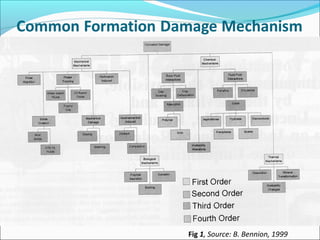
Fig 1, Source: B. Bennion, 1999
The are four primary mechanisms of formation damage:
1. Mechanical 2. Chemical 3. Biological
4. Thermal
Mechanical Formation Damage
• Caused by a direct, non-chemical, interaction between the
equipment or fluid used and the formation.
• This result in a reduction in the permeability of the
formation.
• Changes in the properties of the reservoir fluids during
production operations.
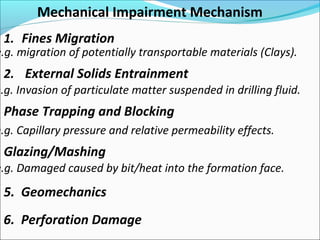
1. Fines Migration
2. External Solids Entrainment
Glazing/Mashing
5. Geomechanics
Mechanical Impairment Mechanism
e.g. migration of potentially transportable materials (Clays).
e.g. Invasion of particulate matter suspended in drilling fluid.
e.g. Capillary pressure and relative permeability effects.
Phase Trapping and Blocking
e.g. Damaged caused by bit/heat into the formation face.
6. Perforation Damage
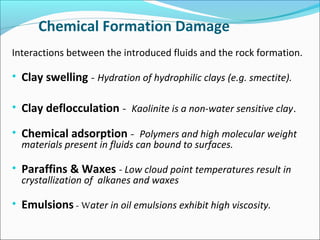
Chemical Formation Damage
Interactions between the introduced fluids and the rock formation.
• Clay swelling - Hydration of hydrophilic clays (e.g. smectite).
• Clay deflocculation - Kaolinite is a non-water sensitive clay.
• Chemical adsorption - Polymers and high molecular weight
materials present in fluids can bound to surfaces.
• Paraffins & Waxes - Low cloud point temperatures result in
crystallization of alkanes and waxes
• Emulsions - Water in oil emulsions exhibit high viscosity.
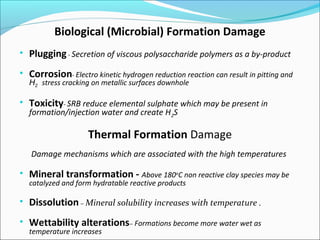
Biological (Microbial) Formation Damage
• Plugging- Secretion of viscous polysaccharide polymers as a by-product
• Corrosion- Electro kinetic hydrogen reduction reaction can result in pitting and
H2 stress cracking on metallic surfaces downhole
• Toxicity- SRB reduce elemental sulphate which may be present in
formation/injection water and create H2S
 
Thermal Formation Damage
Damage mechanisms which are associated with the high temperatures
• Mineral transformation - Above 180o
C non reactive clay species may be
catalyzed and form hydratable reactive products
 
• Dissolution – Mineral solubility increases with temperature .
 
• Wettability alterations– Formations become more water wet as
temperature increases
Control and remediation of formation
damage.
Ensure adequate formation evaluation;  
Use of specially design drill- in- fluids or work over and 
completion fluids thereby minimizing formation damage;
Use of formation heat treatment in the near wellbore region;
Sand control mechanism;
Use of improved perforation techniques (underbalanced 
perforation, removal of crushed zones and other perforating 
debris);
Hydraulic Fracturing.
Control and remediation of formation
damage
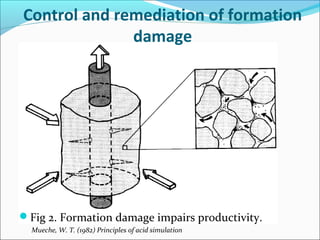
Fig 2. Formation damage impairs productivity.
       Mueche, W. T. (1982) Principles of acid simulation
ACID STIMULATION
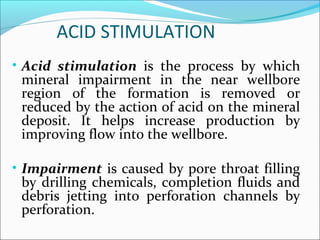
• Acid stimulation is  the  process  by  which 
mineral  impairment  in  the  near  wellbore 
region  of  the  formation  is  removed  or 
reduced by the action of acid on the mineral 
deposit.  It  helps  increase  production  by 
improving flow into the wellbore.
• Impairment is caused by pore throat filling 
by drilling chemicals, completion fluids and 
debris  jetting  into  perforation  channels  by 
perforation.
ACIDISATION MECHANISM
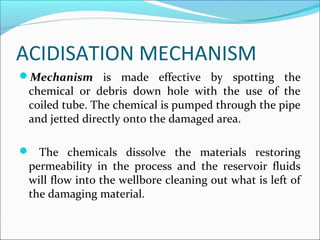
Mechanism  is  made  effective  by  spotting  the 
chemical  or  debris  down  hole  with  the  use  of  the 
coiled tube. The chemical is pumped through the pipe 
and jetted directly onto the damaged area.
  The  chemicals  dissolve  the  materials  restoring 
permeability  in  the  process  and  the  reservoir  fluids 
will flow into the wellbore cleaning out what is left of 
the damaging material.
TYPES OF ACIDISATION
TYPES ACTIVITY
Mud Acid •Mixture of HF and
HCL.
•It dissolves silicate
material.
•Cannot be used in
carbonate
reservoirs because
of acid reactions.
HCL Acid wash •Uses HCL solution
to remove calcium
based deposits
around wellbore.
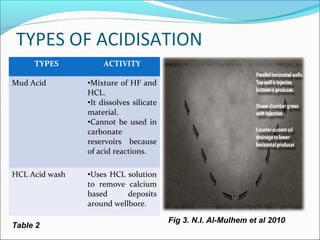
Fig 3. N.I. Al-Mulhem et al 2010
Table 2
RECOMMENDATIONS
After in depth analysis the following course of
action is recommended :
• Reduction in the density of drilling fluids in order
to reduce fluid invasion into the formation during
completion operations.
• Improve drilling fluid rheology to provide better
fluid loss control, and thus better cleanup
potentials.
R.F Krueger: ‘An overview of Formation Damage and Well Productivity in Oilfield
Operations’: An update , SPE 17459, presented at the SPE California Regional
meeting held in Long Beach, California, March 23-25, 1988 (Accessed 13th
May, 2011)
N.I. Al-Mulhem et al: ‘A Smart Approach in Acid Stimulation Resulted in
Successful Reviving of Horizontal Producers Equipped with ICD Completions:
Saudi Arabia Case History’ SPE 127318, presented at the 2010 SPE International
Symposium and Exhibition in Formation Damage Control held in Lafayette,
Louisiana, USA, 10 – 12 February 2010 (Accessed 6th
May 2011)
Ismail Mohammed El-Haib; ‘Production Improvement of Formation Damaged
Wells by Proper Acid Treatment’; SPE 128433, presented at the SPE North Africa
Technical Conference and Exhibition held in Cairo, Egypt, 14-17 February 2010
(Accessed 6th
May 2011)
Farouk Civan; ‘Reservoir Formation Damage’; Gulf Publishing’; Gulf Publishing
Company, Houston, Texas, 2000. (Accessed 31st
May, 2011)
Bennion, D.B., et.al; ‘Remediation of Water and Hydrocarbon Phase Trapping
Problems in Low Permeability Gas Reservoirs.’ CIM Paper 96-80. (Accessed 31st
May 2011).

Formation Damage and Acid Stimulation Presentation 2.

  • 1.
    Group K MSc. PetroleumEngineering LONDON SOUTH BANK UNIVERSITY,UK.
  • 2.
    Group K -members Ilya Pushkarev 2936077  Mike Arhin 2935901 Musa Muhammed 2933794  Samuel G. Emenogu 2933966  Uzochukwu A. Morah 2922166
  • 3.
    Contents  Introduction  Effectsof Formation Damage  Causes of Formation Damage  Control and Remediation  The Concept of Acid Stimulation
  • 4.
    Introduction  Formation Damagecan be described as the reduction in permeability in the reservoir rock due to the infiltration of drilling or treating fluids into the area adjacent to the well bore.  It occurs in the near bore region of the formation (reservoir) where radial flow is dominant.  It results from a combined reduction in porosity and permeability in the near well bore region of the formation.
  • 5.
     Understanding andpreventing Formation Damage should be the responsibility of every Oilfield professional because it is the main reason many Oil and Gas wells produce at rates that fall far-short of their theoretical capabilities. (Sub-optimal Oil production)  This phenomenon also impairs injection and disposal wells, thereby limiting the efficiency of pressure maintenance schemes and increasing operating costs.
  • 6.
    Effects of FormationDamage Swelling of clays The swelling of clays reduces permeability Mud filtrates and formation fluids Formation of emulsions which reduces permeability Invasion Drill solids invade into the formation matrix thereby causing skin effect and reducing porosity. Well performance Reduction in flow efficiency in the near well bore formation during the various phase of oil and gas production Table 1
  • 7.
    Fig 1, Source:B. Bennion, 1999
  • 8.
    The are fourprimary mechanisms of formation damage: 1. Mechanical 2. Chemical 3. Biological 4. Thermal Mechanical Formation Damage • Caused by a direct, non-chemical, interaction between the equipment or fluid used and the formation. • This result in a reduction in the permeability of the formation. • Changes in the properties of the reservoir fluids during production operations.
  • 9.
    1. Fines Migration 2.External Solids Entrainment Glazing/Mashing 5. Geomechanics Mechanical Impairment Mechanism e.g. migration of potentially transportable materials (Clays). e.g. Invasion of particulate matter suspended in drilling fluid. e.g. Capillary pressure and relative permeability effects. Phase Trapping and Blocking e.g. Damaged caused by bit/heat into the formation face. 6. Perforation Damage
  • 10.
    Chemical Formation Damage Interactionsbetween the introduced fluids and the rock formation. • Clay swelling - Hydration of hydrophilic clays (e.g. smectite). • Clay deflocculation - Kaolinite is a non-water sensitive clay. • Chemical adsorption - Polymers and high molecular weight materials present in fluids can bound to surfaces. • Paraffins & Waxes - Low cloud point temperatures result in crystallization of alkanes and waxes • Emulsions - Water in oil emulsions exhibit high viscosity.
  • 11.
    Biological (Microbial) FormationDamage • Plugging- Secretion of viscous polysaccharide polymers as a by-product • Corrosion- Electro kinetic hydrogen reduction reaction can result in pitting and H2 stress cracking on metallic surfaces downhole • Toxicity- SRB reduce elemental sulphate which may be present in formation/injection water and create H2S   Thermal Formation Damage Damage mechanisms which are associated with the high temperatures • Mineral transformation - Above 180o C non reactive clay species may be catalyzed and form hydratable reactive products   • Dissolution – Mineral solubility increases with temperature .   • Wettability alterations– Formations become more water wet as temperature increases
  • 12.
    Control and remediationof formation damage. Ensure adequate formation evaluation;   Use of specially design drill- in- fluids or work over and  completion fluids thereby minimizing formation damage; Use of formation heat treatment in the near wellbore region; Sand control mechanism; Use of improved perforation techniques (underbalanced  perforation, removal of crushed zones and other perforating  debris); Hydraulic Fracturing.
  • 13.
    Control and remediationof formation damage Fig 2. Formation damage impairs productivity.        Mueche, W. T. (1982) Principles of acid simulation
  • 14.
    ACID STIMULATION • Acidstimulation is  the  process  by  which  mineral  impairment  in  the  near  wellbore  region  of  the  formation  is  removed  or  reduced by the action of acid on the mineral  deposit.  It  helps  increase  production  by  improving flow into the wellbore. • Impairment is caused by pore throat filling  by drilling chemicals, completion fluids and  debris  jetting  into  perforation  channels  by  perforation.
  • 15.
    ACIDISATION MECHANISM Mechanism  is made  effective  by  spotting  the  chemical  or  debris  down  hole  with  the  use  of  the  coiled tube. The chemical is pumped through the pipe  and jetted directly onto the damaged area.   The  chemicals  dissolve  the  materials  restoring  permeability  in  the  process  and  the  reservoir  fluids  will flow into the wellbore cleaning out what is left of  the damaging material.
  • 16.
    TYPES OF ACIDISATION TYPESACTIVITY Mud Acid •Mixture of HF and HCL. •It dissolves silicate material. •Cannot be used in carbonate reservoirs because of acid reactions. HCL Acid wash •Uses HCL solution to remove calcium based deposits around wellbore. Fig 3. N.I. Al-Mulhem et al 2010 Table 2
  • 17.
    RECOMMENDATIONS After in depthanalysis the following course of action is recommended : • Reduction in the density of drilling fluids in order to reduce fluid invasion into the formation during completion operations. • Improve drilling fluid rheology to provide better fluid loss control, and thus better cleanup potentials.
  • 18.
    R.F Krueger: ‘Anoverview of Formation Damage and Well Productivity in Oilfield Operations’: An update , SPE 17459, presented at the SPE California Regional meeting held in Long Beach, California, March 23-25, 1988 (Accessed 13th May, 2011) N.I. Al-Mulhem et al: ‘A Smart Approach in Acid Stimulation Resulted in Successful Reviving of Horizontal Producers Equipped with ICD Completions: Saudi Arabia Case History’ SPE 127318, presented at the 2010 SPE International Symposium and Exhibition in Formation Damage Control held in Lafayette, Louisiana, USA, 10 – 12 February 2010 (Accessed 6th May 2011) Ismail Mohammed El-Haib; ‘Production Improvement of Formation Damaged Wells by Proper Acid Treatment’; SPE 128433, presented at the SPE North Africa Technical Conference and Exhibition held in Cairo, Egypt, 14-17 February 2010 (Accessed 6th May 2011) Farouk Civan; ‘Reservoir Formation Damage’; Gulf Publishing’; Gulf Publishing Company, Houston, Texas, 2000. (Accessed 31st May, 2011) Bennion, D.B., et.al; ‘Remediation of Water and Hydrocarbon Phase Trapping Problems in Low Permeability Gas Reservoirs.’ CIM Paper 96-80. (Accessed 31st May 2011).