CHAPTER 5 – FORMATION EVALUATION
CONTENTS 
1. Mud Logging 
2. Coring 
3. Open-hole Logging 
4. Logging While Drilling 
5. Formation Testing 
6. Cased Hole Logging
Formation Evaluation 
 What is Formation Evaluation? 
 Formation Evaluation (FE) is the process of 
interpreting a combination of measurements taken 
inside a wellbore to detect and quantify oil and 
gas reserves in the rock adjacent to the well. FE 
data can be gathered with wireline logging 
instruments or logging-while-drilling tools . 
 Study of the physical properties of rocks and the 
fluids contained within them. 
 Data are organized and interpreted by depth and 
represented on a graph called a log (a record of 
information about the formations through which a 
well has been drilled).
Formation Evaluation 
 Why Formation Evaluation? 
 To evaluate hydrocarbons reservoirs and predict 
oil recovery. 
 To provide the reservoir engineers with the 
formation’s geological and physical parameters 
necessary for the construction of a fluid-flow 
model of the reservoir. 
 Measurement of in situ formation fluid pressure 
and acquisition of formation fluid samples. 
 In petroleum exploration and development, 
formation evaluation is used to determine the 
ability of a borehole to produce petroleum.
Mud Logging 
 Mud logging (or Wellsite Geology) is a well logging 
process in which drilling mud and drill bit cuttings 
from the formation are evaluated during drilling and 
their properties recorded on a strip chart as a visual 
analytical tool and stratigraphic cross sectional 
representation of the well. 
 Provide continuous record of penetration rate, 
lithology and hydrocarbon shows. 
 These information supports wireline log data. 
 From the cuttings, an oil stains or odor of oil may be 
detected, become an excellent qualitative indicator. 
 The fluorescent lamp is also a great help in detecting 
oil shows.
Mud Logging 
 The gas record and lithological sample are plotted 
along with surface parameters such as rate of 
penetration (ROP), Weight On Bit (WOB),rotation 
per minute etc. on the mudlog which serve as a tool 
for the drilling engineers and mud engineers. 
 Some problem: a discrepancy between the time the 
rock was drilled and the time it reached the surface 
– particularly for deep wells, where it take two or 
move hours to reach the surface.
Coring 
 One way to get more detailed 
samples of a formation is by coring, 
where formation sample is drilled 
out by means of special bit. 
 This sample can provide: 
 Detailed lithological decscription. 
 Porosity, permeability, fluid 
saturation and grain density. 
 These parameters are measured in 
the laboratory and serve as a basis 
for calibrating the response of the 
porosity logging tools and to 
establish a porosity/permeability 
relationship.
Coring 
 Two techniques commonly used at 
present. The first is the "whole 
core", a cylinder of rock, usually 
about 3" to 4" in diameter and up to 
50 feet (15 m) to 60 feet (18 m) long. 
 It is cut with a "core barrel", a 
hollow pipe tipped with a ring-shaped 
diamond chip-studded bit that can 
cut a plug and bring it to the surface. 
 Taking a full core is an expensive 
operation that usually stops or slows 
drilling operation, and can be done 
only before the drilling has been 
done. Coring Tool & Core Barrel
Coring 
 The other, cheaper, technique for obtaining samples 
of the formation is "Sidewall Coring". In this 
method, a steel cylinder—a coring gun—has hollow-point 
steel bullets mounted along its sides and 
moored to the gun by short steel cables. 
 The coring gun is lowered to the bottom of the 
interval of interest and the bullets are fired 
individually and the core will be retrieved. 
 Advantages of this technique are low cost and the 
ability to sample the formation after it has been 
drilled.
Core Preservation 
 Once the core is retrieve to surface then it is 
important that it should remain as unchanged as 
possible. 
 The core should be prevented from drying out, 
coming into contact with oxygen or being 
mechanically damaged. 
 Core barrel is filled with resin to prevent the 
core from moving and to minimize the exposed 
surface area. 
 Freezing the core in freezer containers. 
 Core sample is wrapped in a plastic film, aluminium 
foil and then dipped in molten wax.
Core Analysis 
 Can be divided into two categories: 
 Conventional Core Analysis. 
 Special Core Analysis. 
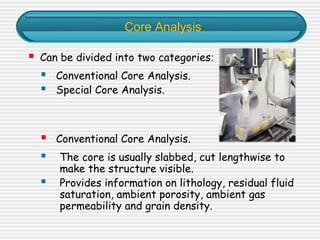
 Conventional Core Analysis. 
 The core is usually slabbed, cut lengthwise to 
make the structure visible. 
 Provides information on lithology, residual fluid 
saturation, ambient porosity, ambient gas 
permeability and grain density.
Gas Permeameter 
Liquid Permeameter
Porosimeter
Core Analysis 
 Special Core Analysis : 
Provides the following information: 
 Porosity and permeability at elevated confining 
stress. 
 Electrical properties such as formation factor 
and resistivity index. 
 Capillary pressure. 
 Wettability and relative permeability. 
 Mechanical rock properties such as 
compressibility. 
 Waterflood sensitivity for injectivity and well 
performance.
Open-hole Logging 
 Open-hole logging, also known as 
well logging is the practice of 
making a detailed record (a well 
log) of the geologic formations 
penetrated by a borehole. 
 Open hole logs are run before 
the oil or gas well is lined with 
pipe or cased
Principal of Well Logging 
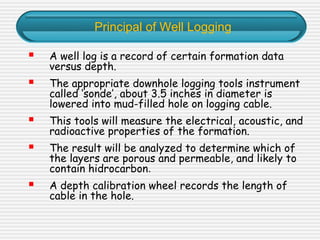
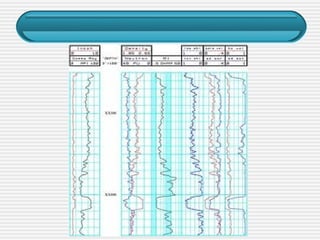
 A well log is a record of certain formation data 
versus depth. 
 The appropriate downhole logging tools instrument 
called ‘sonde’, about 3.5 inches in diameter is 
lowered into mud-filled hole on logging cable. 
 This tools will measure the electrical, acoustic, and 
radioactive properties of the formation. 
 The result will be analyzed to determine which of 
the layers are porous and permeable, and likely to 
contain hidrocarbon. 
 A depth calibration wheel records the length of 
cable in the hole.
Principal of Well Logging 
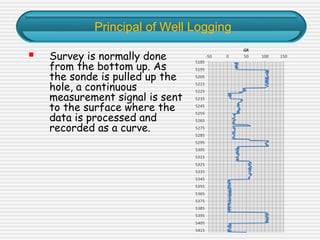
 Survey is normally done 
from the bottom up. As 
the sonde is pulled up the 
hole, a continuous 
measurement signal is sent 
to the surface where the 
data is processed and 
recorded as a curve.
Electrical Logs 
 Developed by Conrad & Marcel Schlumberger (who 
founded Schlumberger Limited), and intoduced to 
the US in 1929. 
 Can be divided into two main types: measurement 
of natural electrical current in the rock (SP Log), 
and measurement of induced electrical current 
(Resistivity Log and Induction Log).
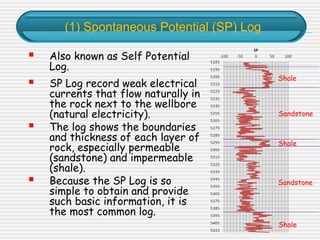
(1) Spontaneous Potential (SP) Log 
 Also known as Self Potential 
Log. 
 SP Log record weak electrical 
currents that flow naturally in 
the rock next to the wellbore 
(natural electricity). 
 The log shows the boundaries 
and thickness of each layer of 
rock, especially permeable 
(sandstone) and impermeable 
(shale). 
 Because the SP Log is so 
simple to obtain and provide 
such basic information, it is 
the most common log. 
Shale 
Sandstone 
Shale 
Sandstone 
Shale
(1) Spontaneous Potential (SP) Log 
 Useful for: 
 Detecting permeable beds 
and it thickness. 
 Locating their boundaries 
and permitting correlation 
of such beds. 
 Determining formation 
water resistivity. 
 Qualitative indication of 
bed shaliness. 
Shale 
Sandstone 
Shale 
Sandstone 
Shale
(2) Resistivity Logs 
 Use to measure the resistivity of the formation, 
and thus the possibility of hc shows. 
 A sonde sends an electrical signal through the 
formation and relays it back to a receiver at the 
surface (induced electricity). The surface detector 
will measure the formation’s resistance to the 
current. 
 A rock which contains an oil and/or gas saturation 
will have a higher resistivity than the same rock 
completely saturated with formation water.
(3) Induction Logs 
 Use to measure the conductivity of the formation, 
and thus the possibility of hc shows. 
 A rock which contains an oil and/or gas saturation 
will have a lower conductivity than the same rock 
completely saturated with formation water. 
 Induction logs use an electric coil in the sonde to 
generate an alternating current loop in the 
formation by induction. 
 Induction tools t give best results when mud 
resistivity is high with respect to formation 
resistivity, i.e., fresh mud or non-conductive fluid. 
In oil-base mud, which is non conductive, induction 
logging is the only option available.
(4) Dielectric Logs 
 Responds essentially to water and is unaffected by 
the presence of hydrocarbons. 
 Particularly important in determining the 
irreducible water saturation when oil-based muds 
are used.
Nuclear Logs 
 Just as SP and resistivity logs record natural and 
induced electrical currents, nuclear logs (also 
called radioactivity logs) record natural and 
induced radioactivity. 
 Three type of logs: Gamma Ray Log, Neutron Log 
and Formation Density Log.
(1) Gamma Ray Log 
 Record the natural γ- 
radioactivity of rocks 
surrounding the borehole. 
 The γ-radiation arises from 
three elements present in the 
rocks, isotopes of potassium, 
uranium and thorium. 
 Useful for defining shale beds 
because K, U and Th are largely 
concentrated in association 
with clay minerals. 
 It is used to define permeable 
beds when SP log cannot be 
employed (eg. When Rmf = Rw). 
Shale 
Sandstone 
Shale 
Sandstone 
Shale
(2) Neutron Log 
 To obtain a neutron log, a sonde sends atomic 
particles called neutrons through the formation. 
 When the neutrons collide with hydrogen, the 
hydrogen slows them down. 
 The response of the devise is primarily a function 
of the hydrogen nuclei concentration. 
 When the detector records slow neutrons, it 
means a lot of hydrogen is present – main 
component of water and hydrocarbon, but not of 
rocks. 
 Considered as porosity log because hydrogen is 
mostly present in pore fluids (water, hydrocarbons) 
the count rate can be converted into apparent 
porosity.
(3) Formation Density Log 
 This devise measure number of photon then be 
related to electron density of the formation. 
 Electron density is related to an apparent bulk 
density which equivalent to formation bulk density. 
 Useable to detect formation lithology.
Sonic or Acoustic Logs 
 Provide continuous record of the time taken in 
microsecond/foot by sound wave to travel from the 
transmitter to the receiver n the sonde. 
 Velocity of sound through a given formation is a 
function of its lithological and porosity. 
 Dense, low porosity rocks are characterized by 
high velocity of sound wave and vise-versa for 
porous and less dense formation.
Logging While Drilling 
 One of the major drawbacks of wireline 
information is that it is received several hours to 
several weeks after the borehole is drilled. 
 During this time period, the formation can undergo 
significant alteration, especially in its fluid 
saturation, effective porosity, and relative perm. 
 LWD allow wireline-type information to be 
available as near as real-time as possible. 
 Logging While Drilling (LWD) is a technique of 
conveying well logging tools into the well borehole 
downhole as part of the bottom hole assembly 
(BHA).
Logging While Drilling 
 Some available measurement in LWD technology: 
 Gamma Ray 
 Resistivity 
 Density 
 Neutron 
 Sonic (fairly recent) 
 Formation pressure 
 Formation fluid sampler 
 Borehole caliper (Ultra sonic azimuthal caliper, 
and density caliper).
Formation Testing 
 Is a means of obtaining information concerning the 
liquid and pressure in an open-hole formations. 
 Three methods: 
■ Wireline testing 
■ Drill stem test (DST) 
■ Well Test Analysis
Wireline Testing 
 Provide reservoir fluid samples, reservoir pressure, 
an indication of fluid mobility and information on 
reservoir continuity. 
 Two types: Repeat Formation Tester (RFT) and 
Formation Interval Tester (FIT). 
 The RFT is run into the hole and a continuous 
digital readout of hydrostatic pressure is obtained. 
 At any point in the hole the tool may be actuated 
to force a rubber pad against the wall of the hole, 
and a tube in the centre of the pad is forced hard 
against the formation. 
 The formation fluid will flow to the chamber 
through the tube.
Wireline Testing 
 The FIT is used for single test – only one pressure 
reading and one fluid sample for each run. 
 A tool is actuated (a pad is tightly against the 
formation to form a seal against hydrostatic 
pressure of the fluid in the hole). 
 A shaped charge is then fired into the fm, opening 
a passageway for fm fluids to flow into a chamber 
in the tool. At he same time the fm pressure will 
be recorded.
Drillstem Test (DST) 
 A drill stem test (DST) is a procedure for isolating 
and testing the surrounding geological formation 
through the drill stem. 
 The test is a measurement of pressure behavior at 
the drill stem and is a valuable way to obtain 
important sampling information on the formation 
fluid and to establish the probability of commercial 
production. 
 The test is made by lowering a valve, a packer, and 
a length of perforated tailpipe to the level of 
formation. 
 The packer set against the wall of the borehole so 
that it seals off the test interval from the mud 
column above.
Drillstem Test (DST) 
 The valve is then opened, and 
the fm fluid will flow to the 
surface through the drillpipe. 
 The amount of fluid produced 
will represent the fluid 
production can be expected 
from the well.
Well Test Analysis 
 Two types of testing: pressure build-up and draw 
down test. 
 The primary objectives of well testing are to 
establish: 
 Permeability thickness (Kh) and permeability (K) 
 Stratification (by sequential testing of layer). 
 Well productivity. 
 Investigate reservoir boundaries and size. 
 The amount of fluid produced will represent the 
fluid production can be expected from the well.
Cased-hole Logging 
 Two major areas of cased-hole logging: 
 Production logging. 
 Reservoir monitoring. 
 Production logging refers to obtaining production 
or injection profiles over a completed interval. 
 Reservoir monitoring refers to obtaining real time 
information about changes in hydrocarbon 
saturation. 
 Crucial for understanding water contact movement. 
 Other services include cement bond log which used 
to evaluate the degree of isolation provided by the 
casing cement.

formation evaluation

  • 1.
    CHAPTER 5 –FORMATION EVALUATION
  • 2.
    CONTENTS 1. MudLogging 2. Coring 3. Open-hole Logging 4. Logging While Drilling 5. Formation Testing 6. Cased Hole Logging
  • 3.
    Formation Evaluation What is Formation Evaluation?  Formation Evaluation (FE) is the process of interpreting a combination of measurements taken inside a wellbore to detect and quantify oil and gas reserves in the rock adjacent to the well. FE data can be gathered with wireline logging instruments or logging-while-drilling tools .  Study of the physical properties of rocks and the fluids contained within them.  Data are organized and interpreted by depth and represented on a graph called a log (a record of information about the formations through which a well has been drilled).
  • 4.
    Formation Evaluation Why Formation Evaluation?  To evaluate hydrocarbons reservoirs and predict oil recovery.  To provide the reservoir engineers with the formation’s geological and physical parameters necessary for the construction of a fluid-flow model of the reservoir.  Measurement of in situ formation fluid pressure and acquisition of formation fluid samples.  In petroleum exploration and development, formation evaluation is used to determine the ability of a borehole to produce petroleum.
  • 5.
    Mud Logging Mud logging (or Wellsite Geology) is a well logging process in which drilling mud and drill bit cuttings from the formation are evaluated during drilling and their properties recorded on a strip chart as a visual analytical tool and stratigraphic cross sectional representation of the well.  Provide continuous record of penetration rate, lithology and hydrocarbon shows.  These information supports wireline log data.  From the cuttings, an oil stains or odor of oil may be detected, become an excellent qualitative indicator.  The fluorescent lamp is also a great help in detecting oil shows.
  • 6.
    Mud Logging The gas record and lithological sample are plotted along with surface parameters such as rate of penetration (ROP), Weight On Bit (WOB),rotation per minute etc. on the mudlog which serve as a tool for the drilling engineers and mud engineers.  Some problem: a discrepancy between the time the rock was drilled and the time it reached the surface – particularly for deep wells, where it take two or move hours to reach the surface.
  • 7.
    Coring  Oneway to get more detailed samples of a formation is by coring, where formation sample is drilled out by means of special bit.  This sample can provide:  Detailed lithological decscription.  Porosity, permeability, fluid saturation and grain density.  These parameters are measured in the laboratory and serve as a basis for calibrating the response of the porosity logging tools and to establish a porosity/permeability relationship.
  • 8.
    Coring  Twotechniques commonly used at present. The first is the "whole core", a cylinder of rock, usually about 3" to 4" in diameter and up to 50 feet (15 m) to 60 feet (18 m) long.  It is cut with a "core barrel", a hollow pipe tipped with a ring-shaped diamond chip-studded bit that can cut a plug and bring it to the surface.  Taking a full core is an expensive operation that usually stops or slows drilling operation, and can be done only before the drilling has been done. Coring Tool & Core Barrel
  • 9.
    Coring  Theother, cheaper, technique for obtaining samples of the formation is "Sidewall Coring". In this method, a steel cylinder—a coring gun—has hollow-point steel bullets mounted along its sides and moored to the gun by short steel cables.  The coring gun is lowered to the bottom of the interval of interest and the bullets are fired individually and the core will be retrieved.  Advantages of this technique are low cost and the ability to sample the formation after it has been drilled.
  • 10.
    Core Preservation Once the core is retrieve to surface then it is important that it should remain as unchanged as possible.  The core should be prevented from drying out, coming into contact with oxygen or being mechanically damaged.  Core barrel is filled with resin to prevent the core from moving and to minimize the exposed surface area.  Freezing the core in freezer containers.  Core sample is wrapped in a plastic film, aluminium foil and then dipped in molten wax.
  • 11.
    Core Analysis Can be divided into two categories:  Conventional Core Analysis.  Special Core Analysis.  Conventional Core Analysis.  The core is usually slabbed, cut lengthwise to make the structure visible.  Provides information on lithology, residual fluid saturation, ambient porosity, ambient gas permeability and grain density.
  • 12.
  • 13.
  • 14.
    Core Analysis Special Core Analysis : Provides the following information:  Porosity and permeability at elevated confining stress.  Electrical properties such as formation factor and resistivity index.  Capillary pressure.  Wettability and relative permeability.  Mechanical rock properties such as compressibility.  Waterflood sensitivity for injectivity and well performance.
  • 15.
    Open-hole Logging Open-hole logging, also known as well logging is the practice of making a detailed record (a well log) of the geologic formations penetrated by a borehole.  Open hole logs are run before the oil or gas well is lined with pipe or cased
  • 16.
    Principal of WellLogging  A well log is a record of certain formation data versus depth.  The appropriate downhole logging tools instrument called ‘sonde’, about 3.5 inches in diameter is lowered into mud-filled hole on logging cable.  This tools will measure the electrical, acoustic, and radioactive properties of the formation.  The result will be analyzed to determine which of the layers are porous and permeable, and likely to contain hidrocarbon.  A depth calibration wheel records the length of cable in the hole.
  • 17.
    Principal of WellLogging  Survey is normally done from the bottom up. As the sonde is pulled up the hole, a continuous measurement signal is sent to the surface where the data is processed and recorded as a curve.
  • 19.
    Electrical Logs Developed by Conrad & Marcel Schlumberger (who founded Schlumberger Limited), and intoduced to the US in 1929.  Can be divided into two main types: measurement of natural electrical current in the rock (SP Log), and measurement of induced electrical current (Resistivity Log and Induction Log).
  • 20.
    (1) Spontaneous Potential(SP) Log  Also known as Self Potential Log.  SP Log record weak electrical currents that flow naturally in the rock next to the wellbore (natural electricity).  The log shows the boundaries and thickness of each layer of rock, especially permeable (sandstone) and impermeable (shale).  Because the SP Log is so simple to obtain and provide such basic information, it is the most common log. Shale Sandstone Shale Sandstone Shale
  • 21.
    (1) Spontaneous Potential(SP) Log  Useful for:  Detecting permeable beds and it thickness.  Locating their boundaries and permitting correlation of such beds.  Determining formation water resistivity.  Qualitative indication of bed shaliness. Shale Sandstone Shale Sandstone Shale
  • 22.
    (2) Resistivity Logs  Use to measure the resistivity of the formation, and thus the possibility of hc shows.  A sonde sends an electrical signal through the formation and relays it back to a receiver at the surface (induced electricity). The surface detector will measure the formation’s resistance to the current.  A rock which contains an oil and/or gas saturation will have a higher resistivity than the same rock completely saturated with formation water.
  • 23.
    (3) Induction Logs  Use to measure the conductivity of the formation, and thus the possibility of hc shows.  A rock which contains an oil and/or gas saturation will have a lower conductivity than the same rock completely saturated with formation water.  Induction logs use an electric coil in the sonde to generate an alternating current loop in the formation by induction.  Induction tools t give best results when mud resistivity is high with respect to formation resistivity, i.e., fresh mud or non-conductive fluid. In oil-base mud, which is non conductive, induction logging is the only option available.
  • 24.
    (4) Dielectric Logs  Responds essentially to water and is unaffected by the presence of hydrocarbons.  Particularly important in determining the irreducible water saturation when oil-based muds are used.
  • 25.
    Nuclear Logs Just as SP and resistivity logs record natural and induced electrical currents, nuclear logs (also called radioactivity logs) record natural and induced radioactivity.  Three type of logs: Gamma Ray Log, Neutron Log and Formation Density Log.
  • 26.
    (1) Gamma RayLog  Record the natural γ- radioactivity of rocks surrounding the borehole.  The γ-radiation arises from three elements present in the rocks, isotopes of potassium, uranium and thorium.  Useful for defining shale beds because K, U and Th are largely concentrated in association with clay minerals.  It is used to define permeable beds when SP log cannot be employed (eg. When Rmf = Rw). Shale Sandstone Shale Sandstone Shale
  • 27.
    (2) Neutron Log  To obtain a neutron log, a sonde sends atomic particles called neutrons through the formation.  When the neutrons collide with hydrogen, the hydrogen slows them down.  The response of the devise is primarily a function of the hydrogen nuclei concentration.  When the detector records slow neutrons, it means a lot of hydrogen is present – main component of water and hydrocarbon, but not of rocks.  Considered as porosity log because hydrogen is mostly present in pore fluids (water, hydrocarbons) the count rate can be converted into apparent porosity.
  • 28.
    (3) Formation DensityLog  This devise measure number of photon then be related to electron density of the formation.  Electron density is related to an apparent bulk density which equivalent to formation bulk density.  Useable to detect formation lithology.
  • 29.
    Sonic or AcousticLogs  Provide continuous record of the time taken in microsecond/foot by sound wave to travel from the transmitter to the receiver n the sonde.  Velocity of sound through a given formation is a function of its lithological and porosity.  Dense, low porosity rocks are characterized by high velocity of sound wave and vise-versa for porous and less dense formation.
  • 30.
    Logging While Drilling  One of the major drawbacks of wireline information is that it is received several hours to several weeks after the borehole is drilled.  During this time period, the formation can undergo significant alteration, especially in its fluid saturation, effective porosity, and relative perm.  LWD allow wireline-type information to be available as near as real-time as possible.  Logging While Drilling (LWD) is a technique of conveying well logging tools into the well borehole downhole as part of the bottom hole assembly (BHA).
  • 31.
    Logging While Drilling  Some available measurement in LWD technology:  Gamma Ray  Resistivity  Density  Neutron  Sonic (fairly recent)  Formation pressure  Formation fluid sampler  Borehole caliper (Ultra sonic azimuthal caliper, and density caliper).
  • 32.
    Formation Testing Is a means of obtaining information concerning the liquid and pressure in an open-hole formations.  Three methods: ■ Wireline testing ■ Drill stem test (DST) ■ Well Test Analysis
  • 33.
    Wireline Testing Provide reservoir fluid samples, reservoir pressure, an indication of fluid mobility and information on reservoir continuity.  Two types: Repeat Formation Tester (RFT) and Formation Interval Tester (FIT).  The RFT is run into the hole and a continuous digital readout of hydrostatic pressure is obtained.  At any point in the hole the tool may be actuated to force a rubber pad against the wall of the hole, and a tube in the centre of the pad is forced hard against the formation.  The formation fluid will flow to the chamber through the tube.
  • 34.
    Wireline Testing The FIT is used for single test – only one pressure reading and one fluid sample for each run.  A tool is actuated (a pad is tightly against the formation to form a seal against hydrostatic pressure of the fluid in the hole).  A shaped charge is then fired into the fm, opening a passageway for fm fluids to flow into a chamber in the tool. At he same time the fm pressure will be recorded.
  • 35.
    Drillstem Test (DST)  A drill stem test (DST) is a procedure for isolating and testing the surrounding geological formation through the drill stem.  The test is a measurement of pressure behavior at the drill stem and is a valuable way to obtain important sampling information on the formation fluid and to establish the probability of commercial production.  The test is made by lowering a valve, a packer, and a length of perforated tailpipe to the level of formation.  The packer set against the wall of the borehole so that it seals off the test interval from the mud column above.
  • 36.
    Drillstem Test (DST)  The valve is then opened, and the fm fluid will flow to the surface through the drillpipe.  The amount of fluid produced will represent the fluid production can be expected from the well.
  • 37.
    Well Test Analysis  Two types of testing: pressure build-up and draw down test.  The primary objectives of well testing are to establish:  Permeability thickness (Kh) and permeability (K)  Stratification (by sequential testing of layer).  Well productivity.  Investigate reservoir boundaries and size.  The amount of fluid produced will represent the fluid production can be expected from the well.
  • 38.
    Cased-hole Logging Two major areas of cased-hole logging:  Production logging.  Reservoir monitoring.  Production logging refers to obtaining production or injection profiles over a completed interval.  Reservoir monitoring refers to obtaining real time information about changes in hydrocarbon saturation.  Crucial for understanding water contact movement.  Other services include cement bond log which used to evaluate the degree of isolation provided by the casing cement.