Reservoir Fluid Properties Course (1st Ed.)
1.
2.
3.
4.

PT-Flash Process
Equilibrium Ratios
PT-Flash Calculations
Mixture Saturation Points

2013 H. AlamiNia

Reservoir Fluid Properties Course: Separators and Phase Envelope Calculations

2
1.
2.
3.
4.

Mixture Saturation Points Calculation
Surface Separation
Phase Envelope
Phase Identification

2013 H. AlamiNia

Reservoir Fluid Properties Course: Separators and Phase Envelope Calculations

3
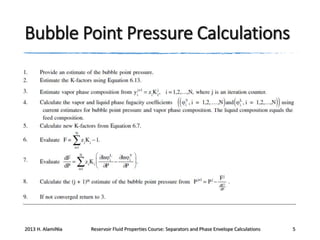
Bubble Point Pressure Calculations

2013 H. AlamiNia

Reservoir Fluid Properties Course: Separators and Phase Envelope Calculations

5
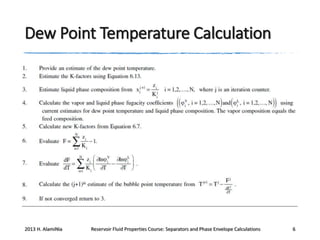
Dew Point Temperature Calculation

2013 H. AlamiNia

Reservoir Fluid Properties Course: Separators and Phase Envelope Calculations

6
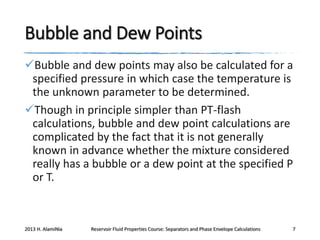
Bubble and Dew Points
Bubble and dew points may also be calculated for a
specified pressure in which case the temperature is
the unknown parameter to be determined.
Though in principle simpler than PT-flash
calculations, bubble and dew point calculations are
complicated by the fact that it is not generally
known in advance whether the mixture considered
really has a bubble or a dew point at the specified P
or T.

2013 H. AlamiNia

Reservoir Fluid Properties Course: Separators and Phase Envelope Calculations

7
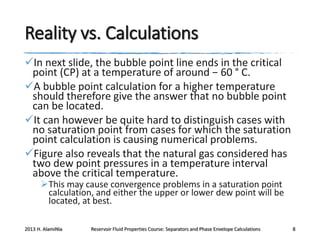
Reality vs. Calculations
In next slide, the bubble point line ends in the critical
point (CP) at a temperature of around − 60 ° C.
A bubble point calculation for a higher temperature
should therefore give the answer that no bubble point
can be located.
It can however be quite hard to distinguish cases with
no saturation point from cases for which the saturation
point calculation is causing numerical problems.
Figure also reveals that the natural gas considered has
two dew point pressures in a temperature interval
above the critical temperature.
This may cause convergence problems in a saturation point
calculation, and either the upper or lower dew point will be
located, at best.

2013 H. AlamiNia

Reservoir Fluid Properties Course: Separators and Phase Envelope Calculations

8
Separator Calculations
The manner in which the hydrocarbon phases are
separated at the surface influences the stock tank oil
recovery.
The principal means of surface separation of gas and oil
is the conventional stage separation. Stage separation is
a process in which gaseous and liquid hydrocarbons are
flashed (separated) into vapor and liquid phases by two
or more separators.
These separators are usually operated in series at
consecutively lower pressure. Each condition of
pressure and temperature at which hydrocarbon phases
are flashed is called a stage of separation. Traditionally,
the stock-tank is normally considered a separate stage
of separation.
2013 H. AlamiNia

Reservoir Fluid Properties Course: Separators and Phase Envelope Calculations

10
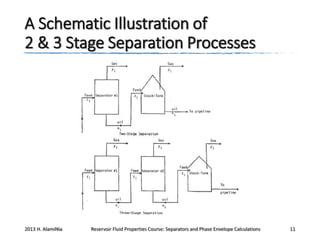
A Schematic Illustration of
2 & 3 Stage Separation Processes

2013 H. AlamiNia

Reservoir Fluid Properties Course: Separators and Phase Envelope Calculations

11
Types of Gas-Oil Separation
Mechanically, there are two types of gas-oil separation:
''Differential'' separation
''Flash'' or ''equilibrium" separation

To explain the various separation processes, it is
convenient to define the composition of a hydrocarbon
mixture by three groups of components:
The very volatile components ("lights''), such as nitrogen,
methane, and ethane.
The components of intermediate volatility, i.e., intermediate,
such as propane through hexane.
The components of less volatility, or the ''heavies," such as
heptane and heavier components.
2013 H. AlamiNia

Reservoir Fluid Properties Course: Separators and Phase Envelope Calculations

12
Differential Separation in Reality
In the differential separation, the liberated gas (which is
composed mainly of lighter components) is removed
from contact with the oil as the pressure on the oil is
reduced.
When the gas is separated in this manner, the
maximum amount of heavy and intermediate
components will remain in the liquid, there will be
minimum shrinkage of the oil and, therefore, greater
stock-tank oil recovery will occur.
This is due to the fact that the gas liberated earlier at
higher pressures is not present at lower pressures to
attract the intermediate and heavy components and
pull them into the gas phase.
2013 H. AlamiNia

Reservoir Fluid Properties Course: Separators and Phase Envelope Calculations

13
Flash Separation in Reality
In the flash (equilibrium) separation, the liberated
gas remains in contact with oil until its
instantaneous removal at the final separation
pressure.
A maximum proportion of intermediate and heavy
components are attracted into the gas phase by this
process and this results in a maximum oil shrinkage
and, thus, a lower oil recovery.

2013 H. AlamiNia

Reservoir Fluid Properties Course: Separators and Phase Envelope Calculations

14
Stage Separation
In practice, the differential process is introduced
first in field separation when gas or liquid is
removed from the primary separator.
In each subsequent stage of separation, the liquid
initially undergoes a flash liberation followed by a
differential process as actual separation occurs.
As the number of stages increases, the differential
aspect of the overall separation becomes greater.
The purpose of stage separation then is to reduce the
pressure on the produced oil in steps so that more stocktank oil recovery will result.
2013 H. AlamiNia

Reservoir Fluid Properties Course: Separators and Phase Envelope Calculations

15
Separator Calculations Goals
Separator calculations are basically performed to
determine:
Optimum separation conditions: separator pressure and
temperature
Compositions of the separated gas and oil phases
Oil formation volume factor
Producing gas-oil ratio
API gravity of the stock-tank oil

2013 H. AlamiNia

Reservoir Fluid Properties Course: Separators and Phase Envelope Calculations

16
High and Low Separator Pressure
If the separator pressure is high, large amounts of
light components will remain in the liquid phase at
the separator and be lost along with other valuable
components to the gas phase at the stock-tank.
On the other hand, if the pressure is too low, large
amounts of light components will be separated
from the liquid and they will attract substantial
quantities of intermediate and heavier
components.

2013 H. AlamiNia

Reservoir Fluid Properties Course: Separators and Phase Envelope Calculations

17
Optimum Separator Pressure
An intermediate pressure, called ''optimum
separator pressure," should be selected to
maximize the oil volume accumulation in the stocktank. This optimum pressure will also yield:
A maximum in the stock-tank API gravity
A minimum in the oil formation volume factor (i.e.,
less oil shrinkage)
A minimum in the gas-oil ratio

2013 H. AlamiNia

Reservoir Fluid Properties Course: Separators and Phase Envelope Calculations

18
Effect of the Separator Pressure on
API, Bo, and Gor

2013 H. AlamiNia

Reservoir Fluid Properties Course: Separators and Phase Envelope Calculations

19
Phase Envelope of Natural Gas

2013 H. AlamiNia

Reservoir Fluid Properties Course: Separators and Phase Envelope Calculations

22
Stability Analysis
A flash calculation presents the problem that the
number of phases is generally not known in
advance.
An important element of a flash calculation is
therefore determination of the number of phases
present.
This may be accomplished by carrying out a stability
analysis. (Using Gibbs free energy concept)
The stability analysis may be extended to test for the
possible presence of three or more phases

2013 H. AlamiNia

Reservoir Fluid Properties Course: Separators and Phase Envelope Calculations

23
Phase Envelope Calculations
A phase envelope may in principle be calculated by
performing a series of saturation point calculations,
but if the complete phase envelope is needed, this
method is not to be recommended.
It is both time consuming and likely to cause
convergence problems at higher pressures and near
the critical point.
The procedure outlined by Michelsen (1980) may
be used instead.

2013 H. AlamiNia

Reservoir Fluid Properties Course: Separators and Phase Envelope Calculations

24
Michelsen’s Technique
Michelsen’s technique for construction of phase
envelopes is not limited to dew and bubble point
lines.
It may also be used to construct inner lines in a
phase envelope, i.e., the PT values for which the
vapor mole fraction equals a specified value.

2013 H. AlamiNia

Reservoir Fluid Properties Course: Separators and Phase Envelope Calculations

25
Phase Envelope of
Oil Mixture Calculated Using SRK EoS

It is seen that the dew and bubble
point lines as well as the inner lines
meet in the critical point at which
the gas and liquid phases are
indistinguishable and the vapor
mole fraction β may therefore be
assigned any value between 0 and
1.

2013 H. AlamiNia

Reservoir Fluid Properties Course: Separators and Phase Envelope Calculations

26
Note about Critical Point
Next slide shows the results of phase envelope
calculations performed for the gas condensate
mixture calculated using PR equation of state.
No critical point is located.
The mixture considered forms three phases in a PT
region at low temperatures. The critical point would
have been located near this region, had the mixture
only formed two phases.
 This example illustrates the fact that a
hydrocarbon mixture will not always have a critical
point.
2013 H. AlamiNia

Reservoir Fluid Properties Course: Separators and Phase Envelope Calculations

27
Phase Envelope of
Gas Condensate Mixture

2013 H. AlamiNia

Reservoir Fluid Properties Course: Separators and Phase Envelope Calculations

28
Two Phase Identification
For water-free mixtures, liquid–liquid splits are
rarely seen for temperatures above 15°C.
If a PT flash calculation for an oil or gas mixture
shows presence of two phases,
The one with lower density is usually assumed to be gas
or vapor, and
The one with higher density is assumed to be liquid or
oil.

2013 H. AlamiNia

Reservoir Fluid Properties Course: Separators and Phase Envelope Calculations

30
One Phase Identification
In the case of a single-phase solution, it is less
obvious whether to consider this single phase to be
a gas or a liquid.
There exists no generally accepted definition to
distinguish a gas from a liquid.

 Because the terms gas and oil are very much used
in the oil industry, it is however of interest to try to
establish a reasonable criterion for distinguishing
between the two types of phases.

2013 H. AlamiNia

Reservoir Fluid Properties Course: Separators and Phase Envelope Calculations

31
One Phase Identification
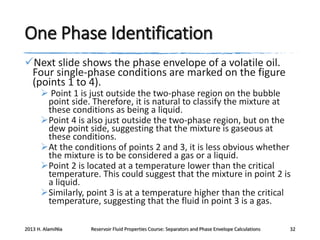
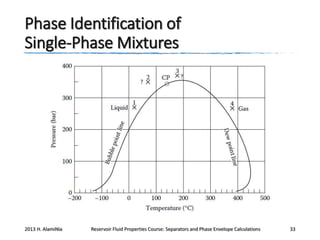
Next slide shows the phase envelope of a volatile oil.
Four single-phase conditions are marked on the figure
(points 1 to 4).

 Point 1 is just outside the two-phase region on the bubble
point side. Therefore, it is natural to classify the mixture at
these conditions as being a liquid.
Point 4 is also just outside the two-phase region, but on the
dew point side, suggesting that the mixture is gaseous at
these conditions.
At the conditions of points 2 and 3, it is less obvious whether
the mixture is to be considered a gas or a liquid.
Point 2 is located at a temperature lower than the critical
temperature. This could suggest that the mixture in point 2 is
a liquid.
Similarly, point 3 is at a temperature higher than the critical
temperature, suggesting that the fluid in point 3 is a gas.

2013 H. AlamiNia

Reservoir Fluid Properties Course: Separators and Phase Envelope Calculations

32
Phase Identification of
Single-Phase Mixtures

2013 H. AlamiNia

Reservoir Fluid Properties Course: Separators and Phase Envelope Calculations

33
Liquid Phase Identification Criterion
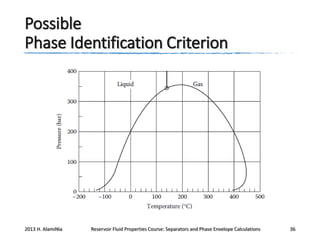
This leads to the following suggestion for a phase
identification criterion
Liquid
1. If the pressure is lower than the critical pressure and
the temperature lower than the bubble point
temperature.
2. If the pressure is higher than the critical pressure and
the temperature lower than the critical temperature.

2013 H. AlamiNia

Reservoir Fluid Properties Course: Separators and Phase Envelope Calculations

34
Gas Phase Identification Criterion
Gas
1. If the pressure is lower than the critical pressure and
the temperature higher than the dew point
temperature.
2. If the pressure is higher than the critical pressure and
the temperature higher than the critical temperature.

2013 H. AlamiNia

Reservoir Fluid Properties Course: Separators and Phase Envelope Calculations

35
Possible
Phase Identification Criterion

2013 H. AlamiNia

Reservoir Fluid Properties Course: Separators and Phase Envelope Calculations

36
1. Pedersen, K.S., Christensen, P.L., and Azeem,
S.J. (2006). Phase behavior of petroleum
reservoir fluids (CRC Press). Ch6.

2013 H. AlamiNia

Reservoir Fluid Properties Course: Separators and Phase Envelope Calculations

37
1. The Estimation of Physical Properties
2. EoS Applications
3. Thermodynamic Properties

2013 H. AlamiNia

Reservoir Fluid Properties Course: Separators and Phase Envelope Calculations

38
Q913 rfp w3 lec 12, Separators and Phase envelope calculations

Q913 rfp w3 lec 12, Separators and Phase envelope calculations

  • 1.
  • 2.
    1. 2. 3. 4. PT-Flash Process Equilibrium Ratios PT-FlashCalculations Mixture Saturation Points 2013 H. AlamiNia Reservoir Fluid Properties Course: Separators and Phase Envelope Calculations 2
  • 3.
    1. 2. 3. 4. Mixture Saturation PointsCalculation Surface Separation Phase Envelope Phase Identification 2013 H. AlamiNia Reservoir Fluid Properties Course: Separators and Phase Envelope Calculations 3
  • 5.
    Bubble Point PressureCalculations 2013 H. AlamiNia Reservoir Fluid Properties Course: Separators and Phase Envelope Calculations 5
  • 6.
    Dew Point TemperatureCalculation 2013 H. AlamiNia Reservoir Fluid Properties Course: Separators and Phase Envelope Calculations 6
  • 7.
    Bubble and DewPoints Bubble and dew points may also be calculated for a specified pressure in which case the temperature is the unknown parameter to be determined. Though in principle simpler than PT-flash calculations, bubble and dew point calculations are complicated by the fact that it is not generally known in advance whether the mixture considered really has a bubble or a dew point at the specified P or T. 2013 H. AlamiNia Reservoir Fluid Properties Course: Separators and Phase Envelope Calculations 7
  • 8.
    Reality vs. Calculations Innext slide, the bubble point line ends in the critical point (CP) at a temperature of around − 60 ° C. A bubble point calculation for a higher temperature should therefore give the answer that no bubble point can be located. It can however be quite hard to distinguish cases with no saturation point from cases for which the saturation point calculation is causing numerical problems. Figure also reveals that the natural gas considered has two dew point pressures in a temperature interval above the critical temperature. This may cause convergence problems in a saturation point calculation, and either the upper or lower dew point will be located, at best. 2013 H. AlamiNia Reservoir Fluid Properties Course: Separators and Phase Envelope Calculations 8
  • 10.
    Separator Calculations The mannerin which the hydrocarbon phases are separated at the surface influences the stock tank oil recovery. The principal means of surface separation of gas and oil is the conventional stage separation. Stage separation is a process in which gaseous and liquid hydrocarbons are flashed (separated) into vapor and liquid phases by two or more separators. These separators are usually operated in series at consecutively lower pressure. Each condition of pressure and temperature at which hydrocarbon phases are flashed is called a stage of separation. Traditionally, the stock-tank is normally considered a separate stage of separation. 2013 H. AlamiNia Reservoir Fluid Properties Course: Separators and Phase Envelope Calculations 10
  • 11.
    A Schematic Illustrationof 2 & 3 Stage Separation Processes 2013 H. AlamiNia Reservoir Fluid Properties Course: Separators and Phase Envelope Calculations 11
  • 12.
    Types of Gas-OilSeparation Mechanically, there are two types of gas-oil separation: ''Differential'' separation ''Flash'' or ''equilibrium" separation To explain the various separation processes, it is convenient to define the composition of a hydrocarbon mixture by three groups of components: The very volatile components ("lights''), such as nitrogen, methane, and ethane. The components of intermediate volatility, i.e., intermediate, such as propane through hexane. The components of less volatility, or the ''heavies," such as heptane and heavier components. 2013 H. AlamiNia Reservoir Fluid Properties Course: Separators and Phase Envelope Calculations 12
  • 13.
    Differential Separation inReality In the differential separation, the liberated gas (which is composed mainly of lighter components) is removed from contact with the oil as the pressure on the oil is reduced. When the gas is separated in this manner, the maximum amount of heavy and intermediate components will remain in the liquid, there will be minimum shrinkage of the oil and, therefore, greater stock-tank oil recovery will occur. This is due to the fact that the gas liberated earlier at higher pressures is not present at lower pressures to attract the intermediate and heavy components and pull them into the gas phase. 2013 H. AlamiNia Reservoir Fluid Properties Course: Separators and Phase Envelope Calculations 13
  • 14.
    Flash Separation inReality In the flash (equilibrium) separation, the liberated gas remains in contact with oil until its instantaneous removal at the final separation pressure. A maximum proportion of intermediate and heavy components are attracted into the gas phase by this process and this results in a maximum oil shrinkage and, thus, a lower oil recovery. 2013 H. AlamiNia Reservoir Fluid Properties Course: Separators and Phase Envelope Calculations 14
  • 15.
    Stage Separation In practice,the differential process is introduced first in field separation when gas or liquid is removed from the primary separator. In each subsequent stage of separation, the liquid initially undergoes a flash liberation followed by a differential process as actual separation occurs. As the number of stages increases, the differential aspect of the overall separation becomes greater. The purpose of stage separation then is to reduce the pressure on the produced oil in steps so that more stocktank oil recovery will result. 2013 H. AlamiNia Reservoir Fluid Properties Course: Separators and Phase Envelope Calculations 15
  • 16.
    Separator Calculations Goals Separatorcalculations are basically performed to determine: Optimum separation conditions: separator pressure and temperature Compositions of the separated gas and oil phases Oil formation volume factor Producing gas-oil ratio API gravity of the stock-tank oil 2013 H. AlamiNia Reservoir Fluid Properties Course: Separators and Phase Envelope Calculations 16
  • 17.
    High and LowSeparator Pressure If the separator pressure is high, large amounts of light components will remain in the liquid phase at the separator and be lost along with other valuable components to the gas phase at the stock-tank. On the other hand, if the pressure is too low, large amounts of light components will be separated from the liquid and they will attract substantial quantities of intermediate and heavier components. 2013 H. AlamiNia Reservoir Fluid Properties Course: Separators and Phase Envelope Calculations 17
  • 18.
    Optimum Separator Pressure Anintermediate pressure, called ''optimum separator pressure," should be selected to maximize the oil volume accumulation in the stocktank. This optimum pressure will also yield: A maximum in the stock-tank API gravity A minimum in the oil formation volume factor (i.e., less oil shrinkage) A minimum in the gas-oil ratio 2013 H. AlamiNia Reservoir Fluid Properties Course: Separators and Phase Envelope Calculations 18
  • 19.
    Effect of theSeparator Pressure on API, Bo, and Gor 2013 H. AlamiNia Reservoir Fluid Properties Course: Separators and Phase Envelope Calculations 19
  • 22.
    Phase Envelope ofNatural Gas 2013 H. AlamiNia Reservoir Fluid Properties Course: Separators and Phase Envelope Calculations 22
  • 23.
    Stability Analysis A flashcalculation presents the problem that the number of phases is generally not known in advance. An important element of a flash calculation is therefore determination of the number of phases present. This may be accomplished by carrying out a stability analysis. (Using Gibbs free energy concept) The stability analysis may be extended to test for the possible presence of three or more phases 2013 H. AlamiNia Reservoir Fluid Properties Course: Separators and Phase Envelope Calculations 23
  • 24.
    Phase Envelope Calculations Aphase envelope may in principle be calculated by performing a series of saturation point calculations, but if the complete phase envelope is needed, this method is not to be recommended. It is both time consuming and likely to cause convergence problems at higher pressures and near the critical point. The procedure outlined by Michelsen (1980) may be used instead. 2013 H. AlamiNia Reservoir Fluid Properties Course: Separators and Phase Envelope Calculations 24
  • 25.
    Michelsen’s Technique Michelsen’s techniquefor construction of phase envelopes is not limited to dew and bubble point lines. It may also be used to construct inner lines in a phase envelope, i.e., the PT values for which the vapor mole fraction equals a specified value. 2013 H. AlamiNia Reservoir Fluid Properties Course: Separators and Phase Envelope Calculations 25
  • 26.
    Phase Envelope of OilMixture Calculated Using SRK EoS It is seen that the dew and bubble point lines as well as the inner lines meet in the critical point at which the gas and liquid phases are indistinguishable and the vapor mole fraction β may therefore be assigned any value between 0 and 1. 2013 H. AlamiNia Reservoir Fluid Properties Course: Separators and Phase Envelope Calculations 26
  • 27.
    Note about CriticalPoint Next slide shows the results of phase envelope calculations performed for the gas condensate mixture calculated using PR equation of state. No critical point is located. The mixture considered forms three phases in a PT region at low temperatures. The critical point would have been located near this region, had the mixture only formed two phases.  This example illustrates the fact that a hydrocarbon mixture will not always have a critical point. 2013 H. AlamiNia Reservoir Fluid Properties Course: Separators and Phase Envelope Calculations 27
  • 28.
    Phase Envelope of GasCondensate Mixture 2013 H. AlamiNia Reservoir Fluid Properties Course: Separators and Phase Envelope Calculations 28
  • 30.
    Two Phase Identification Forwater-free mixtures, liquid–liquid splits are rarely seen for temperatures above 15°C. If a PT flash calculation for an oil or gas mixture shows presence of two phases, The one with lower density is usually assumed to be gas or vapor, and The one with higher density is assumed to be liquid or oil. 2013 H. AlamiNia Reservoir Fluid Properties Course: Separators and Phase Envelope Calculations 30
  • 31.
    One Phase Identification Inthe case of a single-phase solution, it is less obvious whether to consider this single phase to be a gas or a liquid. There exists no generally accepted definition to distinguish a gas from a liquid.  Because the terms gas and oil are very much used in the oil industry, it is however of interest to try to establish a reasonable criterion for distinguishing between the two types of phases. 2013 H. AlamiNia Reservoir Fluid Properties Course: Separators and Phase Envelope Calculations 31
  • 32.
    One Phase Identification Nextslide shows the phase envelope of a volatile oil. Four single-phase conditions are marked on the figure (points 1 to 4).  Point 1 is just outside the two-phase region on the bubble point side. Therefore, it is natural to classify the mixture at these conditions as being a liquid. Point 4 is also just outside the two-phase region, but on the dew point side, suggesting that the mixture is gaseous at these conditions. At the conditions of points 2 and 3, it is less obvious whether the mixture is to be considered a gas or a liquid. Point 2 is located at a temperature lower than the critical temperature. This could suggest that the mixture in point 2 is a liquid. Similarly, point 3 is at a temperature higher than the critical temperature, suggesting that the fluid in point 3 is a gas. 2013 H. AlamiNia Reservoir Fluid Properties Course: Separators and Phase Envelope Calculations 32
  • 33.
    Phase Identification of Single-PhaseMixtures 2013 H. AlamiNia Reservoir Fluid Properties Course: Separators and Phase Envelope Calculations 33
  • 34.
    Liquid Phase IdentificationCriterion This leads to the following suggestion for a phase identification criterion Liquid 1. If the pressure is lower than the critical pressure and the temperature lower than the bubble point temperature. 2. If the pressure is higher than the critical pressure and the temperature lower than the critical temperature. 2013 H. AlamiNia Reservoir Fluid Properties Course: Separators and Phase Envelope Calculations 34
  • 35.
    Gas Phase IdentificationCriterion Gas 1. If the pressure is lower than the critical pressure and the temperature higher than the dew point temperature. 2. If the pressure is higher than the critical pressure and the temperature higher than the critical temperature. 2013 H. AlamiNia Reservoir Fluid Properties Course: Separators and Phase Envelope Calculations 35
  • 36.
    Possible Phase Identification Criterion 2013H. AlamiNia Reservoir Fluid Properties Course: Separators and Phase Envelope Calculations 36
  • 37.
    1. Pedersen, K.S.,Christensen, P.L., and Azeem, S.J. (2006). Phase behavior of petroleum reservoir fluids (CRC Press). Ch6. 2013 H. AlamiNia Reservoir Fluid Properties Course: Separators and Phase Envelope Calculations 37
  • 38.
    1. The Estimationof Physical Properties 2. EoS Applications 3. Thermodynamic Properties 2013 H. AlamiNia Reservoir Fluid Properties Course: Separators and Phase Envelope Calculations 38