PROJECT ON :
PYTHAGORAS THEOREM
PRESENTED BY GROUP 5
CREATED BY SOURAV NETI
SUBJECT TEACHER – D.K. BHUI Sir
GROUP MEMBERS :
SWATI SAGARIKA ROUT ( L )
MITALI GOUDA
SOURAV NETI ( A.L. )
SATYA PRAKASH RAY
RAKESH KUMAR BEHERA
ABHIJEET LENKA
Pythagoras (~580-500 B.C.)
He was a Greek philosopher responsible for important developments in
mathematics, astronomy and the theory of music.
Pythagoras of Samos was an lonian Greek
philosopher, mathematician , and has been credited as
the founder of the movement called Pythagoreanism .
Most of the information about Pythagoras was written
down centuries after he lived , so very little reliable
information is known about him . He was born on the
island of Samos and travelled visiting Egypt and
Greece and maybe India and in 520 BC returned to
Samos . Around 530 BC he moved to Croton in
Magna Graecia , and there established some kind of
school or guild .
Pythagoras made influential contributions to
philosophy and religion in the late 6th century BC . He
is also reversed as a great mathematician and scientist
and is best known for Pythagoras theorem which bears
his name . However , because legend and obfuscation
cloud his work even more than that of the other pre-
Socratic philosophers , one can give only a tentative
account of his teachings , and some have questioned
whether he contributed much to mathematics or natural
philosophy . Many of the accomplishments credited to
Pythagoras may actually have been accomplishments
of his colleagues and successors .
Some accounts mention that the philosophy associated
with Pythagoras was related to mathematics and that
numbers were important . It was said that he was the
first man to call himself as philosopher , or lover of
wisdom , and Pythagorean ideas exercised a marked
influence on Plato , and through him , all of western
philosophy .
SCULPTOR OF
PYTHAGORAS
STATEMENT
In a right triangle the square of hypotenuse is equal to the
sum of the square of other two sides .
MATERIALS REQUIRED
1. Colour paper
2. Pair of scissors
3.Glue
4. Geometry Box
PROCEDURE
1) LET US DRAW A TRIANGLE ABC OF SIDES OF
3CM , 4CM AND 5CM RESPECTIVELY .
2)TAKE OR DRAW ANOTHER TRIANGLE OF
SAME MEASUREMENT AND DRAW OR CUT
SQUARES OF SIDES 3CM , 4CM AND 5CM AND
PASTE THEM ON SIDES OF TRIANGLE .
3)TAKE ANOTHER TWO SQUARES OF SIDES
3CM , 4CM AND 5CM AND PASTE FOUR
TRIANGLES ACCORDING .
4)TAKE ANOTHER SQUARE OF SIDE 5 CM AND
PASTE YOUR PIECES OF THE TRIANGLE , SO
THAT THIS FORM A SQUARE OF SIDE (A+B) .
1. cut a triangle
with base 4 cm
and height 3
cm
0 1 2 3 4 5
4 cm
012345
3cm
2. measure the
length of the
hypotenuse .
Here we have the first figure :
A
B C
a
b
c
FIG 1
a
a
a
a
b
b
b
b
b
a c
c
c
c
c
FIG 2
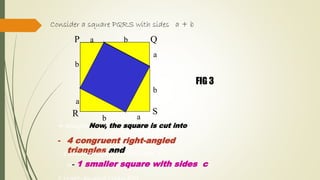
Consider a square PQRS with sides a + b
a
a
a
a
b
b
b
b
c
c
c
c
4 congruNow, the square is cut into
- 4 congruent right-angled
triangles and
- n- 1 smaller square with sides c
- 1 smaller square with sides c .
P Q
R S
FIG 3
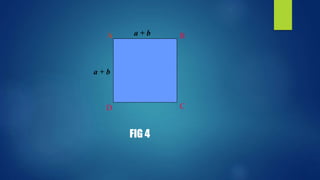
a + b
a + b
A B
CD
FIG 4
a + b
a + b
A B
CD
Area of square ABCD
= (a + b) 2
b
b
a b
b
a
a
a
c
c
c
c
P Q
RS
Area of square PQRS
= 4 + c
2ab
2






a 2 + 2ab + b 2 = 2ab + c 2
a2
+ b2
= c2
FIG 5
Theorem states that:
"The area of the square built upon the hypotenuse of a right triangle is
equal to the sum of the areas of the squares upon the remaining sides."
The Pythagorean Theorem asserts that for a right triangle, the square
of the hypotenuse is equal to the sum of the squares of the other two
sides: a2 + b2 = c2
The figure above at the right is a visual display of the theorem's
conclusion. The figure at the left contains a proof of the theorem,
because the area of the big, outer, green square is equal to the sum of
the areas of the four red triangles and the little, inner white square:
c2 = 4(ab/2) + (a - b)2 = 2ab + (a2 - 2ab + b2) = a2 + b2
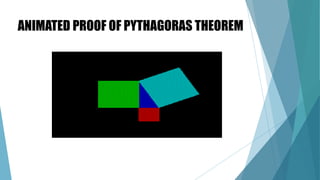
ANIMATED PROOF OF PYTHAGORAS THEOREM
WE HAVE PROVED PYTHAGORAS
THEOREM BUT THERE IS ONE
MORE WAY TO PROVE AND THAT
IS SHOWN FROM THE NEXT
SLIDE .
STATEMENT
In a right triangle the square of hypotenuse is equal to the
sum of the square of other two sides .
MATERIALS REQUIRED
1. Colour paper
2. Pair of scissors
3.Glue
4. Geometry Box
PROCEDURE
1) Let us draw a triangle ABC of sides of 3cm , 4cm and 5cm
respectively .
2)Take or draw another triangle of same measurement and draw
or cut squares of sides 3cm , 4cm and 5cm and paste them on
sides of triangle .
3)Take another two squares of sides 3cm , 4cm and 5cm and paste
four triangles according .
4)Take another square of side 5 cm and paste your pieces of the
triangle , so that this form a square of side (a+b) .
a
a
a
a
b
b
b
b
a
a
a a
b
b
bb
c
c
c
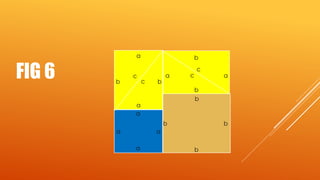
cFIG 6
5) The area of fig.6 and fig.3 are (a+b)^2
respectively . Hence the areas of 5 and 3 are equal
6) Now , we remove four triangles from fig. 5 and 3 .
So the remaining figures must have the same area .
Hence , areas of fig.6 and fig.7 are equal .
b
b
b
b
a
a
a
a
FIG 7
By removing four
triangles from
fig.6 we get
this figure .
Area of square = (side)^2 =
a^2
Similarly,
Area of second square =
(side)^2
=>a^2=a^2+b^2
By removing four triangles from fig.3 we get the
following figure .
a
a
aaFIG 8
Thus , by comparing fig. 7 and 8 we get that [ a^2 + b ^2 ] .
HENCE PROVED
a
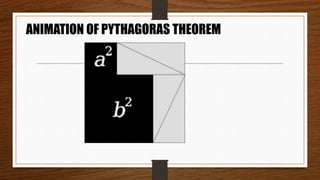
ANIMATION OF PYTHAGORAS THEOREM
THANK
YOU

Pythagoras theorem

  • 1.
    PROJECT ON : PYTHAGORASTHEOREM PRESENTED BY GROUP 5 CREATED BY SOURAV NETI SUBJECT TEACHER – D.K. BHUI Sir
  • 2.
    GROUP MEMBERS : SWATISAGARIKA ROUT ( L ) MITALI GOUDA SOURAV NETI ( A.L. ) SATYA PRAKASH RAY RAKESH KUMAR BEHERA ABHIJEET LENKA
  • 3.
    Pythagoras (~580-500 B.C.) Hewas a Greek philosopher responsible for important developments in mathematics, astronomy and the theory of music.
  • 4.
    Pythagoras of Samoswas an lonian Greek philosopher, mathematician , and has been credited as the founder of the movement called Pythagoreanism . Most of the information about Pythagoras was written down centuries after he lived , so very little reliable information is known about him . He was born on the island of Samos and travelled visiting Egypt and Greece and maybe India and in 520 BC returned to Samos . Around 530 BC he moved to Croton in Magna Graecia , and there established some kind of school or guild .
  • 5.
    Pythagoras made influentialcontributions to philosophy and religion in the late 6th century BC . He is also reversed as a great mathematician and scientist and is best known for Pythagoras theorem which bears his name . However , because legend and obfuscation cloud his work even more than that of the other pre- Socratic philosophers , one can give only a tentative account of his teachings , and some have questioned whether he contributed much to mathematics or natural philosophy . Many of the accomplishments credited to Pythagoras may actually have been accomplishments of his colleagues and successors .
  • 6.
    Some accounts mentionthat the philosophy associated with Pythagoras was related to mathematics and that numbers were important . It was said that he was the first man to call himself as philosopher , or lover of wisdom , and Pythagorean ideas exercised a marked influence on Plato , and through him , all of western philosophy . SCULPTOR OF PYTHAGORAS
  • 7.
    STATEMENT In a righttriangle the square of hypotenuse is equal to the sum of the square of other two sides . MATERIALS REQUIRED 1. Colour paper 2. Pair of scissors 3.Glue 4. Geometry Box
  • 8.
    PROCEDURE 1) LET USDRAW A TRIANGLE ABC OF SIDES OF 3CM , 4CM AND 5CM RESPECTIVELY . 2)TAKE OR DRAW ANOTHER TRIANGLE OF SAME MEASUREMENT AND DRAW OR CUT SQUARES OF SIDES 3CM , 4CM AND 5CM AND PASTE THEM ON SIDES OF TRIANGLE . 3)TAKE ANOTHER TWO SQUARES OF SIDES 3CM , 4CM AND 5CM AND PASTE FOUR TRIANGLES ACCORDING . 4)TAKE ANOTHER SQUARE OF SIDE 5 CM AND PASTE YOUR PIECES OF THE TRIANGLE , SO THAT THIS FORM A SQUARE OF SIDE (A+B) .
  • 9.
    1. cut atriangle with base 4 cm and height 3 cm 0 1 2 3 4 5 4 cm 012345 3cm 2. measure the length of the hypotenuse . Here we have the first figure : A B C a b c FIG 1
  • 10.
  • 11.
    Consider a squarePQRS with sides a + b a a a a b b b b c c c c 4 congruNow, the square is cut into - 4 congruent right-angled triangles and - n- 1 smaller square with sides c - 1 smaller square with sides c . P Q R S FIG 3
  • 12.
    a + b a+ b A B CD FIG 4
  • 13.
    a + b a+ b A B CD Area of square ABCD = (a + b) 2 b b a b b a a a c c c c P Q RS Area of square PQRS = 4 + c 2ab 2       a 2 + 2ab + b 2 = 2ab + c 2 a2 + b2 = c2 FIG 5
  • 14.
    Theorem states that: "Thearea of the square built upon the hypotenuse of a right triangle is equal to the sum of the areas of the squares upon the remaining sides." The Pythagorean Theorem asserts that for a right triangle, the square of the hypotenuse is equal to the sum of the squares of the other two sides: a2 + b2 = c2 The figure above at the right is a visual display of the theorem's conclusion. The figure at the left contains a proof of the theorem, because the area of the big, outer, green square is equal to the sum of the areas of the four red triangles and the little, inner white square: c2 = 4(ab/2) + (a - b)2 = 2ab + (a2 - 2ab + b2) = a2 + b2
  • 15.
    ANIMATED PROOF OFPYTHAGORAS THEOREM
  • 16.
    WE HAVE PROVEDPYTHAGORAS THEOREM BUT THERE IS ONE MORE WAY TO PROVE AND THAT IS SHOWN FROM THE NEXT SLIDE .
  • 17.
    STATEMENT In a righttriangle the square of hypotenuse is equal to the sum of the square of other two sides . MATERIALS REQUIRED 1. Colour paper 2. Pair of scissors 3.Glue 4. Geometry Box
  • 18.
    PROCEDURE 1) Let usdraw a triangle ABC of sides of 3cm , 4cm and 5cm respectively . 2)Take or draw another triangle of same measurement and draw or cut squares of sides 3cm , 4cm and 5cm and paste them on sides of triangle . 3)Take another two squares of sides 3cm , 4cm and 5cm and paste four triangles according . 4)Take another square of side 5 cm and paste your pieces of the triangle , so that this form a square of side (a+b) .
  • 19.
  • 20.
    5) The areaof fig.6 and fig.3 are (a+b)^2 respectively . Hence the areas of 5 and 3 are equal 6) Now , we remove four triangles from fig. 5 and 3 . So the remaining figures must have the same area . Hence , areas of fig.6 and fig.7 are equal . b b b b a a a a FIG 7 By removing four triangles from fig.6 we get this figure . Area of square = (side)^2 = a^2 Similarly, Area of second square = (side)^2 =>a^2=a^2+b^2
  • 21.
    By removing fourtriangles from fig.3 we get the following figure . a a aaFIG 8 Thus , by comparing fig. 7 and 8 we get that [ a^2 + b ^2 ] . HENCE PROVED a
  • 22.
  • 23.