Dharmik Bhatt(17) Jay Patel (28) Aman Juneja(14) Harsh Kahar(20)
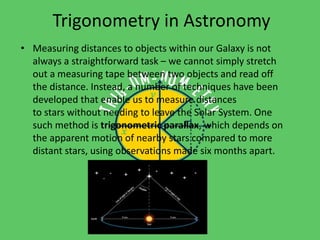
Trigonometry in Astronomy 
• Measuring distances to objects within our Galaxy is not 
always a straightforward task – we cannot simply stretch 
out a measuring tape between two objects and read off 
the distance. Instead, a number of techniques have been 
developed that enable us to measure distances 
to stars without needing to leave the Solar System. One 
such method is trigonometric parallax, which depends on 
the apparent motion of nearby stars compared to more 
distant stars, using observations made six months apart.
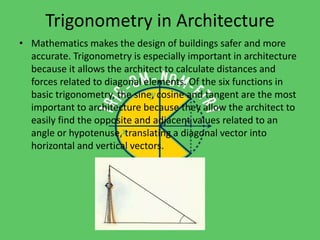
Trigonometry in Architecture 
• Mathematics makes the design of buildings safer and more 
accurate. Trigonometry is especially important in architecture 
because it allows the architect to calculate distances and 
forces related to diagonal elements. Of the six functions in 
basic trigonometry, the sine, cosine and tangent are the most 
important to architecture because they allow the architect to 
easily find the opposite and adjacent values related to an 
angle or hypotenuse, translating a diagonal vector into 
horizontal and vertical vectors.
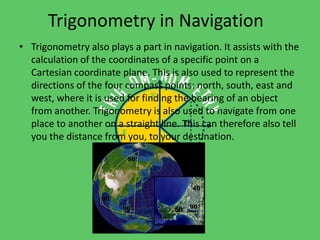
Trigonometry in Navigation 
• Trigonometry also plays a part in navigation. It assists with the 
calculation of the coordinates of a specific point on a 
Cartesian coordinate plane. This is also used to represent the 
directions of the four compass points: north, south, east and 
west, where it is used for finding the bearing of an object 
from another. Trigonometry is also used to navigate from one 
place to another on a straight line. This can therefore also tell 
you the distance from you, to your destination.
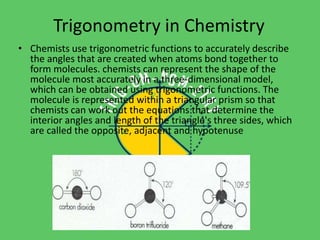
Trigonometry in Chemistry 
• Chemists use trigonometric functions to accurately describe 
the angles that are created when atoms bond together to 
form molecules. chemists can represent the shape of the 
molecule most accurately in a three-dimensional model, 
which can be obtained using trigonometric functions. The 
molecule is represented within a triangular prism so that 
chemists can work out the equations that determine the 
interior angles and length of the triangle's three sides, which 
are called the opposite, adjacent and hypotenuse
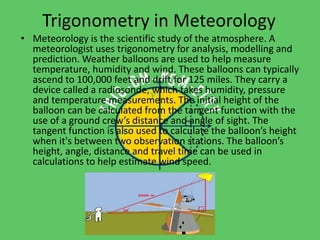
Trigonometry in Meteorology 
• Meteorology is the scientific study of the atmosphere. A 
meteorologist uses trigonometry for analysis, modelling and 
prediction. Weather balloons are used to help measure 
temperature, humidity and wind. These balloons can typically 
ascend to 100,000 feet and drift for 125 miles. They carry a 
device called a radiosonde, which takes humidity, pressure 
and temperature measurements. The initial height of the 
balloon can be calculated from the tangent function with the 
use of a ground crew’s distance and angle of sight. The 
tangent function is also used to calculate the balloon’s height 
when it's between two observation stations. The balloon’s 
height, angle, distance and travel time can be used in 
calculations to help estimate wind speed.
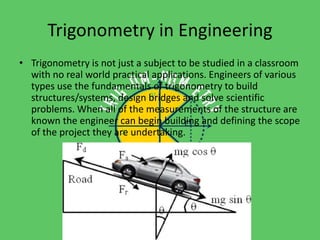
Trigonometry in Engineering 
• Trigonometry is not just a subject to be studied in a classroom 
with no real world practical applications. Engineers of various 
types use the fundamentals of trigonometry to build 
structures/systems, design bridges and solve scientific 
problems. When all of the measurements of the structure are 
known the engineer can begin building and defining the scope 
of the project they are undertaking.
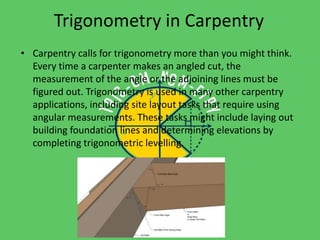
Trigonometry in Carpentry 
• Carpentry calls for trigonometry more than you might think. 
Every time a carpenter makes an angled cut, the 
measurement of the angle or the adjoining lines must be 
figured out. Trigonometry is used in many other carpentry 
applications, including site layout tasks that require using 
angular measurements. These tasks might include laying out 
building foundation lines and determining elevations by 
completing trigonometric levelling.
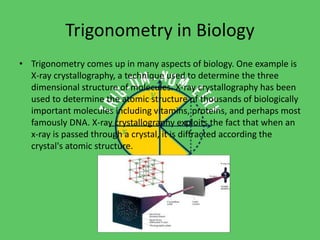
Trigonometry in Biology 
• Trigonometry comes up in many aspects of biology. One example is 
X-ray crystallography, a technique used to determine the three 
dimensional structure of molecules. X-ray crystallography has been 
used to determine the atomic structure of thousands of biologically 
important molecules including vitamins, proteins, and perhaps most 
famously DNA. X-ray crystallography exploits the fact that when an 
x-ray is passed through a crystal, it is diffracted according the 
crystal's atomic structure.
Trigonometry in Forensics 
• Forensics use trigonometry to analyze crime scenes and collect clues. They 
first check for any bullet holes in ceilings, floors and furniture. Next They 
try and re-enact the crime scene in order to try and presume what 
happened. this is where trigonometry comes in. Trigonometry helps them 
to suggest where the suspect or victim was located at the time of the 
incident.For example, a bullet fired into a wall, at an angle of 90° can show 
the investigators the size of the bullet. This can also help to determine the 
specific gun used by the shape of the hole in the wall.If the angle is off by 
even the slightest degree, that makes the hole an ellipse. With a hole of 
this type, investigators can not only determine the size of the bullet, but, 
by using basic trigonometry, they can tell where the bullet came from.
So Maths is not always boring.

Applications of TRIGONOMETRY

  • 1.
    Dharmik Bhatt(17) JayPatel (28) Aman Juneja(14) Harsh Kahar(20)
  • 2.
    Trigonometry in Astronomy • Measuring distances to objects within our Galaxy is not always a straightforward task – we cannot simply stretch out a measuring tape between two objects and read off the distance. Instead, a number of techniques have been developed that enable us to measure distances to stars without needing to leave the Solar System. One such method is trigonometric parallax, which depends on the apparent motion of nearby stars compared to more distant stars, using observations made six months apart.
  • 3.
    Trigonometry in Architecture • Mathematics makes the design of buildings safer and more accurate. Trigonometry is especially important in architecture because it allows the architect to calculate distances and forces related to diagonal elements. Of the six functions in basic trigonometry, the sine, cosine and tangent are the most important to architecture because they allow the architect to easily find the opposite and adjacent values related to an angle or hypotenuse, translating a diagonal vector into horizontal and vertical vectors.
  • 4.
    Trigonometry in Navigation • Trigonometry also plays a part in navigation. It assists with the calculation of the coordinates of a specific point on a Cartesian coordinate plane. This is also used to represent the directions of the four compass points: north, south, east and west, where it is used for finding the bearing of an object from another. Trigonometry is also used to navigate from one place to another on a straight line. This can therefore also tell you the distance from you, to your destination.
  • 5.
    Trigonometry in Chemistry • Chemists use trigonometric functions to accurately describe the angles that are created when atoms bond together to form molecules. chemists can represent the shape of the molecule most accurately in a three-dimensional model, which can be obtained using trigonometric functions. The molecule is represented within a triangular prism so that chemists can work out the equations that determine the interior angles and length of the triangle's three sides, which are called the opposite, adjacent and hypotenuse
  • 6.
    Trigonometry in Meteorology • Meteorology is the scientific study of the atmosphere. A meteorologist uses trigonometry for analysis, modelling and prediction. Weather balloons are used to help measure temperature, humidity and wind. These balloons can typically ascend to 100,000 feet and drift for 125 miles. They carry a device called a radiosonde, which takes humidity, pressure and temperature measurements. The initial height of the balloon can be calculated from the tangent function with the use of a ground crew’s distance and angle of sight. The tangent function is also used to calculate the balloon’s height when it's between two observation stations. The balloon’s height, angle, distance and travel time can be used in calculations to help estimate wind speed.
  • 7.
    Trigonometry in Engineering • Trigonometry is not just a subject to be studied in a classroom with no real world practical applications. Engineers of various types use the fundamentals of trigonometry to build structures/systems, design bridges and solve scientific problems. When all of the measurements of the structure are known the engineer can begin building and defining the scope of the project they are undertaking.
  • 8.
    Trigonometry in Carpentry • Carpentry calls for trigonometry more than you might think. Every time a carpenter makes an angled cut, the measurement of the angle or the adjoining lines must be figured out. Trigonometry is used in many other carpentry applications, including site layout tasks that require using angular measurements. These tasks might include laying out building foundation lines and determining elevations by completing trigonometric levelling.
  • 9.
    Trigonometry in Biology • Trigonometry comes up in many aspects of biology. One example is X-ray crystallography, a technique used to determine the three dimensional structure of molecules. X-ray crystallography has been used to determine the atomic structure of thousands of biologically important molecules including vitamins, proteins, and perhaps most famously DNA. X-ray crystallography exploits the fact that when an x-ray is passed through a crystal, it is diffracted according the crystal's atomic structure.
  • 10.
    Trigonometry in Forensics • Forensics use trigonometry to analyze crime scenes and collect clues. They first check for any bullet holes in ceilings, floors and furniture. Next They try and re-enact the crime scene in order to try and presume what happened. this is where trigonometry comes in. Trigonometry helps them to suggest where the suspect or victim was located at the time of the incident.For example, a bullet fired into a wall, at an angle of 90° can show the investigators the size of the bullet. This can also help to determine the specific gun used by the shape of the hole in the wall.If the angle is off by even the slightest degree, that makes the hole an ellipse. With a hole of this type, investigators can not only determine the size of the bullet, but, by using basic trigonometry, they can tell where the bullet came from.
  • 11.
    So Maths isnot always boring.