WELCOME TO MATHS WITH
       PROFESSOR
PHYTHAGOREAN THEOREM AND
       ITS ORIGIONS
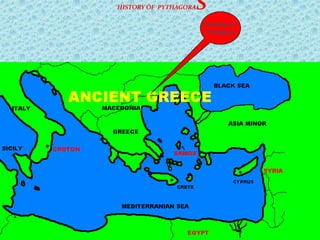
HISTORY OF PYTHAGORA   S
                       Birthplace of
                        Pythagoras
The Pythagorean Order
O Students at the Pythagorean School had
  to live by strict rules since they all strove
  to create pure minds and bodies.
O They all thought that the mind could be
  purified through studying Geometry,
  mathematics, music, and astronomy.
The Pythagorean Order
O Women were allowed to join the Order, but
 they were kept separated from the rest of the
 Order.
Pythagorean Theorem
             What does the formula mean?
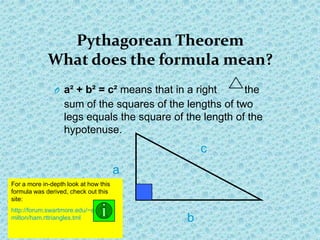
               O a² + b² = c² means that in a right       the
                   sum of the squares of the lengths of two
                   legs equals the square of the length of the
                   hypotenuse.
                                                 c
                                       a
For a more in-depth look at how this
formula was derived, check out this
site:
http://forum.swartmore.edu/~sarah/ha
milton/ham.rttriangles.tml                   b
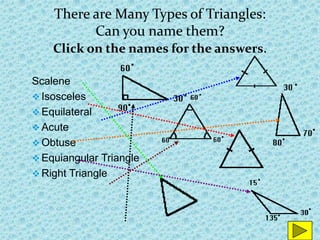
There are Many Types of Triangles:
           Can you name them?
    Click on the names for the answers.

Scalene
 Isosceles
 Equilateral
 Acute
 Obtuse
 Equiangular Triangle
 Right Triangle
Important Contributions
O Pythagoras found mathematical relationships as the
  essence of all things.
O He believed that the earth was spherical and that the sun,
  moon, and planets have movements of their own. This
  contributed to the discovery that the earth revolved around
  the sun.
O He’s credited with developing the Pythagorean Theorem
  which is a formula that is used to determine the lengths of
  the sides of right triangles.
O His discoveries laid the foundation for all subsequent
  developments in Geometry.
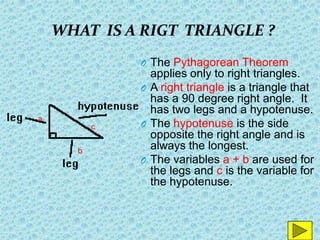
WHAT IS A RIGT TRIANGLE ?
              O The Pythagorean Theorem
                applies only to right triangles.
              O A right triangle is a triangle that
                has a 90 degree right angle. It
                has two legs and a hypotenuse.
a
          c   O The hypotenuse is the side
                opposite the right angle and is
      b
                always the longest.
              O The variables a + b are used for
                the legs and c is the variable for
                the hypotenuse.
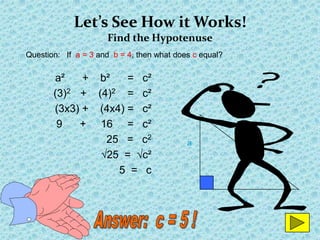
Let’s See How it Works!
                     Find the Hypotenuse
Question: If a = 3 and b = 4, then what does c equal?

       a²    + b²    =         c²
       (3)2 + (4)2 =           c²
       (3x3) + (4x4) =         c²
        9   + 16 =             c²
                25 =           c2          a
                 25 =          c²
                   5 =          c

                                                        b
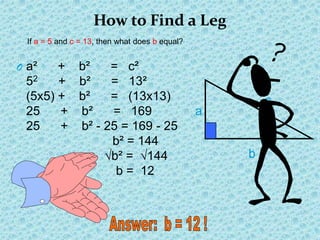
How to Find a Leg
  If a = 5 and c = 13, then what does b equal?


O a²   + b²    = c²
 52    + b²    = 13²
 (5x5) + b²    = (13x13)                                 c
 25    + b²    = 169                             a
 25    + b² - 25 = 169 - 25
               b² = 144
               b² = 144                              b
                b = 12
READ THE NOTES IN THE LINK BELOW BEFORE
         ATTEMPTING THE ASSESMENTS
http://www.math.com/school/subject3/lessons/S3U4L
                   1GL.html

    FINDING A SQUARE ROOT WITHOUT A
                CALCULATOR


http://www.math.com/school/subject1/lessons/S1U1L9
                    DP.html
ONLINE ASSESMENT
Click o the link below and complete the tasks before viewing the
                         memorandum
             http://www.math-aids.com/Pythagorean_Theorem/Pythagoras.html


    FOLLOW THE LINK BELOW TO HAVE PYTHAGOREAN FUNY GAMES
         http://www.math-play.com/Pythagorean-Theorem-Game.html


     FOLLOW THE LINK BELOW TO CALCULATE ANY SQUARE ROOT

    http://www.math.com/students/calculators/source/square-root.htm
PHYTHAGOREAN FACTS AND FILES

      Many proofs of the Pythagorean theorem:
      http://www.cut-the-knot.com/pythagoras/


 And again: http://www.mcn.net/~jimloy/pythag.html

               History and several proofs:
http://jwilson.coe.uga.edu/emt669/Student.Folders/Mo
  rris.Stephanie/EMT.669/Essay.1/Pythagorean.html
          Dr. Math's Pythagorean theorem page:
http://forum.swarthmore.edu/dr.math/faq/faq.pythagore
                         an.html
            Uses of the Pythagorean theorem:
     http://www.geocities.com/primes135/uses.html
REFERENCES

       K von Fritz, Biography in Dictionary of Scientific Biography (New York 1970-1990).
                     http://www.encyclopedia.com/doc/1G2-2830903544.html
                                   ASSESED 12 APRIL 2012

                            Biography in Encyclopaedia Britannica.
                   http://www.britannica.com/eb/article-9062073/Pythagoras
                                  ACCESED 30 APRIL 2012
                                           Books:
 R S Brumbaugh, The philosophers of Greece (Albany, N.Y., 1981).


Buckle Down on Virginia Mathematics, SOL 8, 2nd Edition by Buckle
                      Down Publishing Co.
                         Lesson 7, page 67-70
BEST WIHSHES FROM
          PROFESSOR


HOPE YOU ENJOYED
FOR COMMENT DO NOT HESITATE TO CONTACT ME AT
           PMANGENA 12@GMAIL .COM

Pythagoras theorem history

  • 1.
    WELCOME TO MATHSWITH PROFESSOR PHYTHAGOREAN THEOREM AND ITS ORIGIONS
  • 2.
    HISTORY OF PYTHAGORA S Birthplace of Pythagoras
  • 3.
    The Pythagorean Order OStudents at the Pythagorean School had to live by strict rules since they all strove to create pure minds and bodies. O They all thought that the mind could be purified through studying Geometry, mathematics, music, and astronomy.
  • 4.
    The Pythagorean Order OWomen were allowed to join the Order, but they were kept separated from the rest of the Order.
  • 5.
    Pythagorean Theorem What does the formula mean? O a² + b² = c² means that in a right the sum of the squares of the lengths of two legs equals the square of the length of the hypotenuse. c a For a more in-depth look at how this formula was derived, check out this site: http://forum.swartmore.edu/~sarah/ha milton/ham.rttriangles.tml b
  • 6.
    There are ManyTypes of Triangles: Can you name them? Click on the names for the answers. Scalene  Isosceles  Equilateral  Acute  Obtuse  Equiangular Triangle  Right Triangle
  • 7.
    Important Contributions O Pythagorasfound mathematical relationships as the essence of all things. O He believed that the earth was spherical and that the sun, moon, and planets have movements of their own. This contributed to the discovery that the earth revolved around the sun. O He’s credited with developing the Pythagorean Theorem which is a formula that is used to determine the lengths of the sides of right triangles. O His discoveries laid the foundation for all subsequent developments in Geometry.
  • 8.
    WHAT IS ARIGT TRIANGLE ? O The Pythagorean Theorem applies only to right triangles. O A right triangle is a triangle that has a 90 degree right angle. It has two legs and a hypotenuse. a c O The hypotenuse is the side opposite the right angle and is b always the longest. O The variables a + b are used for the legs and c is the variable for the hypotenuse.
  • 9.
    Let’s See Howit Works! Find the Hypotenuse Question: If a = 3 and b = 4, then what does c equal? a² + b² = c² (3)2 + (4)2 = c² (3x3) + (4x4) = c² 9 + 16 = c² 25 = c2 a 25 = c² 5 = c b
  • 10.
    How to Finda Leg If a = 5 and c = 13, then what does b equal? O a² + b² = c² 52 + b² = 13² (5x5) + b² = (13x13) c 25 + b² = 169 a 25 + b² - 25 = 169 - 25 b² = 144 b² = 144 b b = 12
  • 11.
    READ THE NOTESIN THE LINK BELOW BEFORE ATTEMPTING THE ASSESMENTS http://www.math.com/school/subject3/lessons/S3U4L 1GL.html FINDING A SQUARE ROOT WITHOUT A CALCULATOR http://www.math.com/school/subject1/lessons/S1U1L9 DP.html
  • 12.
    ONLINE ASSESMENT Click othe link below and complete the tasks before viewing the memorandum http://www.math-aids.com/Pythagorean_Theorem/Pythagoras.html FOLLOW THE LINK BELOW TO HAVE PYTHAGOREAN FUNY GAMES http://www.math-play.com/Pythagorean-Theorem-Game.html FOLLOW THE LINK BELOW TO CALCULATE ANY SQUARE ROOT http://www.math.com/students/calculators/source/square-root.htm
  • 13.
    PHYTHAGOREAN FACTS ANDFILES Many proofs of the Pythagorean theorem: http://www.cut-the-knot.com/pythagoras/ And again: http://www.mcn.net/~jimloy/pythag.html History and several proofs: http://jwilson.coe.uga.edu/emt669/Student.Folders/Mo rris.Stephanie/EMT.669/Essay.1/Pythagorean.html Dr. Math's Pythagorean theorem page: http://forum.swarthmore.edu/dr.math/faq/faq.pythagore an.html Uses of the Pythagorean theorem: http://www.geocities.com/primes135/uses.html
  • 14.
    REFERENCES K von Fritz, Biography in Dictionary of Scientific Biography (New York 1970-1990). http://www.encyclopedia.com/doc/1G2-2830903544.html ASSESED 12 APRIL 2012 Biography in Encyclopaedia Britannica. http://www.britannica.com/eb/article-9062073/Pythagoras ACCESED 30 APRIL 2012 Books: R S Brumbaugh, The philosophers of Greece (Albany, N.Y., 1981). Buckle Down on Virginia Mathematics, SOL 8, 2nd Edition by Buckle Down Publishing Co. Lesson 7, page 67-70
  • 15.
    BEST WIHSHES FROM PROFESSOR HOPE YOU ENJOYED FOR COMMENT DO NOT HESITATE TO CONTACT ME AT PMANGENA 12@GMAIL .COM