Download to read offline
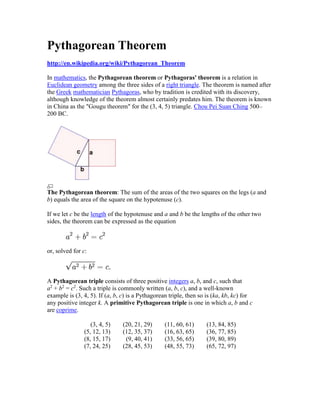

The Pythagorean theorem states that for any right triangle, the square of the hypotenuse is equal to the sum of the squares of the other two sides. Specifically, if c is the length of the hypotenuse and a and b are the lengths of the other two sides, the theorem can be expressed as a2 + b2 = c2. The theorem is named after the Greek mathematician Pythagoras, who is traditionally credited with its discovery. It has applications in many areas of mathematics and is one of the most famous theorems in geometry.


