Poly Vinyl Chloride.
Accidental miracle…….
Introduction
 PVC is the third most used plastic after polyethylene

and poly propylene. Due to its duarability strength and
cost effectiveness it has wide applications.
 On adding plasticizers it is being used as pthalates
which is used in clothing industry, inflatable material
and rubber replacement industries.
 Pure PVC is a white brittle solid, it is insoluble in
alcohol but slightly soluble in Tetra hydro furan.
Discovery
 It was discovered by two chemists working

independently in the nineteenth century. Surprisingly
it was accidental.
 The polymer appeared as a white solid inside flasks of
vinyl chloride that had been left exposed to sunlight.
 It was more flexible and more easily processed
material and hence is widespread in its applications.
Production
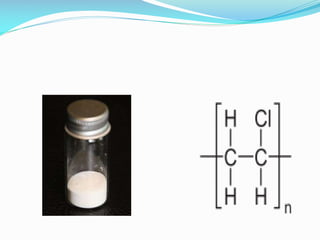
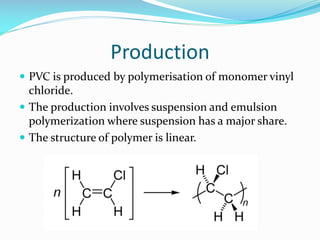
 PVC is produced by polymerisation of monomer vinyl

chloride.
 The production involves suspension and emulsion
polymerization where suspension has a major share.
 The structure of polymer is linear.
 Polymerisation of PVC takes place by addition

polymerisation mainly by free radical mechanism.
 The monomers are mostly arranged head to tail, that is
chlorides on alternating carbon centres.
 PVC has mainly atactic stereo chemistry, which means
that the relative spatial arrangements of the chloride
centres are random.
Suspension polymerisation
 Vinyl chloride monomer and water along with

polymerisation initiator and other additives are taken
into a reactor.
 The reactor is pressurized and the contents are
continually mixed to maintain the suspension and to
ensure the uniform size of formed PVC.
 The reaction is exothermic and thus requires cooling
 As the volume is continually reduced water is added to
maintain the suspension.
Additives
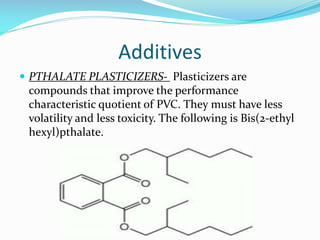
 PTHALATE PLASTICIZERS- Plasticizers are

compounds that improve the performance
characteristic quotient of PVC. They must have less
volatility and less toxicity. The following is Bis(2-ethyl
hexyl)pthalate.
 HEAT STABILIZERS - These are one of the most

important additives. These agents minimise loss of
HCl which is a degradation process that starts at 70
degree celsius.
Once dehydrochlorination starts the process is
autocatalytic and hence it must be minimised.
Derivatives of heavy metals and Calcium stearate are
traditional heat stabilizers.
PHYSICAL PROPERTIES
 Glass Temperature - 82 degree celsius
 Melting Temperature – 100 to 260 degree celsius
 Effective Heat of Combustion – 17.95 MJ/Kg

 Specific Heat – 0.9 KJ/(kg.K)
 Density – 1.1 to 1.45 g/c.c
Properties
 Mechanical- PVC has high hardness. These properties

increases with increasing molecular weights and
decreases with increasing temperatures.
 Thermal- As the heat stability of PVC is very poor we
are adding the heat stabilizers. It starts to decompose
at 140 degrees Celsius and melts at 160 degree Celsius.
 Electrical- PVC is a polymer with good insulation
properties and generally suitable for medium or low
voltage and low frequency insulations.
Chlorinated PVC
 PVC can be usefully modified by chlorination, which

increases its chlorine content .The new material has
higher heat resistance so it is primarily used for hot
water pipes and fittings.
CPVC is produced by chlorination of aqueous
solution of suspension PVC particles followed by
exposure to UV light which initiates the free radical
chlorination.
Applications
PVC is relatively low cost, biological, chemical resistance
and workability of it resulted in it being used in many
applications.
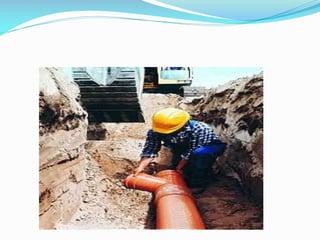
 PIPES- It is used for sewage pipes and other pipe

applications where cost or vulnerability to corrosion
limit the use of metal.
 Electrical cables- PVC is an insulator and hence used
for insulation of electric cables. For this purpose it
must be plasticized
Other applications
 It is used in

Construction
Clothing
Furniture
Sports
Health care
Flooring
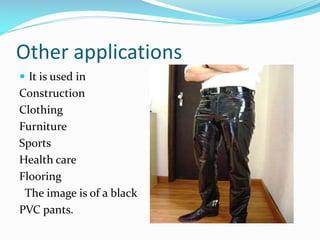
The image is of a black
PVC pants.
Disadvantages
 Recycling difficulty
 It is not recommended for use above 70 degrees






Celsius.
Sensitive to UV and oxidative degradation.
Limited thermal capability.
Thermal decomposition evolves HCl.
Higher density than many plastics.
REFERENCES
 www.australianresearch.com
 www.google.com
 www.sciencedirectory.com

 Wikipedia
THANK YOU
A presentation by

P S V Sai Teja.
D Pramod Reddy.
K Vishnu Teja Reddy.
Nazeem.
B Laxmidhar .

Pvc

  • 1.
  • 2.
    Introduction  PVC isthe third most used plastic after polyethylene and poly propylene. Due to its duarability strength and cost effectiveness it has wide applications.  On adding plasticizers it is being used as pthalates which is used in clothing industry, inflatable material and rubber replacement industries.  Pure PVC is a white brittle solid, it is insoluble in alcohol but slightly soluble in Tetra hydro furan.
  • 4.
    Discovery  It wasdiscovered by two chemists working independently in the nineteenth century. Surprisingly it was accidental.  The polymer appeared as a white solid inside flasks of vinyl chloride that had been left exposed to sunlight.  It was more flexible and more easily processed material and hence is widespread in its applications.
  • 5.
    Production  PVC isproduced by polymerisation of monomer vinyl chloride.  The production involves suspension and emulsion polymerization where suspension has a major share.  The structure of polymer is linear.
  • 6.
     Polymerisation ofPVC takes place by addition polymerisation mainly by free radical mechanism.  The monomers are mostly arranged head to tail, that is chlorides on alternating carbon centres.  PVC has mainly atactic stereo chemistry, which means that the relative spatial arrangements of the chloride centres are random.
  • 7.
    Suspension polymerisation  Vinylchloride monomer and water along with polymerisation initiator and other additives are taken into a reactor.  The reactor is pressurized and the contents are continually mixed to maintain the suspension and to ensure the uniform size of formed PVC.  The reaction is exothermic and thus requires cooling  As the volume is continually reduced water is added to maintain the suspension.
  • 8.
    Additives  PTHALATE PLASTICIZERS-Plasticizers are compounds that improve the performance characteristic quotient of PVC. They must have less volatility and less toxicity. The following is Bis(2-ethyl hexyl)pthalate.
  • 9.
     HEAT STABILIZERS- These are one of the most important additives. These agents minimise loss of HCl which is a degradation process that starts at 70 degree celsius. Once dehydrochlorination starts the process is autocatalytic and hence it must be minimised. Derivatives of heavy metals and Calcium stearate are traditional heat stabilizers.
  • 10.
    PHYSICAL PROPERTIES  GlassTemperature - 82 degree celsius  Melting Temperature – 100 to 260 degree celsius  Effective Heat of Combustion – 17.95 MJ/Kg  Specific Heat – 0.9 KJ/(kg.K)  Density – 1.1 to 1.45 g/c.c
  • 11.
    Properties  Mechanical- PVChas high hardness. These properties increases with increasing molecular weights and decreases with increasing temperatures.  Thermal- As the heat stability of PVC is very poor we are adding the heat stabilizers. It starts to decompose at 140 degrees Celsius and melts at 160 degree Celsius.  Electrical- PVC is a polymer with good insulation properties and generally suitable for medium or low voltage and low frequency insulations.
  • 12.
    Chlorinated PVC  PVCcan be usefully modified by chlorination, which increases its chlorine content .The new material has higher heat resistance so it is primarily used for hot water pipes and fittings. CPVC is produced by chlorination of aqueous solution of suspension PVC particles followed by exposure to UV light which initiates the free radical chlorination.
  • 13.
    Applications PVC is relativelylow cost, biological, chemical resistance and workability of it resulted in it being used in many applications.  PIPES- It is used for sewage pipes and other pipe applications where cost or vulnerability to corrosion limit the use of metal.  Electrical cables- PVC is an insulator and hence used for insulation of electric cables. For this purpose it must be plasticized
  • 15.
    Other applications  Itis used in Construction Clothing Furniture Sports Health care Flooring The image is of a black PVC pants.
  • 16.
    Disadvantages  Recycling difficulty It is not recommended for use above 70 degrees     Celsius. Sensitive to UV and oxidative degradation. Limited thermal capability. Thermal decomposition evolves HCl. Higher density than many plastics.
  • 17.
  • 18.
    THANK YOU A presentationby P S V Sai Teja. D Pramod Reddy. K Vishnu Teja Reddy. Nazeem. B Laxmidhar .