POLYVINYL CHLORIDE
Polyvinyl chloride (PVC) is the world's third-most widely produced
synthetic plastic polymer (after polyethylene and polypropylene).
About 40 million tons of PVC are produced each year.
PVC comes in two basic forms:
I. Rigid (RPVC)
II. Flexible. (PPVC)
I. Rigid (RPVC or uPVC)
The rigid form of PVC is used in construction for pipe and in profile
applications such as doors and windows. It is also used in making bottles,
non-food packaging, food-covering sheets,[8]
and cards (such as bank or
membership cards).
II. Flexible (PPVC)
It can be made softer and more flexible by the addition of plasticizers, the
most widely used being phthalates. In this form, it is also used in plumbing,
electrical cable insulation, imitation leather, flooring,
signage, phonograph records, inflatable products, and many applications
where it replaces rubber. With cotton or linen, it is used in the production
of canvas.
Pure polyvinyl chloride is a white, brittle solid. It is insoluble in alcohol but
slightly soluble in tetrahydrofuran (THF).
Strengths Limitations
Rigid PVC
 Low cost & high stiffness
 Intrinsic flame retardant
 FDA compliant & also suitable for
transparent applications
 Better chemical resistance than plasticized
PVC
 Good electrical insulation & vapor barrier
properties
 Difficult to melt process
 Limited solvent stress cracking
resistance
 Becomes brittle at 5°C (when not
modified with impact modifiers
and/or processing aids)
 Low continuous service
temperature of 50°C
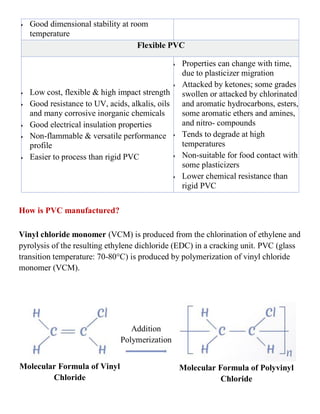
 Good dimensional stability at room
temperature
Flexible PVC
 Low cost, flexible & high impact strength
 Good resistance to UV, acids, alkalis, oils
and many corrosive inorganic chemicals
 Good electrical insulation properties
 Non-flammable & versatile performance
profile
 Easier to process than rigid PVC
 Properties can change with time,
due to plasticizer migration
 Attacked by ketones; some grades
swollen or attacked by chlorinated
and aromatic hydrocarbons, esters,
some aromatic ethers and amines,
and nitro- compounds
 Tends to degrade at high
temperatures
 Non-suitable for food contact with
some plasticizers
 Lower chemical resistance than
rigid PVC
How is PVC manufactured?
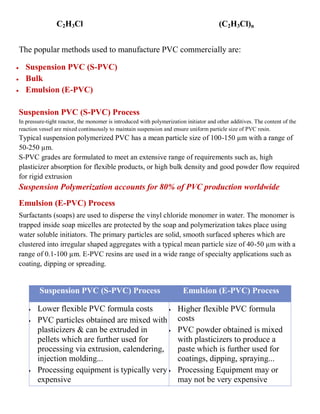
Vinyl chloride monomer (VCM) is produced from the chlorination of ethylene and
pyrolysis of the resulting ethylene dichloride (EDC) in a cracking unit. PVC (glass
transition temperature: 70-80°C) is produced by polymerization of vinyl chloride
monomer (VCM).
Molecular Formula of Vinyl
Chloride
Addition
Polymerization
Molecular Formula of Polyvinyl
Chloride
C2H3Cl (C2H3Cl)n
The popular methods used to manufacture PVC commercially are:
 Suspension PVC (S-PVC)
 Bulk
 Emulsion (E-PVC)
Suspension PVC (S-PVC) Process
In pressure-tight reactor, the monomer is introduced with polymerization initiator and other additives. The content of the
reaction vessel are mixed continuously to maintain suspension and ensure uniform particle size of PVC resin.
Typical suspension polymerized PVC has a mean particle size of 100-150 µm with a range of
50-250 µm.
S-PVC grades are formulated to meet an extensive range of requirements such as, high
plasticizer absorption for flexible products, or high bulk density and good powder flow required
for rigid extrusion
Suspension Polymerization accounts for 80% of PVC production worldwide
Emulsion (E-PVC) Process
Surfactants (soaps) are used to disperse the vinyl chloride monomer in water. The monomer is
trapped inside soap micelles are protected by the soap and polymerization takes place using
water soluble initiators. The primary particles are solid, smooth surfaced spheres which are
clustered into irregular shaped aggregates with a typical mean particle size of 40-50 µm with a
range of 0.1-100 µm. E-PVC resins are used in a wide range of specialty applications such as
coating, dipping or spreading.
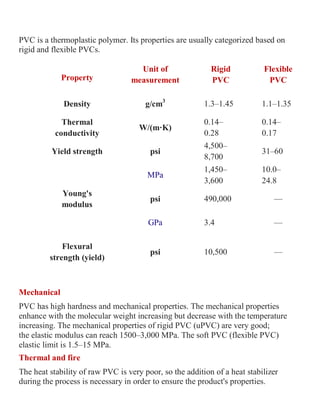
Suspension PVC (S-PVC) Process Emulsion (E-PVC) Process
 Lower flexible PVC formula costs
 PVC particles obtained are mixed with
plasticizers & can be extruded in
pellets which are further used for
processing via extrusion, calendering,
injection molding...
 Processing equipment is typically very
expensive
 Higher flexible PVC formula
costs
 PVC powder obtained is mixed
with plasticizers to produce a
paste which is further used for
coatings, dipping, spraying...
 Processing Equipment may or
may not be very expensive
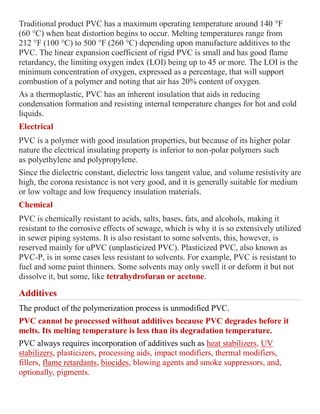
PVC is a thermoplastic polymer. Its properties are usually categorized based on
rigid and flexible PVCs.
Property
Unit of
measurement
Rigid
PVC
Flexible
PVC
Density g/cm3
1.3–1.45 1.1–1.35
Thermal
conductivity
W/(m·K)
0.14–
0.28
0.14–
0.17
Yield strength psi
4,500–
8,700
31–60
MPa
1,450–
3,600
10.0–
24.8
Young's
modulus
psi 490,000 —
GPa 3.4 —
Flexural
strength (yield)
psi 10,500 —
Mechanical
PVC has high hardness and mechanical properties. The mechanical properties
enhance with the molecular weight increasing but decrease with the temperature
increasing. The mechanical properties of rigid PVC (uPVC) are very good;
the elastic modulus can reach 1500–3,000 MPa. The soft PVC (flexible PVC)
elastic limit is 1.5–15 MPa.
Thermal and fire
The heat stability of raw PVC is very poor, so the addition of a heat stabilizer
during the process is necessary in order to ensure the product's properties.
Traditional product PVC has a maximum operating temperature around 140 °F
(60 °C) when heat distortion begins to occur. Melting temperatures range from
212 °F (100 °C) to 500 °F (260 °C) depending upon manufacture additives to the
PVC. The linear expansion coefficient of rigid PVC is small and has good flame
retardancy, the limiting oxygen index (LOI) being up to 45 or more. The LOI is the
minimum concentration of oxygen, expressed as a percentage, that will support
combustion of a polymer and noting that air has 20% content of oxygen.
As a thermoplastic, PVC has an inherent insulation that aids in reducing
condensation formation and resisting internal temperature changes for hot and cold
liquids.
Electrical
PVC is a polymer with good insulation properties, but because of its higher polar
nature the electrical insulating property is inferior to non-polar polymers such
as polyethylene and polypropylene.
Since the dielectric constant, dielectric loss tangent value, and volume resistivity are
high, the corona resistance is not very good, and it is generally suitable for medium
or low voltage and low frequency insulation materials.
Chemical
PVC is chemically resistant to acids, salts, bases, fats, and alcohols, making it
resistant to the corrosive effects of sewage, which is why it is so extensively utilized
in sewer piping systems. It is also resistant to some solvents, this, however, is
reserved mainly for uPVC (unplasticized PVC). Plasticized PVC, also known as
PVC-P, is in some cases less resistant to solvents. For example, PVC is resistant to
fuel and some paint thinners. Some solvents may only swell it or deform it but not
dissolve it, but some, like tetrahydrofuran or acetone.
Additives
The product of the polymerization process is unmodified PVC.
PVC cannot be processed without additives because PVC degrades before it
melts. Its melting temperature is less than its degradation temperature.
PVC always requires incorporation of additives such as heat stabilizers, UV
stabilizers, plasticizers, processing aids, impact modifiers, thermal modifiers,
fillers, flame retardants, biocides, blowing agents and smoke suppressors, and,
optionally, pigments.
The choice of additives used for the PVC finished product is controlled by the cost
performance requirements of the end use specification (underground pipe, window
frames, intravenous tubing and flooring all have very different ingredients to suit
their performance requirements).
Applications
PVC is used extensively in sewage pipes due to its low cost, chemical resistance
and ease of jointing
Pipes
Roughly half of the world's PVC resin manufactured annually is used for producing
pipes for municipal and industrial applications.[27]
In the private homeowner
market, it accounts for
66% 75% to of the household market
The use of chlorinated polyvinyl chloride (CPVC) pipe for use in residential
water supply piping systems.
Electric cables
PVC is commonly used as the insulation on electrical cables.
Flexible PVC coated wire and cable for electrical use has traditionally been
stabilised with lead, but these are being replaced with calcium-zinc based systems.
In a fire, PVC-coated wires can form hydrogen chloride fumes; the chlorine serves
to scavenge free radicals and is the source of the material's fire retardancy.
Hydrogen chloride fumes can also pose a health hazard. It dissolves in moisture and
breaks down onto surfaces, particularly in areas where the air is cool enough to
breathe, and is not available for inhalation.
Applications where smoke is a major hazard (notably in tunnels and communal
areas), PVC-free cable insulation is preferred, such as low smoke zero halogen
(LSZH) insulation.
Construction
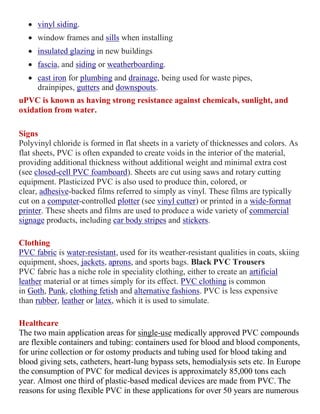
If no plasticizers are added, it is known as uPVC (unplasticized polyvinyl chloride) or
rigid PVC.
uPVC is extensively used in the building industry as a low-maintenance material,
 vinyl siding.
 window frames and sills when installing
 insulated glazing in new buildings
 fascia, and siding or weatherboarding.
 cast iron for plumbing and drainage, being used for waste pipes,
drainpipes, gutters and downspouts.
uPVC is known as having strong resistance against chemicals, sunlight, and
oxidation from water.
Signs
Polyvinyl chloride is formed in flat sheets in a variety of thicknesses and colors. As
flat sheets, PVC is often expanded to create voids in the interior of the material,
providing additional thickness without additional weight and minimal extra cost
(see closed-cell PVC foamboard). Sheets are cut using saws and rotary cutting
equipment. Plasticized PVC is also used to produce thin, colored, or
clear, adhesive-backed films referred to simply as vinyl. These films are typically
cut on a computer-controlled plotter (see vinyl cutter) or printed in a wide-format
printer. These sheets and films are used to produce a wide variety of commercial
signage products, including car body stripes and stickers.
Clothing
PVC fabric is water-resistant, used for its weather-resistant qualities in coats, skiing
equipment, shoes, jackets, aprons, and sports bags. Black PVC Trousers
PVC fabric has a niche role in speciality clothing, either to create an artificial
leather material or at times simply for its effect. PVC clothing is common
in Goth, Punk, clothing fetish and alternative fashions. PVC is less expensive
than rubber, leather or latex, which it is used to simulate.
Healthcare
The two main application areas for single-use medically approved PVC compounds
are flexible containers and tubing: containers used for blood and blood components,
for urine collection or for ostomy products and tubing used for blood taking and
blood giving sets, catheters, heart-lung bypass sets, hemodialysis sets etc. In Europe
the consumption of PVC for medical devices is approximately 85,000 tons each
year. Almost one third of plastic-based medical devices are made from PVC. The
reasons for using flexible PVC in these applications for over 50 years are numerous
and based on cost effectiveness linked to transparency, light weight, softness, tear
strength, kink resistance, suitability for sterilization and biocompatibility.
Flooring
Flexible PVC flooring is inexpensive and used in a variety of buildings, including
homes, hospitals, offices, and schools. The smooth, tough surface of the upper wear
layer prevents the buildup of dirt, which prevents microbes from breeding in areas
that need to be kept sterile, such as hospitals and clinics.
Wire rope
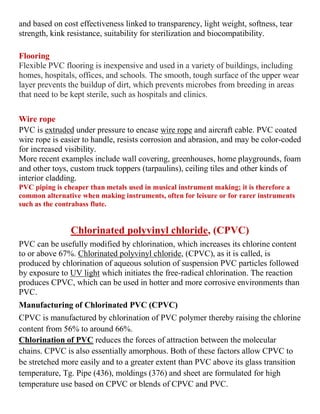
PVC is extruded under pressure to encase wire rope and aircraft cable. PVC coated
wire rope is easier to handle, resists corrosion and abrasion, and may be color-coded
for increased visibility.
More recent examples include wall covering, greenhouses, home playgrounds, foam
and other toys, custom truck toppers (tarpaulins), ceiling tiles and other kinds of
interior cladding.
PVC piping is cheaper than metals used in musical instrument making; it is therefore a
common alternative when making instruments, often for leisure or for rarer instruments
such as the contrabass flute.
Chlorinated polyvinyl chloride, (CPVC)
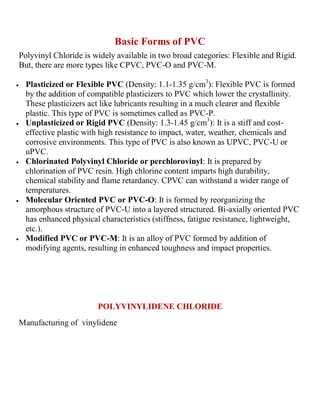
PVC can be usefully modified by chlorination, which increases its chlorine content
to or above 67%. Chlorinated polyvinyl chloride, (CPVC), as it is called, is
produced by chlorination of aqueous solution of suspension PVC particles followed
by exposure to UV light which initiates the free-radical chlorination. The reaction
produces CPVC, which can be used in hotter and more corrosive environments than
PVC.
Manufacturing of Chlorinated PVC (CPVC)
CPVC is manufactured by chlorination of PVC polymer thereby raising the chlorine
content from 56% to around 66%.
Chlorination of PVC reduces the forces of attraction between the molecular
chains. CPVC is also essentially amorphous. Both of these factors allow CPVC to
be stretched more easily and to a greater extent than PVC above its glass transition
temperature, Tg. Pipe (436), moldings (376) and sheet are formulated for high
temperature use based on CPVC or blends of CPVC and PVC.
Basic Forms of PVC
Polyvinyl Chloride is widely available in two broad categories: Flexible and Rigid.
But, there are more types like CPVC, PVC-O and PVC-M.
 Plasticized or Flexible PVC (Density: 1.1-1.35 g/cm3
): Flexible PVC is formed
by the addition of compatible plasticizers to PVC which lower the crystallinity.
These plasticizers act like lubricants resulting in a much clearer and flexible
plastic. This type of PVC is sometimes called as PVC-P.
 Unplasticized or Rigid PVC (Density: 1.3-1.45 g/cm3
): It is a stiff and cost-
effective plastic with high resistance to impact, water, weather, chemicals and
corrosive environments. This type of PVC is also known as UPVC, PVC-U or
uPVC.
 Chlorinated Polyvinyl Chloride or perchlorovinyl: It is prepared by
chlorination of PVC resin. High chlorine content imparts high durability,
chemical stability and flame retardancy. CPVC can withstand a wider range of
temperatures.
 Molecular Oriented PVC or PVC-O: It is formed by reorganizing the
amorphous structure of PVC-U into a layered structured. Bi-axially oriented PVC
has enhanced physical characteristics (stiffness, fatigue resistance, lightweight,
etc.).
 Modified PVC or PVC-M: It is an alloy of PVC formed by addition of
modifying agents, resulting in enhanced toughness and impact properties.
POLYVINYLIDENE CHLORIDE
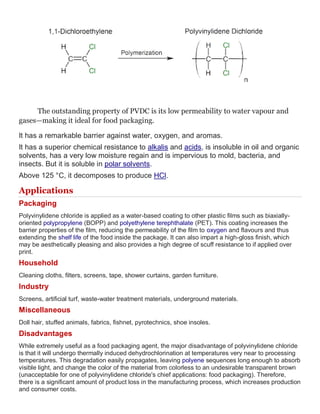
Manufacturing of vinylidene
The outstanding property of PVDC is its low permeability to water vapour and
gases—making it ideal for food packaging.
It has a remarkable barrier against water, oxygen, and aromas.
It has a superior chemical resistance to alkalis and acids, is insoluble in oil and organic
solvents, has a very low moisture regain and is impervious to mold, bacteria, and
insects. But it is soluble in polar solvents.
Above 125 °C, it decomposes to produce HCl.
Applications
Packaging
Polyvinylidene chloride is applied as a water-based coating to other plastic films such as biaxially-
oriented polypropylene (BOPP) and polyethylene terephthalate (PET). This coating increases the
barrier properties of the film, reducing the permeability of the film to oxygen and flavours and thus
extending the shelf life of the food inside the package. It can also impart a high-gloss finish, which
may be aesthetically pleasing and also provides a high degree of scuff resistance to if applied over
print.
Household
Cleaning cloths, filters, screens, tape, shower curtains, garden furniture.
Industry
Screens, artificial turf, waste-water treatment materials, underground materials.
Miscellaneous
Doll hair, stuffed animals, fabrics, fishnet, pyrotechnics, shoe insoles.
Disadvantages
While extremely useful as a food packaging agent, the major disadvantage of polyvinylidene chloride
is that it will undergo thermally induced dehydrochlorination at temperatures very near to processing
temperatures. This degradation easily propagates, leaving polyene sequences long enough to absorb
visible light, and change the color of the material from colorless to an undesirable transparent brown
(unacceptable for one of polyvinylidene chloride's chief applications: food packaging). Therefore,
there is a significant amount of product loss in the manufacturing process, which increases production
and consumer costs.
Trademarks (producers)
 Saran TC and Saran LS (Asahi-Kasei)
 (formerly) Saran Wrap and Saranex (Dow Chemical)
 Ixan and Diofan (SolVin)
 SK Saran
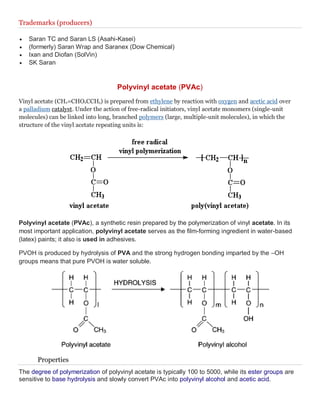
Polyvinyl acetate (PVAc)
Vinyl acetate (CH2=CHO2CCH3) is prepared from ethylene by reaction with oxygen and acetic acid over
a palladium catalyst. Under the action of free-radical initiators, vinyl acetate monomers (single-unit
molecules) can be linked into long, branched polymers (large, multiple-unit molecules), in which the
structure of the vinyl acetate repeating units is:
Polyvinyl acetate (PVAc), a synthetic resin prepared by the polymerization of vinyl acetate. In its
most important application, polyvinyl acetate serves as the film-forming ingredient in water-based
(latex) paints; it also is used in adhesives.
PVOH is produced by hydrolysis of PVA and the strong hydrogen bonding imparted by the –OH
groups means that pure PVOH is water soluble.
Properties
The degree of polymerization of polyvinyl acetate is typically 100 to 5000, while its ester groups are
sensitive to base hydrolysis and slowly convert PVAc into polyvinyl alcohol and acetic acid.
The glass transition temperature of polyvinyl acetate is between 30 and 45 °C depending on the
molecular weight.
PVAc emulsions such as Elmer's Glue-All contain polyvinyl alcohol as a protective colloid. In alkaline
conditions, boron compounds such as boric acid or borax cause the polyvinyl alcohol to cross-link,
forming tackifying precipitates or toys, such as Slime and Flubber.
A number of microorganisms can degrade polyvinyl acetate. Most commonly, damage is caused by
filamentous fungi—however algae, yeasts, lichens, and bacteria can also degrade polyvinyl acetate.[2]
Applications
As an emulsion in water, PVAc emulsions are used as adhesives for porous materials, particularly
for wood, paper, and cloth, and as a consolidant for porous building stone, in particular sandstone.[5]
Applications-
 as wood glue, PVAc is known as "white glue" and the yellow as "carpenter's glue".
 as paper adhesive during paper packaging conversion
 in bookbinding and book arts, due to its flexible strong bond and non-acidic nature (unlike many
other polymers). The use of PVAc on the Archimedes Palimpsest during the 20th century greatly
hindered the task of disbinding the book and preserving and imaging the pages in the early 21st
century, in part because the glue was stronger than the parchment it held together.[6]
 in handicrafts
 as envelope adhesive
 as wallpaper adhesive
 as a primer for drywall and other substrates
 as a gum base in chewing gum[7]
 as an adhesive for cigarette paper[8]
The stiff homopolymer PVAc, but mostly the more soft copolymer, a combination of vinyl acetate and
ethylene, vinyl acetate ethylene (VAE), is also used in paper coatings, paint and other industrial
coatings, as a binder in nonwovens in glass fibers, sanitary napkins, filter paper and in textile
finishing.
Polyvinyl acetate is also the raw material to make other polymers like:
 Polyvinyl alcohol -[HOCHCH2]-: Polyvinyl acetate is partially or completely hydrolysed to give
polyvinyl alcohol. This reversible saponification and esterification reaction was a strong hint
for Hermann Staudinger in the formulation of his theory of macromolecules.[9]
 Polyvinyl acetate phthalate (PVAP): Polyvinyl acetate is partially hydrolyzed and then esterified
with phthalic acid.

PVC and vinyl polymers.pdf

  • 1.
    POLYVINYL CHLORIDE Polyvinyl chloride(PVC) is the world's third-most widely produced synthetic plastic polymer (after polyethylene and polypropylene). About 40 million tons of PVC are produced each year. PVC comes in two basic forms: I. Rigid (RPVC) II. Flexible. (PPVC) I. Rigid (RPVC or uPVC) The rigid form of PVC is used in construction for pipe and in profile applications such as doors and windows. It is also used in making bottles, non-food packaging, food-covering sheets,[8] and cards (such as bank or membership cards). II. Flexible (PPVC) It can be made softer and more flexible by the addition of plasticizers, the most widely used being phthalates. In this form, it is also used in plumbing, electrical cable insulation, imitation leather, flooring, signage, phonograph records, inflatable products, and many applications where it replaces rubber. With cotton or linen, it is used in the production of canvas. Pure polyvinyl chloride is a white, brittle solid. It is insoluble in alcohol but slightly soluble in tetrahydrofuran (THF). Strengths Limitations Rigid PVC  Low cost & high stiffness  Intrinsic flame retardant  FDA compliant & also suitable for transparent applications  Better chemical resistance than plasticized PVC  Good electrical insulation & vapor barrier properties  Difficult to melt process  Limited solvent stress cracking resistance  Becomes brittle at 5°C (when not modified with impact modifiers and/or processing aids)  Low continuous service temperature of 50°C
  • 2.
     Good dimensionalstability at room temperature Flexible PVC  Low cost, flexible & high impact strength  Good resistance to UV, acids, alkalis, oils and many corrosive inorganic chemicals  Good electrical insulation properties  Non-flammable & versatile performance profile  Easier to process than rigid PVC  Properties can change with time, due to plasticizer migration  Attacked by ketones; some grades swollen or attacked by chlorinated and aromatic hydrocarbons, esters, some aromatic ethers and amines, and nitro- compounds  Tends to degrade at high temperatures  Non-suitable for food contact with some plasticizers  Lower chemical resistance than rigid PVC How is PVC manufactured? Vinyl chloride monomer (VCM) is produced from the chlorination of ethylene and pyrolysis of the resulting ethylene dichloride (EDC) in a cracking unit. PVC (glass transition temperature: 70-80°C) is produced by polymerization of vinyl chloride monomer (VCM). Molecular Formula of Vinyl Chloride Addition Polymerization Molecular Formula of Polyvinyl Chloride
  • 3.
    C2H3Cl (C2H3Cl)n The popularmethods used to manufacture PVC commercially are:  Suspension PVC (S-PVC)  Bulk  Emulsion (E-PVC) Suspension PVC (S-PVC) Process In pressure-tight reactor, the monomer is introduced with polymerization initiator and other additives. The content of the reaction vessel are mixed continuously to maintain suspension and ensure uniform particle size of PVC resin. Typical suspension polymerized PVC has a mean particle size of 100-150 µm with a range of 50-250 µm. S-PVC grades are formulated to meet an extensive range of requirements such as, high plasticizer absorption for flexible products, or high bulk density and good powder flow required for rigid extrusion Suspension Polymerization accounts for 80% of PVC production worldwide Emulsion (E-PVC) Process Surfactants (soaps) are used to disperse the vinyl chloride monomer in water. The monomer is trapped inside soap micelles are protected by the soap and polymerization takes place using water soluble initiators. The primary particles are solid, smooth surfaced spheres which are clustered into irregular shaped aggregates with a typical mean particle size of 40-50 µm with a range of 0.1-100 µm. E-PVC resins are used in a wide range of specialty applications such as coating, dipping or spreading. Suspension PVC (S-PVC) Process Emulsion (E-PVC) Process  Lower flexible PVC formula costs  PVC particles obtained are mixed with plasticizers & can be extruded in pellets which are further used for processing via extrusion, calendering, injection molding...  Processing equipment is typically very expensive  Higher flexible PVC formula costs  PVC powder obtained is mixed with plasticizers to produce a paste which is further used for coatings, dipping, spraying...  Processing Equipment may or may not be very expensive
  • 4.
    PVC is athermoplastic polymer. Its properties are usually categorized based on rigid and flexible PVCs. Property Unit of measurement Rigid PVC Flexible PVC Density g/cm3 1.3–1.45 1.1–1.35 Thermal conductivity W/(m·K) 0.14– 0.28 0.14– 0.17 Yield strength psi 4,500– 8,700 31–60 MPa 1,450– 3,600 10.0– 24.8 Young's modulus psi 490,000 — GPa 3.4 — Flexural strength (yield) psi 10,500 — Mechanical PVC has high hardness and mechanical properties. The mechanical properties enhance with the molecular weight increasing but decrease with the temperature increasing. The mechanical properties of rigid PVC (uPVC) are very good; the elastic modulus can reach 1500–3,000 MPa. The soft PVC (flexible PVC) elastic limit is 1.5–15 MPa. Thermal and fire The heat stability of raw PVC is very poor, so the addition of a heat stabilizer during the process is necessary in order to ensure the product's properties.
  • 5.
    Traditional product PVChas a maximum operating temperature around 140 °F (60 °C) when heat distortion begins to occur. Melting temperatures range from 212 °F (100 °C) to 500 °F (260 °C) depending upon manufacture additives to the PVC. The linear expansion coefficient of rigid PVC is small and has good flame retardancy, the limiting oxygen index (LOI) being up to 45 or more. The LOI is the minimum concentration of oxygen, expressed as a percentage, that will support combustion of a polymer and noting that air has 20% content of oxygen. As a thermoplastic, PVC has an inherent insulation that aids in reducing condensation formation and resisting internal temperature changes for hot and cold liquids. Electrical PVC is a polymer with good insulation properties, but because of its higher polar nature the electrical insulating property is inferior to non-polar polymers such as polyethylene and polypropylene. Since the dielectric constant, dielectric loss tangent value, and volume resistivity are high, the corona resistance is not very good, and it is generally suitable for medium or low voltage and low frequency insulation materials. Chemical PVC is chemically resistant to acids, salts, bases, fats, and alcohols, making it resistant to the corrosive effects of sewage, which is why it is so extensively utilized in sewer piping systems. It is also resistant to some solvents, this, however, is reserved mainly for uPVC (unplasticized PVC). Plasticized PVC, also known as PVC-P, is in some cases less resistant to solvents. For example, PVC is resistant to fuel and some paint thinners. Some solvents may only swell it or deform it but not dissolve it, but some, like tetrahydrofuran or acetone. Additives The product of the polymerization process is unmodified PVC. PVC cannot be processed without additives because PVC degrades before it melts. Its melting temperature is less than its degradation temperature. PVC always requires incorporation of additives such as heat stabilizers, UV stabilizers, plasticizers, processing aids, impact modifiers, thermal modifiers, fillers, flame retardants, biocides, blowing agents and smoke suppressors, and, optionally, pigments.
  • 6.
    The choice ofadditives used for the PVC finished product is controlled by the cost performance requirements of the end use specification (underground pipe, window frames, intravenous tubing and flooring all have very different ingredients to suit their performance requirements). Applications PVC is used extensively in sewage pipes due to its low cost, chemical resistance and ease of jointing Pipes Roughly half of the world's PVC resin manufactured annually is used for producing pipes for municipal and industrial applications.[27] In the private homeowner market, it accounts for 66% 75% to of the household market The use of chlorinated polyvinyl chloride (CPVC) pipe for use in residential water supply piping systems. Electric cables PVC is commonly used as the insulation on electrical cables. Flexible PVC coated wire and cable for electrical use has traditionally been stabilised with lead, but these are being replaced with calcium-zinc based systems. In a fire, PVC-coated wires can form hydrogen chloride fumes; the chlorine serves to scavenge free radicals and is the source of the material's fire retardancy. Hydrogen chloride fumes can also pose a health hazard. It dissolves in moisture and breaks down onto surfaces, particularly in areas where the air is cool enough to breathe, and is not available for inhalation. Applications where smoke is a major hazard (notably in tunnels and communal areas), PVC-free cable insulation is preferred, such as low smoke zero halogen (LSZH) insulation. Construction If no plasticizers are added, it is known as uPVC (unplasticized polyvinyl chloride) or rigid PVC. uPVC is extensively used in the building industry as a low-maintenance material,
  • 7.
     vinyl siding. window frames and sills when installing  insulated glazing in new buildings  fascia, and siding or weatherboarding.  cast iron for plumbing and drainage, being used for waste pipes, drainpipes, gutters and downspouts. uPVC is known as having strong resistance against chemicals, sunlight, and oxidation from water. Signs Polyvinyl chloride is formed in flat sheets in a variety of thicknesses and colors. As flat sheets, PVC is often expanded to create voids in the interior of the material, providing additional thickness without additional weight and minimal extra cost (see closed-cell PVC foamboard). Sheets are cut using saws and rotary cutting equipment. Plasticized PVC is also used to produce thin, colored, or clear, adhesive-backed films referred to simply as vinyl. These films are typically cut on a computer-controlled plotter (see vinyl cutter) or printed in a wide-format printer. These sheets and films are used to produce a wide variety of commercial signage products, including car body stripes and stickers. Clothing PVC fabric is water-resistant, used for its weather-resistant qualities in coats, skiing equipment, shoes, jackets, aprons, and sports bags. Black PVC Trousers PVC fabric has a niche role in speciality clothing, either to create an artificial leather material or at times simply for its effect. PVC clothing is common in Goth, Punk, clothing fetish and alternative fashions. PVC is less expensive than rubber, leather or latex, which it is used to simulate. Healthcare The two main application areas for single-use medically approved PVC compounds are flexible containers and tubing: containers used for blood and blood components, for urine collection or for ostomy products and tubing used for blood taking and blood giving sets, catheters, heart-lung bypass sets, hemodialysis sets etc. In Europe the consumption of PVC for medical devices is approximately 85,000 tons each year. Almost one third of plastic-based medical devices are made from PVC. The reasons for using flexible PVC in these applications for over 50 years are numerous
  • 8.
    and based oncost effectiveness linked to transparency, light weight, softness, tear strength, kink resistance, suitability for sterilization and biocompatibility. Flooring Flexible PVC flooring is inexpensive and used in a variety of buildings, including homes, hospitals, offices, and schools. The smooth, tough surface of the upper wear layer prevents the buildup of dirt, which prevents microbes from breeding in areas that need to be kept sterile, such as hospitals and clinics. Wire rope PVC is extruded under pressure to encase wire rope and aircraft cable. PVC coated wire rope is easier to handle, resists corrosion and abrasion, and may be color-coded for increased visibility. More recent examples include wall covering, greenhouses, home playgrounds, foam and other toys, custom truck toppers (tarpaulins), ceiling tiles and other kinds of interior cladding. PVC piping is cheaper than metals used in musical instrument making; it is therefore a common alternative when making instruments, often for leisure or for rarer instruments such as the contrabass flute. Chlorinated polyvinyl chloride, (CPVC) PVC can be usefully modified by chlorination, which increases its chlorine content to or above 67%. Chlorinated polyvinyl chloride, (CPVC), as it is called, is produced by chlorination of aqueous solution of suspension PVC particles followed by exposure to UV light which initiates the free-radical chlorination. The reaction produces CPVC, which can be used in hotter and more corrosive environments than PVC. Manufacturing of Chlorinated PVC (CPVC) CPVC is manufactured by chlorination of PVC polymer thereby raising the chlorine content from 56% to around 66%. Chlorination of PVC reduces the forces of attraction between the molecular chains. CPVC is also essentially amorphous. Both of these factors allow CPVC to be stretched more easily and to a greater extent than PVC above its glass transition temperature, Tg. Pipe (436), moldings (376) and sheet are formulated for high temperature use based on CPVC or blends of CPVC and PVC.
  • 9.
    Basic Forms ofPVC Polyvinyl Chloride is widely available in two broad categories: Flexible and Rigid. But, there are more types like CPVC, PVC-O and PVC-M.  Plasticized or Flexible PVC (Density: 1.1-1.35 g/cm3 ): Flexible PVC is formed by the addition of compatible plasticizers to PVC which lower the crystallinity. These plasticizers act like lubricants resulting in a much clearer and flexible plastic. This type of PVC is sometimes called as PVC-P.  Unplasticized or Rigid PVC (Density: 1.3-1.45 g/cm3 ): It is a stiff and cost- effective plastic with high resistance to impact, water, weather, chemicals and corrosive environments. This type of PVC is also known as UPVC, PVC-U or uPVC.  Chlorinated Polyvinyl Chloride or perchlorovinyl: It is prepared by chlorination of PVC resin. High chlorine content imparts high durability, chemical stability and flame retardancy. CPVC can withstand a wider range of temperatures.  Molecular Oriented PVC or PVC-O: It is formed by reorganizing the amorphous structure of PVC-U into a layered structured. Bi-axially oriented PVC has enhanced physical characteristics (stiffness, fatigue resistance, lightweight, etc.).  Modified PVC or PVC-M: It is an alloy of PVC formed by addition of modifying agents, resulting in enhanced toughness and impact properties. POLYVINYLIDENE CHLORIDE Manufacturing of vinylidene
  • 10.
    The outstanding propertyof PVDC is its low permeability to water vapour and gases—making it ideal for food packaging. It has a remarkable barrier against water, oxygen, and aromas. It has a superior chemical resistance to alkalis and acids, is insoluble in oil and organic solvents, has a very low moisture regain and is impervious to mold, bacteria, and insects. But it is soluble in polar solvents. Above 125 °C, it decomposes to produce HCl. Applications Packaging Polyvinylidene chloride is applied as a water-based coating to other plastic films such as biaxially- oriented polypropylene (BOPP) and polyethylene terephthalate (PET). This coating increases the barrier properties of the film, reducing the permeability of the film to oxygen and flavours and thus extending the shelf life of the food inside the package. It can also impart a high-gloss finish, which may be aesthetically pleasing and also provides a high degree of scuff resistance to if applied over print. Household Cleaning cloths, filters, screens, tape, shower curtains, garden furniture. Industry Screens, artificial turf, waste-water treatment materials, underground materials. Miscellaneous Doll hair, stuffed animals, fabrics, fishnet, pyrotechnics, shoe insoles. Disadvantages While extremely useful as a food packaging agent, the major disadvantage of polyvinylidene chloride is that it will undergo thermally induced dehydrochlorination at temperatures very near to processing temperatures. This degradation easily propagates, leaving polyene sequences long enough to absorb visible light, and change the color of the material from colorless to an undesirable transparent brown (unacceptable for one of polyvinylidene chloride's chief applications: food packaging). Therefore, there is a significant amount of product loss in the manufacturing process, which increases production and consumer costs.
  • 11.
    Trademarks (producers)  SaranTC and Saran LS (Asahi-Kasei)  (formerly) Saran Wrap and Saranex (Dow Chemical)  Ixan and Diofan (SolVin)  SK Saran Polyvinyl acetate (PVAc) Vinyl acetate (CH2=CHO2CCH3) is prepared from ethylene by reaction with oxygen and acetic acid over a palladium catalyst. Under the action of free-radical initiators, vinyl acetate monomers (single-unit molecules) can be linked into long, branched polymers (large, multiple-unit molecules), in which the structure of the vinyl acetate repeating units is: Polyvinyl acetate (PVAc), a synthetic resin prepared by the polymerization of vinyl acetate. In its most important application, polyvinyl acetate serves as the film-forming ingredient in water-based (latex) paints; it also is used in adhesives. PVOH is produced by hydrolysis of PVA and the strong hydrogen bonding imparted by the –OH groups means that pure PVOH is water soluble. Properties The degree of polymerization of polyvinyl acetate is typically 100 to 5000, while its ester groups are sensitive to base hydrolysis and slowly convert PVAc into polyvinyl alcohol and acetic acid.
  • 12.
    The glass transitiontemperature of polyvinyl acetate is between 30 and 45 °C depending on the molecular weight. PVAc emulsions such as Elmer's Glue-All contain polyvinyl alcohol as a protective colloid. In alkaline conditions, boron compounds such as boric acid or borax cause the polyvinyl alcohol to cross-link, forming tackifying precipitates or toys, such as Slime and Flubber. A number of microorganisms can degrade polyvinyl acetate. Most commonly, damage is caused by filamentous fungi—however algae, yeasts, lichens, and bacteria can also degrade polyvinyl acetate.[2] Applications As an emulsion in water, PVAc emulsions are used as adhesives for porous materials, particularly for wood, paper, and cloth, and as a consolidant for porous building stone, in particular sandstone.[5] Applications-  as wood glue, PVAc is known as "white glue" and the yellow as "carpenter's glue".  as paper adhesive during paper packaging conversion  in bookbinding and book arts, due to its flexible strong bond and non-acidic nature (unlike many other polymers). The use of PVAc on the Archimedes Palimpsest during the 20th century greatly hindered the task of disbinding the book and preserving and imaging the pages in the early 21st century, in part because the glue was stronger than the parchment it held together.[6]  in handicrafts  as envelope adhesive  as wallpaper adhesive  as a primer for drywall and other substrates  as a gum base in chewing gum[7]  as an adhesive for cigarette paper[8] The stiff homopolymer PVAc, but mostly the more soft copolymer, a combination of vinyl acetate and ethylene, vinyl acetate ethylene (VAE), is also used in paper coatings, paint and other industrial coatings, as a binder in nonwovens in glass fibers, sanitary napkins, filter paper and in textile finishing. Polyvinyl acetate is also the raw material to make other polymers like:  Polyvinyl alcohol -[HOCHCH2]-: Polyvinyl acetate is partially or completely hydrolysed to give polyvinyl alcohol. This reversible saponification and esterification reaction was a strong hint for Hermann Staudinger in the formulation of his theory of macromolecules.[9]  Polyvinyl acetate phthalate (PVAP): Polyvinyl acetate is partially hydrolyzed and then esterified with phthalic acid.