Quaid-e-Awam University of Engineering, Science &
Technology Nawabshah
PULSE CODE MODULATION (PCM)
Department of Electronic Engineering
What is Pulse code Modulation(PCM)?
The most common technique to change an analog signal to digital data
(digitization) is called pulse code modulation (PCM).
A pulse code modulation is a digital technique in which
the amplitude of an analogue signal is converted to a binary value
represented as a series of pulses.
In others words Pulse-code modulation is a method used to digitally
represent sampled analog signals. It is the standard form of digital
audio in computers, compact discs, digital telephony and other digital
audio applications.
Why digital transmission?
Less susceptible to interference cause by noise due to discrete level.
Easy to detect errors due to discrete level.
Easy to encrypt (higher security).
Simpler to store a digital signal.
Cheaper to implement due to advancement in digital electronics.
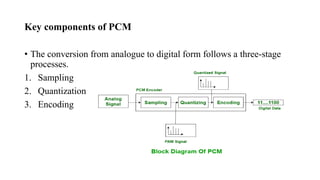
Key components of PCM
• The conversion from analogue to digital form follows a three-stage
processes.
1. Sampling
2. Quantization
3. Encoding
We know by now the benefits of digital signals and systems but most
signals of practical interest are still analog.
 Voice, Video
 RADAR signals
 Biological signals etc
So in order to utilize those benefits, we need to convert our analog
signals into digital.
This process is called A/D conversion.
Sampling: Conversion from continuous-time, continuous valued signal
to discrete-time, continuous-valued signal.(process of measuring the
amplitude of the analogue signal at a regular intervals.)
Sampling operation is performed in accordance with the sampling
theorem.
The sampling theorem essentially says that a signal has to be sampled
at least with twice the frequency of the original signal.
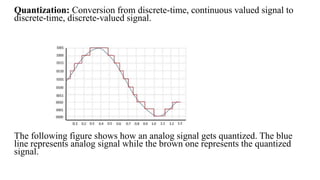
Quantization: Conversion from discrete-time, continuous valued signal to
discrete-time, discrete-valued signal.
The following figure shows how an analog signal gets quantized. The blue
line represents analog signal while the brown one represents the quantized
signal.
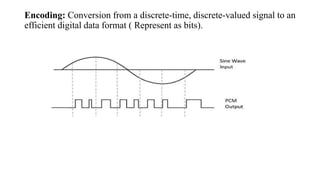
Encoding: Conversion from a discrete-time, discrete-valued signal to an
efficient digital data format ( Represent as bits).
Pros and Cons of PCM
PROS
It has a higher noise immunity.
It has a higher transmitter efficiency.
Low manufacturing cost.
Useful for long-distance communication.
Good performance over a very poor transmission path.
The PCM convenient for long-distance communication.
Due to its digital nature, we can easily store PCM signals.
CONS
Large bandwidth is required for transmission.
he difference between original analog signal and translated digital signal is called
quantizing error.
Applications of PCM
Telecommunication: PCM is widely used in telecomunication for
voice communication over telephone networks.
Audio Recording: PCM forms the basis of the digital audio recording
such as CDs ,DVDs.
Instrumentation and measurements: PCM is employed in
measurements and instrumentation system to digitalize analogue
signals from sensors .it enables the accurate representation , analysis
and processing of the measured data
Pulse code modulation

Pulse code modulation

  • 1.
    Quaid-e-Awam University ofEngineering, Science & Technology Nawabshah PULSE CODE MODULATION (PCM) Department of Electronic Engineering
  • 2.
    What is Pulsecode Modulation(PCM)? The most common technique to change an analog signal to digital data (digitization) is called pulse code modulation (PCM). A pulse code modulation is a digital technique in which the amplitude of an analogue signal is converted to a binary value represented as a series of pulses. In others words Pulse-code modulation is a method used to digitally represent sampled analog signals. It is the standard form of digital audio in computers, compact discs, digital telephony and other digital audio applications.
  • 3.
    Why digital transmission? Lesssusceptible to interference cause by noise due to discrete level. Easy to detect errors due to discrete level. Easy to encrypt (higher security). Simpler to store a digital signal. Cheaper to implement due to advancement in digital electronics.
  • 4.
    Key components ofPCM • The conversion from analogue to digital form follows a three-stage processes. 1. Sampling 2. Quantization 3. Encoding
  • 5.
    We know bynow the benefits of digital signals and systems but most signals of practical interest are still analog.  Voice, Video  RADAR signals  Biological signals etc So in order to utilize those benefits, we need to convert our analog signals into digital. This process is called A/D conversion.
  • 6.
    Sampling: Conversion fromcontinuous-time, continuous valued signal to discrete-time, continuous-valued signal.(process of measuring the amplitude of the analogue signal at a regular intervals.) Sampling operation is performed in accordance with the sampling theorem. The sampling theorem essentially says that a signal has to be sampled at least with twice the frequency of the original signal.
  • 7.
    Quantization: Conversion fromdiscrete-time, continuous valued signal to discrete-time, discrete-valued signal. The following figure shows how an analog signal gets quantized. The blue line represents analog signal while the brown one represents the quantized signal.
  • 8.
    Encoding: Conversion froma discrete-time, discrete-valued signal to an efficient digital data format ( Represent as bits).
  • 9.
    Pros and Consof PCM PROS It has a higher noise immunity. It has a higher transmitter efficiency. Low manufacturing cost. Useful for long-distance communication. Good performance over a very poor transmission path. The PCM convenient for long-distance communication. Due to its digital nature, we can easily store PCM signals. CONS Large bandwidth is required for transmission. he difference between original analog signal and translated digital signal is called quantizing error.
  • 10.
    Applications of PCM Telecommunication:PCM is widely used in telecomunication for voice communication over telephone networks. Audio Recording: PCM forms the basis of the digital audio recording such as CDs ,DVDs. Instrumentation and measurements: PCM is employed in measurements and instrumentation system to digitalize analogue signals from sensors .it enables the accurate representation , analysis and processing of the measured data