
PRESENTED BY: GANDHI SONAM MUKESHCHANDRA
              M.PHARM
              INDUSTRIAL PHARMACY

                                           1
Pulmonary Drug Delivery system
“Pulmonary drug delivery describes various
 systems,devices,formulations & method of delivery of
 drugs to the lung for the treatment of:
Diseases of the respiratory tract.
For systemic delivery via the drug.”


 Once the drug is administered they readily pass into
 the blood stream without the need of any enhancers


                                                        2
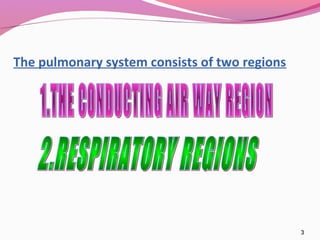
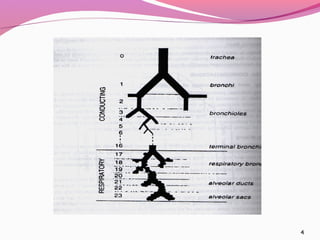
The pulmonary system consists of two regions


                                               3
4
Mechanism of drug
absorption
Drug diffusion through alveoli.


Absorption through aqueous pores by carrier
 mediated transport.

phagocytosis of insoluble particles allow absorption
 of compounds with low lipophilicity & or high
 molecular weight.


                                                        5
Inhaleables
 Advanced technology for pulmonary delivery is
 expanding a category of drugs called Inhaleables defined
 as respiratory & systemic therapies administered simply
 by inhaling.

Advantages:
It supply drugs into the blood stream directly.
It provide a non-invasive method of drugs delivery.
It furnish very rapid onset of action similar to I.V.route.


                                                               6
Aerosols
 Aerosol preparations are stable suspensions of solid
 material & liquid droplets in a gaseous medium.

The drug delivery by aerosols is deposited in the
 airways by:
Gravitational sedimentation
Diffusion


 The term atomizer is used for a device that generates
 an aerosol & may be powdered by
 electrically/mechanically.
                                                     7
Advantages of an aerosol
A dose can be removed without contamination of
 remaining material.
The medication can be delivered directly to the
 affected area in a desired form such as spray or
 stable form.
Irritation produced by mechanical application of
 topical medication is reduced or eliminated.
Minimum contamination.
Maximum stability.

                                                    8
Limitations of aerosols
Poor patient compliance.


Irritant activity .


Increase bronco constriction.


High cost of mfg.


                                 9
Formulation of aerosol
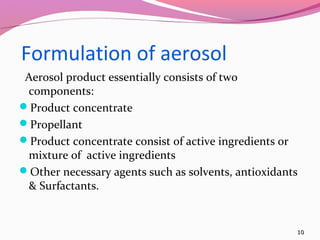
 Aerosol product essentially consists of two
 components:
Product concentrate
Propellant
Product concentrate consist of active ingredients or
 mixture of active ingredients
Other necessary agents such as solvents, antioxidants
 & Surfactants.


                                                     10
Propellant
Single or blend of various propellants are used.
It is selected to give the desired vapour pressure,
 solubility & particle size.
Propellants can be with active ingredients in many
 different ways producing products with varying
 characteristics.
Depending on the type of aerosol system utilized,the
 pharmaceutical aerosol may be dispensed as fine mist,wet
 spray & semi-solid or solid.

                                                       11
Methods of Inhalation delivery
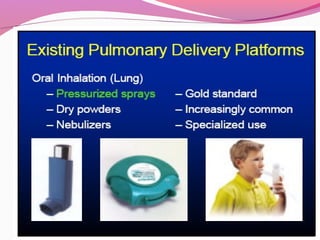
•Aerosols

•Pulmonary metered dose inhalers (PMDIs)

•Dry powder inhalers (DPIs)

•Nebulizers


                                           12
13
Metered dose inhalers(MDIs)
Is a device that helps to deliver a specific
  amount of medication to the lungs.
It is commonly used to treat asthma, chronic
  obstructive pulmonary disease(COPD).
It is composed of 4 essential components.
1.The base formulation-
   drug ,propellant,excipients.
2.The container.
3.Metering valve .
4.The actuator (mouth piece).
                                                14
Propellants:
Commonly CFC propellants are used because of their
 low pulmonary toxicity , high chemical stability and
 purity and compatibility, Non-inflammable.
But now a days the CFC propellants are replaced with
 Hydrofluoroalkanes(HFAs) as these CFC cause the
 ozone depletion effect.

Examples: trichlorofluromethane
         dichlorodifluoromethane
     1.2.dichlorotetrafluromethane.

                                                      15
Surfactants
These are added to maintain the drug in dispersed
  state & promotes stability of formulation.

 It is also lubricates the valve.


Examples : oleic acid ,sorbitol.


                                                     16
Containers & valve
 Usually the container is made up of aluminum or
  glass.

 Glass containers are normally plastic coated or
  laminated to enhances their ability to ensure internal
  pressures of high magnitude.


                                                       17
Metering valves
These are designed to release a fixed volume of
 product during each actuation.

Usually valves volumes range from 25 to 100ml
 although larger volume are available.


                                                   18
DRY POWDER INHALERS

This device dispenses a powder in a stream of inspired
 air.

These are environmentally friend since they do not
 require CFC propellants for drug dispersion.

Self medication is possible.


                                                      19
Two types of dry powder inhaler

Passive dry powder inhaler
  Ex: Disc Inhaler, Easy haler

Active dry powder inhaler
  Ex: spiors,prohaler.


                                  20
Advantages
Product and formulation stability


High drug volume delivery per puff


low susceptibility to microbial growth


Applicable to both soluble and insoluble
 drugs
Self medication is possible
                                            21
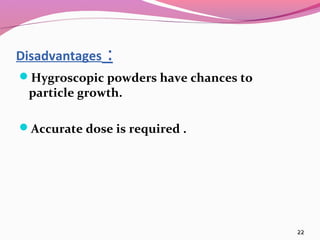
Disadvantages   :
Hygroscopic powders have chances to
 particle growth.

Accurate dose is required .


                                       22
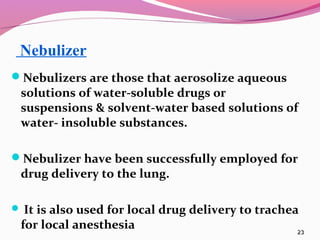
Nebulizer
Nebulizers are those that aerosolize aqueous
 solutions of water-soluble drugs 0r
 suspensions & solvent-water based solutions of
 water- insoluble substances.

Nebulizer have been successfully employed for
 drug delivery to the lung.

 It is also used for local drug delivery to trachea
 for local anesthesia                              23
There are two types of Nebulizer

1. Pneumatic Nebulizer :-It derives from
   pressurized gas source
   ex:- jet or hydro dynamic type

2. Electrical Nebulizer :-It operates from an
    electric source
   ex:-ultra sonic Nebulizer


                                                24
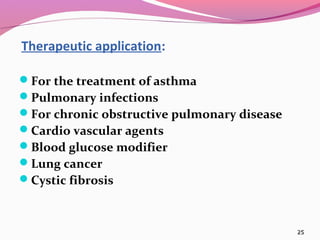
Therapeutic application:

For the treatment of asthma
Pulmonary infections
For chronic obstructive pulmonary disease
Cardio vascular agents
Blood glucose modifier
Lung cancer
Cystic fibrosis


                                             25
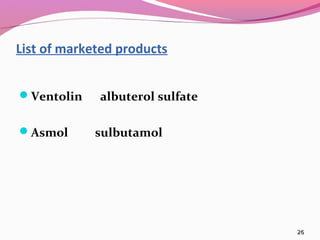
List of marketed products


Ventolin    albuterol sulfate

Asmol       sulbutamol


                                 26
REFERENCES
1.CONTROLLED DRUG DELIVERY CONCEPTS AND
 ADVANCES BY-S.P.VYAS & R.P.KHAR

2.MODERNPHARMACEUTICS FOUTH EDITION BY-
 BANKER & RHODES

3.ADVANCE IN CONTROLLED AND NOVEL DRUG
 DELIVERY BY-N.K. JAIN
4. Google.com


                                           27
28

Pulmonary drug delivery system1

  • 1.
    PRESENTED BY: GANDHISONAM MUKESHCHANDRA M.PHARM INDUSTRIAL PHARMACY 1
  • 2.
    Pulmonary Drug Deliverysystem “Pulmonary drug delivery describes various systems,devices,formulations & method of delivery of drugs to the lung for the treatment of: Diseases of the respiratory tract. For systemic delivery via the drug.” Once the drug is administered they readily pass into the blood stream without the need of any enhancers 2
  • 3.
    The pulmonary systemconsists of two regions 3
  • 4.
  • 5.
    Mechanism of drug absorption Drugdiffusion through alveoli. Absorption through aqueous pores by carrier mediated transport. phagocytosis of insoluble particles allow absorption of compounds with low lipophilicity & or high molecular weight. 5
  • 6.
    Inhaleables Advanced technologyfor pulmonary delivery is expanding a category of drugs called Inhaleables defined as respiratory & systemic therapies administered simply by inhaling. Advantages: It supply drugs into the blood stream directly. It provide a non-invasive method of drugs delivery. It furnish very rapid onset of action similar to I.V.route. 6
  • 7.
    Aerosols Aerosol preparationsare stable suspensions of solid material & liquid droplets in a gaseous medium. The drug delivery by aerosols is deposited in the airways by: Gravitational sedimentation Diffusion The term atomizer is used for a device that generates an aerosol & may be powdered by electrically/mechanically. 7
  • 8.
    Advantages of anaerosol A dose can be removed without contamination of remaining material. The medication can be delivered directly to the affected area in a desired form such as spray or stable form. Irritation produced by mechanical application of topical medication is reduced or eliminated. Minimum contamination. Maximum stability. 8
  • 9.
    Limitations of aerosols Poorpatient compliance. Irritant activity . Increase bronco constriction. High cost of mfg. 9
  • 10.
    Formulation of aerosol Aerosol product essentially consists of two components: Product concentrate Propellant Product concentrate consist of active ingredients or mixture of active ingredients Other necessary agents such as solvents, antioxidants & Surfactants. 10
  • 11.
    Propellant Single or blendof various propellants are used. It is selected to give the desired vapour pressure, solubility & particle size. Propellants can be with active ingredients in many different ways producing products with varying characteristics. Depending on the type of aerosol system utilized,the pharmaceutical aerosol may be dispensed as fine mist,wet spray & semi-solid or solid. 11
  • 12.
    Methods of Inhalationdelivery •Aerosols •Pulmonary metered dose inhalers (PMDIs) •Dry powder inhalers (DPIs) •Nebulizers 12
  • 13.
  • 14.
    Metered dose inhalers(MDIs) Isa device that helps to deliver a specific amount of medication to the lungs. It is commonly used to treat asthma, chronic obstructive pulmonary disease(COPD). It is composed of 4 essential components. 1.The base formulation- drug ,propellant,excipients. 2.The container. 3.Metering valve . 4.The actuator (mouth piece). 14
  • 15.
    Propellants: Commonly CFC propellantsare used because of their low pulmonary toxicity , high chemical stability and purity and compatibility, Non-inflammable. But now a days the CFC propellants are replaced with Hydrofluoroalkanes(HFAs) as these CFC cause the ozone depletion effect. Examples: trichlorofluromethane dichlorodifluoromethane 1.2.dichlorotetrafluromethane. 15
  • 16.
    Surfactants These are addedto maintain the drug in dispersed state & promotes stability of formulation.  It is also lubricates the valve. Examples : oleic acid ,sorbitol. 16
  • 17.
    Containers & valve Usually the container is made up of aluminum or glass. Glass containers are normally plastic coated or laminated to enhances their ability to ensure internal pressures of high magnitude. 17
  • 18.
    Metering valves These aredesigned to release a fixed volume of product during each actuation. Usually valves volumes range from 25 to 100ml although larger volume are available. 18
  • 19.
    DRY POWDER INHALERS Thisdevice dispenses a powder in a stream of inspired air. These are environmentally friend since they do not require CFC propellants for drug dispersion. Self medication is possible. 19
  • 20.
    Two types ofdry powder inhaler Passive dry powder inhaler Ex: Disc Inhaler, Easy haler Active dry powder inhaler Ex: spiors,prohaler. 20
  • 21.
    Advantages Product and formulationstability High drug volume delivery per puff low susceptibility to microbial growth Applicable to both soluble and insoluble drugs Self medication is possible 21
  • 22.
    Disadvantages : Hygroscopic powders have chances to particle growth. Accurate dose is required . 22
  • 23.
    Nebulizer Nebulizers are thosethat aerosolize aqueous solutions of water-soluble drugs 0r suspensions & solvent-water based solutions of water- insoluble substances. Nebulizer have been successfully employed for drug delivery to the lung.  It is also used for local drug delivery to trachea for local anesthesia 23
  • 24.
    There are twotypes of Nebulizer 1. Pneumatic Nebulizer :-It derives from pressurized gas source ex:- jet or hydro dynamic type 2. Electrical Nebulizer :-It operates from an electric source ex:-ultra sonic Nebulizer 24
  • 25.
    Therapeutic application: For thetreatment of asthma Pulmonary infections For chronic obstructive pulmonary disease Cardio vascular agents Blood glucose modifier Lung cancer Cystic fibrosis 25
  • 26.
    List of marketedproducts Ventolin albuterol sulfate Asmol sulbutamol 26
  • 27.
    REFERENCES 1.CONTROLLED DRUG DELIVERYCONCEPTS AND ADVANCES BY-S.P.VYAS & R.P.KHAR 2.MODERNPHARMACEUTICS FOUTH EDITION BY- BANKER & RHODES 3.ADVANCE IN CONTROLLED AND NOVEL DRUG DELIVERY BY-N.K. JAIN 4. Google.com 27
  • 28.