N. Gregory Mankiw, Principles of Economics, 9th Edition © 2021 Cengage. All Rights Reserved. May not be scanned, copied or duplicated, or
posted to a publicly accessible website, in whole or in part.
PowerPoint Slides prepared by:
V. Andreea CHIRITESCU
Eastern Illinois University
1
Principles of Economics, Ninth Edition
N. Gregory Mankiw
N. Gregory Mankiw, Principles of Economics, 9th Edition © 2021 Cengage. All Rights Reserved. May not be scanned, copied or duplicated, or
posted to a publicly accessible website, in whole or in part.
Chapter 10
Externalities
2
N. Gregory Mankiw, Principles of Economics, 9th Edition © 2021 Cengage. All Rights Reserved. May not be scanned, copied or duplicated, or
posted to a publicly accessible website, in whole or in part.
Externalities, Part 1
• Government action can sometimes
improve upon market outcomes
–Why markets sometimes fail to allocate
resources efficiently
–How government policies can potentially
improve the market’s allocation
–What kinds of policies are likely to work
best
3
N. Gregory Mankiw, Principles of Economics, 9th Edition © 2021 Cengage. All Rights Reserved. May not be scanned, copied or duplicated, or
posted to a publicly accessible website, in whole or in part.
Externalities, Part 2
• Externality
–The uncompensated impact of one
person’s actions on the well-being of a
bystander
–Market failure
• Negative externality
–Impact on the bystander is adverse
• Positive externality
–Impact on the bystander is beneficial
4
N. Gregory Mankiw, Principles of Economics, 9th Edition © 2021 Cengage. All Rights Reserved. May not be scanned, copied or duplicated, or
posted to a publicly accessible website, in whole or in part.
Externalities, Part 3
• Negative externalities
–Exhaust from automobiles
–Barking dogs
• Positive externalities
–Restored historic buildings
–Research into new technologies
5
N. Gregory Mankiw, Principles of Economics, 9th Edition © 2021 Cengage. All Rights Reserved. May not be scanned, copied or duplicated, or
posted to a publicly accessible website, in whole or in part.
ASK THE EXPERTS, Part 1
Vaccines
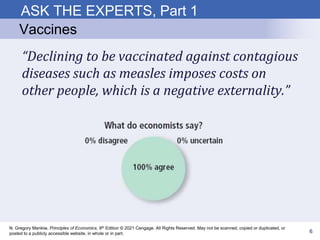
“Declining to be vaccinated against contagious
diseases such as measles imposes costs on
other people, which is a negative externality.”
6
N. Gregory Mankiw, Principles of Economics, 9th Edition © 2021 Cengage. All Rights Reserved. May not be scanned, copied or duplicated, or
posted to a publicly accessible website, in whole or in part.
Externalities and Market Inefficiency, Part 1
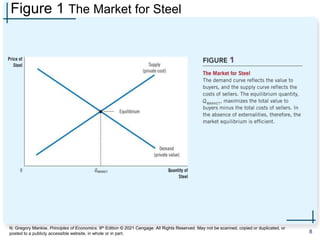
• Welfare economics: A recap
–Demand curve: value to consumers
• Prices they are willing to pay
–Supply curve: cost to suppliers
–Equilibrium quantity and price
• Efficient
• Maximizes the sum of producer and
consumer surplus
7
N. Gregory Mankiw, Principles of Economics, 9th Edition © 2021 Cengage. All Rights Reserved. May not be scanned, copied or duplicated, or
posted to a publicly accessible website, in whole or in part.
Figure 1 The Market for Steel
8
N. Gregory Mankiw, Principles of Economics, 9th Edition © 2021 Cengage. All Rights Reserved. May not be scanned, copied or duplicated, or
posted to a publicly accessible website, in whole or in part.
Externalities and Market Inefficiency, Part 2
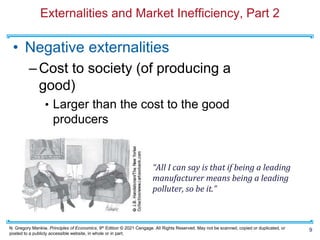
• Negative externalities
–Cost to society (of producing a
good)
• Larger than the cost to the good
producers
“All I can say is that if being a leading
manufacturer means being a leading
polluter, so be it.”
9
N. Gregory Mankiw, Principles of Economics, 9th Edition © 2021 Cengage. All Rights Reserved. May not be scanned, copied or duplicated, or
posted to a publicly accessible website, in whole or in part.
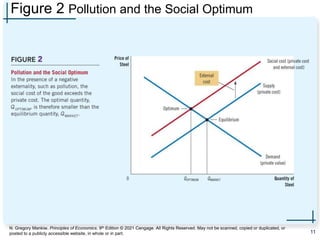
Externalities and Market Inefficiency, Part 3
• Negative externalities
–Social cost
• Private costs of the producers (supply)
• Plus the costs to those bystanders affected
adversely by the negative externality
–Social cost curve is above the supply
curve
• Takes into account the external costs
imposed on society
10
N. Gregory Mankiw, Principles of Economics, 9th Edition © 2021 Cengage. All Rights Reserved. May not be scanned, copied or duplicated, or
posted to a publicly accessible website, in whole or in part.
Figure 2 Pollution and the Social Optimum
11
N. Gregory Mankiw, Principles of Economics, 9th Edition © 2021 Cengage. All Rights Reserved. May not be scanned, copied or duplicated, or
posted to a publicly accessible website, in whole or in part.
Externalities and Market Inefficiency, Part 4
• Negative externalities
–Optimum quantity produced
• Maximize total welfare
• Smaller than market equilibrium quantity
• Government – correct market failure
–Internalizing the externality
• Altering incentives so that people take
account of the external effects of their actions
12
N. Gregory Mankiw, Principles of Economics, 9th Edition © 2021 Cengage. All Rights Reserved. May not be scanned, copied or duplicated, or
posted to a publicly accessible website, in whole or in part.
Externalities and Market Inefficiency, Part 5
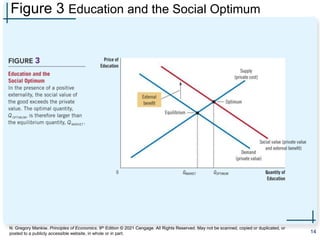
• Positive externalities
–Education
• Benefit of education is private
• Externalities: better government, lower crime
rates, higher productivity and wages
–Social value is greater than private value
–Social value curve
• Above the demand curve
13
N. Gregory Mankiw, Principles of Economics, 9th Edition © 2021 Cengage. All Rights Reserved. May not be scanned, copied or duplicated, or
posted to a publicly accessible website, in whole or in part.
Figure 3 Education and the Social Optimum
14
N. Gregory Mankiw, Principles of Economics, 9th Edition © 2021 Cengage. All Rights Reserved. May not be scanned, copied or duplicated, or
posted to a publicly accessible website, in whole or in part.
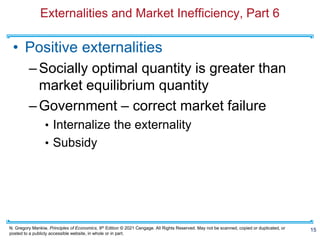
Externalities and Market Inefficiency, Part 6
• Positive externalities
–Socially optimal quantity is greater than
market equilibrium quantity
–Government – correct market failure
• Internalize the externality
• Subsidy
15
N. Gregory Mankiw, Principles of Economics, 9th Edition © 2021 Cengage. All Rights Reserved. May not be scanned, copied or duplicated, or
posted to a publicly accessible website, in whole or in part.
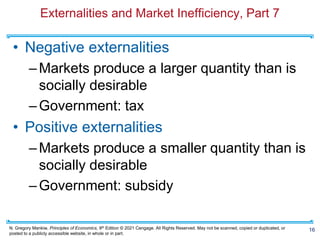
Externalities and Market Inefficiency, Part 7
• Negative externalities
–Markets produce a larger quantity than is
socially desirable
–Government: tax
• Positive externalities
–Markets produce a smaller quantity than is
socially desirable
–Government: subsidy
16
N. Gregory Mankiw, Principles of Economics, 9th Edition © 2021 Cengage. All Rights Reserved. May not be scanned, copied or duplicated, or
posted to a publicly accessible website, in whole or in part.
Technology Spillovers, Industrial Policy, and
Patent Protection, Part 1
• Technology spillover = Positive
externality
–Impact of one firm’s research and
production efforts on other firms’ access
to technological advance
–Government: internalize the externality
• Subsidy = value of the technology spillover
17
N. Gregory Mankiw, Principles of Economics, 9th Edition © 2021 Cengage. All Rights Reserved. May not be scanned, copied or duplicated, or
posted to a publicly accessible website, in whole or in part.
Technology Spillovers, Industrial Policy, and
Patent Protection, Part 2
• Industrial policy
–Government intervention in the economy
that aims to promote technology-
enhancing industries
• Patent law
–Protect the rights of inventors by giving
them exclusive use of their inventions for
a period of time
18
N. Gregory Mankiw, Principles of Economics, 9th Edition © 2021 Cengage. All Rights Reserved. May not be scanned, copied or duplicated, or
posted to a publicly accessible website, in whole or in part.
ASK THE EXPERTS, Part 2
Vaccines
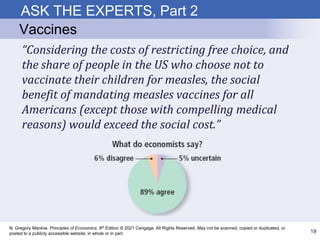
“Considering the costs of restricting free choice, and
the share of people in the US who choose not to
vaccinate their children for measles, the social
benefit of mandating measles vaccines for all
Americans (except those with compelling medical
reasons) would exceed the social cost.”
19
N. Gregory Mankiw, Principles of Economics, 9th Edition © 2021 Cengage. All Rights Reserved. May not be scanned, copied or duplicated, or
posted to a publicly accessible website, in whole or in part.
Public Policies toward Externalities, Part 1
• Command-and-control policies
–Regulate behavior directly
–Regulation
• Market-based policies
–Provide incentives so that private decision
makers will choose to solve the problem
on their own
–Corrective taxes and subsidies
–Tradable pollution permits
20
N. Gregory Mankiw, Principles of Economics, 9th Edition © 2021 Cengage. All Rights Reserved. May not be scanned, copied or duplicated, or
posted to a publicly accessible website, in whole or in part.
Public Policies toward Externalities, Part 2
• Regulation
–Regulate behavior directly: making certain
behaviors either required or forbidden
–Cannot eradicate pollution
–Environmental Protection Agency (EPA)
• Develop and enforce regulations
• Dictates maximum level of pollution
• Requires that firms adopt a particular
technology to reduce emissions
21
N. Gregory Mankiw, Principles of Economics, 9th Edition © 2021 Cengage. All Rights Reserved. May not be scanned, copied or duplicated, or
posted to a publicly accessible website, in whole or in part.
Public Policies toward Externalities, Part 3
• Corrective taxes and subsidies
–Corrective taxes (Pigovian taxes)
• Induce private decision makers to take
account of the social costs that arise from a
negative externality
• Places a price on the right to pollute
• Reduce pollution at a lower cost to society
• Raise revenue for the government
• Enhance economic efficiency
22
N. Gregory Mankiw, Principles of Economics, 9th Edition © 2021 Cengage. All Rights Reserved. May not be scanned, copied or duplicated, or
posted to a publicly accessible website, in whole or in part.
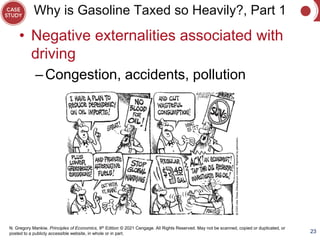
Why is Gasoline Taxed so Heavily?, Part 1
• Negative externalities associated with
driving
–Congestion, accidents, pollution
23
N. Gregory Mankiw, Principles of Economics, 9th Edition © 2021 Cengage. All Rights Reserved. May not be scanned, copied or duplicated, or
posted to a publicly accessible website, in whole or in part.
Why is Gasoline Taxed so Heavily?, Part 2
• The gas tax = corrective tax
–Doesn’t cause deadweight losses
–Makes the economy work better
• Less traffic congestion
• Safer roads
• Cleaner environment
24
N. Gregory Mankiw, Principles of Economics, 9th Edition © 2021 Cengage. All Rights Reserved. May not be scanned, copied or duplicated, or
posted to a publicly accessible website, in whole or in part.
Why is Gasoline Taxed so Heavily?, Part 3
• How high should the tax on gasoline be?
–Most European countries
• Higher gasoline tax than in the U.S.
• 2007, Journal of Economic Literature
–Optimal corrective tax on gasoline
–$2.28 per gallon in 2005 dollars
–$2.00 per gallon in 2018 dollars
• Actual tax in the U.S. in 2018:
–50 cents per gallon
25
N. Gregory Mankiw, Principles of Economics, 9th Edition © 2021 Cengage. All Rights Reserved. May not be scanned, copied or duplicated, or
posted to a publicly accessible website, in whole or in part.
Why is Gasoline Taxed so Heavily?, Part 4
• Tax revenue from a gasoline tax
–Used to lower taxes that distort incentives
and cause deadweight losses
–Some government regulations
• Production of fuel-efficient cars –
unnecessary
26
N. Gregory Mankiw, Principles of Economics, 9th Edition © 2021 Cengage. All Rights Reserved. May not be scanned, copied or duplicated, or
posted to a publicly accessible website, in whole or in part.
ASK THE EXPERTS, Part 3
Carbon Taxes
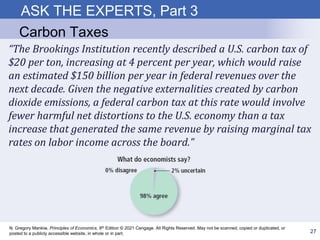
“The Brookings Institution recently described a U.S. carbon tax of
$20 per ton, increasing at 4 percent per year, which would raise
an estimated $150 billion per year in federal revenues over the
next decade. Given the negative externalities created by carbon
dioxide emissions, a federal carbon tax at this rate would involve
fewer harmful net distortions to the U.S. economy than a tax
increase that generated the same revenue by raising marginal tax
rates on labor income across the board.”
27
N. Gregory Mankiw, Principles of Economics, 9th Edition © 2021 Cengage. All Rights Reserved. May not be scanned, copied or duplicated, or
posted to a publicly accessible website, in whole or in part.
ASK THE EXPERTS, Part 4
Carbon Taxes
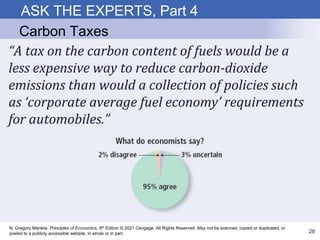
“A tax on the carbon content of fuels would be a
less expensive way to reduce carbon-dioxide
emissions than would a collection of policies such
as ‘corporate average fuel economy’ requirements
for automobiles.”
28
N. Gregory Mankiw, Principles of Economics, 9th Edition © 2021 Cengage. All Rights Reserved. May not be scanned, copied or duplicated, or
posted to a publicly accessible website, in whole or in part.
Public Policies toward Externalities, Part 4
• Tradable pollution permits
–Voluntary transfer of the right to pollute
from one firm to another
–New scarce resource: pollution permits
–Market to trade permits
–Firm’s willingness to pay
• Depend on its cost of reducing pollution
29
N. Gregory Mankiw, Principles of Economics, 9th Edition © 2021 Cengage. All Rights Reserved. May not be scanned, copied or duplicated, or
posted to a publicly accessible website, in whole or in part.
Public Policies toward Externalities, Part 5
• Advantage of free market for pollution
permits
–Initial allocation of pollution permits
doesn't matter
–If firms can reduce pollution at a low cost:
• Sell whatever permits they get
–If firms can reduce pollution only at a high
cost: buy whatever permits they need
–Efficient final allocation
30
N. Gregory Mankiw, Principles of Economics, 9th Edition © 2021 Cengage. All Rights Reserved. May not be scanned, copied or duplicated, or
posted to a publicly accessible website, in whole or in part.
Public Policies toward Externalities, Part 6
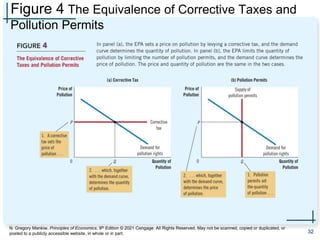
• Reducing pollution using pollution permits
or corrective taxes
–Firms pay for their pollution
• Corrective taxes: pay to the government
• Pollution permits: pay to buy permits
–Internalize the externality of pollution
31
N. Gregory Mankiw, Principles of Economics, 9th Edition © 2021 Cengage. All Rights Reserved. May not be scanned, copied or duplicated, or
posted to a publicly accessible website, in whole or in part.
Figure 4 The Equivalence of Corrective Taxes and
Pollution Permits
32
N. Gregory Mankiw, Principles of Economics, 9th Edition © 2021 Cengage. All Rights Reserved. May not be scanned, copied or duplicated, or
posted to a publicly accessible website, in whole or in part.
Public Policies toward Externalities, Part 7
• Objections to the economic analysis of
pollution
–“We cannot give anyone the option of
polluting for a fee.” – late Senator Edmund
Muskie
• People face trade-offs
–Eliminating all pollution is impossible
–Clean water and clean air — opportunity
cost: lower standard of living
33
N. Gregory Mankiw, Principles of Economics, 9th Edition © 2021 Cengage. All Rights Reserved. May not be scanned, copied or duplicated, or
posted to a publicly accessible website, in whole or in part.
Public Policies toward Externalities, Part 8
• Clean environment is a normal good
–Positive income elasticity
• Rich countries can afford a cleaner
environment
• More rigorous environmental protection
–Clean air and clean water – law of
demand
• The lower the price of environmental
protection
• The more the public will want it
34
N. Gregory Mankiw, Principles of Economics, 9th Edition © 2021 Cengage. All Rights Reserved. May not be scanned, copied or duplicated, or
posted to a publicly accessible website, in whole or in part.
Private Solutions to Externalities, Part 1
• The types of private solutions
–Moral codes and social sanctions
–Charities
–Self-interest of the relevant parties
• Integrating different types of businesses
–Interested parties can enter into a contract
35
N. Gregory Mankiw, Principles of Economics, 9th Edition © 2021 Cengage. All Rights Reserved. May not be scanned, copied or duplicated, or
posted to a publicly accessible website, in whole or in part.
Private Solutions to Externalities, Part 2
• The Coase theorem
–If private parties can bargain without cost
over the allocation of resources
• They can solve the problem of externalities
on their own
• Whatever the initial distribution of rights
–Interested parties can reach a bargain:
• Everyone is better off
• Outcome is efficient
36
N. Gregory Mankiw, Principles of Economics, 9th Edition © 2021 Cengage. All Rights Reserved. May not be scanned, copied or duplicated, or
posted to a publicly accessible website, in whole or in part.
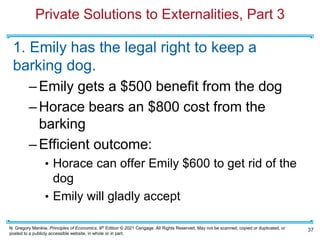
Private Solutions to Externalities, Part 3
1. Emily has the legal right to keep a
barking dog.
–Emily gets a $500 benefit from the dog
–Horace bears an $800 cost from the
barking
–Efficient outcome:
• Horace can offer Emily $600 to get rid of the
dog
• Emily will gladly accept
37
N. Gregory Mankiw, Principles of Economics, 9th Edition © 2021 Cengage. All Rights Reserved. May not be scanned, copied or duplicated, or
posted to a publicly accessible website, in whole or in part.
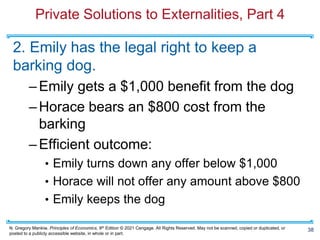
Private Solutions to Externalities, Part 4
2. Emily has the legal right to keep a
barking dog.
–Emily gets a $1,000 benefit from the dog
–Horace bears an $800 cost from the
barking
–Efficient outcome:
• Emily turns down any offer below $1,000
• Horace will not offer any amount above $800
• Emily keeps the dog
38
N. Gregory Mankiw, Principles of Economics, 9th Edition © 2021 Cengage. All Rights Reserved. May not be scanned, copied or duplicated, or
posted to a publicly accessible website, in whole or in part.
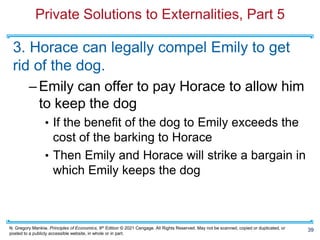
Private Solutions to Externalities, Part 5
3. Horace can legally compel Emily to get
rid of the dog.
–Emily can offer to pay Horace to allow him
to keep the dog
• If the benefit of the dog to Emily exceeds the
cost of the barking to Horace
• Then Emily and Horace will strike a bargain in
which Emily keeps the dog
39
N. Gregory Mankiw, Principles of Economics, 9th Edition © 2021 Cengage. All Rights Reserved. May not be scanned, copied or duplicated, or
posted to a publicly accessible website, in whole or in part.
Private Solutions to Externalities, Part 6
• Why private solutions do not always work
–High transaction costs
• Costs that parties incur in the process of
agreeing to and following through on a
bargain
–Bargaining simply breaks down
–Large number of interested parties
• Coordinating everyone is costly
40

Chapter 10 Externalities, negative and positive.pptx

  • 1.
    N. Gregory Mankiw,Principles of Economics, 9th Edition © 2021 Cengage. All Rights Reserved. May not be scanned, copied or duplicated, or posted to a publicly accessible website, in whole or in part. PowerPoint Slides prepared by: V. Andreea CHIRITESCU Eastern Illinois University 1 Principles of Economics, Ninth Edition N. Gregory Mankiw
  • 2.
    N. Gregory Mankiw,Principles of Economics, 9th Edition © 2021 Cengage. All Rights Reserved. May not be scanned, copied or duplicated, or posted to a publicly accessible website, in whole or in part. Chapter 10 Externalities 2
  • 3.
    N. Gregory Mankiw,Principles of Economics, 9th Edition © 2021 Cengage. All Rights Reserved. May not be scanned, copied or duplicated, or posted to a publicly accessible website, in whole or in part. Externalities, Part 1 • Government action can sometimes improve upon market outcomes –Why markets sometimes fail to allocate resources efficiently –How government policies can potentially improve the market’s allocation –What kinds of policies are likely to work best 3
  • 4.
    N. Gregory Mankiw,Principles of Economics, 9th Edition © 2021 Cengage. All Rights Reserved. May not be scanned, copied or duplicated, or posted to a publicly accessible website, in whole or in part. Externalities, Part 2 • Externality –The uncompensated impact of one person’s actions on the well-being of a bystander –Market failure • Negative externality –Impact on the bystander is adverse • Positive externality –Impact on the bystander is beneficial 4
  • 5.
    N. Gregory Mankiw,Principles of Economics, 9th Edition © 2021 Cengage. All Rights Reserved. May not be scanned, copied or duplicated, or posted to a publicly accessible website, in whole or in part. Externalities, Part 3 • Negative externalities –Exhaust from automobiles –Barking dogs • Positive externalities –Restored historic buildings –Research into new technologies 5
  • 6.
    N. Gregory Mankiw,Principles of Economics, 9th Edition © 2021 Cengage. All Rights Reserved. May not be scanned, copied or duplicated, or posted to a publicly accessible website, in whole or in part. ASK THE EXPERTS, Part 1 Vaccines “Declining to be vaccinated against contagious diseases such as measles imposes costs on other people, which is a negative externality.” 6
  • 7.
    N. Gregory Mankiw,Principles of Economics, 9th Edition © 2021 Cengage. All Rights Reserved. May not be scanned, copied or duplicated, or posted to a publicly accessible website, in whole or in part. Externalities and Market Inefficiency, Part 1 • Welfare economics: A recap –Demand curve: value to consumers • Prices they are willing to pay –Supply curve: cost to suppliers –Equilibrium quantity and price • Efficient • Maximizes the sum of producer and consumer surplus 7
  • 8.
    N. Gregory Mankiw,Principles of Economics, 9th Edition © 2021 Cengage. All Rights Reserved. May not be scanned, copied or duplicated, or posted to a publicly accessible website, in whole or in part. Figure 1 The Market for Steel 8
  • 9.
    N. Gregory Mankiw,Principles of Economics, 9th Edition © 2021 Cengage. All Rights Reserved. May not be scanned, copied or duplicated, or posted to a publicly accessible website, in whole or in part. Externalities and Market Inefficiency, Part 2 • Negative externalities –Cost to society (of producing a good) • Larger than the cost to the good producers “All I can say is that if being a leading manufacturer means being a leading polluter, so be it.” 9
  • 10.
    N. Gregory Mankiw,Principles of Economics, 9th Edition © 2021 Cengage. All Rights Reserved. May not be scanned, copied or duplicated, or posted to a publicly accessible website, in whole or in part. Externalities and Market Inefficiency, Part 3 • Negative externalities –Social cost • Private costs of the producers (supply) • Plus the costs to those bystanders affected adversely by the negative externality –Social cost curve is above the supply curve • Takes into account the external costs imposed on society 10
  • 11.
    N. Gregory Mankiw,Principles of Economics, 9th Edition © 2021 Cengage. All Rights Reserved. May not be scanned, copied or duplicated, or posted to a publicly accessible website, in whole or in part. Figure 2 Pollution and the Social Optimum 11
  • 12.
    N. Gregory Mankiw,Principles of Economics, 9th Edition © 2021 Cengage. All Rights Reserved. May not be scanned, copied or duplicated, or posted to a publicly accessible website, in whole or in part. Externalities and Market Inefficiency, Part 4 • Negative externalities –Optimum quantity produced • Maximize total welfare • Smaller than market equilibrium quantity • Government – correct market failure –Internalizing the externality • Altering incentives so that people take account of the external effects of their actions 12
  • 13.
    N. Gregory Mankiw,Principles of Economics, 9th Edition © 2021 Cengage. All Rights Reserved. May not be scanned, copied or duplicated, or posted to a publicly accessible website, in whole or in part. Externalities and Market Inefficiency, Part 5 • Positive externalities –Education • Benefit of education is private • Externalities: better government, lower crime rates, higher productivity and wages –Social value is greater than private value –Social value curve • Above the demand curve 13
  • 14.
    N. Gregory Mankiw,Principles of Economics, 9th Edition © 2021 Cengage. All Rights Reserved. May not be scanned, copied or duplicated, or posted to a publicly accessible website, in whole or in part. Figure 3 Education and the Social Optimum 14
  • 15.
    N. Gregory Mankiw,Principles of Economics, 9th Edition © 2021 Cengage. All Rights Reserved. May not be scanned, copied or duplicated, or posted to a publicly accessible website, in whole or in part. Externalities and Market Inefficiency, Part 6 • Positive externalities –Socially optimal quantity is greater than market equilibrium quantity –Government – correct market failure • Internalize the externality • Subsidy 15
  • 16.
    N. Gregory Mankiw,Principles of Economics, 9th Edition © 2021 Cengage. All Rights Reserved. May not be scanned, copied or duplicated, or posted to a publicly accessible website, in whole or in part. Externalities and Market Inefficiency, Part 7 • Negative externalities –Markets produce a larger quantity than is socially desirable –Government: tax • Positive externalities –Markets produce a smaller quantity than is socially desirable –Government: subsidy 16
  • 17.
    N. Gregory Mankiw,Principles of Economics, 9th Edition © 2021 Cengage. All Rights Reserved. May not be scanned, copied or duplicated, or posted to a publicly accessible website, in whole or in part. Technology Spillovers, Industrial Policy, and Patent Protection, Part 1 • Technology spillover = Positive externality –Impact of one firm’s research and production efforts on other firms’ access to technological advance –Government: internalize the externality • Subsidy = value of the technology spillover 17
  • 18.
    N. Gregory Mankiw,Principles of Economics, 9th Edition © 2021 Cengage. All Rights Reserved. May not be scanned, copied or duplicated, or posted to a publicly accessible website, in whole or in part. Technology Spillovers, Industrial Policy, and Patent Protection, Part 2 • Industrial policy –Government intervention in the economy that aims to promote technology- enhancing industries • Patent law –Protect the rights of inventors by giving them exclusive use of their inventions for a period of time 18
  • 19.
    N. Gregory Mankiw,Principles of Economics, 9th Edition © 2021 Cengage. All Rights Reserved. May not be scanned, copied or duplicated, or posted to a publicly accessible website, in whole or in part. ASK THE EXPERTS, Part 2 Vaccines “Considering the costs of restricting free choice, and the share of people in the US who choose not to vaccinate their children for measles, the social benefit of mandating measles vaccines for all Americans (except those with compelling medical reasons) would exceed the social cost.” 19
  • 20.
    N. Gregory Mankiw,Principles of Economics, 9th Edition © 2021 Cengage. All Rights Reserved. May not be scanned, copied or duplicated, or posted to a publicly accessible website, in whole or in part. Public Policies toward Externalities, Part 1 • Command-and-control policies –Regulate behavior directly –Regulation • Market-based policies –Provide incentives so that private decision makers will choose to solve the problem on their own –Corrective taxes and subsidies –Tradable pollution permits 20
  • 21.
    N. Gregory Mankiw,Principles of Economics, 9th Edition © 2021 Cengage. All Rights Reserved. May not be scanned, copied or duplicated, or posted to a publicly accessible website, in whole or in part. Public Policies toward Externalities, Part 2 • Regulation –Regulate behavior directly: making certain behaviors either required or forbidden –Cannot eradicate pollution –Environmental Protection Agency (EPA) • Develop and enforce regulations • Dictates maximum level of pollution • Requires that firms adopt a particular technology to reduce emissions 21
  • 22.
    N. Gregory Mankiw,Principles of Economics, 9th Edition © 2021 Cengage. All Rights Reserved. May not be scanned, copied or duplicated, or posted to a publicly accessible website, in whole or in part. Public Policies toward Externalities, Part 3 • Corrective taxes and subsidies –Corrective taxes (Pigovian taxes) • Induce private decision makers to take account of the social costs that arise from a negative externality • Places a price on the right to pollute • Reduce pollution at a lower cost to society • Raise revenue for the government • Enhance economic efficiency 22
  • 23.
    N. Gregory Mankiw,Principles of Economics, 9th Edition © 2021 Cengage. All Rights Reserved. May not be scanned, copied or duplicated, or posted to a publicly accessible website, in whole or in part. Why is Gasoline Taxed so Heavily?, Part 1 • Negative externalities associated with driving –Congestion, accidents, pollution 23
  • 24.
    N. Gregory Mankiw,Principles of Economics, 9th Edition © 2021 Cengage. All Rights Reserved. May not be scanned, copied or duplicated, or posted to a publicly accessible website, in whole or in part. Why is Gasoline Taxed so Heavily?, Part 2 • The gas tax = corrective tax –Doesn’t cause deadweight losses –Makes the economy work better • Less traffic congestion • Safer roads • Cleaner environment 24
  • 25.
    N. Gregory Mankiw,Principles of Economics, 9th Edition © 2021 Cengage. All Rights Reserved. May not be scanned, copied or duplicated, or posted to a publicly accessible website, in whole or in part. Why is Gasoline Taxed so Heavily?, Part 3 • How high should the tax on gasoline be? –Most European countries • Higher gasoline tax than in the U.S. • 2007, Journal of Economic Literature –Optimal corrective tax on gasoline –$2.28 per gallon in 2005 dollars –$2.00 per gallon in 2018 dollars • Actual tax in the U.S. in 2018: –50 cents per gallon 25
  • 26.
    N. Gregory Mankiw,Principles of Economics, 9th Edition © 2021 Cengage. All Rights Reserved. May not be scanned, copied or duplicated, or posted to a publicly accessible website, in whole or in part. Why is Gasoline Taxed so Heavily?, Part 4 • Tax revenue from a gasoline tax –Used to lower taxes that distort incentives and cause deadweight losses –Some government regulations • Production of fuel-efficient cars – unnecessary 26
  • 27.
    N. Gregory Mankiw,Principles of Economics, 9th Edition © 2021 Cengage. All Rights Reserved. May not be scanned, copied or duplicated, or posted to a publicly accessible website, in whole or in part. ASK THE EXPERTS, Part 3 Carbon Taxes “The Brookings Institution recently described a U.S. carbon tax of $20 per ton, increasing at 4 percent per year, which would raise an estimated $150 billion per year in federal revenues over the next decade. Given the negative externalities created by carbon dioxide emissions, a federal carbon tax at this rate would involve fewer harmful net distortions to the U.S. economy than a tax increase that generated the same revenue by raising marginal tax rates on labor income across the board.” 27
  • 28.
    N. Gregory Mankiw,Principles of Economics, 9th Edition © 2021 Cengage. All Rights Reserved. May not be scanned, copied or duplicated, or posted to a publicly accessible website, in whole or in part. ASK THE EXPERTS, Part 4 Carbon Taxes “A tax on the carbon content of fuels would be a less expensive way to reduce carbon-dioxide emissions than would a collection of policies such as ‘corporate average fuel economy’ requirements for automobiles.” 28
  • 29.
    N. Gregory Mankiw,Principles of Economics, 9th Edition © 2021 Cengage. All Rights Reserved. May not be scanned, copied or duplicated, or posted to a publicly accessible website, in whole or in part. Public Policies toward Externalities, Part 4 • Tradable pollution permits –Voluntary transfer of the right to pollute from one firm to another –New scarce resource: pollution permits –Market to trade permits –Firm’s willingness to pay • Depend on its cost of reducing pollution 29
  • 30.
    N. Gregory Mankiw,Principles of Economics, 9th Edition © 2021 Cengage. All Rights Reserved. May not be scanned, copied or duplicated, or posted to a publicly accessible website, in whole or in part. Public Policies toward Externalities, Part 5 • Advantage of free market for pollution permits –Initial allocation of pollution permits doesn't matter –If firms can reduce pollution at a low cost: • Sell whatever permits they get –If firms can reduce pollution only at a high cost: buy whatever permits they need –Efficient final allocation 30
  • 31.
    N. Gregory Mankiw,Principles of Economics, 9th Edition © 2021 Cengage. All Rights Reserved. May not be scanned, copied or duplicated, or posted to a publicly accessible website, in whole or in part. Public Policies toward Externalities, Part 6 • Reducing pollution using pollution permits or corrective taxes –Firms pay for their pollution • Corrective taxes: pay to the government • Pollution permits: pay to buy permits –Internalize the externality of pollution 31
  • 32.
    N. Gregory Mankiw,Principles of Economics, 9th Edition © 2021 Cengage. All Rights Reserved. May not be scanned, copied or duplicated, or posted to a publicly accessible website, in whole or in part. Figure 4 The Equivalence of Corrective Taxes and Pollution Permits 32
  • 33.
    N. Gregory Mankiw,Principles of Economics, 9th Edition © 2021 Cengage. All Rights Reserved. May not be scanned, copied or duplicated, or posted to a publicly accessible website, in whole or in part. Public Policies toward Externalities, Part 7 • Objections to the economic analysis of pollution –“We cannot give anyone the option of polluting for a fee.” – late Senator Edmund Muskie • People face trade-offs –Eliminating all pollution is impossible –Clean water and clean air — opportunity cost: lower standard of living 33
  • 34.
    N. Gregory Mankiw,Principles of Economics, 9th Edition © 2021 Cengage. All Rights Reserved. May not be scanned, copied or duplicated, or posted to a publicly accessible website, in whole or in part. Public Policies toward Externalities, Part 8 • Clean environment is a normal good –Positive income elasticity • Rich countries can afford a cleaner environment • More rigorous environmental protection –Clean air and clean water – law of demand • The lower the price of environmental protection • The more the public will want it 34
  • 35.
    N. Gregory Mankiw,Principles of Economics, 9th Edition © 2021 Cengage. All Rights Reserved. May not be scanned, copied or duplicated, or posted to a publicly accessible website, in whole or in part. Private Solutions to Externalities, Part 1 • The types of private solutions –Moral codes and social sanctions –Charities –Self-interest of the relevant parties • Integrating different types of businesses –Interested parties can enter into a contract 35
  • 36.
    N. Gregory Mankiw,Principles of Economics, 9th Edition © 2021 Cengage. All Rights Reserved. May not be scanned, copied or duplicated, or posted to a publicly accessible website, in whole or in part. Private Solutions to Externalities, Part 2 • The Coase theorem –If private parties can bargain without cost over the allocation of resources • They can solve the problem of externalities on their own • Whatever the initial distribution of rights –Interested parties can reach a bargain: • Everyone is better off • Outcome is efficient 36
  • 37.
    N. Gregory Mankiw,Principles of Economics, 9th Edition © 2021 Cengage. All Rights Reserved. May not be scanned, copied or duplicated, or posted to a publicly accessible website, in whole or in part. Private Solutions to Externalities, Part 3 1. Emily has the legal right to keep a barking dog. –Emily gets a $500 benefit from the dog –Horace bears an $800 cost from the barking –Efficient outcome: • Horace can offer Emily $600 to get rid of the dog • Emily will gladly accept 37
  • 38.
    N. Gregory Mankiw,Principles of Economics, 9th Edition © 2021 Cengage. All Rights Reserved. May not be scanned, copied or duplicated, or posted to a publicly accessible website, in whole or in part. Private Solutions to Externalities, Part 4 2. Emily has the legal right to keep a barking dog. –Emily gets a $1,000 benefit from the dog –Horace bears an $800 cost from the barking –Efficient outcome: • Emily turns down any offer below $1,000 • Horace will not offer any amount above $800 • Emily keeps the dog 38
  • 39.
    N. Gregory Mankiw,Principles of Economics, 9th Edition © 2021 Cengage. All Rights Reserved. May not be scanned, copied or duplicated, or posted to a publicly accessible website, in whole or in part. Private Solutions to Externalities, Part 5 3. Horace can legally compel Emily to get rid of the dog. –Emily can offer to pay Horace to allow him to keep the dog • If the benefit of the dog to Emily exceeds the cost of the barking to Horace • Then Emily and Horace will strike a bargain in which Emily keeps the dog 39
  • 40.
    N. Gregory Mankiw,Principles of Economics, 9th Edition © 2021 Cengage. All Rights Reserved. May not be scanned, copied or duplicated, or posted to a publicly accessible website, in whole or in part. Private Solutions to Externalities, Part 6 • Why private solutions do not always work –High transaction costs • Costs that parties incur in the process of agreeing to and following through on a bargain –Bargaining simply breaks down –Large number of interested parties • Coordinating everyone is costly 40

Editor's Notes

  • #2 N. Gregory Mankiw Principles Of Economics Ninth Edition