Chapter 19Chapter 19
Social WelfareSocial Welfare
Copyright © 2011 CengageCopyright © 2011 Cengage
 WHO GOVERNS?WHO GOVERNS?
1.1. How, if at all, have Americans’ views ofHow, if at all, have Americans’ views of
government’s responsibility to help thegovernment’s responsibility to help the
“deserving poor” changed over time?“deserving poor” changed over time?
2.2. Why are some government socialWhy are some government social
welfare programs politically protectedwelfare programs politically protected
while others are politically imperiled?while others are politically imperiled?
 TO WHAT ENDS?TO WHAT ENDS?
1.1. What does the Constitution mean byWhat does the Constitution mean by
“promote the general Welfare”?“promote the general Welfare”?
2.2. Should religious groups be eligible toShould religious groups be eligible to
administer some federal welfareadminister some federal welfare
programs?programs?
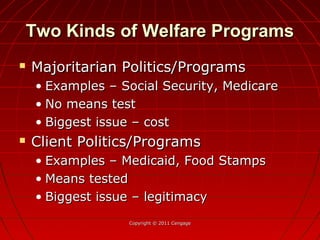
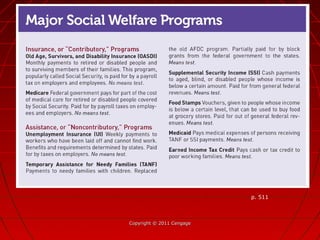
Two Kinds of Welfare ProgramsTwo Kinds of Welfare Programs
 Majoritarian Politics/ProgramsMajoritarian Politics/Programs
• Examples – Social Security, MedicareExamples – Social Security, Medicare
• No means testNo means test
• Biggest issue – costBiggest issue – cost
 Client Politics/ProgramsClient Politics/Programs
• Examples – Medicaid, Food StampsExamples – Medicaid, Food Stamps
• Means testedMeans tested
• Biggest issue – legitimacyBiggest issue – legitimacy
Copyright © 2011 CengageCopyright © 2011 Cengage
Social Welfare in theSocial Welfare in the
United StatesUnited States
United States compared to otherUnited States compared to other
nations:nations:
 More restrictive view of who isMore restrictive view of who is
entitled to governmentalentitled to governmental
assistanceassistance
 Slower to embrace the welfareSlower to embrace the welfare
statestate
 States play a large roleStates play a large role
 NongovernmentalNongovernmental
organizations play a large roleorganizations play a large role
Copyright © 2011 CengageCopyright © 2011 Cengage
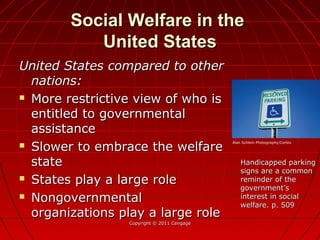
Handicapped parkingHandicapped parking
signs are a commonsigns are a common
reminder of thereminder of the
government’sgovernment’s
interest in socialinterest in social
welfare. p. 509welfare. p. 509
Alan Schlein Photography/Corbis
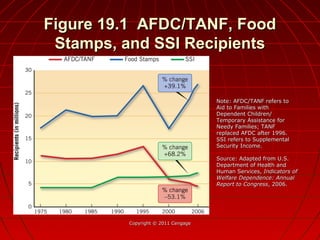
Figure 19.1 AFDC/TANF, FoodFigure 19.1 AFDC/TANF, Food
Stamps, and SSI RecipientsStamps, and SSI Recipients
1975-20061975-2006
Copyright © 2011 CengageCopyright © 2011 Cengage
Note: AFDC/TANF refers toNote: AFDC/TANF refers to
Aid to Families withAid to Families with
Dependent Children/Dependent Children/
Temporary Assistance forTemporary Assistance for
Needy Families; TANFNeedy Families; TANF
replaced AFDC after 1996.replaced AFDC after 1996.
SSI refers to SupplementalSSI refers to Supplemental
Security Income.Security Income.
Source: Adapted from U.S.Source: Adapted from U.S.
Department of Health andDepartment of Health and
Human Services,Human Services, Indicators ofIndicators of
Welfare Dependence: AnnualWelfare Dependence: Annual
Report to CongressReport to Congress, 2006., 2006.
Social Welfare in theSocial Welfare in the
United StatesUnited States
 Charitable ChoiceCharitable Choice
 Majoritarian Welfare Programs:Majoritarian Welfare Programs:
Social Security and MedicareSocial Security and Medicare
 Reforming Majoritarian WelfareReforming Majoritarian Welfare
ProgramsPrograms
 Client Welfare Programs: Aid toClient Welfare Programs: Aid to
Families with Dependent ChildrenFamilies with Dependent Children
 Earned Income Tax Credit (EITC)Earned Income Tax Credit (EITC)
Copyright © 2011 CengageCopyright © 2011 Cengage
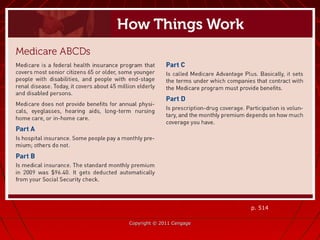
p. 511
Copyright © 2011 CengageCopyright © 2011 Cengage
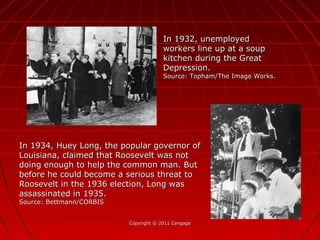
In 1932, unemployedIn 1932, unemployed
workers line up at a soupworkers line up at a soup
kitchen during the Greatkitchen during the Great
Depression.Depression.
Source: Topham/The Image Works.Source: Topham/The Image Works.
In 1934, Huey Long, the popular governor ofIn 1934, Huey Long, the popular governor of
Louisiana, claimed that Roosevelt was notLouisiana, claimed that Roosevelt was not
doing enough to help the common man. Butdoing enough to help the common man. But
before he could become a serious threat tobefore he could become a serious threat to
Roosevelt in the 1936 election, Long wasRoosevelt in the 1936 election, Long was
assassinated in 1935.assassinated in 1935.
Source: Bettmann/CORBISSource: Bettmann/CORBIS
Copyright © 2011 CengageCopyright © 2011 Cengage
p. 514
Copyright © 2011 CengageCopyright © 2011 Cengage
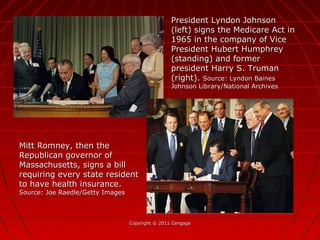
President Lyndon JohnsonPresident Lyndon Johnson
(left) signs the Medicare Act in(left) signs the Medicare Act in
1965 in the company of Vice1965 in the company of Vice
President Hubert HumphreyPresident Hubert Humphrey
(standing) and former(standing) and former
president Harry S. Trumanpresident Harry S. Truman
(right).(right). Source: Lyndon BainesSource: Lyndon Baines
Johnson Library/National ArchivesJohnson Library/National Archives
Mitt Romney, then theMitt Romney, then the
Republican governor ofRepublican governor of
Massachusetts, signs a billMassachusetts, signs a bill
requiring every state residentrequiring every state resident
to have health insurance.to have health insurance.
Source: Joe Raedle/Getty ImagesSource: Joe Raedle/Getty Images
Copyright © 2011 CengageCopyright © 2011 Cengage
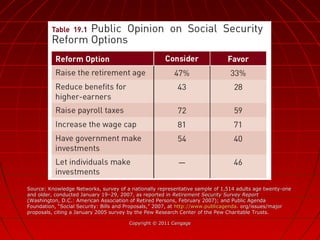
Source: Knowledge Networks, survey of a nationally representative sample of 1,514 adults age twenty-oneSource: Knowledge Networks, survey of a nationally representative sample of 1,514 adults age twenty-one
and older, conducted January 19–29, 2007, as reported inand older, conducted January 19–29, 2007, as reported in Retirement Security Survey ReportRetirement Security Survey Report
(Washington, D.C.: American Association of Retired(Washington, D.C.: American Association of Retired Persons, February 2007); and Public AgendaPersons, February 2007); and Public Agenda
Foundation, “Social Security: Bills and Proposals,” 2007, atFoundation, “Social Security: Bills and Proposals,” 2007, at http://www.publicagendahttp://www.publicagenda. org/issues/major. org/issues/major
proposals, citing a January 2005 survey by the Pew Research Center of the Pew Charitable Trusts.proposals, citing a January 2005 survey by the Pew Research Center of the Pew Charitable Trusts.
Copyright © 2011 CengageCopyright © 2011 Cengage
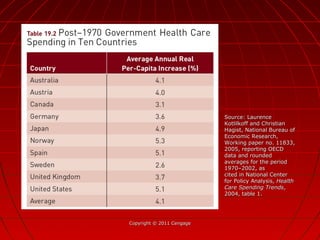
Source: LaurenceSource: Laurence
Kotlilkoff and ChristianKotlilkoff and Christian
Hagist, National Bureau ofHagist, National Bureau of
Economic Research,Economic Research,
Working paper no. 11833,Working paper no. 11833,
2005, reporting OECD2005, reporting OECD
data and roundeddata and rounded
averages for the periodaverages for the period
1970–2002, as1970–2002, as
cited in National Centercited in National Center
for Policy Analysis,for Policy Analysis, HealthHealth
Care Spending TrendsCare Spending Trends,,
2004, table 1.2004, table 1.
Copyright © 2011 CengageCopyright © 2011 Cengage
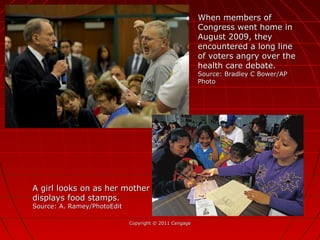
When members ofWhen members of
Congress went home inCongress went home in
August 2009, theyAugust 2009, they
encountered a long lineencountered a long line
of voters angry over theof voters angry over the
health care debate.health care debate.
Source: Bradley C Bower/APSource: Bradley C Bower/AP
PhotoPhoto
A girl looks on as her motherA girl looks on as her mother
displays food stamps.displays food stamps.
Source: A. Ramey/PhotoEditSource: A. Ramey/PhotoEdit
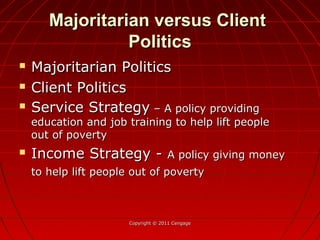
Majoritarian versus ClientMajoritarian versus Client
PoliticsPolitics
 Majoritarian PoliticsMajoritarian Politics
 Client PoliticsClient Politics
 Service StrategyService Strategy – A policy providing– A policy providing
education and job training to help lift peopleeducation and job training to help lift people
out of povertyout of poverty
 Income Strategy -Income Strategy - A policy giving moneyA policy giving money
to help lift people out of povertyto help lift people out of poverty
Copyright © 2011 CengageCopyright © 2011 Cengage
M E M O R A N D U MM E M O R A N D U M
To:To: Ursula Marx, Senate Committee chairUrsula Marx, Senate Committee chair
From:From: Cindy Fried, senior staff memberCindy Fried, senior staff member
Subject:Subject: Universal Health Care LegislationUniversal Health Care Legislation
You and the committee have two fairly distinct sets ofYou and the committee have two fairly distinct sets of
options on this universal health care package.options on this universal health care package.
Copyright © 2011 CengageCopyright © 2011 Cengage
WHAT WOULD YOU DO?WHAT WOULD YOU DO?
Arguments for:Arguments for:
1. With more than 47 million Americans, or one in seven,1. With more than 47 million Americans, or one in seven,
lacking health care coverage, the government needs tolacking health care coverage, the government needs to
enact far-reaching reform to ensure that everyone receivesenact far-reaching reform to ensure that everyone receives
quality medical care.quality medical care.
2. The soaring cost of health care (which is expected to reach2. The soaring cost of health care (which is expected to reach
approximately one-fifth of the federal budget in the nextapproximately one-fifth of the federal budget in the next
decade) can be contained only by a public system that hasdecade) can be contained only by a public system that has
the power to set prices and control costs.the power to set prices and control costs.
3. Universal health care is a logical expansion of the Medicare3. Universal health care is a logical expansion of the Medicare
and Medicaid programs created in 1965; nearly half aand Medicaid programs created in 1965; nearly half a
century later, health care should be a fundamental rightcentury later, health care should be a fundamental right
guaranteed for everyone who lives in the United States.guaranteed for everyone who lives in the United States.
Copyright © 2011 CengageCopyright © 2011 Cengage
WHAT WOULD YOU DO?WHAT WOULD YOU DO?
Arguments against:Arguments against:
1. Though many people lack health insurance, most of them1. Though many people lack health insurance, most of them
get health care in hospital emergency rooms and fromget health care in hospital emergency rooms and from
doctors who donate their services.doctors who donate their services.
2. Medical services in the United States are the best in the2. Medical services in the United States are the best in the
world, and government controls on costs will serve only toworld, and government controls on costs will serve only to
reduce the quality of care available.reduce the quality of care available.
3. In an era of budget deficits and trillions of dollars in3. In an era of budget deficits and trillions of dollars in
national debt, the United States cannot afford to expandnational debt, the United States cannot afford to expand
social welfare programs.social welfare programs.
Copyright © 2011 CengageCopyright © 2011 Cengage
WHAT WOULD YOU DO?WHAT WOULD YOU DO?
Your decision:Your decision:
Support?Support?
Oppose?Oppose?
Copyright © 2011 CengageCopyright © 2011 Cengage
WHAT WOULD YOU DO?WHAT WOULD YOU DO?

Social Welfare

  • 1.
    Chapter 19Chapter 19 SocialWelfareSocial Welfare
  • 2.
    Copyright © 2011CengageCopyright © 2011 Cengage  WHO GOVERNS?WHO GOVERNS? 1.1. How, if at all, have Americans’ views ofHow, if at all, have Americans’ views of government’s responsibility to help thegovernment’s responsibility to help the “deserving poor” changed over time?“deserving poor” changed over time? 2.2. Why are some government socialWhy are some government social welfare programs politically protectedwelfare programs politically protected while others are politically imperiled?while others are politically imperiled?  TO WHAT ENDS?TO WHAT ENDS? 1.1. What does the Constitution mean byWhat does the Constitution mean by “promote the general Welfare”?“promote the general Welfare”? 2.2. Should religious groups be eligible toShould religious groups be eligible to administer some federal welfareadminister some federal welfare programs?programs?
  • 3.
    Two Kinds ofWelfare ProgramsTwo Kinds of Welfare Programs  Majoritarian Politics/ProgramsMajoritarian Politics/Programs • Examples – Social Security, MedicareExamples – Social Security, Medicare • No means testNo means test • Biggest issue – costBiggest issue – cost  Client Politics/ProgramsClient Politics/Programs • Examples – Medicaid, Food StampsExamples – Medicaid, Food Stamps • Means testedMeans tested • Biggest issue – legitimacyBiggest issue – legitimacy Copyright © 2011 CengageCopyright © 2011 Cengage
  • 4.
    Social Welfare intheSocial Welfare in the United StatesUnited States United States compared to otherUnited States compared to other nations:nations:  More restrictive view of who isMore restrictive view of who is entitled to governmentalentitled to governmental assistanceassistance  Slower to embrace the welfareSlower to embrace the welfare statestate  States play a large roleStates play a large role  NongovernmentalNongovernmental organizations play a large roleorganizations play a large role Copyright © 2011 CengageCopyright © 2011 Cengage Handicapped parkingHandicapped parking signs are a commonsigns are a common reminder of thereminder of the government’sgovernment’s interest in socialinterest in social welfare. p. 509welfare. p. 509 Alan Schlein Photography/Corbis
  • 5.
    Figure 19.1 AFDC/TANF,FoodFigure 19.1 AFDC/TANF, Food Stamps, and SSI RecipientsStamps, and SSI Recipients 1975-20061975-2006 Copyright © 2011 CengageCopyright © 2011 Cengage Note: AFDC/TANF refers toNote: AFDC/TANF refers to Aid to Families withAid to Families with Dependent Children/Dependent Children/ Temporary Assistance forTemporary Assistance for Needy Families; TANFNeedy Families; TANF replaced AFDC after 1996.replaced AFDC after 1996. SSI refers to SupplementalSSI refers to Supplemental Security Income.Security Income. Source: Adapted from U.S.Source: Adapted from U.S. Department of Health andDepartment of Health and Human Services,Human Services, Indicators ofIndicators of Welfare Dependence: AnnualWelfare Dependence: Annual Report to CongressReport to Congress, 2006., 2006.
  • 6.
    Social Welfare intheSocial Welfare in the United StatesUnited States  Charitable ChoiceCharitable Choice  Majoritarian Welfare Programs:Majoritarian Welfare Programs: Social Security and MedicareSocial Security and Medicare  Reforming Majoritarian WelfareReforming Majoritarian Welfare ProgramsPrograms  Client Welfare Programs: Aid toClient Welfare Programs: Aid to Families with Dependent ChildrenFamilies with Dependent Children  Earned Income Tax Credit (EITC)Earned Income Tax Credit (EITC) Copyright © 2011 CengageCopyright © 2011 Cengage
  • 7.
    Copyright © 2011CengageCopyright © 2011 Cengage p. 511
  • 8.
    Copyright © 2011CengageCopyright © 2011 Cengage In 1932, unemployedIn 1932, unemployed workers line up at a soupworkers line up at a soup kitchen during the Greatkitchen during the Great Depression.Depression. Source: Topham/The Image Works.Source: Topham/The Image Works. In 1934, Huey Long, the popular governor ofIn 1934, Huey Long, the popular governor of Louisiana, claimed that Roosevelt was notLouisiana, claimed that Roosevelt was not doing enough to help the common man. Butdoing enough to help the common man. But before he could become a serious threat tobefore he could become a serious threat to Roosevelt in the 1936 election, Long wasRoosevelt in the 1936 election, Long was assassinated in 1935.assassinated in 1935. Source: Bettmann/CORBISSource: Bettmann/CORBIS
  • 9.
    Copyright © 2011CengageCopyright © 2011 Cengage p. 514
  • 10.
    Copyright © 2011CengageCopyright © 2011 Cengage President Lyndon JohnsonPresident Lyndon Johnson (left) signs the Medicare Act in(left) signs the Medicare Act in 1965 in the company of Vice1965 in the company of Vice President Hubert HumphreyPresident Hubert Humphrey (standing) and former(standing) and former president Harry S. Trumanpresident Harry S. Truman (right).(right). Source: Lyndon BainesSource: Lyndon Baines Johnson Library/National ArchivesJohnson Library/National Archives Mitt Romney, then theMitt Romney, then the Republican governor ofRepublican governor of Massachusetts, signs a billMassachusetts, signs a bill requiring every state residentrequiring every state resident to have health insurance.to have health insurance. Source: Joe Raedle/Getty ImagesSource: Joe Raedle/Getty Images
  • 11.
    Copyright © 2011CengageCopyright © 2011 Cengage Source: Knowledge Networks, survey of a nationally representative sample of 1,514 adults age twenty-oneSource: Knowledge Networks, survey of a nationally representative sample of 1,514 adults age twenty-one and older, conducted January 19–29, 2007, as reported inand older, conducted January 19–29, 2007, as reported in Retirement Security Survey ReportRetirement Security Survey Report (Washington, D.C.: American Association of Retired(Washington, D.C.: American Association of Retired Persons, February 2007); and Public AgendaPersons, February 2007); and Public Agenda Foundation, “Social Security: Bills and Proposals,” 2007, atFoundation, “Social Security: Bills and Proposals,” 2007, at http://www.publicagendahttp://www.publicagenda. org/issues/major. org/issues/major proposals, citing a January 2005 survey by the Pew Research Center of the Pew Charitable Trusts.proposals, citing a January 2005 survey by the Pew Research Center of the Pew Charitable Trusts.
  • 12.
    Copyright © 2011CengageCopyright © 2011 Cengage Source: LaurenceSource: Laurence Kotlilkoff and ChristianKotlilkoff and Christian Hagist, National Bureau ofHagist, National Bureau of Economic Research,Economic Research, Working paper no. 11833,Working paper no. 11833, 2005, reporting OECD2005, reporting OECD data and roundeddata and rounded averages for the periodaverages for the period 1970–2002, as1970–2002, as cited in National Centercited in National Center for Policy Analysis,for Policy Analysis, HealthHealth Care Spending TrendsCare Spending Trends,, 2004, table 1.2004, table 1.
  • 13.
    Copyright © 2011CengageCopyright © 2011 Cengage When members ofWhen members of Congress went home inCongress went home in August 2009, theyAugust 2009, they encountered a long lineencountered a long line of voters angry over theof voters angry over the health care debate.health care debate. Source: Bradley C Bower/APSource: Bradley C Bower/AP PhotoPhoto A girl looks on as her motherA girl looks on as her mother displays food stamps.displays food stamps. Source: A. Ramey/PhotoEditSource: A. Ramey/PhotoEdit
  • 14.
    Majoritarian versus ClientMajoritarianversus Client PoliticsPolitics  Majoritarian PoliticsMajoritarian Politics  Client PoliticsClient Politics  Service StrategyService Strategy – A policy providing– A policy providing education and job training to help lift peopleeducation and job training to help lift people out of povertyout of poverty  Income Strategy -Income Strategy - A policy giving moneyA policy giving money to help lift people out of povertyto help lift people out of poverty Copyright © 2011 CengageCopyright © 2011 Cengage
  • 15.
    M E MO R A N D U MM E M O R A N D U M To:To: Ursula Marx, Senate Committee chairUrsula Marx, Senate Committee chair From:From: Cindy Fried, senior staff memberCindy Fried, senior staff member Subject:Subject: Universal Health Care LegislationUniversal Health Care Legislation You and the committee have two fairly distinct sets ofYou and the committee have two fairly distinct sets of options on this universal health care package.options on this universal health care package. Copyright © 2011 CengageCopyright © 2011 Cengage WHAT WOULD YOU DO?WHAT WOULD YOU DO?
  • 16.
    Arguments for:Arguments for: 1.With more than 47 million Americans, or one in seven,1. With more than 47 million Americans, or one in seven, lacking health care coverage, the government needs tolacking health care coverage, the government needs to enact far-reaching reform to ensure that everyone receivesenact far-reaching reform to ensure that everyone receives quality medical care.quality medical care. 2. The soaring cost of health care (which is expected to reach2. The soaring cost of health care (which is expected to reach approximately one-fifth of the federal budget in the nextapproximately one-fifth of the federal budget in the next decade) can be contained only by a public system that hasdecade) can be contained only by a public system that has the power to set prices and control costs.the power to set prices and control costs. 3. Universal health care is a logical expansion of the Medicare3. Universal health care is a logical expansion of the Medicare and Medicaid programs created in 1965; nearly half aand Medicaid programs created in 1965; nearly half a century later, health care should be a fundamental rightcentury later, health care should be a fundamental right guaranteed for everyone who lives in the United States.guaranteed for everyone who lives in the United States. Copyright © 2011 CengageCopyright © 2011 Cengage WHAT WOULD YOU DO?WHAT WOULD YOU DO?
  • 17.
    Arguments against:Arguments against: 1.Though many people lack health insurance, most of them1. Though many people lack health insurance, most of them get health care in hospital emergency rooms and fromget health care in hospital emergency rooms and from doctors who donate their services.doctors who donate their services. 2. Medical services in the United States are the best in the2. Medical services in the United States are the best in the world, and government controls on costs will serve only toworld, and government controls on costs will serve only to reduce the quality of care available.reduce the quality of care available. 3. In an era of budget deficits and trillions of dollars in3. In an era of budget deficits and trillions of dollars in national debt, the United States cannot afford to expandnational debt, the United States cannot afford to expand social welfare programs.social welfare programs. Copyright © 2011 CengageCopyright © 2011 Cengage WHAT WOULD YOU DO?WHAT WOULD YOU DO?
  • 18.
    Your decision:Your decision: Support?Support? Oppose?Oppose? Copyright© 2011 CengageCopyright © 2011 Cengage WHAT WOULD YOU DO?WHAT WOULD YOU DO?

Editor's Notes

  • #6 Replace with jpeg, p. 512
  • #12 Replace with jpeg, p. 516
  • #13 Replace with jpeg, p. 517