8
THE DATA OF MACROECONOMICS
Copyright © 2004 South-Western
2323Measuring a Nation’s
Income
Copyright © 2004 South-Western
Measuring a Nation’s Income
• Microeconomics
• Microeconomics is the study of how individual
households and firms make decisions and how they
interact with one another in markets.
• Macroeconomics
• Macroeconomics is the study of the economy as a
whole.
• Its goal is to explain the economic changes that
affect many households, firms, and markets at once.
Copyright © 2004 South-Western
Measuring a Nation’s Income
• Macroeconomics answers questions like the
following:
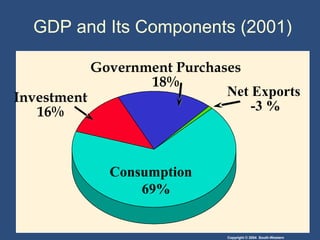
• Why is average income high in some countries and
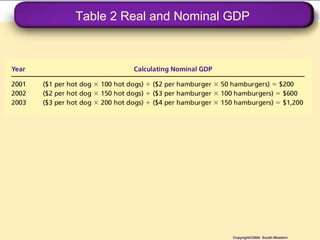
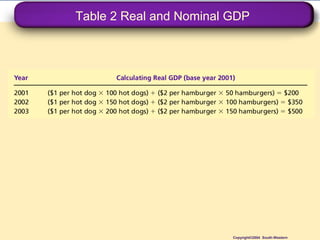
low in others?
• Why do prices rise rapidly in some time periods
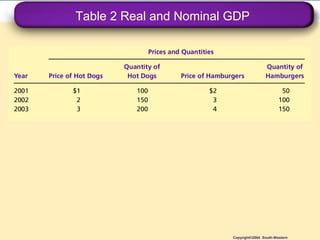
while they are more stable in others?
• Why do production and employment expand in
some years and contract in others?
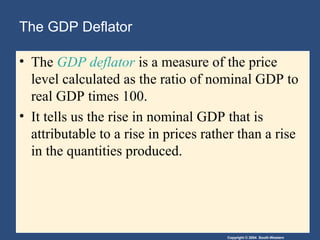
Copyright © 2004 South-Western
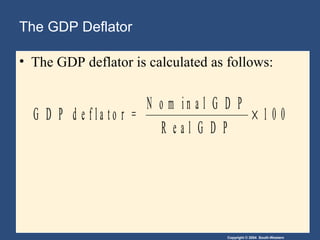
THE ECONOMY’S INCOME AND
EXPENDITURE
• When judging whether the economy is doing
well or poorly, it is natural to look at the total
income that everyone in the economy is
earning.
Copyright © 2004 South-Western
THE ECONOMY’S INCOME AND
EXPENDITURE
• For an economy as a whole, income must equal
expenditure because:
• Every transaction has a buyer and a seller.
• Every dollar of spending by some buyer is a dollar
of income for some seller.
Copyright © 2004 South-Western
THE MEASUREMENT OF GROSS
DOMESTIC PRODUCT
• Gross domestic product (GDP) is a measure of
the income and expenditures of an economy.
• It is the total market value of all final goods and
services produced within a country in a given
period of time.
Copyright © 2004 South-Western
THE MEASUREMENT OF GROSS
DOMESTIC PRODUCT
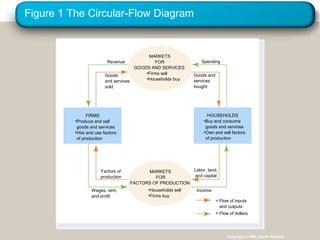
• The equality of income and expenditure can be
illustrated with the circular-flow diagram.
Figure 1 The Circular-Flow Diagram
Spending
Goods and
services
bought
Revenue
Goods
and services
sold
Labor, land,
and capital
Income
= Flow of inputs
and outputs
= Flow of dollars
Factors of
production
Wages, rent,
and profit
FIRMS
•Produce and sell
goods and services
•Hire and use factors
of production
•Buy and consume
goods and services
•Own and sell factors
of production
HOUSEHOLDS
•Households sell
•Firms buy
MARKETS
FOR
FACTORS OF PRODUCTION
•Firms sell
•Households buy
MARKETS
FOR
GOODS AND SERVICES
Copyright © 2004 South-Western
THE MEASUREMENT OF GROSS
DOMESTIC PRODUCT
• GDP is the market value of all final goods and
services produced within a country in a given
period of time.
Copyright © 2004 South-Western
THE MEASUREMENT OF GROSS
DOMESTIC PRODUCT
• “GDP is the Market Value . . .”
• Output is valued at market prices.
• “. . . Of All Final . . .”
• It records only the value of final goods, not
intermediate goods (the value is counted only once).
• “. . . Goods and Services . . . “
• It includes both tangible goods (food, clothing,
cars) and intangible services (haircuts,
housecleaning, doctor visits).
Copyright © 2004 South-Western
THE MEASUREMENT OF GROSS
DOMESTIC PRODUCT
• “. . . Produced . . .”
• It includes goods and services currently produced,
not transactions involving goods produced in the
past.
• “ . . . Within a Country . . .”
• It measures the value of production within the
geographic confines of a country.
Copyright © 2004 South-Western
THE MEASUREMENT OF GROSS
DOMESTIC PRODUCT
• “. . . In a Given Period of Time.”
• It measures the value of production that takes place
within a specific interval of time, usually a year or a
quarter (three months).
Copyright © 2004 South-Western
THE COMPONENTS OF GDP
• GDP includes all items produced in the
economy and sold legally in markets.
Copyright © 2004 South-Western
THE COMPONENTS OF GDP
• What Is Not Counted in GDP?
• GDP excludes most items that are produced and
consumed at home and that never enter the
marketplace.
• It excludes items produced and sold illicitly, such as
illegal drugs.
Copyright © 2004 South-Western
THE COMPONENTS OF GDP
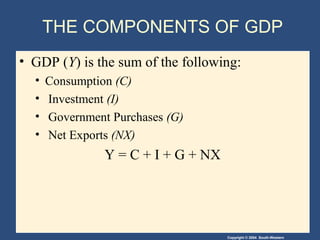
• GDP (Y) is the sum of the following:
• Consumption (C)
• Investment (I)
• Government Purchases (G)
• Net Exports (NX)
Y = C + I + G + NX
Copyright © 2004 South-Western
THE COMPONENTS OF GDP
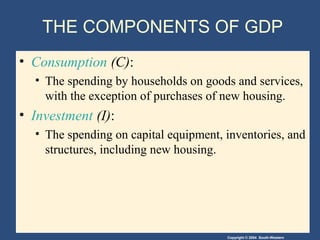
• Consumption (C):
• The spending by households on goods and services,
with the exception of purchases of new housing.
• Investment (I):
• The spending on capital equipment, inventories, and
structures, including new housing.
Copyright © 2004 South-Western
THE COMPONENTS OF GDP
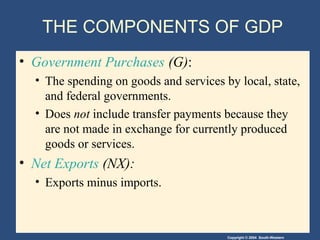
• Government Purchases (G):
• The spending on goods and services by local, state,
and federal governments.
• Does not include transfer payments because they
are not made in exchange for currently produced
goods or services.
• Net Exports (NX):
• Exports minus imports.
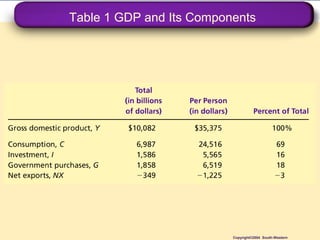
Table 1 GDP and Its Components
Copyright©2004 South-Western
Copyright © 2004 South-Western
GDP and Its Components (2001)
Consumption
69%
Government Purchases
18%
Net Exports
-3 %
Investment
16%
Copyright © 2004 South-Western
REAL VERSUS NOMINAL GDP
• Nominal GDP values the production of goods
and services at current prices.
• Real GDP values the production of goods and
services at constant prices.
Copyright © 2004 South-Western
REAL VERSUS NOMINAL GDP
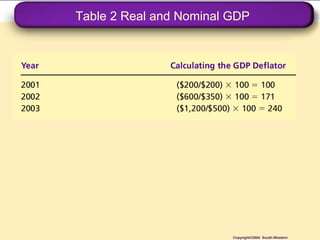
• An accurate view of the economy requires
adjusting nominal to real GDP by using the
GDP deflator.
Table 2 Real and Nominal GDP
Copyright©2004 South-Western
Table 2 Real and Nominal GDP
Copyright©2004 South-Western
Table 2 Real and Nominal GDP
Copyright©2004 South-Western
Copyright © 2004 South-Western
The GDP Deflator
• The GDP deflator is a measure of the price
level calculated as the ratio of nominal GDP to
real GDP times 100.
• It tells us the rise in nominal GDP that is
attributable to a rise in prices rather than a rise
in the quantities produced.
Copyright © 2004 South-Western
The GDP Deflator
• The GDP deflator is calculated as follows:
G D P d e f l a t o r =
N o m i n a l G D P
R e a l G D P
× 1 0 0
Copyright © 2004 South-Western
The GDP Deflator
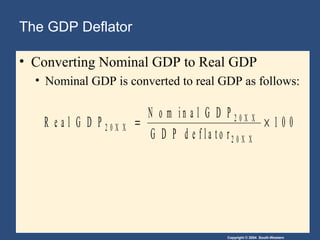
• Converting Nominal GDP to Real GDP
• Nominal GDP is converted to real GDP as follows:
R e a l G D P
N o m i n a l G D P
G D P d e f l a t o r
2 0 X X
2 0 X X
2 0 X X
= × 1 0 0
Table 2 Real and Nominal GDP
Copyright©2004 South-Western
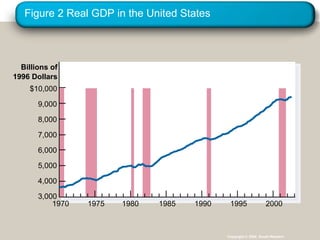
Figure 2 Real GDP in the United States
Billions of
1996 Dollars
$10,000
9,000
8,000
7,000
6,000
5,000
4,000
3,000
1970 1975 1980 1985 1990 20001995
Copyright © 2004 South-Western
GDP AND ECONOMIC WELL-
BEING
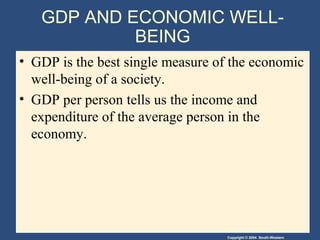
• GDP is the best single measure of the economic
well-being of a society.
• GDP per person tells us the income and
expenditure of the average person in the
economy.
Copyright © 2004 South-Western
GDP AND ECONOMIC WELL-
BEING
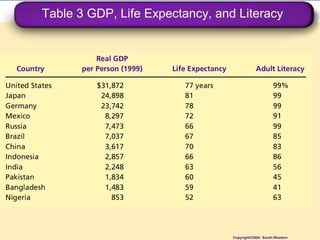
• Higher GDP per person indicates a higher
standard of living.
• GDP is not a perfect measure of the happiness
or quality of life, however.
Copyright © 2004 South-Western
GDP AND ECONOMIC
WELL-BEING
• Some things that contribute to well-being are
not included in GDP.
• The value of leisure.
• The value of a clean environment.
• The value of almost all activity that takes place
outside of markets, such as the value of the time
parents spend with their children and the value of
volunteer work.
Table 3 GDP, Life Expectancy, and Literacy
Copyright©2004 South-Western
Copyright © 2004 South-Western
Summary
• Because every transaction has a buyer and a
seller, the total expenditure in the economy
must equal the total income in the economy.
• Gross Domestic Product (GDP) measures an
economy’s total expenditure on newly
produced goods and services and the total
income earned from the production of these
goods and services.
Copyright © 2004 South-Western
Summary
• GDP is the market value of all final goods and
services produced within a country in a given
period of time.
• GDP is divided among four components of
expenditure: consumption, investment,
government purchases, and net exports.
Copyright © 2004 South-Western
Summary
• Nominal GDP uses current prices to value the
economy’s production. Real GDP uses constant
base-year prices to value the economy’s
production of goods and services.
• The GDP deflator—calculated from the ratio of
nominal to real GDP—measures the level of
prices in the economy.
Copyright © 2004 South-Western
Summary
• GDP is a good measure of economic well-being
because people prefer higher to lower incomes.
• It is not a perfect measure of well-being
because some things, such as leisure time and a
clean environment, aren’t measured by GDP.

Measuring a Nation's Income

  • 1.
    8 THE DATA OFMACROECONOMICS
  • 2.
    Copyright © 2004South-Western 2323Measuring a Nation’s Income
  • 3.
    Copyright © 2004South-Western Measuring a Nation’s Income • Microeconomics • Microeconomics is the study of how individual households and firms make decisions and how they interact with one another in markets. • Macroeconomics • Macroeconomics is the study of the economy as a whole. • Its goal is to explain the economic changes that affect many households, firms, and markets at once.
  • 4.
    Copyright © 2004South-Western Measuring a Nation’s Income • Macroeconomics answers questions like the following: • Why is average income high in some countries and low in others? • Why do prices rise rapidly in some time periods while they are more stable in others? • Why do production and employment expand in some years and contract in others?
  • 5.
    Copyright © 2004South-Western THE ECONOMY’S INCOME AND EXPENDITURE • When judging whether the economy is doing well or poorly, it is natural to look at the total income that everyone in the economy is earning.
  • 6.
    Copyright © 2004South-Western THE ECONOMY’S INCOME AND EXPENDITURE • For an economy as a whole, income must equal expenditure because: • Every transaction has a buyer and a seller. • Every dollar of spending by some buyer is a dollar of income for some seller.
  • 7.
    Copyright © 2004South-Western THE MEASUREMENT OF GROSS DOMESTIC PRODUCT • Gross domestic product (GDP) is a measure of the income and expenditures of an economy. • It is the total market value of all final goods and services produced within a country in a given period of time.
  • 8.
    Copyright © 2004South-Western THE MEASUREMENT OF GROSS DOMESTIC PRODUCT • The equality of income and expenditure can be illustrated with the circular-flow diagram.
  • 9.
    Figure 1 TheCircular-Flow Diagram Spending Goods and services bought Revenue Goods and services sold Labor, land, and capital Income = Flow of inputs and outputs = Flow of dollars Factors of production Wages, rent, and profit FIRMS •Produce and sell goods and services •Hire and use factors of production •Buy and consume goods and services •Own and sell factors of production HOUSEHOLDS •Households sell •Firms buy MARKETS FOR FACTORS OF PRODUCTION •Firms sell •Households buy MARKETS FOR GOODS AND SERVICES Copyright © 2004 South-Western
  • 10.
    Copyright © 2004South-Western THE MEASUREMENT OF GROSS DOMESTIC PRODUCT • GDP is the market value of all final goods and services produced within a country in a given period of time.
  • 11.
    Copyright © 2004South-Western THE MEASUREMENT OF GROSS DOMESTIC PRODUCT • “GDP is the Market Value . . .” • Output is valued at market prices. • “. . . Of All Final . . .” • It records only the value of final goods, not intermediate goods (the value is counted only once). • “. . . Goods and Services . . . “ • It includes both tangible goods (food, clothing, cars) and intangible services (haircuts, housecleaning, doctor visits).
  • 12.
    Copyright © 2004South-Western THE MEASUREMENT OF GROSS DOMESTIC PRODUCT • “. . . Produced . . .” • It includes goods and services currently produced, not transactions involving goods produced in the past. • “ . . . Within a Country . . .” • It measures the value of production within the geographic confines of a country.
  • 13.
    Copyright © 2004South-Western THE MEASUREMENT OF GROSS DOMESTIC PRODUCT • “. . . In a Given Period of Time.” • It measures the value of production that takes place within a specific interval of time, usually a year or a quarter (three months).
  • 14.
    Copyright © 2004South-Western THE COMPONENTS OF GDP • GDP includes all items produced in the economy and sold legally in markets.
  • 15.
    Copyright © 2004South-Western THE COMPONENTS OF GDP • What Is Not Counted in GDP? • GDP excludes most items that are produced and consumed at home and that never enter the marketplace. • It excludes items produced and sold illicitly, such as illegal drugs.
  • 16.
    Copyright © 2004South-Western THE COMPONENTS OF GDP • GDP (Y) is the sum of the following: • Consumption (C) • Investment (I) • Government Purchases (G) • Net Exports (NX) Y = C + I + G + NX
  • 17.
    Copyright © 2004South-Western THE COMPONENTS OF GDP • Consumption (C): • The spending by households on goods and services, with the exception of purchases of new housing. • Investment (I): • The spending on capital equipment, inventories, and structures, including new housing.
  • 18.
    Copyright © 2004South-Western THE COMPONENTS OF GDP • Government Purchases (G): • The spending on goods and services by local, state, and federal governments. • Does not include transfer payments because they are not made in exchange for currently produced goods or services. • Net Exports (NX): • Exports minus imports.
  • 19.
    Table 1 GDPand Its Components Copyright©2004 South-Western
  • 20.
    Copyright © 2004South-Western GDP and Its Components (2001) Consumption 69% Government Purchases 18% Net Exports -3 % Investment 16%
  • 21.
    Copyright © 2004South-Western REAL VERSUS NOMINAL GDP • Nominal GDP values the production of goods and services at current prices. • Real GDP values the production of goods and services at constant prices.
  • 22.
    Copyright © 2004South-Western REAL VERSUS NOMINAL GDP • An accurate view of the economy requires adjusting nominal to real GDP by using the GDP deflator.
  • 23.
    Table 2 Realand Nominal GDP Copyright©2004 South-Western
  • 24.
    Table 2 Realand Nominal GDP Copyright©2004 South-Western
  • 25.
    Table 2 Realand Nominal GDP Copyright©2004 South-Western
  • 26.
    Copyright © 2004South-Western The GDP Deflator • The GDP deflator is a measure of the price level calculated as the ratio of nominal GDP to real GDP times 100. • It tells us the rise in nominal GDP that is attributable to a rise in prices rather than a rise in the quantities produced.
  • 27.
    Copyright © 2004South-Western The GDP Deflator • The GDP deflator is calculated as follows: G D P d e f l a t o r = N o m i n a l G D P R e a l G D P × 1 0 0
  • 28.
    Copyright © 2004South-Western The GDP Deflator • Converting Nominal GDP to Real GDP • Nominal GDP is converted to real GDP as follows: R e a l G D P N o m i n a l G D P G D P d e f l a t o r 2 0 X X 2 0 X X 2 0 X X = × 1 0 0
  • 29.
    Table 2 Realand Nominal GDP Copyright©2004 South-Western
  • 30.
    Figure 2 RealGDP in the United States Billions of 1996 Dollars $10,000 9,000 8,000 7,000 6,000 5,000 4,000 3,000 1970 1975 1980 1985 1990 20001995 Copyright © 2004 South-Western
  • 31.
    Copyright © 2004South-Western GDP AND ECONOMIC WELL- BEING • GDP is the best single measure of the economic well-being of a society. • GDP per person tells us the income and expenditure of the average person in the economy.
  • 32.
    Copyright © 2004South-Western GDP AND ECONOMIC WELL- BEING • Higher GDP per person indicates a higher standard of living. • GDP is not a perfect measure of the happiness or quality of life, however.
  • 33.
    Copyright © 2004South-Western GDP AND ECONOMIC WELL-BEING • Some things that contribute to well-being are not included in GDP. • The value of leisure. • The value of a clean environment. • The value of almost all activity that takes place outside of markets, such as the value of the time parents spend with their children and the value of volunteer work.
  • 34.
    Table 3 GDP,Life Expectancy, and Literacy Copyright©2004 South-Western
  • 35.
    Copyright © 2004South-Western Summary • Because every transaction has a buyer and a seller, the total expenditure in the economy must equal the total income in the economy. • Gross Domestic Product (GDP) measures an economy’s total expenditure on newly produced goods and services and the total income earned from the production of these goods and services.
  • 36.
    Copyright © 2004South-Western Summary • GDP is the market value of all final goods and services produced within a country in a given period of time. • GDP is divided among four components of expenditure: consumption, investment, government purchases, and net exports.
  • 37.
    Copyright © 2004South-Western Summary • Nominal GDP uses current prices to value the economy’s production. Real GDP uses constant base-year prices to value the economy’s production of goods and services. • The GDP deflator—calculated from the ratio of nominal to real GDP—measures the level of prices in the economy.
  • 38.
    Copyright © 2004South-Western Summary • GDP is a good measure of economic well-being because people prefer higher to lower incomes. • It is not a perfect measure of well-being because some things, such as leisure time and a clean environment, aren’t measured by GDP.