Public AdministrationPublic Administration
Prepared by
Nazia Ashraf
Nazia.ashraf1536@gmail.com
Meaning of Public Administration
Administer is a English word, which is
originated from the Latin word ‘ad’
and ‘ministrare’. It means to serve or
to manage. Administration means
management of affairs, public or
private
Public Administration
 “Public Administration is a detailed and
systematic application of law.” by Prof.
Woodrow Wilson
 “Public Administration consists of all
those operations having for their purpose
the fulfillment of public policy as declared
by authority.” by L. D. White.
Public Administration
 “By Public Administration is meant the
activities of the executive branches of the
national, state, & local governments.” by
Simon.
 “Public Administration is the art and
science of management as applied to the
affairs of the state.”(Waldo)
Functions Public
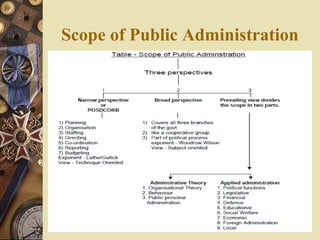
Administration (POSDCORB)
 ‘P’ stands for planning
 ‘O’ stands for organization
 ‘S’ stands for staffing.
 ‘D’ stands for Directing.
 ‘Co.’ stands for Co-ordination.
 ‘R’ stands for Reporting
 ‘B’ stands for Budgeting
Administrative Theory
Administrative Theory
Applied Administration
Administrative theory
Organizational Theory
Behavior
Public Personal Administration
Applied Administration
 Political functions
 Legislative function
 Financial functions
 Defense
 Educational function
 Economic Administration
 Foreign administration
Scope of Public Administration
It is the basis of government.
It is the instrument of change in the
society.
It plays vital role in the life of the
people.
 It is an instrument for executing laws,
policies, programmes of the state.
Scope of Public Administration
It is a stabilising force in the society
as it provides continuity.
 It is instrument of national integration
in the developing countries which are
facing classwars.
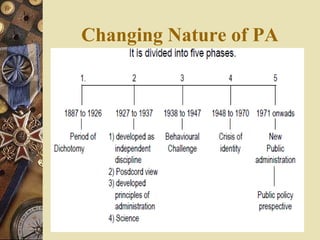
Changing Nature of PA
COMPARATIVE PUBLIC
ADMINISTRATION
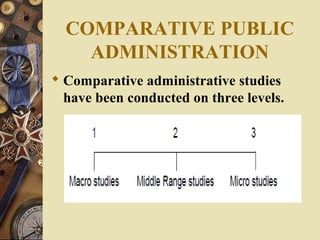
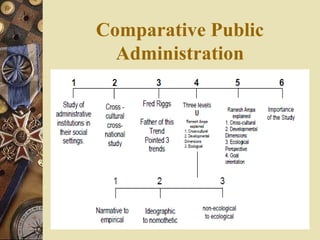
 Comparative administrative studies
have been conducted on three levels.
Ramesh Arora has summed up the
elements of comparative
public administration
 Cross cultural Comparison
 Developmental Dimensions
 Ecological perspective
 Goal orientation
Comparative Public
Administration
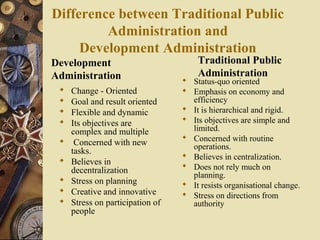
Difference between Traditional Public
Administration and
Development Administration
Development
Administration
 Change - Oriented
 Goal and result oriented
 Flexible and dynamic
 Its objectives are
complex and multiple
 Concerned with new
tasks.
 Believes in
decentralization
 Stress on planning
 Creative and innovative
 Stress on participation of
people
Traditional Public
Administration
 Status-quo oriented
 Emphasis on economy and
efficiency
 It is hierarchical and rigid.
 Its objectives are simple and
limited.
 Concerned with routine
operations.
 Believes in centralization.
 Does not rely much on
planning.
 It resists organisational change.
 Stress on directions from
authority
Development Administration
NEW PUBLIC
ADMINISTRATION
Frank Marini (1971)
Administration’ New Public Administration
emphasis on the following themes :-
 Rejected the value neutral view
 Less generic and more public
 Stress on social equity
NEW PUBLIC
ADMINISTRATION
 Anti-bureaucratic, anti-hierachical, anti-
technical.
 Socially conscious and client oriented
view.
 Stress on Decentralization of
administrative process.
 Stress on qualitative transformation.

Public administration

  • 1.
    Public AdministrationPublic Administration Preparedby Nazia Ashraf Nazia.ashraf1536@gmail.com
  • 2.
    Meaning of PublicAdministration Administer is a English word, which is originated from the Latin word ‘ad’ and ‘ministrare’. It means to serve or to manage. Administration means management of affairs, public or private
  • 3.
    Public Administration  “PublicAdministration is a detailed and systematic application of law.” by Prof. Woodrow Wilson  “Public Administration consists of all those operations having for their purpose the fulfillment of public policy as declared by authority.” by L. D. White.
  • 4.
    Public Administration  “ByPublic Administration is meant the activities of the executive branches of the national, state, & local governments.” by Simon.  “Public Administration is the art and science of management as applied to the affairs of the state.”(Waldo)
  • 5.
    Functions Public Administration (POSDCORB) ‘P’ stands for planning  ‘O’ stands for organization  ‘S’ stands for staffing.  ‘D’ stands for Directing.  ‘Co.’ stands for Co-ordination.  ‘R’ stands for Reporting  ‘B’ stands for Budgeting
  • 6.
  • 7.
  • 8.
    Applied Administration  Politicalfunctions  Legislative function  Financial functions  Defense  Educational function  Educational function  Economic Administration  Foreign administration
  • 9.
    Scope of PublicAdministration
  • 10.
    Scope of PublicAdministration It is the basis of government. It is the instrument of change in the society. It plays vital role in the life of the people.  It is an instrument for executing laws, policies, programmes of the state.
  • 11.
    Scope of PublicAdministration It is a stabilising force in the society as it provides continuity.  It is instrument of national integration in the developing countries which are facing classwars.
  • 12.
  • 13.
    COMPARATIVE PUBLIC ADMINISTRATION  Comparativeadministrative studies have been conducted on three levels.
  • 14.
    Ramesh Arora hassummed up the elements of comparative public administration  Cross cultural Comparison  Developmental Dimensions  Ecological perspective  Goal orientation
  • 15.
  • 16.
    Difference between TraditionalPublic Administration and Development Administration Development Administration  Change - Oriented  Goal and result oriented  Flexible and dynamic  Its objectives are complex and multiple  Concerned with new tasks.  Believes in decentralization  Stress on planning  Creative and innovative  Stress on participation of people Traditional Public Administration  Status-quo oriented  Emphasis on economy and efficiency  It is hierarchical and rigid.  Its objectives are simple and limited.  Concerned with routine operations.  Believes in centralization.  Does not rely much on planning.  It resists organisational change.  Stress on directions from authority
  • 17.
  • 18.
    NEW PUBLIC ADMINISTRATION Frank Marini(1971) Administration’ New Public Administration emphasis on the following themes :-  Rejected the value neutral view  Less generic and more public  Stress on social equity
  • 19.
    NEW PUBLIC ADMINISTRATION  Anti-bureaucratic,anti-hierachical, anti- technical.  Socially conscious and client oriented view.  Stress on Decentralization of administrative process.  Stress on qualitative transformation.