Evolution of the
 Field of Public
Administration
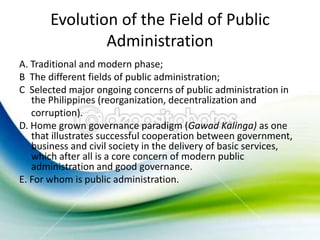
Evolution of the Field of Public
               Administration
A. Traditional and modern phase;
B The different fields of public administration;
C Selected major ongoing concerns of public administration in
   the Philippines (reorganization, decentralization and
   corruption).
D. Home grown governance paradigm (Gawad Kalinga) as one
   that illustrates successful cooperation between government,
   business and civil society in the delivery of basic services,
   which after all is a core concern of modern public
   administration and good governance.
E. For whom is public administration.
Evolution of the
         Field of Public Administration
• To retrace the history and evolution of the broad
  discipline and examine the various strands and
  influences that have influenced the theory and
  practice – the praxis - of public administration in the
  Philippines.
• To examine the specific areas and fields of
  specialization of the field, taking cognizance of the
  many other emerging fields going beyond the
  traditional fields of public administration
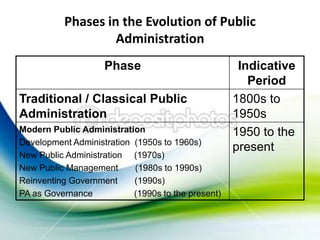
Phases in the Evolution of Public
                   Administration
                    Phase                            Indicative
                                                       Period
Traditional / Classical Public                      1800s to
Administration                                      1950s
Modern Public Administration                        1950 to the
Development Administration (1950s to 1960s)
                                                    present
New Public Administration (1970s)
New Public Management      (1980s to 1990s)
Reinventing Government     (1990s)
PA as Governance           (1990s to the present)
Traditional / Classical Public Administration


• Public Administration can be traced back to
  human history. It has been suggested that it is
  as old as the ancient empires of China, India,
  Egypt, Greece, Rome and Mesopotomia.
• The institutionalization of administrative
  capacity for collective purposes is the
  foundation of public administration. Such
  arrangement has existed in all societies
  (Caiden (1982),.
Traditional / Classical Public Administration

• All societies are devoted to advancing the general
  welfare or the public interest. The idea that “public
  administration should not be considered
  administration of the public but administration for
  the public” has been practiced and expressed in the
  Code of Hammurabi, in Confucianism and in the
  funeral oration of Pericles. (Caiden 1982: 7)

• In other words, the idea of client-oriented public
  administration has its roots in ancient public
  administration.
• Caiden (1982) also noted that the genesis of
  Public Administration must have had
  originated from monarchial Europe where
  household officials were divided into two
  groups: one in charge of public affairs, i.e. the
  administration of justice, finance, training of
  armies, and the other is responsible for
  personal services. Rutgers (1998) supports this
  claim that (i.e. royal) administration had
  already been manifested way back in the mid
  17th century and early 18th century in
  Prussia.
• F.K. Medikus (as cited in Rutgers 1998)
  likewise argued on the study of public
  administration and its positions amidst the
  sciences in the 18th century. He advocated
  “cameralism” and claimed that it should be
  treated as an autonomous field of study of
  great importance to the state. Cameral science
  is designed to prepare potential public officials
  for government service. This practice
  flourished in Europe until the 21st century but
  it was, in the long run, replaced by
  administrative law and legal studies.
Woodrow Wilson’s 1887
1800s to 1950s. If the roots of Public Administration as a
  distinct field of study have to be traced, the tendency is to
  draw on classic essay, “The Study of Public Administration,”
  which was written at the height of Progressive Movement
  in the US. It was in that essay that there was a serious
  claim that public administration should be a self-conscious,
  professional field. Wilson suggested the distinction
  between politics and administration i.e. administration
  should be politics-free and that “the field of
  administration is the field of business;” (Wilson 1953: 71)
  thus, establishing what became known as the “politics-
  administration” dichotomy. Although Wilson set a
  demarcation line between politics and administration
Frank Goodnow (1900)
• Frank Goodnow (1900), the “Father of
  American Public Administration,”
  presented a more meticulous
  examination of politics-administration
  dichotomy in his book, “Politics and
  Administration” that “supplanted the
  traditional concern with the separation
  of powers among the various branches
  of the government.” (Shafritz and Hyde
  1997: 2)
Frank Goodnow (1900)
• Politics administration dichotomy has
  provoked long-running debates which
  persist until today. It may be argued
  though that, as far as the Philippine
  experience is concerned, the dichotomy
  is artificial and that in practice, power
  and partisan politics have had a
  disproportionate influence upon the
  workings of public administration in the
  Philippines
Leonard D. White, 1926
It was in 1926 that the first text in the field of
   public administration was written by Leonard D.
   White. His book, Introduction to the Study of
   Public Administration, is one of the most
   influential texts in public administration to date.
   One of his assumptions was that administration
   is still an art. He, however, recognized the ideal
   of transforming it into a science. Interestingly,
   his work avoided the potential pitfalls of the
   politics-administration dichotomy but rather
   concentrated on emphasizing the managerial
   phase of administration.
Max Weber (1946),
• a German sociologist who is known as the “Father of
  Modern Sociology,” made a lucid descriptive analysis
  of bureaucratic organizations. He presented some
  major variables or features of bureaucracy such as:
  hierarchy, division of labor, formally written rules and
  procedures, impersonality and neutrality; hence,
  providing a reference point in evaluating both the
  good and bad effects of bureaucratic structures.
  (Weber 1946 as cited in Shafritz and Hyde 1997)
Reference:
Is there a Philippine Public Administration or
        Better Still, for whom is Public
                Administration?
      By; Alex Brillantes, Jr. and Maricel
                    Fernandez
                  June, 2008

Evolution of Public Administration

  • 1.
    Evolution of the Field of Public Administration
  • 2.
    Evolution of theField of Public Administration A. Traditional and modern phase; B The different fields of public administration; C Selected major ongoing concerns of public administration in the Philippines (reorganization, decentralization and corruption). D. Home grown governance paradigm (Gawad Kalinga) as one that illustrates successful cooperation between government, business and civil society in the delivery of basic services, which after all is a core concern of modern public administration and good governance. E. For whom is public administration.
  • 3.
    Evolution of the Field of Public Administration • To retrace the history and evolution of the broad discipline and examine the various strands and influences that have influenced the theory and practice – the praxis - of public administration in the Philippines. • To examine the specific areas and fields of specialization of the field, taking cognizance of the many other emerging fields going beyond the traditional fields of public administration
  • 4.
    Phases in theEvolution of Public Administration Phase Indicative Period Traditional / Classical Public 1800s to Administration 1950s Modern Public Administration 1950 to the Development Administration (1950s to 1960s) present New Public Administration (1970s) New Public Management (1980s to 1990s) Reinventing Government (1990s) PA as Governance (1990s to the present)
  • 5.
    Traditional / ClassicalPublic Administration • Public Administration can be traced back to human history. It has been suggested that it is as old as the ancient empires of China, India, Egypt, Greece, Rome and Mesopotomia. • The institutionalization of administrative capacity for collective purposes is the foundation of public administration. Such arrangement has existed in all societies (Caiden (1982),.
  • 6.
    Traditional / ClassicalPublic Administration • All societies are devoted to advancing the general welfare or the public interest. The idea that “public administration should not be considered administration of the public but administration for the public” has been practiced and expressed in the Code of Hammurabi, in Confucianism and in the funeral oration of Pericles. (Caiden 1982: 7) • In other words, the idea of client-oriented public administration has its roots in ancient public administration.
  • 7.
    • Caiden (1982)also noted that the genesis of Public Administration must have had originated from monarchial Europe where household officials were divided into two groups: one in charge of public affairs, i.e. the administration of justice, finance, training of armies, and the other is responsible for personal services. Rutgers (1998) supports this claim that (i.e. royal) administration had already been manifested way back in the mid 17th century and early 18th century in Prussia.
  • 8.
    • F.K. Medikus(as cited in Rutgers 1998) likewise argued on the study of public administration and its positions amidst the sciences in the 18th century. He advocated “cameralism” and claimed that it should be treated as an autonomous field of study of great importance to the state. Cameral science is designed to prepare potential public officials for government service. This practice flourished in Europe until the 21st century but it was, in the long run, replaced by administrative law and legal studies.
  • 9.
    Woodrow Wilson’s 1887 1800sto 1950s. If the roots of Public Administration as a distinct field of study have to be traced, the tendency is to draw on classic essay, “The Study of Public Administration,” which was written at the height of Progressive Movement in the US. It was in that essay that there was a serious claim that public administration should be a self-conscious, professional field. Wilson suggested the distinction between politics and administration i.e. administration should be politics-free and that “the field of administration is the field of business;” (Wilson 1953: 71) thus, establishing what became known as the “politics- administration” dichotomy. Although Wilson set a demarcation line between politics and administration
  • 10.
    Frank Goodnow (1900) •Frank Goodnow (1900), the “Father of American Public Administration,” presented a more meticulous examination of politics-administration dichotomy in his book, “Politics and Administration” that “supplanted the traditional concern with the separation of powers among the various branches of the government.” (Shafritz and Hyde 1997: 2)
  • 11.
    Frank Goodnow (1900) •Politics administration dichotomy has provoked long-running debates which persist until today. It may be argued though that, as far as the Philippine experience is concerned, the dichotomy is artificial and that in practice, power and partisan politics have had a disproportionate influence upon the workings of public administration in the Philippines
  • 12.
    Leonard D. White,1926 It was in 1926 that the first text in the field of public administration was written by Leonard D. White. His book, Introduction to the Study of Public Administration, is one of the most influential texts in public administration to date. One of his assumptions was that administration is still an art. He, however, recognized the ideal of transforming it into a science. Interestingly, his work avoided the potential pitfalls of the politics-administration dichotomy but rather concentrated on emphasizing the managerial phase of administration.
  • 13.
    Max Weber (1946), •a German sociologist who is known as the “Father of Modern Sociology,” made a lucid descriptive analysis of bureaucratic organizations. He presented some major variables or features of bureaucracy such as: hierarchy, division of labor, formally written rules and procedures, impersonality and neutrality; hence, providing a reference point in evaluating both the good and bad effects of bureaucratic structures. (Weber 1946 as cited in Shafritz and Hyde 1997)
  • 14.
    Reference: Is there aPhilippine Public Administration or Better Still, for whom is Public Administration? By; Alex Brillantes, Jr. and Maricel Fernandez June, 2008