NEW PUBLIC ADMINISTRATIOIN
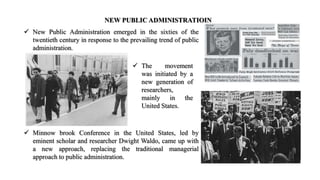
 New Public Administration emerged in the sixties of the
twentieth century in response to the prevailing trend of public
administration.
 The movement
was initiated by a
new generation of
researchers,
mainly in the
United States.
 Minnow brook Conference in the United States, led by
eminent scholar and researcher Dwight Waldo, came up with
a new approach, replacing the traditional managerial
approach to public administration.
Evolution of New Public Administration?
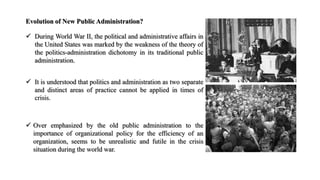
 During World War II, the political and administrative affairs in
the United States was marked by the weakness of the theory of
the politics-administration dichotomy in its traditional public
administration.
 It is understood that politics and administration as two separate
and distinct areas of practice cannot be applied in times of
crisis.
 Over emphasized by the old public administration to the
importance of organizational policy for the efficiency of an
organization, seems to be unrealistic and futile in the crisis
situation during the world war.
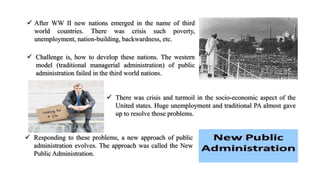
 After WW II new nations emerged in the name of third
world countries. There was crisis such poverty,
unemployment, nation-building, backwardness, etc.
 Challenge is, how to develop these nations. The western
model (traditional managerial administration) of public
administration failed in the third world nations.
 There was crisis and turmoil in the socio-economic aspect of the
United states. Huge unemployment and traditional PA almost gave
up to resolve those problems.
 Responding to these problems, a new approach of public
administration evolves. The approach was called the New
Public Administration.
The Minnowbrook Conference
1. The 1960s was a turbulent period besieged by numerous social
disturbances; yet public administration indicated no signs of
being aware of them, much less being eager to solve them.
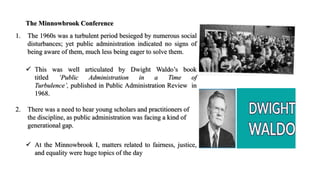
 This was well articulated by Dwight Waldo’s book
titled ‘Public Administration in a Time of
Turbulence’, published in Public Administration Review in
1968.
2. There was a need to hear young scholars and practitioners of
the discipline, as public administration was facing a kind of
generational gap.
 At the Minnowbrook I, matters related to fairness, justice,
and equality were huge topics of the day
The major themes of the conference:
1. The relevance of public administration to the issues of the day.
2. The democratic grounding of public administration.
3. Public administration as a moral enterprise
4. Internal democratic administration.
5. Fairness, justice, and equality in public administration
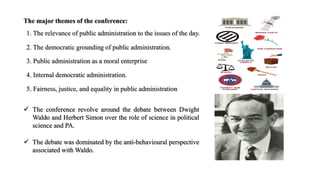
 The conference revolve around the debate between Dwight
Waldo and Herbert Simon over the role of science in political
science and PA.
 The debate was dominated by the anti-behavioural perspective
associated with Waldo.
 Simon laid emphasis on a more empirical investigation of
organizational and behavioural approaches to understanding
decision making
 Waldo’s views were different; he emphasized a more
political, theoretical, and philosophical approach.
 His emphasis was more of a critique, less positivism and
more directed at increasing the bureaucracy’s involvement
in developing processes for public participation and
democratic expression.
 He is apprehensive of the fact that efficacy and
effectiveness of government organizations may be done at
the expense of democratic values.
Major Landmarks of New Public Administration:
Honey Report (1967):
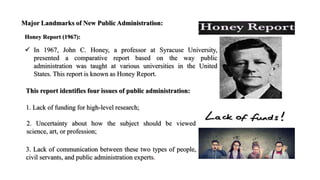
 In 1967, John C. Honey, a professor at Syracuse University,
presented a comparative report based on the way public
administration was taught at various universities in the United
States. This report is known as Honey Report.
This report identifies four issues of public administration:
1. Lack of funding for high-level research;
2. Uncertainty about how the subject should be viewed
science, art, or profession;
3. Lack of communication between these two types of people,
civil servants, and public administration experts.
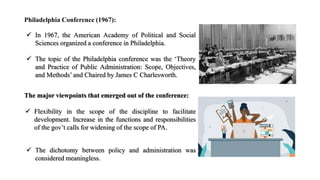
Philadelphia Conference (1967):
 In 1967, the American Academy of Political and Social
Sciences organized a conference in Philadelphia.
 The topic of the Philadelphia conference was the ‘Theory
and Practice of Public Administration: Scope, Objectives,
and Methods’ and Chaired by James C Charlesworth.
The major viewpoints that emerged out of the conference:
 Flexibility in the scope of the discipline to facilitate
development. Increase in the functions and responsibilities
of the gov’t calls for widening of the scope of PA.
 The dichotomy between policy and administration was
considered meaningless.
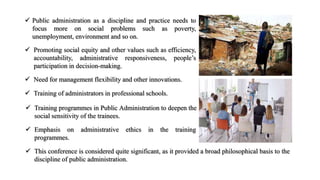
 Public administration as a discipline and practice needs to
focus more on social problems such as poverty,
unemployment, environment and so on.
 Promoting social equity and other values such as efficiency,
accountability, administrative responsiveness, people’s
participation in decision-making.
 Need for management flexibility and other innovations.
 Training of administrators in professional schools.
 Training programmes in Public Administration to deepen the
social sensitivity of the trainees.
 Emphasis on administrative ethics in the training
programmes.
 This conference is considered quite significant, as it provided a broad philosophical basis to the
discipline of public administration.
Minnowbrook Conference (1968):
 The basic objective of this was to examine the ways of making
public administration responsive to social concerns and
assume the role of a change agent in reforming the society.
 The New Public Administration emerged out the discourses of
this conference.
 Responsive government has to manage change, not just growth.
 Active and participative citizenry, it has been considered,
needs to be a part of public administration.
 The young academicians who participated in the conference
attempted to provide a new focus to public administration.
 The main purpose of this conference was to discuss the new
theories of public administration and to identify how to give
more importance to the ‘Public’ part of public administration.
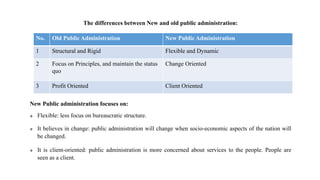
The differences between New and old public administration:
New Public administration focuses on:
 Flexible: less focus on bureaucratic structure.
 It believes in change: public administration will change when socio-economic aspects of the nation will
be changed.
 It is client-oriented: public administration is more concerned about services to the people. People are
seen as a client.
No. Old Public Administration New Public Administration
1 Structural and Rigid Flexible and Dynamic
2 Focus on Principles, and maintain the status
quo
Change Oriented
3 Profit Oriented Client Oriented
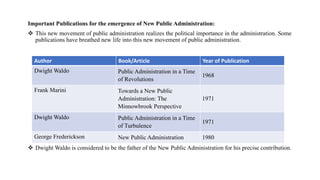
Important Publications for the emergence of New Public Administration:
 This new movement of public administration realizes the political importance in the administration. Some
publications have breathed new life into this new movement of public administration.
 Dwight Waldo is considered to be the father of the New Public Administration for his precise contribution.
Author Book/Article Year of Publication
Dwight Waldo Public Administration in a Time
of Revolutions
1968
Frank Marini Towards a New Public
Administration: The
Minnowbrook Perspective
1971
Dwight Waldo Public Administration in a Time
of Turbulence
1971
George Frederickson New Public Administration 1980
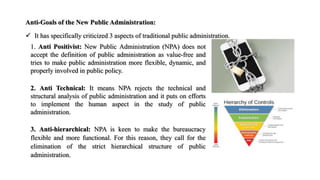
Anti-Goals of the New Public Administration:
 It has specifically criticized 3 aspects of traditional public administration.
1. Anti Positivist: New Public Administration (NPA) does not
accept the definition of public administration as value-free and
tries to make public administration more flexible, dynamic, and
properly involved in public policy.
2. Anti Technical: It means NPA rejects the technical and
structural analysis of public administration and it puts on efforts
to implement the human aspect in the study of public
administration.
3. Anti-hierarchical: NPA is keen to make the bureaucracy
flexible and more functional. For this reason, they call for the
elimination of the strict hierarchical structure of public
administration.
1. Relevance
 Public administration has traditionally been interested in
efficiency and economy. However, for NPA discipline had
little to say about contemporary problems and issues.
 Management-oriented public administration curriculum
was found 'irrelevant', and demanded to deal explicitly with
political and the administrative implications of
administrative action.
2. Values
 The NPA openly rejected the value-neutral position taken
by traditional public administration.
 It was held that commitment to values would enable the
discipline to promote the cause of the disadvantaged
sections in society.
The new public administration lays emphasis on the following major themes:
 Frederickson said that "the new public administrator’ is less
generic' and more public', less descriptive' and more
'prescriptive', less 'institution-oriented' and 'client-impact
oriented', less 'neutral' and 'more normative, and it is hoped,
no less scientific.“
3. Social Equity:
 The conference made a plea for distributive justice and
equity to be the basic concerns of Public Administration.
 The NPA protagonists were in favour of making the
discipline proactive towards major social issues.
4. Change
 To serve the cause of social equity is to actively work for
social change. This is the motto of a new public
administration.
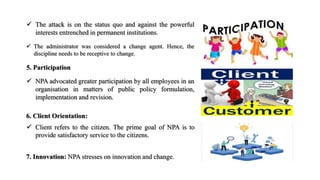
 The administrator was considered a change agent. Hence, the
discipline needs to be receptive to change.
 The attack is on the status quo and against the powerful
interests entrenched in permanent institutions.
6. Client Orientation:
 Client refers to the citizen. The prime goal of NPA is to
provide satisfactory service to the citizens.
5. Participation
 NPA advocated greater participation by all employees in an
organisation in matters of public policy formulation,
implementation and revision.
7. Innovation: NPA stresses on innovation and change.
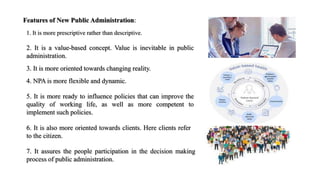
Features of New Public Administration:
1. It is more prescriptive rather than descriptive.
2. It is a value-based concept. Value is inevitable in public
administration.
3. It is more oriented towards changing reality.
4. NPA is more flexible and dynamic.
5. It is more ready to influence policies that can improve the
quality of working life, as well as more competent to
implement such policies.
6. It is also more oriented towards clients. Here clients refer
to the citizen.
7. It assures the people participation in the decision making
process of public administration.
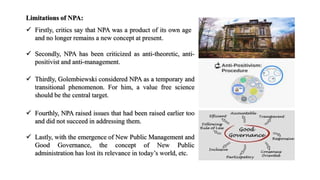
Limitations of NPA:
 Firstly, critics say that NPA was a product of its own age
and no longer remains a new concept at present.
 Secondly, NPA has been criticized as anti-theoretic, anti-
positivist and anti-management.
 Thirdly, Golembiewski considered NPA as a temporary and
transitional phenomenon. For him, a value free science
should be the central target.
 Fourthly, NPA raised issues that had been raised earlier too
and did not succeed in addressing them.
 Lastly, with the emergence of New Public Management and
Good Governance, the concept of New Public
administration has lost its relevance in today’s world, etc.
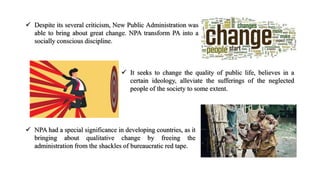
 Despite its several criticism, New Public Administration was
able to bring about great change. NPA transform PA into a
socially conscious discipline.
 It seeks to change the quality of public life, believes in a
certain ideology, alleviate the sufferings of the neglected
people of the society to some extent.
 NPA had a special significance in developing countries, as it
bringing about qualitative change by freeing the
administration from the shackles of bureaucratic red tape.
 To the proponents of NPA, the process of action is
relatively secondary; Social problems make them think a lot
more.
 Thus, NPA marked a turning point in the growth of the
discipline of public administration and has sought to bring
the discipline closer to the society.
 With the emergence of NPA, the questions of values and
ethics have remained a focal topic of public administration.
 Ethics, values, new thinking,
variability, social problems,
these are relevant and
important to the new public
administration.

NEW PUBLIC ADMINISTRATIOIN.pptx

  • 2.
    NEW PUBLIC ADMINISTRATIOIN New Public Administration emerged in the sixties of the twentieth century in response to the prevailing trend of public administration.  The movement was initiated by a new generation of researchers, mainly in the United States.  Minnow brook Conference in the United States, led by eminent scholar and researcher Dwight Waldo, came up with a new approach, replacing the traditional managerial approach to public administration.
  • 3.
    Evolution of NewPublic Administration?  During World War II, the political and administrative affairs in the United States was marked by the weakness of the theory of the politics-administration dichotomy in its traditional public administration.  It is understood that politics and administration as two separate and distinct areas of practice cannot be applied in times of crisis.  Over emphasized by the old public administration to the importance of organizational policy for the efficiency of an organization, seems to be unrealistic and futile in the crisis situation during the world war.
  • 4.
     After WWII new nations emerged in the name of third world countries. There was crisis such poverty, unemployment, nation-building, backwardness, etc.  Challenge is, how to develop these nations. The western model (traditional managerial administration) of public administration failed in the third world nations.  There was crisis and turmoil in the socio-economic aspect of the United states. Huge unemployment and traditional PA almost gave up to resolve those problems.  Responding to these problems, a new approach of public administration evolves. The approach was called the New Public Administration.
  • 5.
    The Minnowbrook Conference 1.The 1960s was a turbulent period besieged by numerous social disturbances; yet public administration indicated no signs of being aware of them, much less being eager to solve them.  This was well articulated by Dwight Waldo’s book titled ‘Public Administration in a Time of Turbulence’, published in Public Administration Review in 1968. 2. There was a need to hear young scholars and practitioners of the discipline, as public administration was facing a kind of generational gap.  At the Minnowbrook I, matters related to fairness, justice, and equality were huge topics of the day
  • 6.
    The major themesof the conference: 1. The relevance of public administration to the issues of the day. 2. The democratic grounding of public administration. 3. Public administration as a moral enterprise 4. Internal democratic administration. 5. Fairness, justice, and equality in public administration  The conference revolve around the debate between Dwight Waldo and Herbert Simon over the role of science in political science and PA.  The debate was dominated by the anti-behavioural perspective associated with Waldo.
  • 7.
     Simon laidemphasis on a more empirical investigation of organizational and behavioural approaches to understanding decision making  Waldo’s views were different; he emphasized a more political, theoretical, and philosophical approach.  His emphasis was more of a critique, less positivism and more directed at increasing the bureaucracy’s involvement in developing processes for public participation and democratic expression.  He is apprehensive of the fact that efficacy and effectiveness of government organizations may be done at the expense of democratic values.
  • 8.
    Major Landmarks ofNew Public Administration: Honey Report (1967):  In 1967, John C. Honey, a professor at Syracuse University, presented a comparative report based on the way public administration was taught at various universities in the United States. This report is known as Honey Report. This report identifies four issues of public administration: 1. Lack of funding for high-level research; 2. Uncertainty about how the subject should be viewed science, art, or profession; 3. Lack of communication between these two types of people, civil servants, and public administration experts.
  • 9.
    Philadelphia Conference (1967): In 1967, the American Academy of Political and Social Sciences organized a conference in Philadelphia.  The topic of the Philadelphia conference was the ‘Theory and Practice of Public Administration: Scope, Objectives, and Methods’ and Chaired by James C Charlesworth. The major viewpoints that emerged out of the conference:  Flexibility in the scope of the discipline to facilitate development. Increase in the functions and responsibilities of the gov’t calls for widening of the scope of PA.  The dichotomy between policy and administration was considered meaningless.
  • 10.
     Public administrationas a discipline and practice needs to focus more on social problems such as poverty, unemployment, environment and so on.  Promoting social equity and other values such as efficiency, accountability, administrative responsiveness, people’s participation in decision-making.  Need for management flexibility and other innovations.  Training of administrators in professional schools.  Training programmes in Public Administration to deepen the social sensitivity of the trainees.  Emphasis on administrative ethics in the training programmes.  This conference is considered quite significant, as it provided a broad philosophical basis to the discipline of public administration.
  • 11.
    Minnowbrook Conference (1968): The basic objective of this was to examine the ways of making public administration responsive to social concerns and assume the role of a change agent in reforming the society.  The New Public Administration emerged out the discourses of this conference.  Responsive government has to manage change, not just growth.  Active and participative citizenry, it has been considered, needs to be a part of public administration.  The young academicians who participated in the conference attempted to provide a new focus to public administration.  The main purpose of this conference was to discuss the new theories of public administration and to identify how to give more importance to the ‘Public’ part of public administration.
  • 12.
    The differences betweenNew and old public administration: New Public administration focuses on:  Flexible: less focus on bureaucratic structure.  It believes in change: public administration will change when socio-economic aspects of the nation will be changed.  It is client-oriented: public administration is more concerned about services to the people. People are seen as a client. No. Old Public Administration New Public Administration 1 Structural and Rigid Flexible and Dynamic 2 Focus on Principles, and maintain the status quo Change Oriented 3 Profit Oriented Client Oriented
  • 13.
    Important Publications forthe emergence of New Public Administration:  This new movement of public administration realizes the political importance in the administration. Some publications have breathed new life into this new movement of public administration.  Dwight Waldo is considered to be the father of the New Public Administration for his precise contribution. Author Book/Article Year of Publication Dwight Waldo Public Administration in a Time of Revolutions 1968 Frank Marini Towards a New Public Administration: The Minnowbrook Perspective 1971 Dwight Waldo Public Administration in a Time of Turbulence 1971 George Frederickson New Public Administration 1980
  • 14.
    Anti-Goals of theNew Public Administration:  It has specifically criticized 3 aspects of traditional public administration. 1. Anti Positivist: New Public Administration (NPA) does not accept the definition of public administration as value-free and tries to make public administration more flexible, dynamic, and properly involved in public policy. 2. Anti Technical: It means NPA rejects the technical and structural analysis of public administration and it puts on efforts to implement the human aspect in the study of public administration. 3. Anti-hierarchical: NPA is keen to make the bureaucracy flexible and more functional. For this reason, they call for the elimination of the strict hierarchical structure of public administration.
  • 15.
    1. Relevance  Publicadministration has traditionally been interested in efficiency and economy. However, for NPA discipline had little to say about contemporary problems and issues.  Management-oriented public administration curriculum was found 'irrelevant', and demanded to deal explicitly with political and the administrative implications of administrative action. 2. Values  The NPA openly rejected the value-neutral position taken by traditional public administration.  It was held that commitment to values would enable the discipline to promote the cause of the disadvantaged sections in society. The new public administration lays emphasis on the following major themes:
  • 16.
     Frederickson saidthat "the new public administrator’ is less generic' and more public', less descriptive' and more 'prescriptive', less 'institution-oriented' and 'client-impact oriented', less 'neutral' and 'more normative, and it is hoped, no less scientific.“ 3. Social Equity:  The conference made a plea for distributive justice and equity to be the basic concerns of Public Administration.  The NPA protagonists were in favour of making the discipline proactive towards major social issues. 4. Change  To serve the cause of social equity is to actively work for social change. This is the motto of a new public administration.
  • 17.
     The administratorwas considered a change agent. Hence, the discipline needs to be receptive to change.  The attack is on the status quo and against the powerful interests entrenched in permanent institutions. 6. Client Orientation:  Client refers to the citizen. The prime goal of NPA is to provide satisfactory service to the citizens. 5. Participation  NPA advocated greater participation by all employees in an organisation in matters of public policy formulation, implementation and revision. 7. Innovation: NPA stresses on innovation and change.
  • 18.
    Features of NewPublic Administration: 1. It is more prescriptive rather than descriptive. 2. It is a value-based concept. Value is inevitable in public administration. 3. It is more oriented towards changing reality. 4. NPA is more flexible and dynamic. 5. It is more ready to influence policies that can improve the quality of working life, as well as more competent to implement such policies. 6. It is also more oriented towards clients. Here clients refer to the citizen. 7. It assures the people participation in the decision making process of public administration.
  • 19.
    Limitations of NPA: Firstly, critics say that NPA was a product of its own age and no longer remains a new concept at present.  Secondly, NPA has been criticized as anti-theoretic, anti- positivist and anti-management.  Thirdly, Golembiewski considered NPA as a temporary and transitional phenomenon. For him, a value free science should be the central target.  Fourthly, NPA raised issues that had been raised earlier too and did not succeed in addressing them.  Lastly, with the emergence of New Public Management and Good Governance, the concept of New Public administration has lost its relevance in today’s world, etc.
  • 20.
     Despite itsseveral criticism, New Public Administration was able to bring about great change. NPA transform PA into a socially conscious discipline.  It seeks to change the quality of public life, believes in a certain ideology, alleviate the sufferings of the neglected people of the society to some extent.  NPA had a special significance in developing countries, as it bringing about qualitative change by freeing the administration from the shackles of bureaucratic red tape.
  • 21.
     To theproponents of NPA, the process of action is relatively secondary; Social problems make them think a lot more.  Thus, NPA marked a turning point in the growth of the discipline of public administration and has sought to bring the discipline closer to the society.  With the emergence of NPA, the questions of values and ethics have remained a focal topic of public administration.  Ethics, values, new thinking, variability, social problems, these are relevant and important to the new public administration.