Meaning, Nature andScope of
Public Administration
Made By:
Dr. Iqbal singh
Associate Professor ,Public
Administration Dept
2.
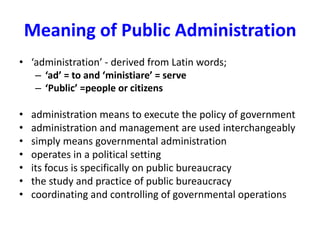
Meaning of PublicAdministration
• ‘administration’ - derived from Latin words;
– ‘ad’ = to and ‘ministiare’ = serve
– ‘Public’ =people or citizens
• administration means to execute the policy of government
• administration and management are used interchangeably
• simply means governmental administration
• operates in a political setting
• its focus is specifically on public bureaucracy
• the study and practice of public bureaucracy
• coordinating and controlling of governmental operations
3.
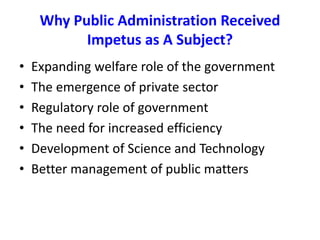
Why Public AdministrationReceived
Impetus as A Subject?
• Expanding welfare role of the government
• The emergence of private sector
• Regulatory role of government
• The need for increased efficiency
• Development of Science and Technology
• Better management of public matters
4.
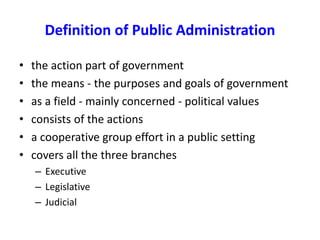
Definition of PublicAdministration
• the action part of government
• the means - the purposes and goals of government
• as a field - mainly concerned - political values
• consists of the actions
• a cooperative group effort in a public setting
• covers all the three branches
– Executive
– Legislative
– Judicial
5.
Cont…
• seen asthe activities of groups
– Such common goals include;
• defence,
• safeguarding the frontiers
• maintenance of law and order
• fire protection
• communications
• public health
• education, etc.
6.
Cont…
• Public administrationfocuses principally on the;
– Planning
– Organizing
– Directing
• The study of public administration overlaps a
number of other disciplines, including;
– Political Science
– Sociology
– Economics
– Psychology
– Business Administration
7.
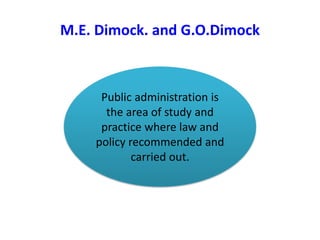
M.E. Dimock. andG.O.Dimock
Public administration is
the area of study and
practice where law and
policy recommended and
carried out.
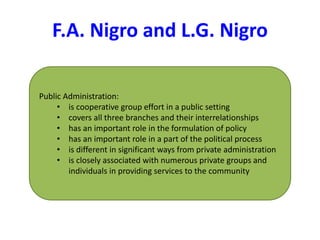
F.A. Nigro andL.G. Nigro
Public Administration:
• is cooperative group effort in a public setting
• covers all three branches and their interrelationships
• has an important role in the formulation of policy
• has an important role in a part of the political process
• is different in significant ways from private administration
• is closely associated with numerous private groups and
individuals in providing services to the community
Willoughby
Public Administration inbroadest
sense denotes the work involved in
the actual conduct of governmental
affairs, and in narrowest senses
denotes the operations of the
administrative branch only.
14.
Gullick
Public Administration isthat part of
the science of administration which
has to do with government and
thus, concerns itself primarily with
the executive branch where the
work of the government is done.
Marshall E. Dimock
1.Administration is concerned with ‘what’
and ‘How’ of the government.
2. The ‘what’ is the subject matter, the
technical knowledge of afield which
enables the administrator to perform his
tasks.
3. The ‘How’ is the technique of
management according to which co-
operative programmes are carried to
success.
17.
Nature of PublicAdministration
1. The Integral View
2. The Managerial View
18.
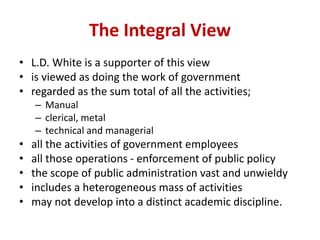
The Integral View
•L.D. White is a supporter of this view
• is viewed as doing the work of government
• regarded as the sum total of all the activities;
– Manual
– clerical, metal
– technical and managerial
• all the activities of government employees
• all those operations - enforcement of public policy
• the scope of public administration vast and unwieldy
• includes a heterogeneous mass of activities
• may not develop into a distinct academic discipline.
19.
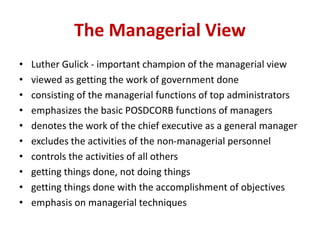
The Managerial View
•Luther Gulick - important champion of the managerial view
• viewed as getting the work of government done
• consisting of the managerial functions of top administrators
• emphasizes the basic POSDCORB functions of managers
• denotes the work of the chief executive as a general manager
• excludes the activities of the non-managerial personnel
• controls the activities of all others
• getting things done, not doing things
• getting things done with the accomplishment of objectives
• emphasis on managerial techniques
20.
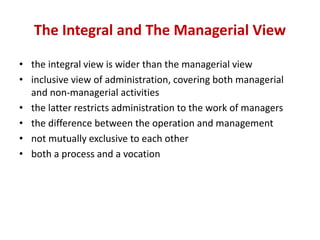
The Integral andThe Managerial View
• the integral view is wider than the managerial view
• inclusive view of administration, covering both managerial
and non-managerial activities
• the latter restricts administration to the work of managers
• the difference between the operation and management
• not mutually exclusive to each other
• both a process and a vocation
21.
Public Administration
• Asa process:
–is concerned with all the steps from the first
to last taken in the implementation of
public policy.
• As a vocation:
–it is concerned with the management of the
activities of others) in a public agency.
22.
Characteristics of PublicAdministration
• part of executive branch of government
• related with the activities of the state
• carries out the public policies
• realize the aspirations of the people
• non-political public bureaucracy
• the monopoly of the state
• concentrated in the executive branch
• naturally a big and complex organization
• concerned with policy execution
• to an end, and not an end in itself
• merely a tool of government to implement its policies
23.
Scope of PublicAdministration
• Scope of Public Administration:
1. The views of L.D. White and traditionalist
2. Gullick and the scientific management
school
• Following are the three important perspectives
•
1.Narrow perspective or POSDCORB perspective
2.Broad perspective or subject matter view
3.Prevailing view
24.
Narrow perspective or
POSDCORBperspective
• Luther Gullick is the main exponent
• According to him the scope is narrow or limited.
• It is also regarded as POSDCORB view.
• Seven types of functions:
– Planning
– Organizing
– Staffing
– Directing
– Coordinating
– Reporting
– Budgeting
25.
Broad perspective orsubject
oriented perspective
• Prof. Woodrow Wilson, L D While
• According to them:
– Public Adminstration covers all three branches of the
government.
– Scope of Public Adminstration is like a cooperative group.
– Public Adminstration is a part of the political process.
26.
Prevailing view
• Administrativetheory: It includes the following aspects.
– Organizational Theory
– Behaviour
– Public Personal Administration
• Applied administration: It includes the following aspects.
– Political functions
– Legislative function
– Financial functions
– Denfence
– Educational function
– Social welfare administration
– Economic Administration
– Foreign administration
– Local administration
27.
Elements of PublicAdministration
1. Planning
2. Organizing
3. Commanding
4. Coordinating
5. Controlling
28.
Significance of PublicAdministration
• Basis of Government
• An Instrument for Implementing Laws and Policies
• Participation in Policy Formulation
• A Great Stabilizing Force in Society
• Provides Continuity When Government Change
• Provides a Wide Variety of Services in the Public Interest
• An Instrument of Social Change and Economic Development
• Essential for the Development of Civilization
• Reasons for the Growing Importance of Public Administration
• New Agenda Items
29.
Public Administration inDeveloping
Countries
• has to meet the Rising Expectation of the People.
• Role - Socio-Economic Development
• Effective Performance of Traditional Functions
• Developing a Sense of National-hood
• Helps Democracy Survive
• The Impact of Developmental Activities
30.
The Benefits ofthe Study of Public
Administration
• Helps the student to learn
• Helps explain the purposes, functions, and continuation of
bureaucracy
• Provides knowledge of public organizations and the context
• Promotes a superior understanding of government
• Is useful as training for citizenship
• Makes us learn how to promote the public interest more effectively
• Promotes among the people an awareness
• Is useful to make public policies
• Provides knowledge which is helpful to the policy makers
• Prepares students for employment in the government services
31.
References:
• Adebayo, A.(2000). Principles and Practice of Public Administration in Nigeria. 2nd
Edition. Ibadan: Spectrum Books Ltd.
• Basu, R. (2004). Public Administration: Concepts and Theories. Fourth Revised and
Enlarged Edition. New Delhi: Sterling Publishers Private Ltd.
• Certo, S.C. (1986). Principles of Modern Management: Functions and Systems.
Third Edition. Chicago: Wm. C. Brown Publishers, College Division.
• Ezeani, E.O. (2006). Fundamentals of Public Administration. Revised Edition.
Enugu: Snap Press Ltd.
• Hermann, Theo et al (1985). Management Fifth Edition. U.S.A.: Houghton Mifflin
Company Boston.
• Polinaidu, S. (2004). Public Administration. New Delhi: Galgotia Publications PVT.
• Sapru, R.K. (2008). Administrative Theories and Management thought. 2nd Edition.
New Delhi: Prentice – Hall of India Private Ltd.
• Ujo, A.A. (2004). Understanding Public Administration. Kaduna: Joyce Graphic
printer & Publishers Company.