Governance
and
Development
Prepared By:
Bikram Adhikari
Introduction
• Governance
– Governance is defined as structures and processes
that are designed to ensure accountability,
transparency, responsiveness, rule of law, stability,
equity and inclusiveness, empowerment, and
broad-based participation.
– Governance also represents the norms, values and
rules of the game through which public affairs are
managed in a manner that is transparent,
participatory, inclusive and responsive.
Introduction
– International agencies such as UNDP, the World
Bank, the OECD Development Assistance
Committee (DAC) and others define governance as
the exercise of authority or power in order to
manage a country’s economic, political and
administrative affairs.
Types of Governance
• Governance as process
– Democratic Governance
– Economic And Financial Governance
– e-Governance Services
– Corporate Governance
– Environmental Governance and Natural Resources
Types of Governance
• As a normative concept
– Good Governance
– Poor Governance
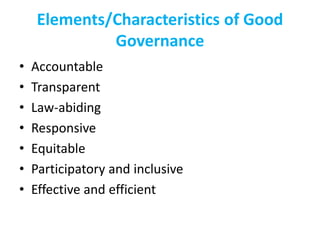
Elements/Characteristics of Good
Governance
• Accountable
• Transparent
• Law-abiding
• Responsive
• Equitable
• Participatory and inclusive
• Effective and efficient
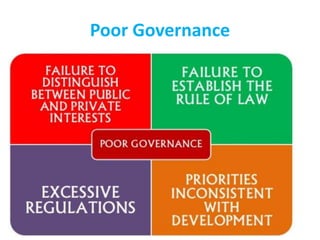
Poor Governance
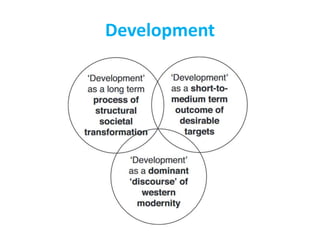
Development
• Development is the process of bringing about
fundamental and substantial changes in the
society.
• Development involves not only capital
accumulation and economic growth but also
the condition in which a country has adequate
food and job and the income inequality
among them is greatly reduced.
Development
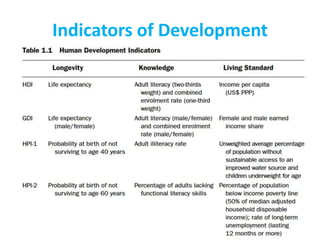
Indicators of Development
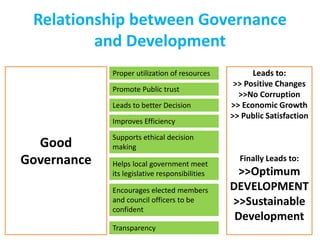
Relationship between Governance
and Development
Good
Governance
Proper utilization of resources
Promote Public trust
Leads to better Decision
Improves Efficiency
Supports ethical decision
making
Helps local government meet
its legislative responsibilities
Encourages elected members
and council officers to be
confident
Leads to:
>> Positive Changes
>>No Corruption
>> Economic Growth
>> Public Satisfaction
Finally Leads to:
>>Optimum
DEVELOPMENT
>>Sustainable
Development
Transparency
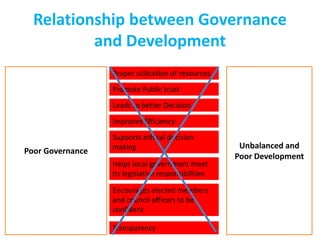
Relationship between Governance
and Development
Poor Governance
Proper utilization of resources
Promote Public trust
Leads to better Decision
Improves Efficiency
Supports ethical decision
making
Helps local government meet
its legislative responsibilities
Encourages elected members
and council officers to be
confident
Unbalanced and
Poor Development
Transparency
Relationship between Governance
and Development
• When there is Development in a country or
specific area. It means there is proper system
leading that specific area.
• The Proper system falls under GOOD
GOVERNANCE
• DEVELOPMENT and GOVERNANCE are
interrelated to each other.
References
• http://www.unesco.org/new/en/education/themes/str
engthening-education-systems/quality-
framework/technical-notes/concept-of-governance/
• https://www.esds.co.in/blog/types-of-
governance/#sthash.iK0gFk18.7V8LZOWW.dpbs
• https://uk.sagepub.com/sites/default/files/upm-
binaries/18296_5070_Sumner_Ch01.pdf
• http://www.dpac.tas.gov.au/divisions/local_governme
nt/good_governance_guide/about_good_governance/
What_are_the_benefits_of_Good_Governance
Thank you
Any Queries????
Be calm as Nature
BikPh

Governance and development