Phuwanat Srithong
School of Tourism,
Chiang Rai Rajhaphat University
Unit 1 Public Administration
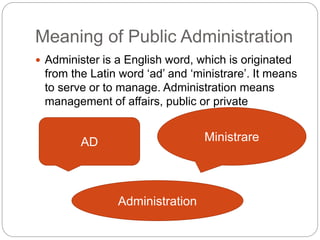
Meaning of Public Administration
 Administer is a English word, which is originated
from the Latin word ‘ad’ and ‘ministrare’. It means
to serve or to manage. Administration means
management of affairs, public or private
AD Ministrare
Administration
Public Administration
“Public Administration is a
detailed and systematic
application of law.” by Prof.
Woodrow Wilson
“Public Administration consists
of all those operations having
for their purpose the fulfillment
of public policy as declared by
authority.” by L. D. White.
Public Administration
 “By Public Administration is meant
the activities of the executive
branches of the national, state, &
local governments.” by Simon.
 “Public Administration is the art and
science of management as applied
to the affairs of the state.”(Waldo)
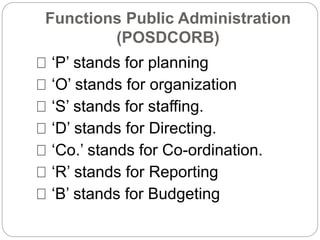
Functions Public Administration
(POSDCORB)
‘P’ stands for planning
‘O’ stands for organization
‘S’ stands for staffing.
‘D’ stands for Directing.
‘Co.’ stands for Co-ordination.
‘R’ stands for Reporting
‘B’ stands for Budgeting
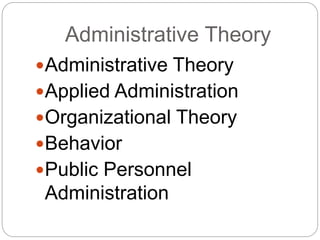
Administrative Theory
Administrative Theory
Applied Administration
Organizational Theory
Behavior
Public Personnel
Administration
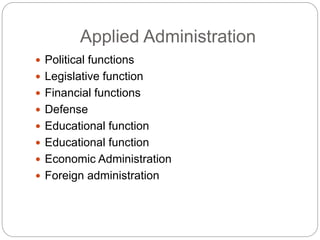
Applied Administration
 Political functions
 Legislative function
 Financial functions
 Defense
 Educational function
 Economic Administration
 Foreign administration
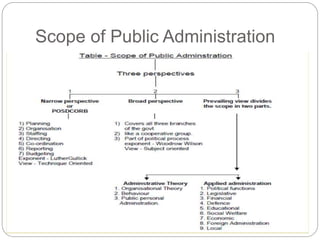
Scope of Public Administration
 It is the basis of government.
 It is the instrument of change in the
society.
 It plays vital role in the life of the people.
 It is an instrument for executing laws,
policies, programs of the state
 It is a stabilizing force in the society as it
provides continuity.
 It is instrument of national integration in
the developing countries which are
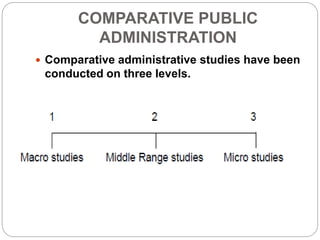
COMPARATIVE PUBLIC
ADMINISTRATION
 Comparative administrative studies have been
conducted on three levels.
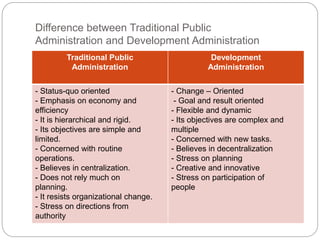
Difference between Traditional Public
Administration and Development Administration
Traditional Public
Administration
Development
Administration
- Status-quo oriented
- Emphasis on economy and
efficiency
- It is hierarchical and rigid.
- Its objectives are simple and
limited.
- Concerned with routine
operations.
- Believes in centralization.
- Does not rely much on
planning.
- It resists organizational change.
- Stress on directions from
authority
- Change – Oriented
- Goal and result oriented
- Flexible and dynamic
- Its objectives are complex and
multiple
- Concerned with new tasks.
- Believes in decentralization
- Stress on planning
- Creative and innovative
- Stress on participation of
people
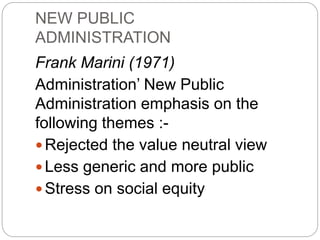
NEW PUBLIC
ADMINISTRATION
Frank Marini (1971)
Administration’ New Public
Administration emphasis on the
following themes :-
 Rejected the value neutral view
 Less generic and more public
 Stress on social equity
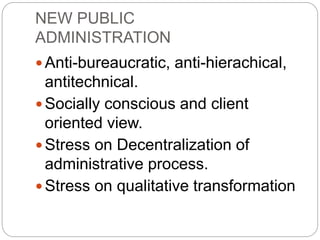
NEW PUBLIC
ADMINISTRATION
 Anti-bureaucratic, anti-hierachical,
antitechnical.
 Socially conscious and client
oriented view.
 Stress on Decentralization of
administrative process.
 Stress on qualitative transformation
What is also considered an applied
discipline?
 It has practical use for government,
particularly in improving government
performance.
 It prepares persons for careers in public
service and trains them to be good
public administrators.
Views of Public Administration As:
Both an Art and a Science
 As an Art:
PA involves creativity,
leadership, a good sense of the
intangibles in administration. This
view is closely to the practice of PA
Views of Public Administration As:
Both an Art and a Science
As a Science:
 There is a body of knowledge or
theories that can explain or predict
phenomenon or variables in the field of
PA
 The PA theories and concepts are built
based on empirical research using
systematic methods
 These theories can be used not only to
explain but also improve the art and
Assignment 1
What is the public
administration or focus to
be studied?
Please explain at least 1
pages of A4 paper

Unit 1 Public Administration.pptx

  • 1.
    Phuwanat Srithong School ofTourism, Chiang Rai Rajhaphat University Unit 1 Public Administration
  • 2.
    Meaning of PublicAdministration  Administer is a English word, which is originated from the Latin word ‘ad’ and ‘ministrare’. It means to serve or to manage. Administration means management of affairs, public or private AD Ministrare Administration
  • 3.
    Public Administration “Public Administrationis a detailed and systematic application of law.” by Prof. Woodrow Wilson “Public Administration consists of all those operations having for their purpose the fulfillment of public policy as declared by authority.” by L. D. White.
  • 4.
    Public Administration  “ByPublic Administration is meant the activities of the executive branches of the national, state, & local governments.” by Simon.  “Public Administration is the art and science of management as applied to the affairs of the state.”(Waldo)
  • 5.
    Functions Public Administration (POSDCORB) ‘P’stands for planning ‘O’ stands for organization ‘S’ stands for staffing. ‘D’ stands for Directing. ‘Co.’ stands for Co-ordination. ‘R’ stands for Reporting ‘B’ stands for Budgeting
  • 6.
    Administrative Theory Administrative Theory AppliedAdministration Organizational Theory Behavior Public Personnel Administration
  • 7.
    Applied Administration  Politicalfunctions  Legislative function  Financial functions  Defense  Educational function  Educational function  Economic Administration  Foreign administration
  • 8.
    Scope of PublicAdministration
  • 9.
    Scope of PublicAdministration  It is the basis of government.  It is the instrument of change in the society.  It plays vital role in the life of the people.  It is an instrument for executing laws, policies, programs of the state  It is a stabilizing force in the society as it provides continuity.  It is instrument of national integration in the developing countries which are
  • 10.
    COMPARATIVE PUBLIC ADMINISTRATION  Comparativeadministrative studies have been conducted on three levels.
  • 11.
    Difference between TraditionalPublic Administration and Development Administration Traditional Public Administration Development Administration - Status-quo oriented - Emphasis on economy and efficiency - It is hierarchical and rigid. - Its objectives are simple and limited. - Concerned with routine operations. - Believes in centralization. - Does not rely much on planning. - It resists organizational change. - Stress on directions from authority - Change – Oriented - Goal and result oriented - Flexible and dynamic - Its objectives are complex and multiple - Concerned with new tasks. - Believes in decentralization - Stress on planning - Creative and innovative - Stress on participation of people
  • 12.
    NEW PUBLIC ADMINISTRATION Frank Marini(1971) Administration’ New Public Administration emphasis on the following themes :-  Rejected the value neutral view  Less generic and more public  Stress on social equity
  • 13.
    NEW PUBLIC ADMINISTRATION  Anti-bureaucratic,anti-hierachical, antitechnical.  Socially conscious and client oriented view.  Stress on Decentralization of administrative process.  Stress on qualitative transformation
  • 14.
    What is alsoconsidered an applied discipline?  It has practical use for government, particularly in improving government performance.  It prepares persons for careers in public service and trains them to be good public administrators.
  • 15.
    Views of PublicAdministration As: Both an Art and a Science  As an Art: PA involves creativity, leadership, a good sense of the intangibles in administration. This view is closely to the practice of PA
  • 16.
    Views of PublicAdministration As: Both an Art and a Science As a Science:  There is a body of knowledge or theories that can explain or predict phenomenon or variables in the field of PA  The PA theories and concepts are built based on empirical research using systematic methods  These theories can be used not only to explain but also improve the art and
  • 17.
    Assignment 1 What isthe public administration or focus to be studied? Please explain at least 1 pages of A4 paper