Welcome to the Session
 Lecture Outline
 Chapter 1
 Definition of Public
Administration. Scope
and Evolution
 Paradigm of Public
Adminstration
Prepared By
 Karimun Nessa
 Lecturer
 Sociology & Rural
Development Department
 Khulna Agricultural
University
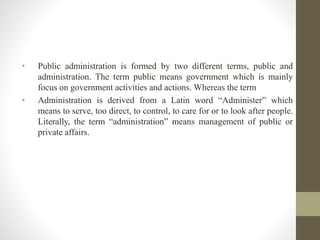
• Public administration is formed by two different terms, public and
administration. The term public means government which is mainly
focus on government activities and actions. Whereas the term
• Administration is derived from a Latin word “Administer” which
means to serve, too direct, to control, to care for or to look after people.
Literally, the term “administration” means management of public or
private affairs.
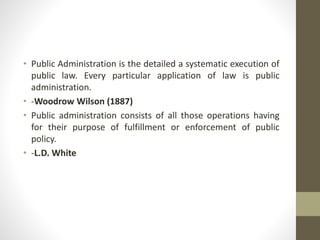
• Public Administration is the detailed a systematic execution of
public law. Every particular application of law is public
administration.
• -Woodrow Wilson (1887)
• Public administration consists of all those operations having
for their purpose of fulfillment or enforcement of public
policy.
• -L.D. White
Nature of public administration:
• There are two broad views regarding the nature of
public administration. The integral view and the
managerial view;
• 1. The Integral view
According to this view, administration is the sum of total
activities- manual, clerical, technical, managerial etc.,
which are under taken to realize the objectives. This view
believes that public administration comprises all types of
operations undertaken by all persons ranging from the
lowest to the highest in order to implement public
policies. Supporter of this views are
• Woodrow Wilson, Marshal Dimock, John Piffnner,
L.D. White etc.
2. Managerial View
According to this view, administration comprises the work of only
those people who are engaged in performing managerial functions
in an organization. we take a managerial view, public
administration focus principally on the planning, organizing,
directing, controlling and coordination of governmental
operations. Managerial view believes in getting the things done,
not doing things.
Luther Gulick, Henry Fayol, Robert Dhal, Herbert Simon etc
support this view.
Scope of Public Administration:
• Public administration is an evolving applied social science. It is
still in the process of evolution.
• 1. Traditional view:
The traditional writers restricted the scope of public
administration to the executive branch of government only. In
narrow sense public administration covers the primarily the
organization,
personnel, practices and procedures essential to effective
performance of the civilian functions entrusted to the executive
branch of the government.
2. Modern view:
The modern writers have extended the scope of public
administration to all the three branches of government,
according to them; public administration is the whole
government in action. In a democracy all major administrative
policies from the legislative in the form of laws and the
legislature also exercise control over administration with the
view to see that the policies are implemented as it intends.
The judiciary has the power to restrain public administration
from the unconstitutional, illegal and arbitrary acts. Therefore,
all three branches of government are part of the study and
practice of public administration. By the scope of public
administration, we mean the major concern of public
administration; as an activity and as a discipline.
Paradigm of Public
Admibnstration
The growth of public administration has many facets. As a
discipline, the term Public Administration has emerged in the late
19th century and beginning of 20th century. American President
Woodrow Wilson also known as the father of Public
Administration (PA) contributed through his essay, “The Study of
Administration” published in “The Political Science Quaterly” in
year 1887. Public Administration has passed through several
phases of development.
Concept of LOCUS & FOCUS
• All the paradigms are either LOCUS or FOCUS. These are
given by Nicholas Henry in his book Public Administration
and Public Affair.
• He divided the LOCUS and FOCUS into Six PARADIGMS of
Public Administration.
• Locus means “where” of the field. The Institution,
Traditionally it was Bureaucracy has been the LOCUS of
Public Administration..
• FOCUS is specific “WHAT” of field.
• The knowledge of the field and its expertise comprise the
FOCUS. •
• The FOCUS od PA is changing depending upon the context,
sometimes it is HUMAN BEHAVIOUR or MANAGEMENT
or GOOD GOVERNANCE
• Paradigm 1: Politics/Administration Dichotomy, 1900-
1926
• (Traditional/Classical) tradition (Woodrow Wilson, Frank
Goodnow), provided the rationale for PA to be an academic
discipline and professional specialty.
• Wilson was credited for positing the existence of major
distinction between Politics/Administration or what became
known as P/A dichotomy. The role of politics has something to
do with policies or the expressions of the will of state while
administration, with execution.
• “Introduction to the Study of Public Administration” by L.D.
White, made a distinction the PA is a value free science that
aims at economy and efficiency.
• Paradigm 2: The Principles of Administration 1927-37
• W.F. Willoughby published “Principles of Public
Administration. Advocated the idea of Principles in
Administration.
• LOCUS was lost to the FOCUS on Principles. These
principles could be applied anywhere of the PA. • In 1937,
Gulick and Urwick published, “Papers on the Science of
Administration gave Seven Principles POSDCORB-
• Planning, Organising , Staffing, Directing, Coordinating,
Reporting and Budgeting
• Paradigm 3: Public Administration as Political Science
1950-1970
• It resulted in loss of FOCUS of PA.
• While LOCUS was maintained as the Governmental
Bureaucracy. The influence of this paradigm was that, PA was
just an ‘Area of Interest’ of Political Science. PA was
mentioned as “Intellectual Wasteland”.The impact of Political
Science over PA was: Democratic Pluralistic Polity Political
Participation Equality under Law.
• Paradigm 4: Public Administration as Management 1956-
1970 •
• Developed by side by side to Paradigm 3. It lost its identity
behind some ‘Larger’ concept. FOCUS was in some specialized
technique and expertise.
• In 1956, “Administrative Science Quaterly” was founded for
both Public & Private Administration. A artificial distinction
between Business and Public Administration was removed due to
same techniques and Expertise in administration. • In 1968,
Minnow brook Conference was organized and “NPA” was born.
• PA showed disinclination towards economy, administrative
techniques, budgeting etc. It called to free PA both from Political
Science and management to help discipline identify its
uniqueness and identity
• Paradigm 5: Public Administration as Public
Administration 1970-Present
• It distinguishes it both from Political Science and
Management. It is viewed as return of LOCUS of PA.
• In 1970, The National Association of Schools of Public Affairs
and Administration(NASPAA) was established.
Paradigm 6: Emergence of Governance 1990-
Present
• It doesn’t replaced Paradigm 5 but evolved side by side.
Some trends were developed as Globalisation, Redefining
Government as Partner, Treating citizens as customers.
Governance is seen as a joint responsibility of Public,
Private and Non-Profit organizations. • Less Government
and more Governance was emphasized. Trend was from
“Hierarchical Govt” to “Horizontal Governing”. •
• Government today is Sum Total of Laws, Policies,
Organizations, Institutions, Co-operative Arrangements.
The Rockefeller Foundation in US factored separation of
PA from politics but emphasized the role of
administration in policy formulation. “Refunding
Movement” argued for Constitutionally based Policy
roles for Administrators. A new role of PA was in ‘Policy
Making’.
• New Paradigms in Public Administration
• Reinventing Government
• The New Public Management
• New Public Services
• Post-Modern Public Administration
• E-Governance
Thank You

Introduction to Public Administration

  • 1.
    Welcome to theSession  Lecture Outline  Chapter 1  Definition of Public Administration. Scope and Evolution  Paradigm of Public Adminstration Prepared By  Karimun Nessa  Lecturer  Sociology & Rural Development Department  Khulna Agricultural University
  • 2.
    • Public administrationis formed by two different terms, public and administration. The term public means government which is mainly focus on government activities and actions. Whereas the term • Administration is derived from a Latin word “Administer” which means to serve, too direct, to control, to care for or to look after people. Literally, the term “administration” means management of public or private affairs.
  • 3.
    • Public Administrationis the detailed a systematic execution of public law. Every particular application of law is public administration. • -Woodrow Wilson (1887) • Public administration consists of all those operations having for their purpose of fulfillment or enforcement of public policy. • -L.D. White
  • 4.
    Nature of publicadministration: • There are two broad views regarding the nature of public administration. The integral view and the managerial view; • 1. The Integral view According to this view, administration is the sum of total activities- manual, clerical, technical, managerial etc., which are under taken to realize the objectives. This view believes that public administration comprises all types of operations undertaken by all persons ranging from the lowest to the highest in order to implement public policies. Supporter of this views are • Woodrow Wilson, Marshal Dimock, John Piffnner, L.D. White etc.
  • 5.
    2. Managerial View Accordingto this view, administration comprises the work of only those people who are engaged in performing managerial functions in an organization. we take a managerial view, public administration focus principally on the planning, organizing, directing, controlling and coordination of governmental operations. Managerial view believes in getting the things done, not doing things. Luther Gulick, Henry Fayol, Robert Dhal, Herbert Simon etc support this view.
  • 6.
    Scope of PublicAdministration: • Public administration is an evolving applied social science. It is still in the process of evolution. • 1. Traditional view: The traditional writers restricted the scope of public administration to the executive branch of government only. In narrow sense public administration covers the primarily the organization, personnel, practices and procedures essential to effective performance of the civilian functions entrusted to the executive branch of the government.
  • 7.
    2. Modern view: Themodern writers have extended the scope of public administration to all the three branches of government, according to them; public administration is the whole government in action. In a democracy all major administrative policies from the legislative in the form of laws and the legislature also exercise control over administration with the view to see that the policies are implemented as it intends. The judiciary has the power to restrain public administration from the unconstitutional, illegal and arbitrary acts. Therefore, all three branches of government are part of the study and practice of public administration. By the scope of public administration, we mean the major concern of public administration; as an activity and as a discipline.
  • 8.
    Paradigm of Public Admibnstration Thegrowth of public administration has many facets. As a discipline, the term Public Administration has emerged in the late 19th century and beginning of 20th century. American President Woodrow Wilson also known as the father of Public Administration (PA) contributed through his essay, “The Study of Administration” published in “The Political Science Quaterly” in year 1887. Public Administration has passed through several phases of development.
  • 9.
    Concept of LOCUS& FOCUS • All the paradigms are either LOCUS or FOCUS. These are given by Nicholas Henry in his book Public Administration and Public Affair. • He divided the LOCUS and FOCUS into Six PARADIGMS of Public Administration. • Locus means “where” of the field. The Institution, Traditionally it was Bureaucracy has been the LOCUS of Public Administration..
  • 10.
    • FOCUS isspecific “WHAT” of field. • The knowledge of the field and its expertise comprise the FOCUS. • • The FOCUS od PA is changing depending upon the context, sometimes it is HUMAN BEHAVIOUR or MANAGEMENT or GOOD GOVERNANCE
  • 11.
    • Paradigm 1:Politics/Administration Dichotomy, 1900- 1926 • (Traditional/Classical) tradition (Woodrow Wilson, Frank Goodnow), provided the rationale for PA to be an academic discipline and professional specialty. • Wilson was credited for positing the existence of major distinction between Politics/Administration or what became known as P/A dichotomy. The role of politics has something to do with policies or the expressions of the will of state while administration, with execution. • “Introduction to the Study of Public Administration” by L.D. White, made a distinction the PA is a value free science that aims at economy and efficiency.
  • 12.
    • Paradigm 2:The Principles of Administration 1927-37 • W.F. Willoughby published “Principles of Public Administration. Advocated the idea of Principles in Administration. • LOCUS was lost to the FOCUS on Principles. These principles could be applied anywhere of the PA. • In 1937, Gulick and Urwick published, “Papers on the Science of Administration gave Seven Principles POSDCORB- • Planning, Organising , Staffing, Directing, Coordinating, Reporting and Budgeting
  • 13.
    • Paradigm 3:Public Administration as Political Science 1950-1970 • It resulted in loss of FOCUS of PA. • While LOCUS was maintained as the Governmental Bureaucracy. The influence of this paradigm was that, PA was just an ‘Area of Interest’ of Political Science. PA was mentioned as “Intellectual Wasteland”.The impact of Political Science over PA was: Democratic Pluralistic Polity Political Participation Equality under Law.
  • 14.
    • Paradigm 4:Public Administration as Management 1956- 1970 • • Developed by side by side to Paradigm 3. It lost its identity behind some ‘Larger’ concept. FOCUS was in some specialized technique and expertise. • In 1956, “Administrative Science Quaterly” was founded for both Public & Private Administration. A artificial distinction between Business and Public Administration was removed due to same techniques and Expertise in administration. • In 1968, Minnow brook Conference was organized and “NPA” was born. • PA showed disinclination towards economy, administrative techniques, budgeting etc. It called to free PA both from Political Science and management to help discipline identify its uniqueness and identity
  • 15.
    • Paradigm 5:Public Administration as Public Administration 1970-Present • It distinguishes it both from Political Science and Management. It is viewed as return of LOCUS of PA. • In 1970, The National Association of Schools of Public Affairs and Administration(NASPAA) was established.
  • 16.
    Paradigm 6: Emergenceof Governance 1990- Present • It doesn’t replaced Paradigm 5 but evolved side by side. Some trends were developed as Globalisation, Redefining Government as Partner, Treating citizens as customers. Governance is seen as a joint responsibility of Public, Private and Non-Profit organizations. • Less Government and more Governance was emphasized. Trend was from “Hierarchical Govt” to “Horizontal Governing”. • • Government today is Sum Total of Laws, Policies, Organizations, Institutions, Co-operative Arrangements. The Rockefeller Foundation in US factored separation of PA from politics but emphasized the role of administration in policy formulation. “Refunding Movement” argued for Constitutionally based Policy roles for Administrators. A new role of PA was in ‘Policy Making’.
  • 17.
    • New Paradigmsin Public Administration • Reinventing Government • The New Public Management • New Public Services • Post-Modern Public Administration • E-Governance
  • 18.