PUBLIC
ADMINISTRATION
NINA MAUREEN PANIS
MPA
DEFINITION
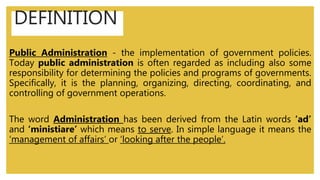
Public Administration - the implementation of government policies.
Today public administration is often regarded as including also some
responsibility for determining the policies and programs of governments.
Specifically, it is the planning, organizing, directing, coordinating, and
controlling of government operations.
The word Administration has been derived from the Latin words ‘ad’
and ‘ministiare’ which means to serve. In simple language it means the
‘management of affairs’ or ‘looking after the people’.
◦ L.D. White observes, “Public Administration consist of all those operations having for
their purpose the fulfilment or enforcement of public policy”.
◦ Pliffner defines It would seem that “Public Administration consists of getting the work of
government done by co-ordinating the efforts of the people so that they can work
together to accomplish their set tasks”.
◦ Prof: Woodrow Wilson defined Public Administration as detailed and systematic
execution of public law; every particular application of general law is an act of
administration.
◦ Luther Gullick ‘Public Administration is that part of the science of administration which
has to do with Government and thus concerns itself primarily with the executive branch
where the work of the government is done.
◦ Dwight Waldo, defines Public Administration as ‘the art and science of management as
applied to the affairs of state’.
DEFINITION
EVOLUTION & GROWTH
OF PUBLIC
ADMINISTRATION
Period I (1887 – 1926) Public Administration Dichotomy
The discipline of Public Administration was born in the USA. The credit for
initiating as an academic study of Public Administration goes to Woodrow
Wilson. He is regarded as the father of the discipline of Public Administration.
In his article entitled “The Study of Administration”, published in 1887, he
emphasized the need for studying Public Administration as a discipline apart from
politics. This is known as “Principle of Politic Administration Dichotomy”, i.e.,
a separation of Politics and Administration. Wilson argued that, “Administration
lies outside the proper sphere of politics.
According to Frank J. Goodnow, politics “has to do with the expression of the
state will” while administration “has to do with the execution of these policies.” In
short, Goodnow posited the politics-administration dichotomy and he developed
the Wilsonian theme further and greater courage and conviction.
Period II (1927 - 1937) Principles of Administration
• The central belief of this period was that there are certain ‘principles’ of
administration and which is the task of the scholars to discover and applied to
increase the efficiency and economy of Public Administration.
• Scientific management handled the business of administration becomes a
slogan. Administrative practitioners and business school join hands to
mechanistic aspect of management. They claim that Public Administration is
a science. The great depression in America contributed a lot to the
development.
• These periods were the golden years of ‘principles’ in the history of Public
Administration.
• This was also a period when Public Administration commanded a high degree
or respectability and its product were in great demand both in government and
business.
Period III (1938 – 1947) Era of Challenge
The main theme during this period was the advocacy of ‘Human
Relationship Behavioral Approach’ to the study of Public Administration.
The idea of administrative dichotomy was rejected. It was argued that
Administration cannot be separated from politics because its political nature
and role, Administration is not only concern with policy decision but it deals with
the policy formulation. Similarly, the principle of Administration was challenge.
Period IV (1947-1970) Crisis of Identity
• The mid-1940s theorists challenged Wilson and Gulick. The politics-
administration dichotomy remained the center of criticism.
• In the 1960s and 1970s, government itself came under fire as ineffective,
inefficient, and largely a wasted effort. There was a call by citizens for efficient
administration to replace ineffective, wasteful bureaucracy. Public
administration would have to distance itself from politics to answer this call
and remain effective.
• Concurrently, after World War II, the whole concept of public administration
expanded to include policy-making and analysis, thus the study of
‘administrative policy making and analyses was introduced and enhanced into
the government decision-making bodies. Later on, the human factor became a
predominant concern and emphasis in the study of Public Administration.
Period IV (1947-1970) Crisis of Identity
• This period witnessed the development and inclusion of other social
sciences knowledge, predominantly, psychology, anthropology, and
sociology, into the study of public administration. Fritz Morstein Marx with
his book ‘The Elements of Public Administration’ (1946), Paul H. Appleby
‘Policy and Administration’ (1952), Frank Marini ‘Towards a New Public
Administration’ (1971), and others that have contributed positively in these
endeavors.
Period V (1971) Public Policy Perspective
• After the 1970s the evolution of Public Administration has gained new ways.
The emergence of Development Administration, Comparative Public
administration and New Public Administration etc. were contributed to the
evolution of Public Administration. The emergence of globalization further
contributed to this growth.
SIGNIFICANCE OF PUBLIC
ADMINISTRATION
The importance of Public Administration is a specialized subject of study. which
can be done from various perspectives such as, the importance of public
administration (1) as an instrument of Government, its importance (2) as an
instrument for development and change, its importance in (3) modern
domestic welfare state, lastly, its importance (4) as a study of discipline.
(1) The importance of public
administration as a Governmental
Instrument.
Government’s most important function is to rule, i.e. to maintain
peace and order as well as protect the lives and property of its
citizens. It has to ensure that citizens should obey the contract or
agreement and also settle their disputes.
This important function of Government is expedited through the
instrument of public administration. But, with the increase in
governmental functions, the need for better management of public
affairs was voiced by practitioners.
(2) The importance of public
administration as an instrument for
development and change.
The administration of any country reflects the merit and potentialities of its
people and gives shape to their qualities, and desire.
Whenever people think to move ahead in the direction of progress and growth,
their main instrument is public administration. To run their institutions, schools
and technical institutes, they need to have trained human force. To build roads,
bridges, buildings, they require technical experts. To work towards development
and new explorations, they need scientific human brain. For all these, a fully
developed public administration can only meet the above mentioned needs.
(3) The importance of public
administration as an instrument for
welfare state.
Government has imparted many services for the welfare of its citizens in
modern democratic state. The services including in the field of education,
medical care, social security, care of the weak, orphans, and widows.
It also provides employment opportunities for the young aspirants.
(4) The importance of public
administration as a study of a
discipline.
The increase of the importance of public administration in the lives
of the people, it becomes essential to study its working system and
procedure. Therefore, its study in the course of academic institution
has become an essential part. The study of public administration as
a separate discipline has made a major breakthrough.
REFERENCES
Norwich University Online (2017).https://online.norwich.edu/academic-
programs/resources/overview-importance-public-administration
Mondal, M.S. (Retrieved September 23, 2020).
http://www.legalservicesindia.com/article/2311/Nature-And-Scope-of-Public-
Administration.html
Rajyam, A. (2018). Public Administration and its Effectiveness in Attaining A Welfare State.
International Journal of Engineering Technology Science and Research.
http://ijetsr.com/images/short_pdf/1522136103_1430-1434-oucip912_ijetsr.pdf
Owlgen (Retrieved September 23, 2020). Explain the Importance of Public Administration.
https://www.owlgen.in/explain-the-importance-of-public-administration

PUBLIC ADMINISTRATION

  • 1.
  • 2.
    DEFINITION Public Administration -the implementation of government policies. Today public administration is often regarded as including also some responsibility for determining the policies and programs of governments. Specifically, it is the planning, organizing, directing, coordinating, and controlling of government operations. The word Administration has been derived from the Latin words ‘ad’ and ‘ministiare’ which means to serve. In simple language it means the ‘management of affairs’ or ‘looking after the people’.
  • 3.
    ◦ L.D. Whiteobserves, “Public Administration consist of all those operations having for their purpose the fulfilment or enforcement of public policy”. ◦ Pliffner defines It would seem that “Public Administration consists of getting the work of government done by co-ordinating the efforts of the people so that they can work together to accomplish their set tasks”. ◦ Prof: Woodrow Wilson defined Public Administration as detailed and systematic execution of public law; every particular application of general law is an act of administration. ◦ Luther Gullick ‘Public Administration is that part of the science of administration which has to do with Government and thus concerns itself primarily with the executive branch where the work of the government is done. ◦ Dwight Waldo, defines Public Administration as ‘the art and science of management as applied to the affairs of state’. DEFINITION
  • 4.
    EVOLUTION & GROWTH OFPUBLIC ADMINISTRATION
  • 5.
    Period I (1887– 1926) Public Administration Dichotomy The discipline of Public Administration was born in the USA. The credit for initiating as an academic study of Public Administration goes to Woodrow Wilson. He is regarded as the father of the discipline of Public Administration. In his article entitled “The Study of Administration”, published in 1887, he emphasized the need for studying Public Administration as a discipline apart from politics. This is known as “Principle of Politic Administration Dichotomy”, i.e., a separation of Politics and Administration. Wilson argued that, “Administration lies outside the proper sphere of politics. According to Frank J. Goodnow, politics “has to do with the expression of the state will” while administration “has to do with the execution of these policies.” In short, Goodnow posited the politics-administration dichotomy and he developed the Wilsonian theme further and greater courage and conviction.
  • 6.
    Period II (1927- 1937) Principles of Administration • The central belief of this period was that there are certain ‘principles’ of administration and which is the task of the scholars to discover and applied to increase the efficiency and economy of Public Administration. • Scientific management handled the business of administration becomes a slogan. Administrative practitioners and business school join hands to mechanistic aspect of management. They claim that Public Administration is a science. The great depression in America contributed a lot to the development. • These periods were the golden years of ‘principles’ in the history of Public Administration. • This was also a period when Public Administration commanded a high degree or respectability and its product were in great demand both in government and business.
  • 7.
    Period III (1938– 1947) Era of Challenge The main theme during this period was the advocacy of ‘Human Relationship Behavioral Approach’ to the study of Public Administration. The idea of administrative dichotomy was rejected. It was argued that Administration cannot be separated from politics because its political nature and role, Administration is not only concern with policy decision but it deals with the policy formulation. Similarly, the principle of Administration was challenge.
  • 8.
    Period IV (1947-1970)Crisis of Identity • The mid-1940s theorists challenged Wilson and Gulick. The politics- administration dichotomy remained the center of criticism. • In the 1960s and 1970s, government itself came under fire as ineffective, inefficient, and largely a wasted effort. There was a call by citizens for efficient administration to replace ineffective, wasteful bureaucracy. Public administration would have to distance itself from politics to answer this call and remain effective. • Concurrently, after World War II, the whole concept of public administration expanded to include policy-making and analysis, thus the study of ‘administrative policy making and analyses was introduced and enhanced into the government decision-making bodies. Later on, the human factor became a predominant concern and emphasis in the study of Public Administration.
  • 9.
    Period IV (1947-1970)Crisis of Identity • This period witnessed the development and inclusion of other social sciences knowledge, predominantly, psychology, anthropology, and sociology, into the study of public administration. Fritz Morstein Marx with his book ‘The Elements of Public Administration’ (1946), Paul H. Appleby ‘Policy and Administration’ (1952), Frank Marini ‘Towards a New Public Administration’ (1971), and others that have contributed positively in these endeavors.
  • 10.
    Period V (1971)Public Policy Perspective • After the 1970s the evolution of Public Administration has gained new ways. The emergence of Development Administration, Comparative Public administration and New Public Administration etc. were contributed to the evolution of Public Administration. The emergence of globalization further contributed to this growth.
  • 11.
    SIGNIFICANCE OF PUBLIC ADMINISTRATION Theimportance of Public Administration is a specialized subject of study. which can be done from various perspectives such as, the importance of public administration (1) as an instrument of Government, its importance (2) as an instrument for development and change, its importance in (3) modern domestic welfare state, lastly, its importance (4) as a study of discipline.
  • 12.
    (1) The importanceof public administration as a Governmental Instrument. Government’s most important function is to rule, i.e. to maintain peace and order as well as protect the lives and property of its citizens. It has to ensure that citizens should obey the contract or agreement and also settle their disputes. This important function of Government is expedited through the instrument of public administration. But, with the increase in governmental functions, the need for better management of public affairs was voiced by practitioners.
  • 13.
    (2) The importanceof public administration as an instrument for development and change. The administration of any country reflects the merit and potentialities of its people and gives shape to their qualities, and desire. Whenever people think to move ahead in the direction of progress and growth, their main instrument is public administration. To run their institutions, schools and technical institutes, they need to have trained human force. To build roads, bridges, buildings, they require technical experts. To work towards development and new explorations, they need scientific human brain. For all these, a fully developed public administration can only meet the above mentioned needs.
  • 14.
    (3) The importanceof public administration as an instrument for welfare state. Government has imparted many services for the welfare of its citizens in modern democratic state. The services including in the field of education, medical care, social security, care of the weak, orphans, and widows. It also provides employment opportunities for the young aspirants.
  • 15.
    (4) The importanceof public administration as a study of a discipline. The increase of the importance of public administration in the lives of the people, it becomes essential to study its working system and procedure. Therefore, its study in the course of academic institution has become an essential part. The study of public administration as a separate discipline has made a major breakthrough.
  • 16.
    REFERENCES Norwich University Online(2017).https://online.norwich.edu/academic- programs/resources/overview-importance-public-administration Mondal, M.S. (Retrieved September 23, 2020). http://www.legalservicesindia.com/article/2311/Nature-And-Scope-of-Public- Administration.html Rajyam, A. (2018). Public Administration and its Effectiveness in Attaining A Welfare State. International Journal of Engineering Technology Science and Research. http://ijetsr.com/images/short_pdf/1522136103_1430-1434-oucip912_ijetsr.pdf Owlgen (Retrieved September 23, 2020). Explain the Importance of Public Administration. https://www.owlgen.in/explain-the-importance-of-public-administration