-   Binesh Bilal (A11042)
-   Eyeni Yanthan (A11373)
-   Riddhi Vartak (A11365)
-   Vaishnavi Savant (A11287)
 New  Public Management (NPM) is the label given to a
 series of reforms from the 1980s onwards, to improve the
 efficiency and performance of western governments
 and/or public sector organizations.

 NPM points to the failures and inadequacies of public
 sector performance over time, and locates the problem in
 the nature and processes of public sector activity and
 public administration.
   Key public change in public sector ethos.

   Basis of NPM has been an emphasis of efficiency and cost
    cutting and general assumption the government should
    deliver more for less.

    Ideas borrowed from private sector can improve
    experience and serve of those who use the planning
    system.
 NPM    seeks to reshape public interactions with the
    government.

   Customer oriented public service.

 At   the core of these changes has been a fundamental
    and ideological transformation of public sector ethos
    collectively referred to as New Public Management.
   According to Kickert, the characteristics of NPM
    are the following eight aspects:

   Strengthening steering functions at the center.

   Devolving authority, providing flexibility.

    Ensuring performance, control and
     accountability.
   Improving the management of human resources.

   Optimizing information technology.

   Improving the quality of regulation.

   Providing responsive service.

   Developing competition and choice
 Emphasis on  increasing adoption of managerial
 practices of private sector in public administration.

 Promotion   of competition within public sector.

 Greater
        use of contract arrangements within the
 government as well as outside it.

 Emphasis on   results rather than procedures.
 Formulation   of explicit or definite standards and
    measures of performance.

 Emphasis on      separation of administrative units.

   A shift away from policy to management .

 Encouragement of       lack of wastefulness in public
    expenditure.
 ThePublic choice perspective in public administration
  was increasing in the early seventies.

 Various   Authors criticised public bureaucracy in their
  books.

 David Osborne and Ted Gaebler made a proposal for
  re-inventing the Government in their book.

 Itwas soon adopted by the United States Government
  via Al Gore’s (Vice-President) Report of the National
  Performance Review (1993).
1.   Government must promote competition among
     service- providers.

2.    It must empower citizens by pushing control out of
     the bureaucracy into the community.

3.    It must measure the performance of their agencies
     focussing on outcomes, not on inputs.

4.    It must be motivated by goals , not by rules and
     regulations.
5.   It re- defines its clients as customers , and offers
     them choices.

6.   It must prevent problems before these emerge,
     rather than simply offering them services afterwards.

7.   It must direct its energy towards earning money not
     simply spending it.

8.   It must decentralize authority and promote participative
     management
9.    It must prefer market mechanisms to bureaucratic
      mechanisms.

10.   It must focus on providing public services but on
      catalyzing all sectors in the society-public , private ,
      voluntary-into action to solve the community’s
      problems.
   Economist Ha-Joon Chang claims that "increased NPM inspired
         reforms have often increased corruption, creating new
         opportunities for bribes and future, direct or indirect, employment
         in the private sector.

        The reform strategy of the Australian government failed in two
         important respects:

1.         The reform techniques were expensive and have increased costs
          in the short term.

2.        An attempt to save costs has damaged the organizational capacity
          to maintain quality services and innovation.
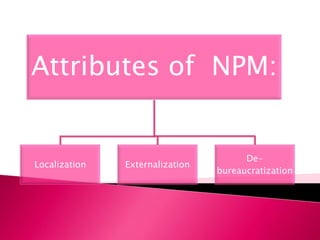
Attributes of NPM:


                                       De-
Localization   Externalization
                                 bureaucratization
     NPM – Result oriented and objective focused.

    Flexible arrangements in organizations, conditions of
    employment etc.

     Driving motives : Three E’s –Economy, Efficiency ,
    and Effectiveness.

     Change in the governing style : From rowing to
    steering.

New public management

  • 1.
    - Binesh Bilal (A11042) - Eyeni Yanthan (A11373) - Riddhi Vartak (A11365) - Vaishnavi Savant (A11287)
  • 2.
     New Public Management (NPM) is the label given to a series of reforms from the 1980s onwards, to improve the efficiency and performance of western governments and/or public sector organizations.  NPM points to the failures and inadequacies of public sector performance over time, and locates the problem in the nature and processes of public sector activity and public administration.
  • 3.
    Key public change in public sector ethos.  Basis of NPM has been an emphasis of efficiency and cost cutting and general assumption the government should deliver more for less.  Ideas borrowed from private sector can improve experience and serve of those who use the planning system.
  • 4.
     NPM seeks to reshape public interactions with the government.  Customer oriented public service.  At the core of these changes has been a fundamental and ideological transformation of public sector ethos collectively referred to as New Public Management.
  • 5.
    According to Kickert, the characteristics of NPM are the following eight aspects:  Strengthening steering functions at the center.  Devolving authority, providing flexibility.  Ensuring performance, control and accountability.
  • 6.
    Improving the management of human resources.  Optimizing information technology.  Improving the quality of regulation.  Providing responsive service.  Developing competition and choice
  • 7.
     Emphasis on increasing adoption of managerial practices of private sector in public administration.  Promotion of competition within public sector.  Greater use of contract arrangements within the government as well as outside it.  Emphasis on results rather than procedures.
  • 8.
     Formulation of explicit or definite standards and measures of performance.  Emphasis on separation of administrative units.  A shift away from policy to management .  Encouragement of lack of wastefulness in public expenditure.
  • 9.
     ThePublic choiceperspective in public administration was increasing in the early seventies.  Various Authors criticised public bureaucracy in their books.  David Osborne and Ted Gaebler made a proposal for re-inventing the Government in their book.  Itwas soon adopted by the United States Government via Al Gore’s (Vice-President) Report of the National Performance Review (1993).
  • 10.
    1. Government must promote competition among service- providers. 2. It must empower citizens by pushing control out of the bureaucracy into the community. 3. It must measure the performance of their agencies focussing on outcomes, not on inputs. 4. It must be motivated by goals , not by rules and regulations.
  • 11.
    5. It re- defines its clients as customers , and offers them choices. 6. It must prevent problems before these emerge, rather than simply offering them services afterwards. 7. It must direct its energy towards earning money not simply spending it. 8. It must decentralize authority and promote participative management
  • 12.
    9. It must prefer market mechanisms to bureaucratic mechanisms. 10. It must focus on providing public services but on catalyzing all sectors in the society-public , private , voluntary-into action to solve the community’s problems.
  • 13.
    Economist Ha-Joon Chang claims that "increased NPM inspired reforms have often increased corruption, creating new opportunities for bribes and future, direct or indirect, employment in the private sector.  The reform strategy of the Australian government failed in two important respects: 1. The reform techniques were expensive and have increased costs in the short term. 2. An attempt to save costs has damaged the organizational capacity to maintain quality services and innovation.
  • 14.
    Attributes of NPM: De- Localization Externalization bureaucratization
  • 15.
    NPM – Result oriented and objective focused.  Flexible arrangements in organizations, conditions of employment etc.  Driving motives : Three E’s –Economy, Efficiency , and Effectiveness.  Change in the governing style : From rowing to steering.