This Session Covers .....
• Introduction
• Meaning and Definition
• Nature
• Scope
• Significance
• Public administration and Private Administration
 Public administration started in America.
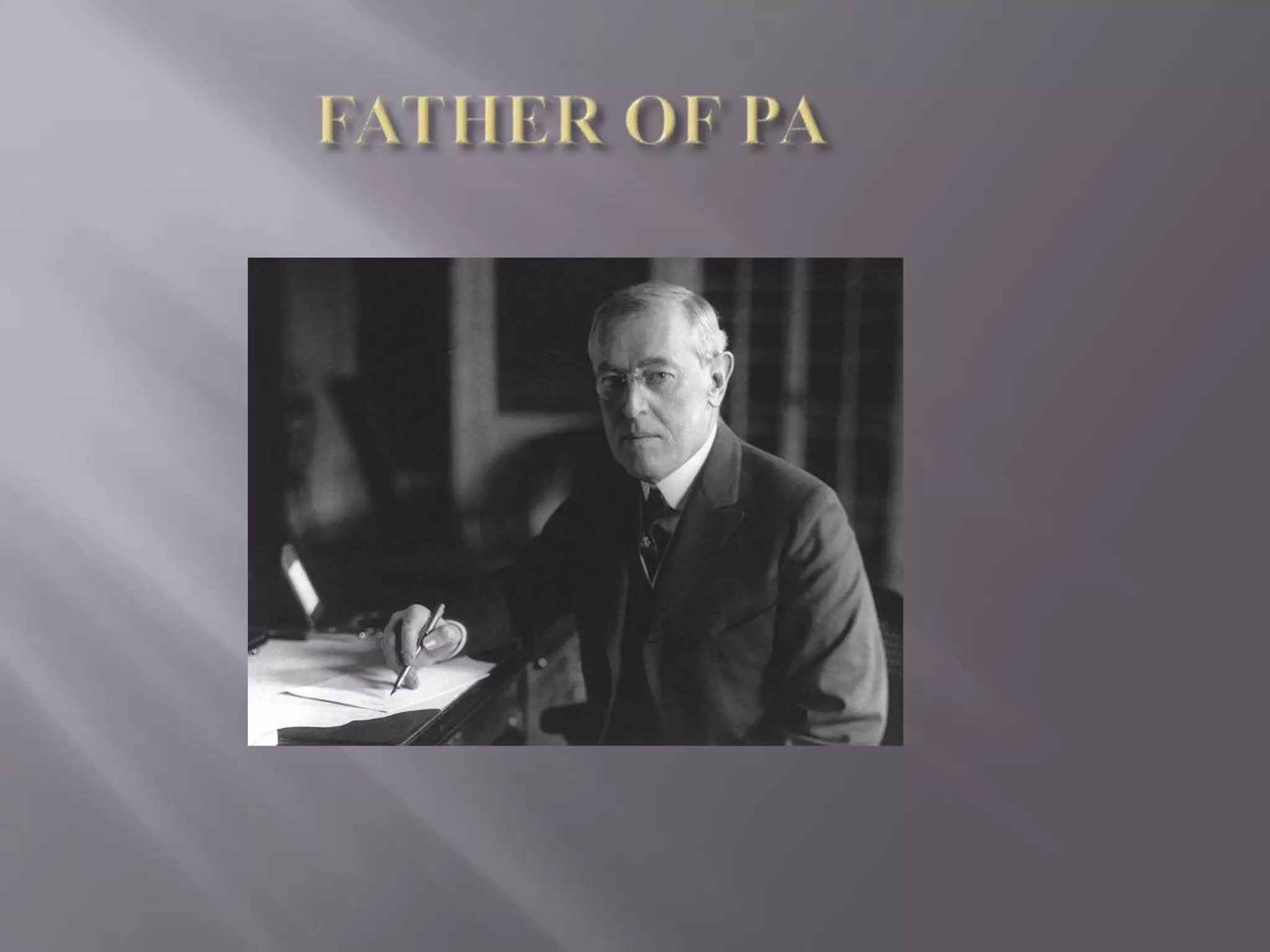
 Woodrow Wilson , the former American President of
America and a professor of Political Science in Priston
University is called the father of PA.
 “The Study of Administration”(1887) – an article
published in “Political Science Quarterly.”
 L.D. White wrote the first text book of PA “Public
Administration”(1926).
 Dwight Waldo published a booklet called “The Study
of Public Administration”(1900).
 Administer is the combination of two Latin
words, ‘ad’ + ‘ministrare’ which means to
serve, to direct, to control and to manaage
affairs.
 In its literal sense, administration simply
means management of affairs.
 The word ‘public’ here means governmental.
 Public Administration, therefore, simply
means governmental administration.
Definitions
 Woodrow Wilson – “PA is detailed and systematic
application of law. Every application of law is an act of
administration.”
 Dwight Waldo – “PA is the organization of man and
materials to achieve the purposes of govt.”
 “PA is art and science of management applied to the
state”.
 “The immediate effect of all one sentence or one
paragraph definition of PA is mental paralysis rather than
enlightenment and stimulation.”
Continued....
 Felix A. Nigro & Lioyed G. Nigro,
1. “ is cooperative group effort in a public setting
2. covers all three branches – executive,legislativve and
judicial – and their inter-relationships
3. has an important role in formulation of public policy
and thus a part of the political process
4. is different in significant ways from private
administartion
5. is closely associated with numerous private groups and
individuals in providing services to the community.”
NATURE
 There are 2 broad views regarding the nature of public administration:
 Integral View
 Administration is the sum total of all the activities such as; manual, clerical, managerial,
etc., which are undertaken to realize the objectives of the organisation. According to this
view, all the acts of officials of the government from the attendant to the secretaries to
the government and head of the state constitute Public Administration. Henri Fayol and
L.D. White are the supporters of this view.
 Managerial View
 According to this view of administration, the managerial activities of people who are
involved in planning, organizing, commanding, coordinating and controlling (POCCC-
according to H. Fayol) constitute Public Administration.
 This view regards administration as getting things done and not doing things. Luther
Gullick, Herbert Simon, Smithburg and Thompson are the supporters of this view. The
managerial view excludes Public Administration from non-managerial activities such as
manual, clerical and technical activities.
 https://aspirantforum.com/2015/08/08/basics-of-public-administration-nature-scope/
Scope of PA
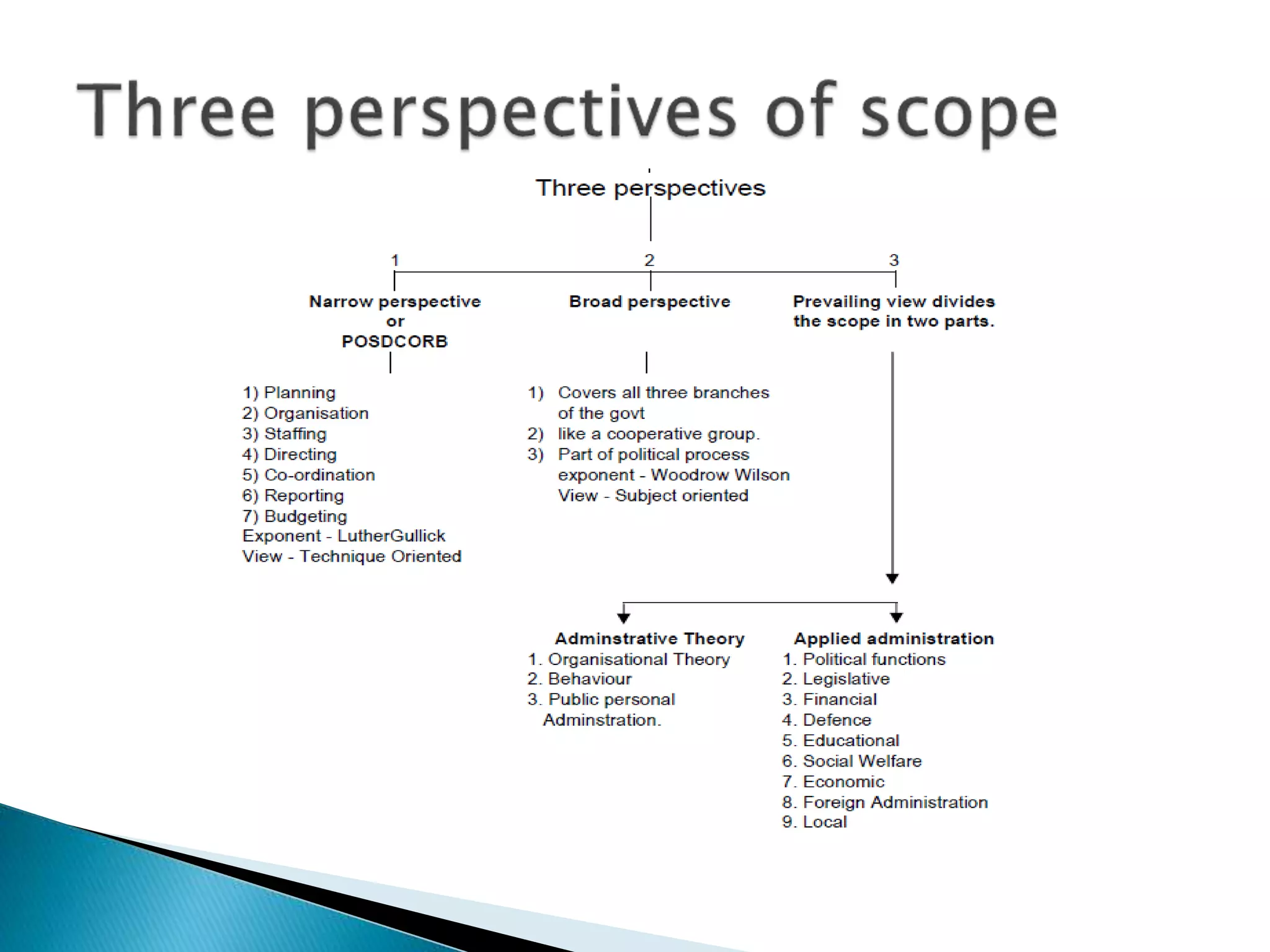
 Scope – The major concerns of PA as an activity and
as a discipline.
 Two views: Traditional view and Modern view
 Traditional View: Restricted to the executive branch
only.
 No role in legislative and judicial function.
 Modern View: The whole government in action. Thus
covers all the three branches.
 This view is more realistic.
Continued...
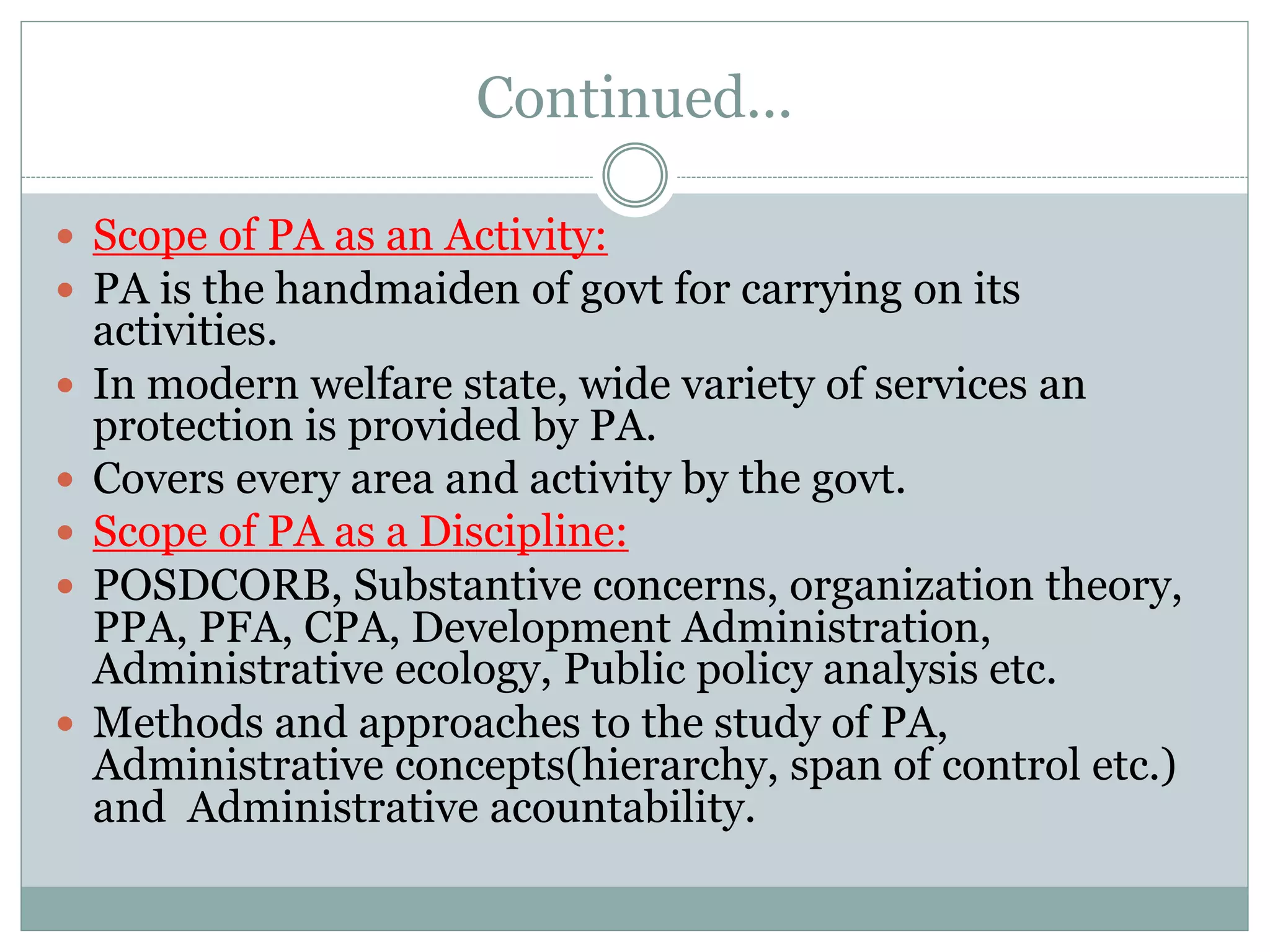
 Scope of PA as an Activity:
 PA is the handmaiden of govt for carrying on its
activities.
 In modern welfare state, wide variety of services an
protection is provided by PA.
 Covers every area and activity by the govt.
 Scope of PA as a Discipline:
 POSDCORB, Substantive concerns, organization theory,
PPA, PFA, CPA, Development Administration,
Administrative ecology, Public policy analysis etc.
 Methods and approaches to the study of PA,
Administrative concepts(hierarchy, span of control etc.)
and Administrative acountability.
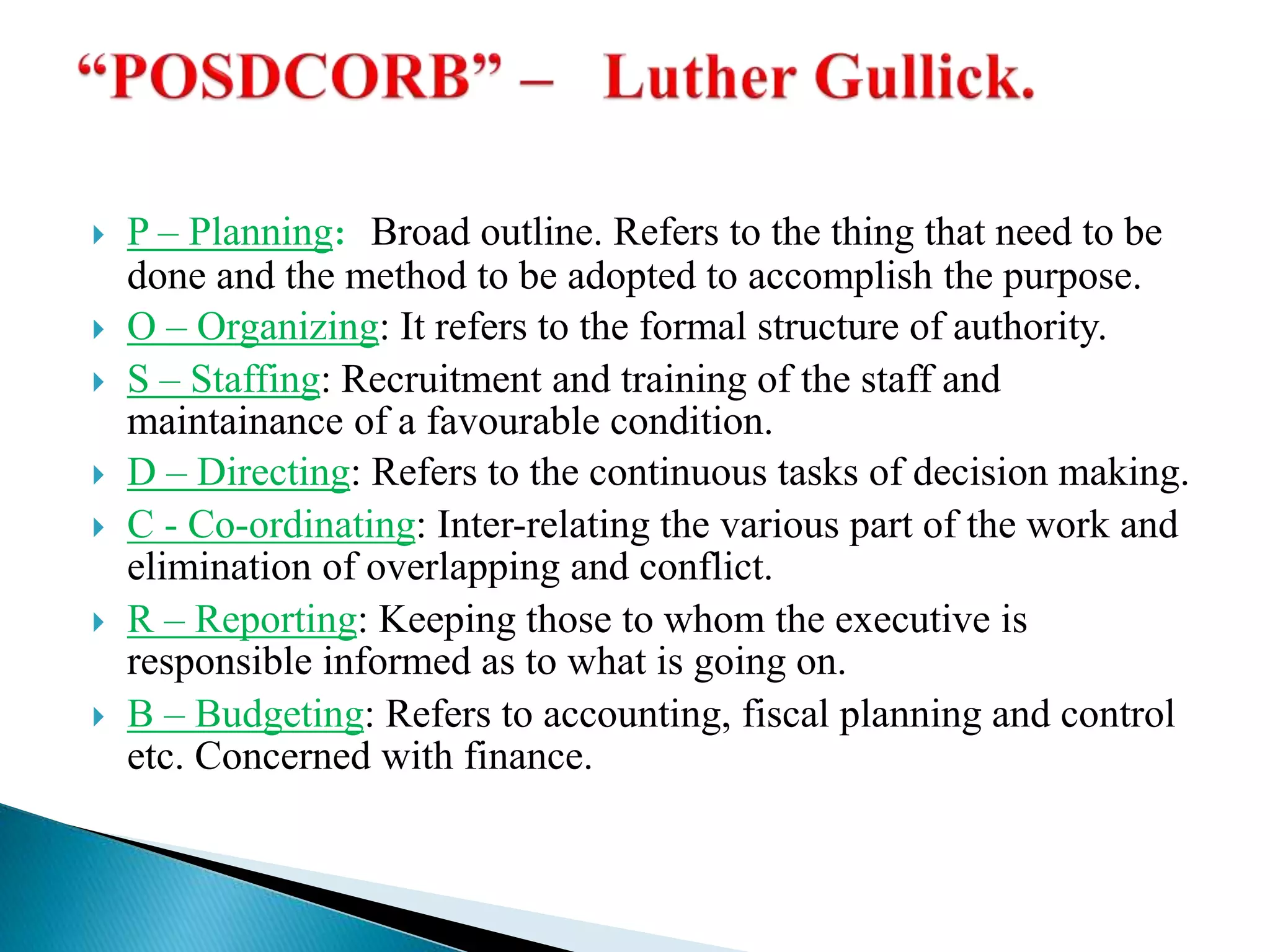
 P – Planning: Broad outline. Refers to the thing that need to be
done and the method to be adopted to accomplish the purpose.
 O – Organizing: It refers to the formal structure of authority.
 S – Staffing: Recruitment and training of the staff and
maintainance of a favourable condition.
 D – Directing: Refers to the continuous tasks of decision making.
 C - Co-ordinating: Inter-relating the various part of the work and
elimination of overlapping and conflict.
 R – Reporting: Keeping those to whom the executive is
responsible informed as to what is going on.
 B – Budgeting: Refers to accounting, fiscal planning and control
etc. Concerned with finance.
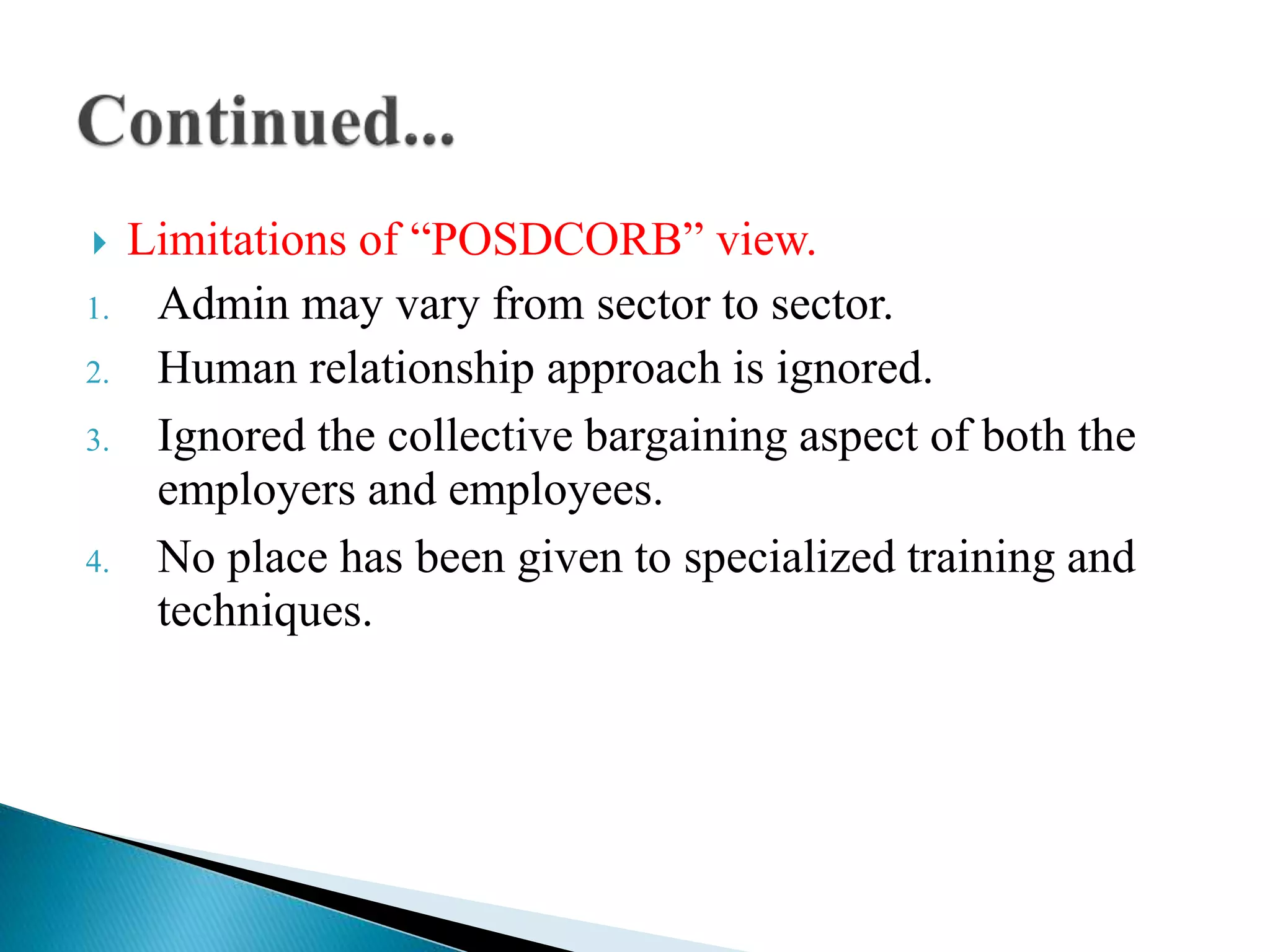
 Limitations of “POSDCORB” view.
1. Admin may vary from sector to sector.
2. Human relationship approach is ignored.
3. Ignored the collective bargaining aspect of both the
employers and employees.
4. No place has been given to specialized training and
techniques.
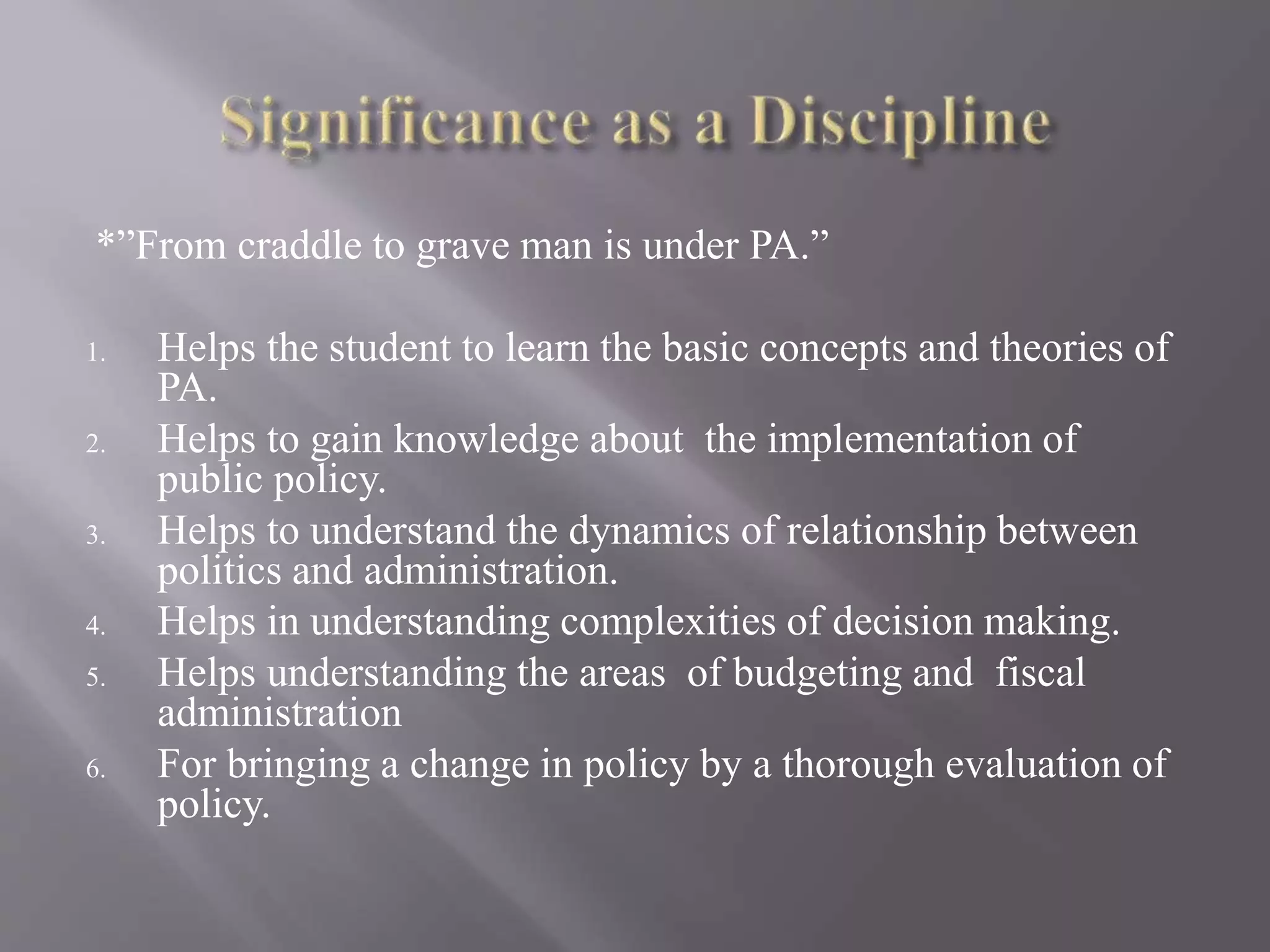
*”From craddle to grave man is under PA.”
1. Helps the student to learn the basic concepts and theories of
PA.
2. Helps to gain knowledge about the implementation of
public policy.
3. Helps to understand the dynamics of relationship between
politics and administration.
4. Helps in understanding complexities of decision making.
5. Helps understanding the areas of budgeting and fiscal
administration
6. For bringing a change in policy by a thorough evaluation of
policy.
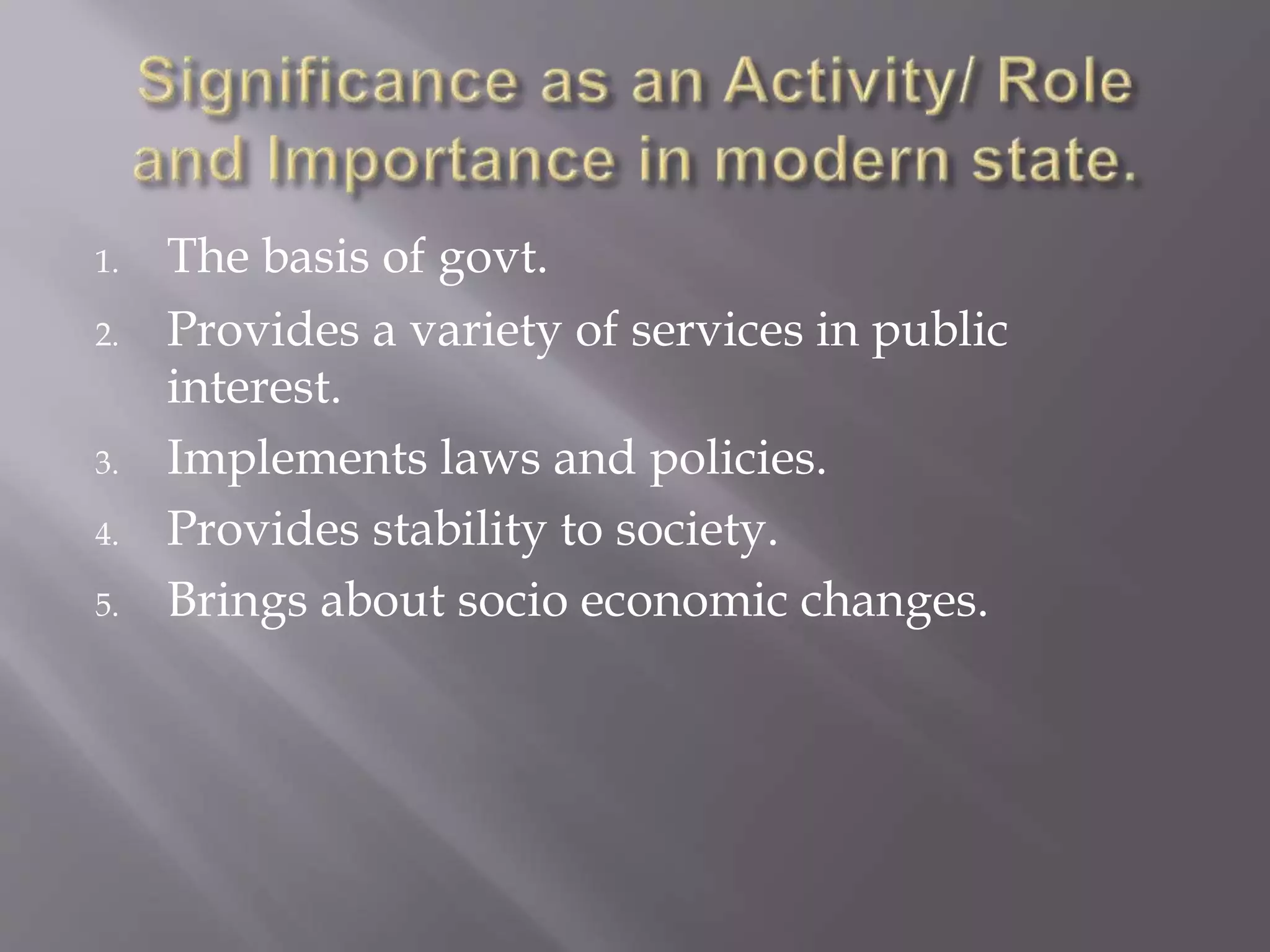
1. The basis of govt.
2. Provides a variety of services in public
interest.
3. Implements laws and policies.
4. Provides stability to society.
5. Brings about socio economic changes.
Public Administration and Private Administration
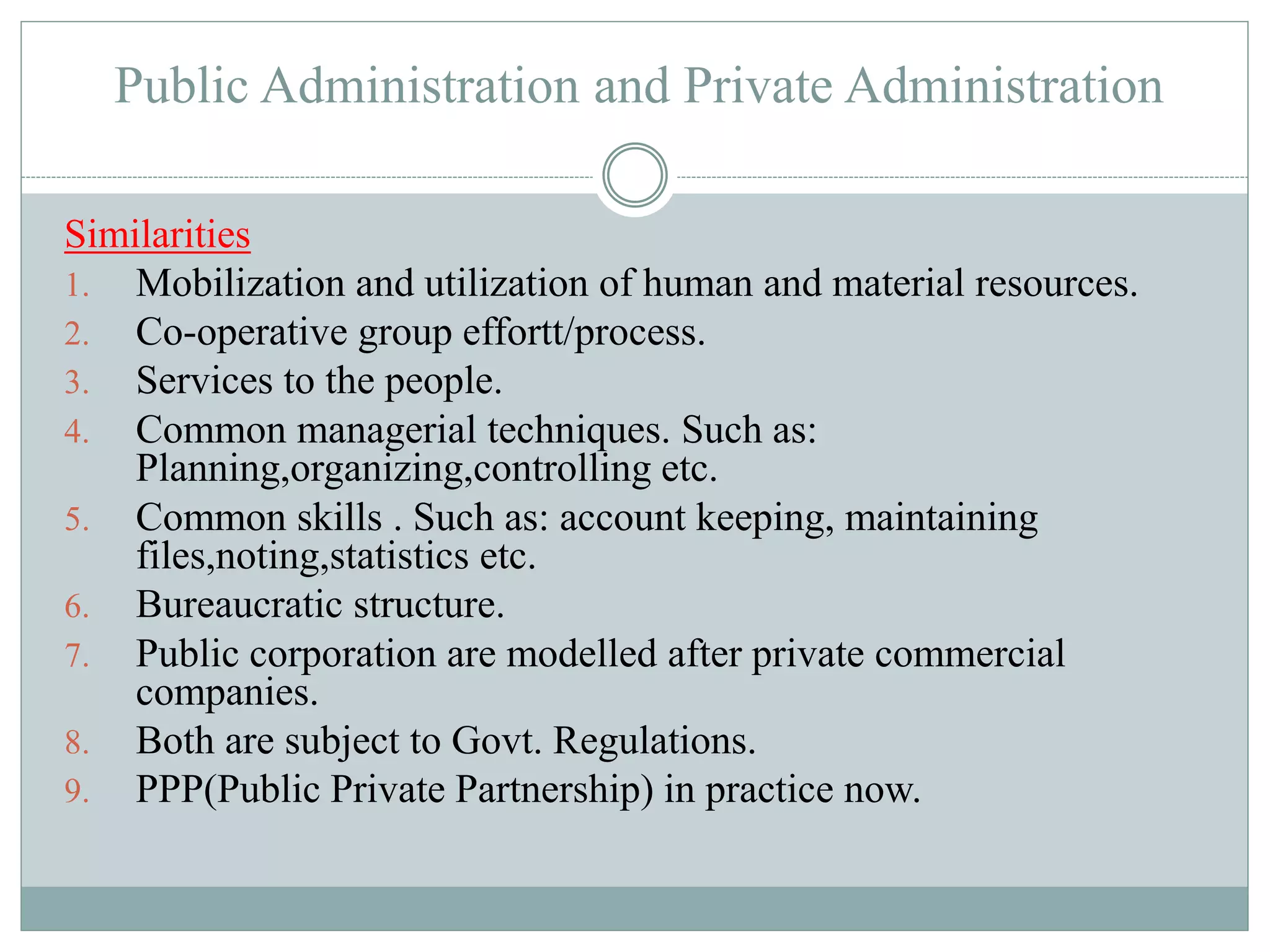
Similarities
1. Mobilization and utilization of human and material resources.
2. Co-operative group effortt/process.
3. Services to the people.
4. Common managerial techniques. Such as:
Planning,organizing,controlling etc.
5. Common skills . Such as: account keeping, maintaining
files,noting,statistics etc.
6. Bureaucratic structure.
7. Public corporation are modelled after private commercial
companies.
8. Both are subject to Govt. Regulations.
9. PPP(Public Private Partnership) in practice now.
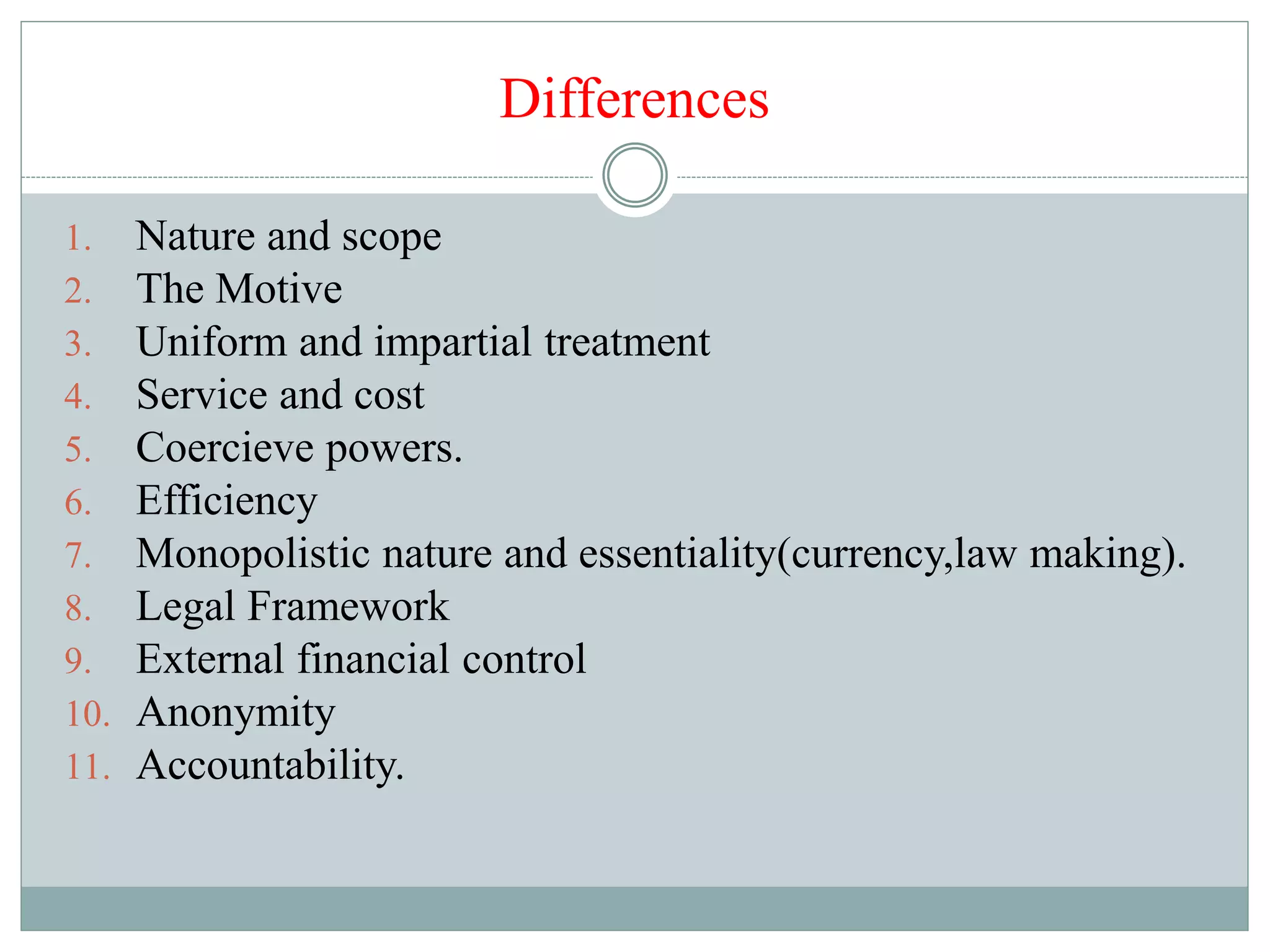
Differences
1. Nature and scope
2. The Motive
3. Uniform and impartial treatment
4. Service and cost
5. Coercieve powers.
6. Efficiency
7. Monopolistic nature and essentiality(currency,law making).
8. Legal Framework
9. External financial control
10. Anonymity
11. Accountability.
1. S. Polinaido – “Public Administration”. Chapter
1,3,4.
2. Felix A. Nigro & Lioyed G. Nigro – “Modern
Public Administration”. Chapter 1.
3. Prof. Amir Mohammad Nasrullah – “Fundamentals
of Public Administration”. Chapter 1.
4. https://aspirantforum.com/2015/08/08/basics-of-
public-administration-nature-scope/
Md. Mahtab Uddin
Dept. Of Public Administration, University of
Chittagong.
Session: 2016-17

Introduction to Public Administration

  • 1.
    This Session Covers..... • Introduction • Meaning and Definition • Nature • Scope • Significance • Public administration and Private Administration
  • 3.
     Public administrationstarted in America.  Woodrow Wilson , the former American President of America and a professor of Political Science in Priston University is called the father of PA.  “The Study of Administration”(1887) – an article published in “Political Science Quarterly.”  L.D. White wrote the first text book of PA “Public Administration”(1926).  Dwight Waldo published a booklet called “The Study of Public Administration”(1900).
  • 4.
     Administer isthe combination of two Latin words, ‘ad’ + ‘ministrare’ which means to serve, to direct, to control and to manaage affairs.  In its literal sense, administration simply means management of affairs.  The word ‘public’ here means governmental.  Public Administration, therefore, simply means governmental administration.
  • 5.
    Definitions  Woodrow Wilson– “PA is detailed and systematic application of law. Every application of law is an act of administration.”  Dwight Waldo – “PA is the organization of man and materials to achieve the purposes of govt.”  “PA is art and science of management applied to the state”.  “The immediate effect of all one sentence or one paragraph definition of PA is mental paralysis rather than enlightenment and stimulation.”
  • 6.
    Continued....  Felix A.Nigro & Lioyed G. Nigro, 1. “ is cooperative group effort in a public setting 2. covers all three branches – executive,legislativve and judicial – and their inter-relationships 3. has an important role in formulation of public policy and thus a part of the political process 4. is different in significant ways from private administartion 5. is closely associated with numerous private groups and individuals in providing services to the community.”
  • 7.
    NATURE  There are2 broad views regarding the nature of public administration:  Integral View  Administration is the sum total of all the activities such as; manual, clerical, managerial, etc., which are undertaken to realize the objectives of the organisation. According to this view, all the acts of officials of the government from the attendant to the secretaries to the government and head of the state constitute Public Administration. Henri Fayol and L.D. White are the supporters of this view.  Managerial View  According to this view of administration, the managerial activities of people who are involved in planning, organizing, commanding, coordinating and controlling (POCCC- according to H. Fayol) constitute Public Administration.  This view regards administration as getting things done and not doing things. Luther Gullick, Herbert Simon, Smithburg and Thompson are the supporters of this view. The managerial view excludes Public Administration from non-managerial activities such as manual, clerical and technical activities.  https://aspirantforum.com/2015/08/08/basics-of-public-administration-nature-scope/
  • 8.
    Scope of PA Scope – The major concerns of PA as an activity and as a discipline.  Two views: Traditional view and Modern view  Traditional View: Restricted to the executive branch only.  No role in legislative and judicial function.  Modern View: The whole government in action. Thus covers all the three branches.  This view is more realistic.
  • 9.
    Continued...  Scope ofPA as an Activity:  PA is the handmaiden of govt for carrying on its activities.  In modern welfare state, wide variety of services an protection is provided by PA.  Covers every area and activity by the govt.  Scope of PA as a Discipline:  POSDCORB, Substantive concerns, organization theory, PPA, PFA, CPA, Development Administration, Administrative ecology, Public policy analysis etc.  Methods and approaches to the study of PA, Administrative concepts(hierarchy, span of control etc.) and Administrative acountability.
  • 11.
     P –Planning: Broad outline. Refers to the thing that need to be done and the method to be adopted to accomplish the purpose.  O – Organizing: It refers to the formal structure of authority.  S – Staffing: Recruitment and training of the staff and maintainance of a favourable condition.  D – Directing: Refers to the continuous tasks of decision making.  C - Co-ordinating: Inter-relating the various part of the work and elimination of overlapping and conflict.  R – Reporting: Keeping those to whom the executive is responsible informed as to what is going on.  B – Budgeting: Refers to accounting, fiscal planning and control etc. Concerned with finance.
  • 12.
     Limitations of“POSDCORB” view. 1. Admin may vary from sector to sector. 2. Human relationship approach is ignored. 3. Ignored the collective bargaining aspect of both the employers and employees. 4. No place has been given to specialized training and techniques.
  • 13.
    *”From craddle tograve man is under PA.” 1. Helps the student to learn the basic concepts and theories of PA. 2. Helps to gain knowledge about the implementation of public policy. 3. Helps to understand the dynamics of relationship between politics and administration. 4. Helps in understanding complexities of decision making. 5. Helps understanding the areas of budgeting and fiscal administration 6. For bringing a change in policy by a thorough evaluation of policy.
  • 14.
    1. The basisof govt. 2. Provides a variety of services in public interest. 3. Implements laws and policies. 4. Provides stability to society. 5. Brings about socio economic changes.
  • 15.
    Public Administration andPrivate Administration Similarities 1. Mobilization and utilization of human and material resources. 2. Co-operative group effortt/process. 3. Services to the people. 4. Common managerial techniques. Such as: Planning,organizing,controlling etc. 5. Common skills . Such as: account keeping, maintaining files,noting,statistics etc. 6. Bureaucratic structure. 7. Public corporation are modelled after private commercial companies. 8. Both are subject to Govt. Regulations. 9. PPP(Public Private Partnership) in practice now.
  • 16.
    Differences 1. Nature andscope 2. The Motive 3. Uniform and impartial treatment 4. Service and cost 5. Coercieve powers. 6. Efficiency 7. Monopolistic nature and essentiality(currency,law making). 8. Legal Framework 9. External financial control 10. Anonymity 11. Accountability.
  • 17.
    1. S. Polinaido– “Public Administration”. Chapter 1,3,4. 2. Felix A. Nigro & Lioyed G. Nigro – “Modern Public Administration”. Chapter 1. 3. Prof. Amir Mohammad Nasrullah – “Fundamentals of Public Administration”. Chapter 1. 4. https://aspirantforum.com/2015/08/08/basics-of- public-administration-nature-scope/
  • 20.
    Md. Mahtab Uddin Dept.Of Public Administration, University of Chittagong. Session: 2016-17