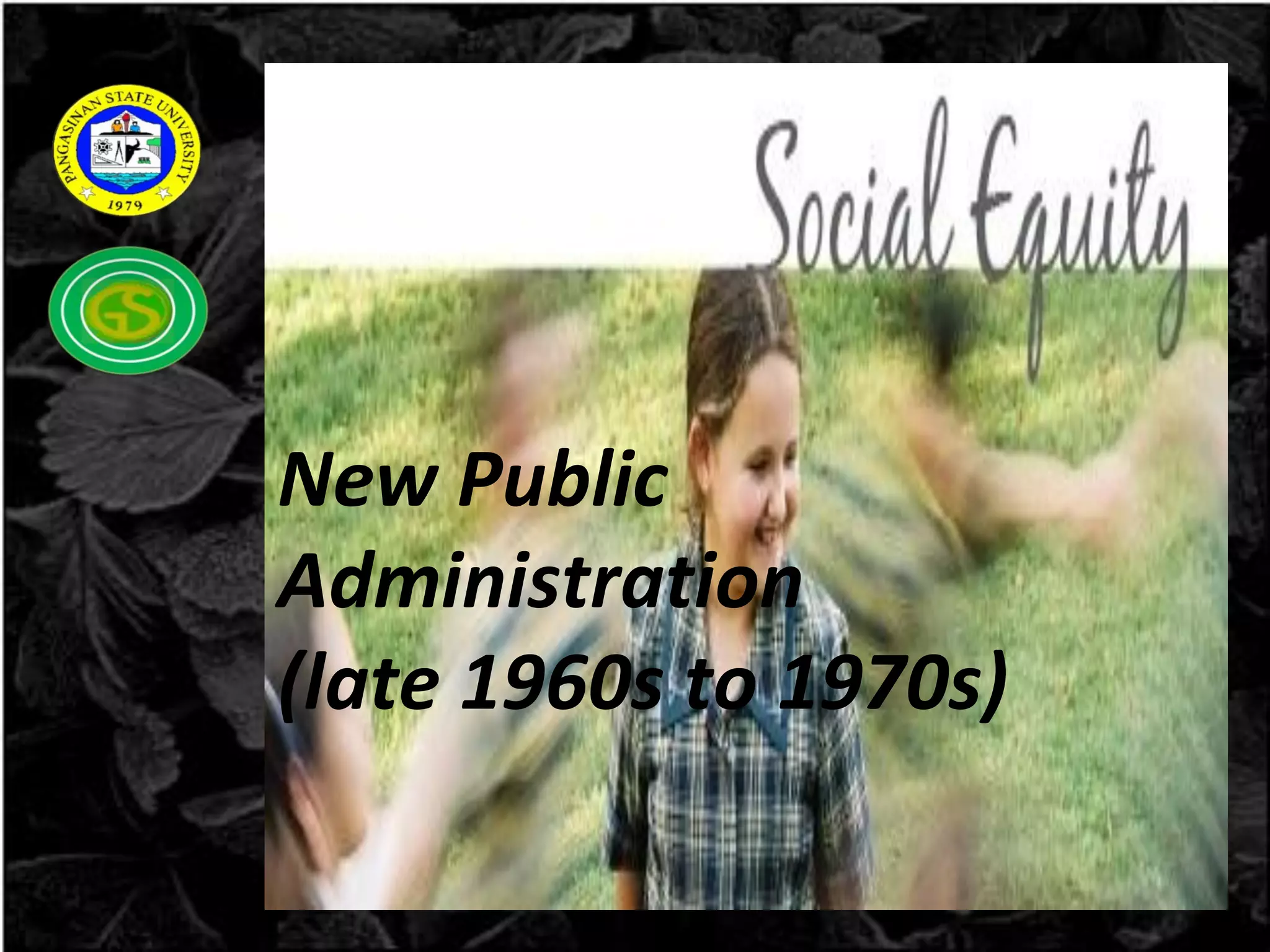
New Public
Administration
(late 1960s to 1970s)
New Public Administration
(late 1960s to 1970s)
The term “New Public Administration” or
New PA may have emerged from the
Minnowbrook Conference in 1968 in
Syracuse University. The conference was
the brainchild and inspiration of Dwight
Waldo who brought together young public
administrators and scholars to discuss
important issues and varying perspectives
on public administration. The conference
created a hullabaloo.
One of its controversies is that it had rejected the
classical theories of public administration and
instead offered new principles. For instance,
Frederickson in his essay, “Towards a New Public
Administration,” adds social equity to the classic
definition of public administration.
Conventional or classic public administration sought
to only answer inquiries on efficiency and
effectiveness like: how can the government offer
better services with available resources
(efficiency) or how can we maintain our level of
services while spending less money (economy)? In
introducing the principles of New PA, he adds the
question: “Does this service enhance social
equity?” (Frederickson 1971)
The Minnowbrook conferees also questioned
the relevance of traditional public administration to
existing deprivation with an era of fast-paced
technological advancement in the backdrop.
Frederickson argued that, disparities existed because
public administration focused less on social purposes
or values of government policies and programs and
more on the economy and efficiency of execution.
The value-free and neutral stance of traditional
PA has alienated the less privileged and deprived
groups in the society. New PA’s proponents, likewise,
advocated that public administrators should not be
neutral; they should be committed to both good
management and social equity as values to be
achieved.
Social Equity
Social Equity—while named the fourth pillar of
public administration by the National Academy
of Public Administration in 2005—still
struggles to find equal footing with its
partners, economy, efficiency and
effectiveness. As Wooldridge and Gooden
(2009) have argued, it is the rare public
administrator who has the courage to make
social equity the primary goal of policy. The
question for this work is, “Can we achieve
equity for social equity among the pillars of
public administration?”
Kristen Norman-Major (2006)
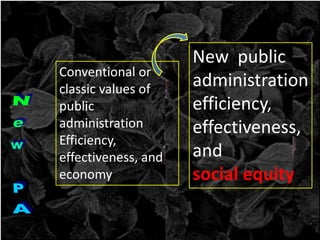
Conventional or
classic values of
public
administration
Efficiency,
effectiveness, and
economy
New public
administration
efficiency,
effectiveness,
and
social equity
New PA is “change”
New PA then called for client-oriented
administration, non-bureaucratic
structures, participatory decision-
making, decentralized administration
and advocate-administrators.
(Frederickson 1971; Nigro and Nigro
1989) With the above contentions, it
can be said that the theme of New PA
is “change” and the challenge is for
the public administrators is their
capacity to accept change.
Is the New PA relevant?
Pilar (1993) in his article “Relevance of
New PA in Philippine Public
Administration. He argued that New PA
is relevant while there is no indigenous
model of public administration, the
relevance of New PA maybe regarded in
terms of their compatibility with the
context or the environment, as well as
the convergence between the content
and intent of new PA with the goals,
purposes, and aspirations of the
country.” (Pilar 1993: 145)
The principle of New PA is compatible
with the environment of the Philippine
PA, although it was conceived during
the time that the US was in chaotic and
unpredictable environment amidst
prosperity. Such situation is different in
the Philippines considering that not
only it grappled with advancement but
it struggled to pull itself out of poverty
which is a major concern of the
government up to this date.
New PA created the need to stimulate change:
meeting the needs of the society through
the government’s development programs
and projects, and addressing social equity
and justice. It must be emphasized though,
that the core questions raised by New PA are
also embedded in our second order
question, “for whom is PA?” It is indeed
critical to define the ultimate targets and
partners of public administration structures,
institutions and processes. In other words,
who is the “public” in public administration?
Kristen Norman-Major (2006)
It is argued here that social equity can be simplified
to maintaining or creating equality of opportunity
in the provision of public services and that it can
take three different forms in public
administration:
1. Simple fairness and equal treatment
2. Distribution of resources to reduce inequalities in
universal programs and services
3. Redistribution of resources to level the playing
field or increase equality of opportunity through
targeted programs
Kristen Norman-Major (2006)
Social equity among the values of public administration
has gained ground in acceptance since the first
Minnowbrook conference. But over 40 years later, it still
struggles to gain traction as an equal among its partners
economy, efficiency, and effectiveness. Despite other
symposia in the Journal of Public Affairs Education, the
work of the Standing Panel on Social Equity in NAPA
and its annual Social Equity Leadership Conference, and
the establishment of a Democracy and Social Justice
Section in the American Society for Public
Administration, the field of public administration has
not fully accepted the role of social equity in public
administration. In part, this is due to the lack of clear
definitions and measures for social equity.
Kristen Norman-Major (2006)
Alex Brillantes, Jr. and Maricel Fernandez Is there
a Philippine Public Administration or Better
Still, for whom is Public Administration? UP
NCPAG June, 2008
Kristen Norman-Major (2006) Balancing the Four
Es; or Can We Achieve Equity for Social Equity in
Public Administration?
Hamline University. JPAE 17(2), 233–252
Reference:

New Public Administration

  • 1.
  • 2.
    New Public Administration (late1960s to 1970s) The term “New Public Administration” or New PA may have emerged from the Minnowbrook Conference in 1968 in Syracuse University. The conference was the brainchild and inspiration of Dwight Waldo who brought together young public administrators and scholars to discuss important issues and varying perspectives on public administration. The conference created a hullabaloo.
  • 3.
    One of itscontroversies is that it had rejected the classical theories of public administration and instead offered new principles. For instance, Frederickson in his essay, “Towards a New Public Administration,” adds social equity to the classic definition of public administration. Conventional or classic public administration sought to only answer inquiries on efficiency and effectiveness like: how can the government offer better services with available resources (efficiency) or how can we maintain our level of services while spending less money (economy)? In introducing the principles of New PA, he adds the question: “Does this service enhance social equity?” (Frederickson 1971)
  • 4.
    The Minnowbrook confereesalso questioned the relevance of traditional public administration to existing deprivation with an era of fast-paced technological advancement in the backdrop. Frederickson argued that, disparities existed because public administration focused less on social purposes or values of government policies and programs and more on the economy and efficiency of execution. The value-free and neutral stance of traditional PA has alienated the less privileged and deprived groups in the society. New PA’s proponents, likewise, advocated that public administrators should not be neutral; they should be committed to both good management and social equity as values to be achieved.
  • 5.
    Social Equity Social Equity—whilenamed the fourth pillar of public administration by the National Academy of Public Administration in 2005—still struggles to find equal footing with its partners, economy, efficiency and effectiveness. As Wooldridge and Gooden (2009) have argued, it is the rare public administrator who has the courage to make social equity the primary goal of policy. The question for this work is, “Can we achieve equity for social equity among the pillars of public administration?” Kristen Norman-Major (2006)
  • 6.
    Conventional or classic valuesof public administration Efficiency, effectiveness, and economy New public administration efficiency, effectiveness, and social equity
  • 7.
    New PA is“change” New PA then called for client-oriented administration, non-bureaucratic structures, participatory decision- making, decentralized administration and advocate-administrators. (Frederickson 1971; Nigro and Nigro 1989) With the above contentions, it can be said that the theme of New PA is “change” and the challenge is for the public administrators is their capacity to accept change.
  • 8.
    Is the NewPA relevant? Pilar (1993) in his article “Relevance of New PA in Philippine Public Administration. He argued that New PA is relevant while there is no indigenous model of public administration, the relevance of New PA maybe regarded in terms of their compatibility with the context or the environment, as well as the convergence between the content and intent of new PA with the goals, purposes, and aspirations of the country.” (Pilar 1993: 145)
  • 9.
    The principle ofNew PA is compatible with the environment of the Philippine PA, although it was conceived during the time that the US was in chaotic and unpredictable environment amidst prosperity. Such situation is different in the Philippines considering that not only it grappled with advancement but it struggled to pull itself out of poverty which is a major concern of the government up to this date.
  • 10.
    New PA createdthe need to stimulate change: meeting the needs of the society through the government’s development programs and projects, and addressing social equity and justice. It must be emphasized though, that the core questions raised by New PA are also embedded in our second order question, “for whom is PA?” It is indeed critical to define the ultimate targets and partners of public administration structures, institutions and processes. In other words, who is the “public” in public administration? Kristen Norman-Major (2006)
  • 11.
    It is arguedhere that social equity can be simplified to maintaining or creating equality of opportunity in the provision of public services and that it can take three different forms in public administration: 1. Simple fairness and equal treatment 2. Distribution of resources to reduce inequalities in universal programs and services 3. Redistribution of resources to level the playing field or increase equality of opportunity through targeted programs Kristen Norman-Major (2006)
  • 12.
    Social equity amongthe values of public administration has gained ground in acceptance since the first Minnowbrook conference. But over 40 years later, it still struggles to gain traction as an equal among its partners economy, efficiency, and effectiveness. Despite other symposia in the Journal of Public Affairs Education, the work of the Standing Panel on Social Equity in NAPA and its annual Social Equity Leadership Conference, and the establishment of a Democracy and Social Justice Section in the American Society for Public Administration, the field of public administration has not fully accepted the role of social equity in public administration. In part, this is due to the lack of clear definitions and measures for social equity. Kristen Norman-Major (2006)
  • 13.
    Alex Brillantes, Jr.and Maricel Fernandez Is there a Philippine Public Administration or Better Still, for whom is Public Administration? UP NCPAG June, 2008 Kristen Norman-Major (2006) Balancing the Four Es; or Can We Achieve Equity for Social Equity in Public Administration? Hamline University. JPAE 17(2), 233–252 Reference: