Psychometric assessment  Bivin.JB Dept. of Psychiatric Nursing
What is a psychological test? A psychological test is  a structured technique to generate carefully selected sample of behavior. . It is used to derive inference about someone's behavior on basis of results of the tests.  We can judge the level of attributes like intelligence , self-esteem , aptitude in an individual.
Psychological tests are as:  cognitive functioning:  Intelligence, Aptitude, & Achievement  Personality : Objective, Projective Neuropsychological
Characteristics of a good test  Validity. Reliability. Practicability.  Usability.  Uniform as different testers will follow same test steps anywhere.  Biases due to personal reasons is reduced.  Norms are set to work with.
Types of tests Depending upon time limit:  Speed test and power test.  e.g. Kaufman Assessment battery for children ( intelligence test to find fast learners)  Depending upon number of individuals:  Group test and Individual test Depending upon language:  Verbal and Non- verbal test.  Depending upon method:  Paper -pencil and performance test . Depending upon what is measured:  Intelligence tests, Aptitude tests, Achievement tests, Personality tests.
Intelligence tests These include:  Stanford – Binet test.  Ravens Progressive Matrices.  Group tests of Army Alpha and Beta types.  Weschler intelligence test.  Bhatia's Battery of performance test of intelligence.
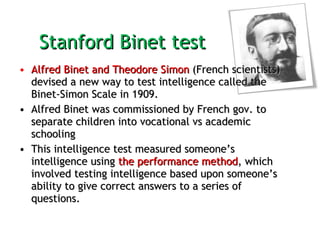
Stanford Binet test  Alfred Binet and Theodore Simon  (French scientists) devised a new way to test intelligence called the Binet-Simon Scale in 1909.  Alfred Binet was commissioned by French gov. to separate children into vocational vs academic schooling  This intelligence test measured someone’s intelligence using  the performance method , which involved testing intelligence based upon someone’s ability to give correct answers to a series of questions.
To help compare intelligence between different types of people, the Binet-Simon Scale used a measure called  mental age.  For example, if on average a group of nine year olds score twenty correct questions, and then a child who is seven years old scores the same amount, then that seven year old child is said to have a mental age of nine.  In general, mental age should rise as a person grows older. So the older they are, the better they will do on the test. Between 2- 23 years of age.
 
Army alpha and Beta tests  Army Alpha/Beta IQ Test (1917) – designed for World War I recruits  Assumed to be testing native intelligence  Alpha for literates;  Beta for  illiterates  and non-English speakers  Alpha subtests:  Oral Directions; Arithmetic; Practical Judgment; Analogies; Disarranged Sentences; Number Series; Information  Beta subtests:  Memory; Matching; Picture Completion; Geometric Construction
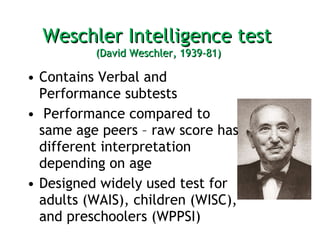
Weschler Intelligence test  (David Weschler, 1939-81)  Contains Verbal and Performance subtests Performance compared to same age peers – raw score has different interpretation depending on age  Designed widely used test for adults (WAIS), children (WISC), and preschoolers (WPPSI)
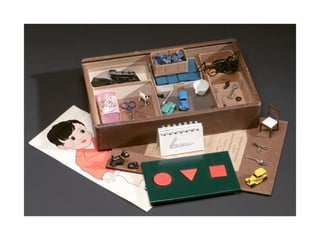
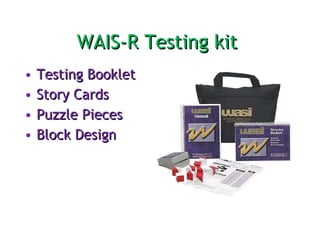
WAIS-R Testing kit  Testing Booklet  Story Cards  Puzzle Pieces  Block Design
Verbal tests: Information Comprehension Arithmetic Similarities Digit span  Vocabulary  Letter number Sequencing.  Performance scale: Digit symbol  Picture completion Block design  Picture arrangement Matrix reasoning Object assembly Symbol search
Verbal Intelligence test  Information  : A persons level of general knowledge  Comprehension :  How well you can understand questions and grasp concepts. Arithmetic :  A persons mathematical abilities.  Similarities :  Measures abstract thought.  Digit Span :  Measures attention span.  Vocabulary :  How many word meanings you know.
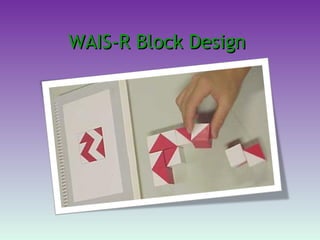
Performance Intelligence Test  Digit Symbol :  Mental flexibility with random symbols.  Picture Completion :  Ability to notice differences between two similar pictures.  Block Design :  Mentally construct printed designs in your head.  Picture Arrangement :  Arrange pictures in a logical order.  Object Assembly :  Place the correct part in relationship to a whole.
WAIS-R Block Design
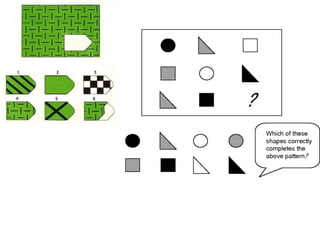
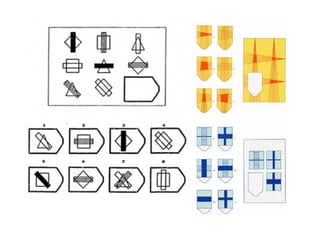
Ravens progressive matrices  The test consists of 50 designs each of which has a cut out segment . The subject is shown the 6-8 cut out alternative pieces and is asked to indicate what to be put in the matrix.  There is children Progressive Matrices, standard progressive matrices, advanced matrices.
 
 
Uses of the intelligence tests Predicts to some extent how well we will do in life  Many occupations are available only to persons with college or graduate degrees. It takes less time to train persons with higher intelligence to a high level of job knowledge and skill.  Persons with higher intelligence tend to perform better in complex jobs.
Guidance , counseling  Help to place vocationally.  Select right person for promotion.  Job selection, diagnosis of mental states and treatment.  Helps to measure intellectual functions of memory , problem solving and verbal fluency.  Diagnose the differences between two individuals on basis of their intellectual differences and leading to the development of the knowledge about the individual differences.
Personality tests  A personality test aims to describe aspects of a  person's character  that remain stable throughout that person's lifetime, the individual's character pattern of behavior, thoughts, and feelings.
Personality tests  Minnesota Multiphasic Personality Inventory (MMPI]  Rorschach Inkblot Test  Thematic Apperception Test , or TAT  16PF Questionnaire  Performance testing
Minnesota Multiphasic Personality Inventory  The  most widely researched and clinically used  of all personality tests  Developed to  identify emotional disorders This is one of  the most frequently used  personality tests in mental health.  The test is used by trained professionals to assist in identifying personality structure and psychopathology.
The original authors of the MMPI were  Starke R. Hathaway, PhD, and J. C. McKinley, MD.  The MMPI  is copyrighted  by the University of Minnesota.  The standardized answer sheets can be hand scored with templates that fit over the answer sheets, but most tests are computer scored.  It is appropriate for use with  adults 18 and over .  The current MMPI-2 has  567 items , all true-or-false format, and usually  takes between 1 and 2 hours  to complete depending on reading level.
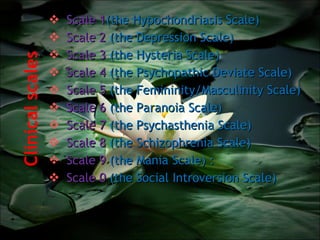
Clinical scales  Scale 1 (the Hypochondriasis Scale)  Scale 2  (the Depression Scale)  Scale 3  (the Hysteria Scale)  Scale 4  (the Psychopathic Deviate Scale)  Scale 5  (the Femininity/Masculinity Scale)  Scale 6  (the Paranoia Scale)  Scale 7  (the Psychasthenia Scale)  Scale 8  (the Schizophrenia Scale)  Scale 9  (the Mania Scale) :  Scale 0  (the Social Introversion Scale)
MMPI: examples “ Nothing in the newspaper interests me except the comics.”  “ I get angry sometimes.”
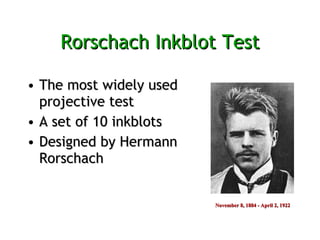
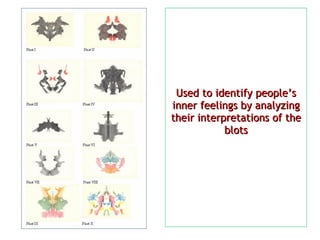
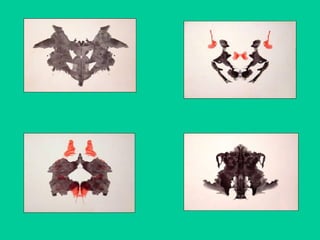
Rorschach Inkblot Test The most widely used projective test  A set of 10 inkblots  Designed by Hermann Rorschach November 8, 1884 - April 2, 1922
Used to identify people’s inner feelings by analyzing their interpretations of the blots
 
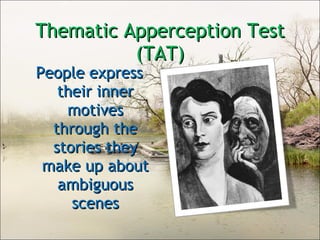
Thematic Apperception Test (TAT) People express their inner motives through the stories they make up about ambiguous scenes
The Thematic Apperception Test, or TAT, is a  projective psychological test .  Historically, it has been among the  most widely researched, taught, and used  of such tests.  Its adherents assert that the TAT taps a subject's unconscious to reveal  repressed aspects of personality , motives and needs for achievement, power and intimacy, and problem-solving abilities.
The TAT is popularly known as the  picture interpretation technique  because it uses a standard series of provocative yet ambiguous pictures about which the subject is asked to tell a story .  The subject is asked to tell as dramatic a story as they can for each picture presented, including the following:  what has led up to the event shown  what is happening at the moment  what the characters are feeling and thinking what the outcome of the story was
There are  31 picture cards  in the standard form of the TAT. Some of the cards show  male  figures, some  female , some  both male and female  figures, some of  ambiguous  gender, some  adults , some  children , and some show  no human  figures at all.  One card is completely  blank .
The TAT is a projective test in which the scoring is based on what the subject projects onto the ambiguous images.  Therefore, to complete the assessment, each narrative created by a subject must be  carefully recorded and analyzed  to uncover underlying needs, attitudes, and patterns of reaction.
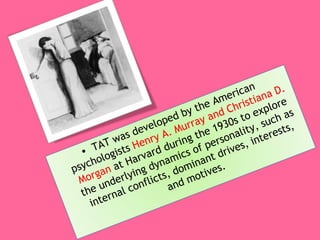
TAT was developed by the American psychologists  Henry A. Murray and Christiana D. Morgan  at Harvard during the 1930s to explore the underlying dynamics of personality, such as internal conflicts, dominant drives, interests, and motives.
Uses   Individual assessments for  employment in fields  requiring a high degree such as law enforcement, military leadership positions.  For  diagnosis  in order to match psychotherapy best suited to patients personalities.  Forensic purposes  in evaluating the motivations and general attitudes of persons accused of violent crimes.  Research into  specific aspects of human personality , most often needs for achievement, fears of failure, hostility.
The Sixteen Personality Factor Questionnaire  (or 16PF ) is a  multiple-choice personality questionnaire  which was developed over several decades of research by  Raymond B. Cattell  and his colleagues.  16 primary traits, personality i.e. Big Five are present showing structure of personality to be multi-level and hierarchical
Performance testing  Performance Testing covers a broad range of  engineering or functional evaluations .  Testing can be a qualitative or quantitative procedure.  Performance testing can refer to the assessment of the performance of a human examinee.
Advantages Easy  Economical  Higher interrater reliability Less response bias Disadvantages Rely on clients which could lead to a response bias.  Tells little about unconscious process.  Limited to high functioning individuals Interpretation not objective.  Interpretation not consistent.  Lack of standard scoring.
Neuropsychological Assessment  Assessment of the neurological deficit predicts the possible  organic psychopathology Identification of intact neurological functioning help in the process of  neuro-rehabilitation  (Cognitive retraining) Evaluation and comparison of various treatment  options and its perceived efficacy Progressive evaluation and  formulation of differential diagnosis Among children,- Developmental progression of the milestones Tackling the  mental developmental delay,  and taking necessary actions on time
Common areas of assessment include; Attention,  perception,  intelligence,  judgment,  concentration,  memory,  learning, & Thought process
Test of attention & concentration The capacity to arouse & sustain attention varies with individual time  Most of the Ψ illness attention become poor and fluctuate Common tests include; Eysenck’s Digit Test Of Concentration Color Cancellation Tasks Digit Symbol Subtraction Letter Cancellation Knox Cube Imitation Test
Test for mental alertness & retention Assessing the degree of psychomotor retardation- Eg; Differentiating Mild to Severe D’ Common tests include; Minnesota block reversal test Check for  reaction time, Response time, & Productivity/Unit time
Test for memory Many of the neuropsychiatric illness present with the complaints of memory loss or forgetfulness Common verbal tests include; Wechsler Memory scale:  It is the commonly used memory test battery for adults. It is a composite of verbal paired associate, paragraph retention, visual memory for design, orientation, digit span, reverse recall of the alphabet & counting backward. This test is appropriate for the age group of 16-74. Continues….
PGI Memory scale,  has been standardized for Indian population Verbal memory is assessed through the presentation of stimuli such as these that must then be recalled: Words, Digits, Nonsense syllables & Sentences. Performance tests on Memory assessment are; Benton Test of Visual Retention-Revised.  Memory for Designs Test.
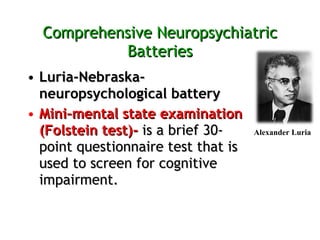
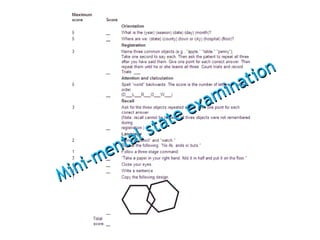
Comprehensive Neuropsychiatric Batteries Luria-Nebraska-neuropsychological battery Mini–mental state examination (Folstein test)-   is a brief 30-point questionnaire test that is used to screen for cognitive impairment. Alexander Luria
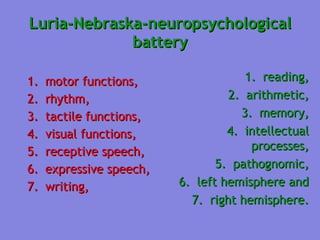
Luria-Nebraska-neuropsychological battery motor functions, rhythm, tactile functions, visual functions, receptive speech, expressive speech, writing, reading, arithmetic, memory, intellectual processes, pathognomic, left hemisphere and right hemisphere.
Mini–mental state examination
Thank You

Psychometric Assessment

  • 1.
    Psychometric assessment Bivin.JB Dept. of Psychiatric Nursing
  • 2.
    What is apsychological test? A psychological test is a structured technique to generate carefully selected sample of behavior. . It is used to derive inference about someone's behavior on basis of results of the tests. We can judge the level of attributes like intelligence , self-esteem , aptitude in an individual.
  • 3.
    Psychological tests areas: cognitive functioning: Intelligence, Aptitude, & Achievement Personality : Objective, Projective Neuropsychological
  • 4.
    Characteristics of agood test Validity. Reliability. Practicability. Usability. Uniform as different testers will follow same test steps anywhere. Biases due to personal reasons is reduced. Norms are set to work with.
  • 5.
    Types of testsDepending upon time limit: Speed test and power test. e.g. Kaufman Assessment battery for children ( intelligence test to find fast learners) Depending upon number of individuals: Group test and Individual test Depending upon language: Verbal and Non- verbal test. Depending upon method: Paper -pencil and performance test . Depending upon what is measured: Intelligence tests, Aptitude tests, Achievement tests, Personality tests.
  • 6.
    Intelligence tests Theseinclude: Stanford – Binet test. Ravens Progressive Matrices. Group tests of Army Alpha and Beta types. Weschler intelligence test. Bhatia's Battery of performance test of intelligence.
  • 7.
    Stanford Binet test Alfred Binet and Theodore Simon (French scientists) devised a new way to test intelligence called the Binet-Simon Scale in 1909. Alfred Binet was commissioned by French gov. to separate children into vocational vs academic schooling This intelligence test measured someone’s intelligence using the performance method , which involved testing intelligence based upon someone’s ability to give correct answers to a series of questions.
  • 8.
    To help compareintelligence between different types of people, the Binet-Simon Scale used a measure called mental age. For example, if on average a group of nine year olds score twenty correct questions, and then a child who is seven years old scores the same amount, then that seven year old child is said to have a mental age of nine. In general, mental age should rise as a person grows older. So the older they are, the better they will do on the test. Between 2- 23 years of age.
  • 9.
  • 10.
    Army alpha andBeta tests Army Alpha/Beta IQ Test (1917) – designed for World War I recruits Assumed to be testing native intelligence Alpha for literates; Beta for illiterates and non-English speakers Alpha subtests: Oral Directions; Arithmetic; Practical Judgment; Analogies; Disarranged Sentences; Number Series; Information Beta subtests: Memory; Matching; Picture Completion; Geometric Construction
  • 11.
    Weschler Intelligence test (David Weschler, 1939-81) Contains Verbal and Performance subtests Performance compared to same age peers – raw score has different interpretation depending on age Designed widely used test for adults (WAIS), children (WISC), and preschoolers (WPPSI)
  • 12.
    WAIS-R Testing kit Testing Booklet Story Cards Puzzle Pieces Block Design
  • 13.
    Verbal tests: InformationComprehension Arithmetic Similarities Digit span Vocabulary Letter number Sequencing. Performance scale: Digit symbol Picture completion Block design Picture arrangement Matrix reasoning Object assembly Symbol search
  • 14.
    Verbal Intelligence test Information : A persons level of general knowledge Comprehension : How well you can understand questions and grasp concepts. Arithmetic : A persons mathematical abilities. Similarities : Measures abstract thought. Digit Span : Measures attention span. Vocabulary : How many word meanings you know.
  • 15.
    Performance Intelligence Test Digit Symbol : Mental flexibility with random symbols. Picture Completion : Ability to notice differences between two similar pictures. Block Design : Mentally construct printed designs in your head. Picture Arrangement : Arrange pictures in a logical order. Object Assembly : Place the correct part in relationship to a whole.
  • 16.
  • 17.
    Ravens progressive matrices The test consists of 50 designs each of which has a cut out segment . The subject is shown the 6-8 cut out alternative pieces and is asked to indicate what to be put in the matrix. There is children Progressive Matrices, standard progressive matrices, advanced matrices.
  • 18.
  • 19.
  • 20.
    Uses of theintelligence tests Predicts to some extent how well we will do in life Many occupations are available only to persons with college or graduate degrees. It takes less time to train persons with higher intelligence to a high level of job knowledge and skill. Persons with higher intelligence tend to perform better in complex jobs.
  • 21.
    Guidance , counseling Help to place vocationally. Select right person for promotion. Job selection, diagnosis of mental states and treatment. Helps to measure intellectual functions of memory , problem solving and verbal fluency. Diagnose the differences between two individuals on basis of their intellectual differences and leading to the development of the knowledge about the individual differences.
  • 22.
    Personality tests A personality test aims to describe aspects of a person's character that remain stable throughout that person's lifetime, the individual's character pattern of behavior, thoughts, and feelings.
  • 23.
    Personality tests Minnesota Multiphasic Personality Inventory (MMPI] Rorschach Inkblot Test Thematic Apperception Test , or TAT 16PF Questionnaire Performance testing
  • 24.
    Minnesota Multiphasic PersonalityInventory The most widely researched and clinically used of all personality tests Developed to identify emotional disorders This is one of the most frequently used personality tests in mental health. The test is used by trained professionals to assist in identifying personality structure and psychopathology.
  • 25.
    The original authorsof the MMPI were Starke R. Hathaway, PhD, and J. C. McKinley, MD. The MMPI is copyrighted by the University of Minnesota. The standardized answer sheets can be hand scored with templates that fit over the answer sheets, but most tests are computer scored. It is appropriate for use with adults 18 and over . The current MMPI-2 has 567 items , all true-or-false format, and usually takes between 1 and 2 hours to complete depending on reading level.
  • 26.
    Clinical scales Scale 1 (the Hypochondriasis Scale) Scale 2 (the Depression Scale) Scale 3 (the Hysteria Scale) Scale 4 (the Psychopathic Deviate Scale) Scale 5 (the Femininity/Masculinity Scale) Scale 6 (the Paranoia Scale) Scale 7 (the Psychasthenia Scale) Scale 8 (the Schizophrenia Scale) Scale 9 (the Mania Scale) : Scale 0 (the Social Introversion Scale)
  • 27.
    MMPI: examples “Nothing in the newspaper interests me except the comics.” “ I get angry sometimes.”
  • 28.
    Rorschach Inkblot TestThe most widely used projective test A set of 10 inkblots Designed by Hermann Rorschach November 8, 1884 - April 2, 1922
  • 29.
    Used to identifypeople’s inner feelings by analyzing their interpretations of the blots
  • 30.
  • 31.
    Thematic Apperception Test(TAT) People express their inner motives through the stories they make up about ambiguous scenes
  • 32.
    The Thematic ApperceptionTest, or TAT, is a projective psychological test . Historically, it has been among the most widely researched, taught, and used of such tests. Its adherents assert that the TAT taps a subject's unconscious to reveal repressed aspects of personality , motives and needs for achievement, power and intimacy, and problem-solving abilities.
  • 33.
    The TAT ispopularly known as the picture interpretation technique because it uses a standard series of provocative yet ambiguous pictures about which the subject is asked to tell a story . The subject is asked to tell as dramatic a story as they can for each picture presented, including the following: what has led up to the event shown what is happening at the moment what the characters are feeling and thinking what the outcome of the story was
  • 34.
    There are 31 picture cards in the standard form of the TAT. Some of the cards show male figures, some female , some both male and female figures, some of ambiguous gender, some adults , some children , and some show no human figures at all. One card is completely blank .
  • 35.
    The TAT isa projective test in which the scoring is based on what the subject projects onto the ambiguous images. Therefore, to complete the assessment, each narrative created by a subject must be carefully recorded and analyzed to uncover underlying needs, attitudes, and patterns of reaction.
  • 36.
    TAT was developedby the American psychologists Henry A. Murray and Christiana D. Morgan at Harvard during the 1930s to explore the underlying dynamics of personality, such as internal conflicts, dominant drives, interests, and motives.
  • 37.
    Uses Individual assessments for employment in fields requiring a high degree such as law enforcement, military leadership positions. For diagnosis in order to match psychotherapy best suited to patients personalities. Forensic purposes in evaluating the motivations and general attitudes of persons accused of violent crimes. Research into specific aspects of human personality , most often needs for achievement, fears of failure, hostility.
  • 38.
    The Sixteen PersonalityFactor Questionnaire (or 16PF ) is a multiple-choice personality questionnaire which was developed over several decades of research by Raymond B. Cattell and his colleagues. 16 primary traits, personality i.e. Big Five are present showing structure of personality to be multi-level and hierarchical
  • 39.
    Performance testing Performance Testing covers a broad range of engineering or functional evaluations . Testing can be a qualitative or quantitative procedure. Performance testing can refer to the assessment of the performance of a human examinee.
  • 40.
    Advantages Easy Economical Higher interrater reliability Less response bias Disadvantages Rely on clients which could lead to a response bias. Tells little about unconscious process. Limited to high functioning individuals Interpretation not objective. Interpretation not consistent. Lack of standard scoring.
  • 41.
    Neuropsychological Assessment Assessment of the neurological deficit predicts the possible organic psychopathology Identification of intact neurological functioning help in the process of neuro-rehabilitation (Cognitive retraining) Evaluation and comparison of various treatment options and its perceived efficacy Progressive evaluation and formulation of differential diagnosis Among children,- Developmental progression of the milestones Tackling the mental developmental delay, and taking necessary actions on time
  • 42.
    Common areas ofassessment include; Attention, perception, intelligence, judgment, concentration, memory, learning, & Thought process
  • 43.
    Test of attention& concentration The capacity to arouse & sustain attention varies with individual time Most of the Ψ illness attention become poor and fluctuate Common tests include; Eysenck’s Digit Test Of Concentration Color Cancellation Tasks Digit Symbol Subtraction Letter Cancellation Knox Cube Imitation Test
  • 44.
    Test for mentalalertness & retention Assessing the degree of psychomotor retardation- Eg; Differentiating Mild to Severe D’ Common tests include; Minnesota block reversal test Check for reaction time, Response time, & Productivity/Unit time
  • 45.
    Test for memoryMany of the neuropsychiatric illness present with the complaints of memory loss or forgetfulness Common verbal tests include; Wechsler Memory scale: It is the commonly used memory test battery for adults. It is a composite of verbal paired associate, paragraph retention, visual memory for design, orientation, digit span, reverse recall of the alphabet & counting backward. This test is appropriate for the age group of 16-74. Continues….
  • 46.
    PGI Memory scale, has been standardized for Indian population Verbal memory is assessed through the presentation of stimuli such as these that must then be recalled: Words, Digits, Nonsense syllables & Sentences. Performance tests on Memory assessment are; Benton Test of Visual Retention-Revised. Memory for Designs Test.
  • 47.
    Comprehensive Neuropsychiatric BatteriesLuria-Nebraska-neuropsychological battery Mini–mental state examination (Folstein test)- is a brief 30-point questionnaire test that is used to screen for cognitive impairment. Alexander Luria
  • 48.
    Luria-Nebraska-neuropsychological battery motorfunctions, rhythm, tactile functions, visual functions, receptive speech, expressive speech, writing, reading, arithmetic, memory, intellectual processes, pathognomic, left hemisphere and right hemisphere.
  • 49.
  • 50.