Remya Menon
What are Psychometric Tests?
Psycho = Mind
Metric = To Measure
any standardized procedure for measuring sensitivity or
memory or intelligence or aptitude or personality etc….
Source : www.thefreedictionary.com
Psychometrics
 Field of study about technique of measuring and mapping the
psychological makeup of a human being.
 Includes the measurement of knowledge, abilities, attitudes, and
personality traits.
 Aims to provide employers with a reliable method of selecting the
most suitable job applicants or devising career progression.
Psychometric Tests
1 There is no “pass-or-fail” in Psychometric Test
2 It’s about “job-fit”
3 There is a job for everyone, HR’s task is to find the right candidate to fit
in the role/job
4 Psychometric Test are based on the assumption “Past behaviour is the
best predictor of future behaviour”
What do psychometric tests measure?
How well you work with other people
How well you handle stress
Whether you will be able to cope with the intellectual demands of the job
Your personality, preferences and abilities
Most do not analyze your emotional or psychological stability
Best match of individual to occupation and working environment
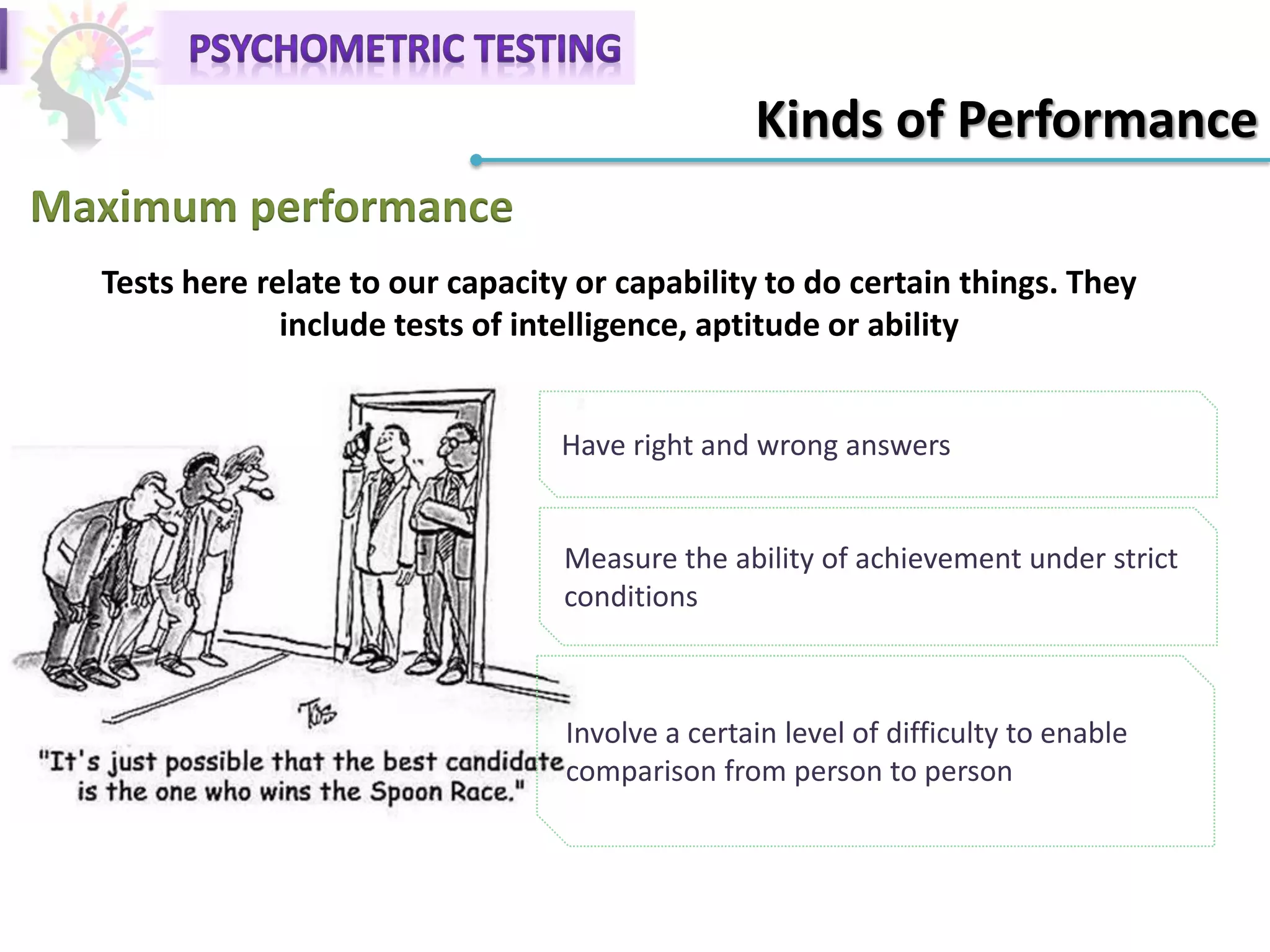
Kinds of Performance
Maximum performance
Have right and wrong answers
Tests here relate to our capacity or capability to do certain things. They
include tests of intelligence, aptitude or ability
Measure the ability of achievement under strict
conditions
Involve a certain level of difficulty to enable
comparison from person to person
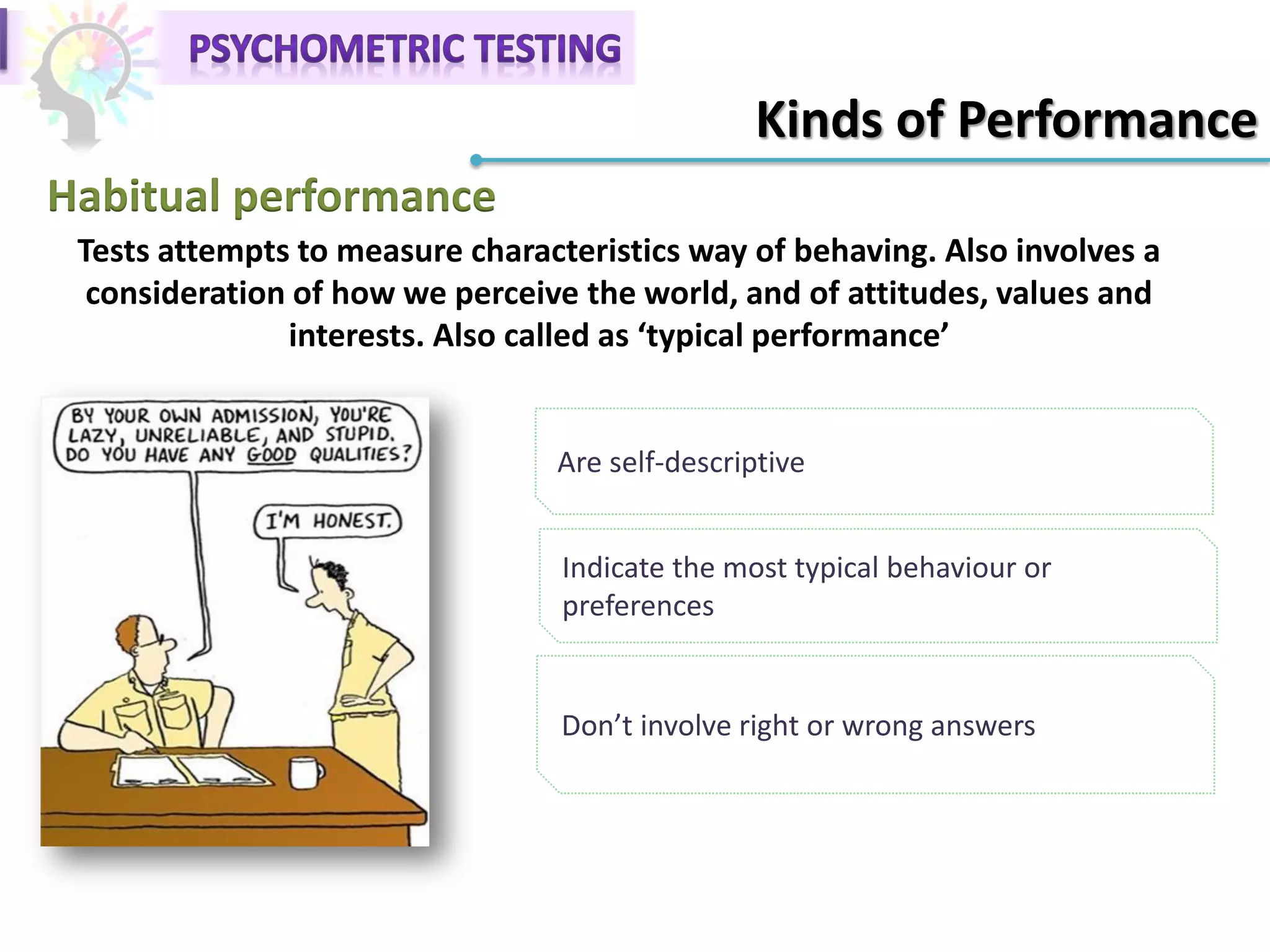
Habitual performance
Are self-descriptive
Tests attempts to measure characteristics way of behaving. Also involves a
consideration of how we perceive the world, and of attitudes, values and
interests. Also called as ‘typical performance’
Indicate the most typical behaviour or
preferences
Don’t involve right or wrong answers
Kinds of Performance
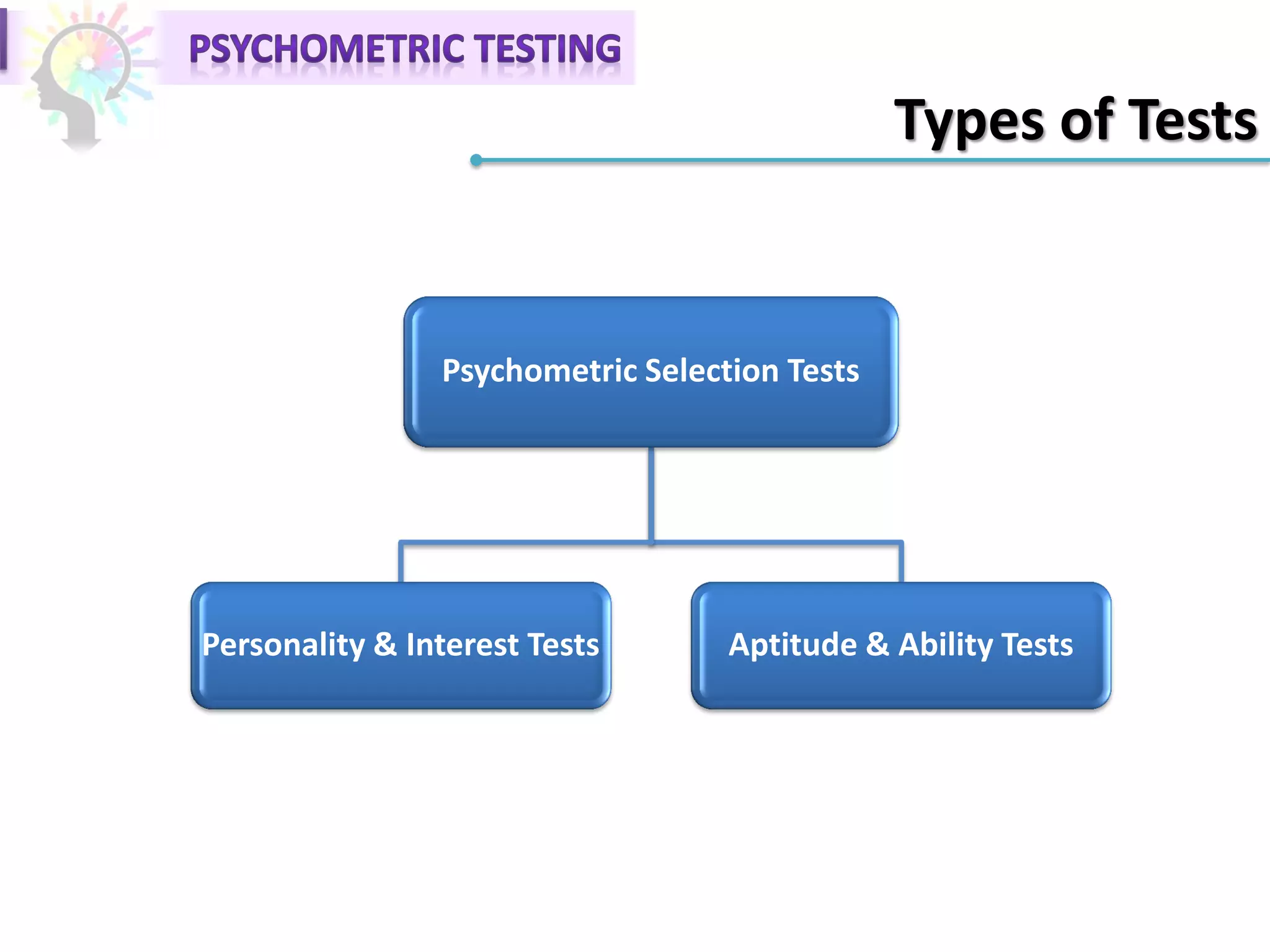
Types of Tests
Psychometric Selection Tests
Personality & Interest Tests Aptitude & Ability Tests
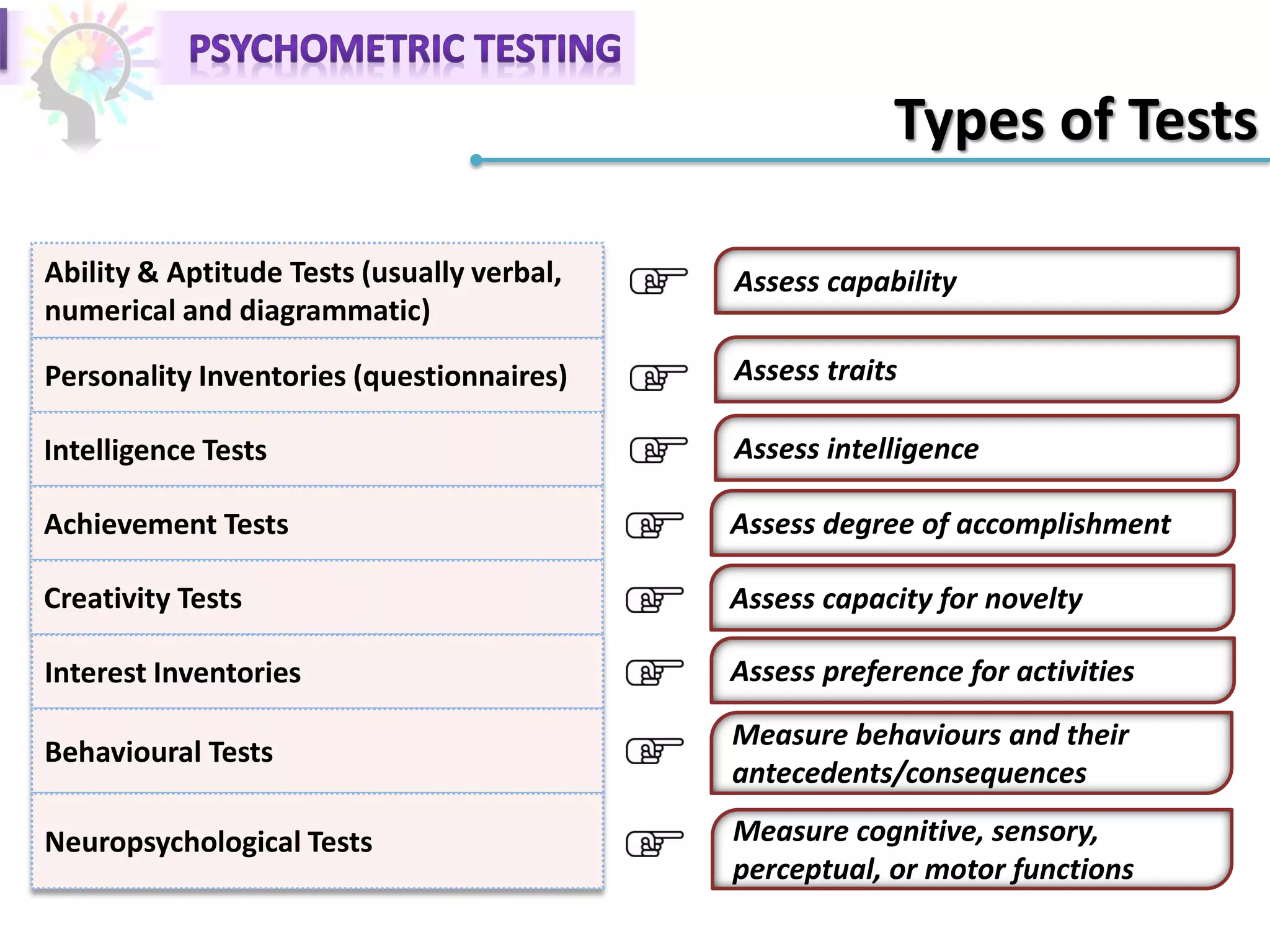
Ability & Aptitude Tests (usually verbal,
numerical and diagrammatic)
Personality Inventories (questionnaires)
Types of Tests
Intelligence Tests
Achievement Tests
Creativity Tests
Interest Inventories
Behavioural Tests
Neuropsychological Tests
Assess capability
Assess traits
Assess intelligence
Assess degree of accomplishment
Assess capacity for novelty
Assess preference for activities
Measure behaviours and their
antecedents/consequences
Measure cognitive, sensory,
perceptual, or motor functions
Why do Employers use them?
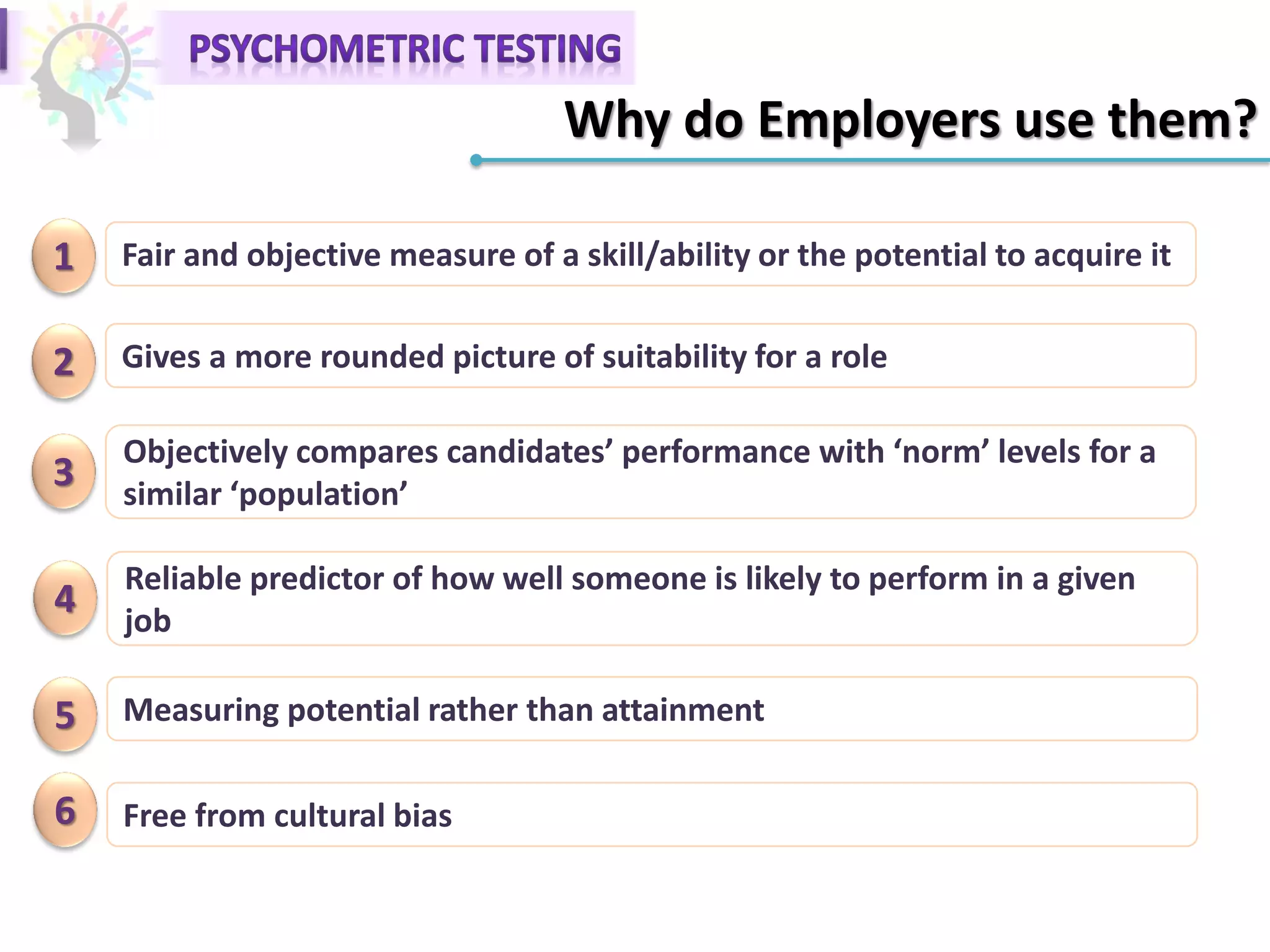
1 Fair and objective measure of a skill/ability or the potential to acquire it
2 Gives a more rounded picture of suitability for a role
3
Objectively compares candidates’ performance with ‘norm’ levels for a
similar ‘population’
4
Reliable predictor of how well someone is likely to perform in a given
job
5 Measuring potential rather than attainment
6 Free from cultural bias
Integrated Selection Strategy
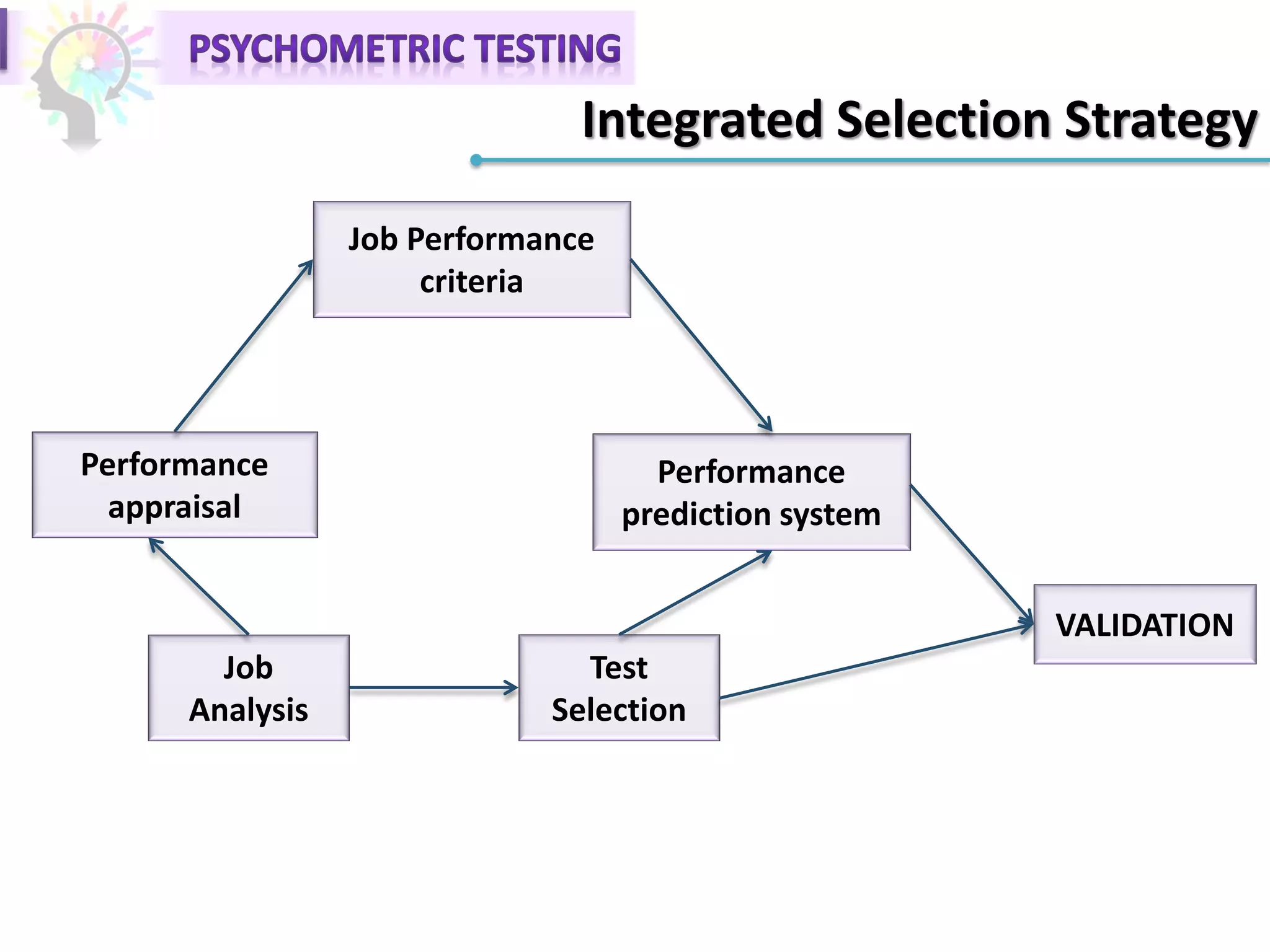
Job Performance
criteria
Performance
prediction system
Test
Selection
Job
Analysis
Performance
appraisal
VALIDATION
Personality tests
Tests that use projective techniques and trait inventories to measure
basic aspects of an applicant’s personality, such as introversion, stability,
and motivation.
Disadvantage
• Personality tests—particularly the projective type—are the most
difficult tests to evaluate and use.
Advantage
• Tests have been used successfully to predict dysfunctional job
behaviors and identify successful candidates for overseas
assignments.
Measuring Personality and Interests
Types of Personality Tests
16 PF
MBTI
Big Five
Thomas Personal Profiling System
FIRO-B
The “Big Five”
Extraversion
The tendency to be sociable, assertive, active, and to experience positive effects,
such as energy and zeal.
Emotional stability/neuroticism
The tendency to exhibit poor emotional adjustment and experience negative effects,
such as anxiety, insecurity, and hostility.
Openness to experience
The disposition to be imaginative, nonconforming, unconventional, and
autonomous.
Agreeableness
The tendency to be trusting, compliant, caring, and gentle.
Conscientiousness
Is comprised of two related facets: achievement and dependability.
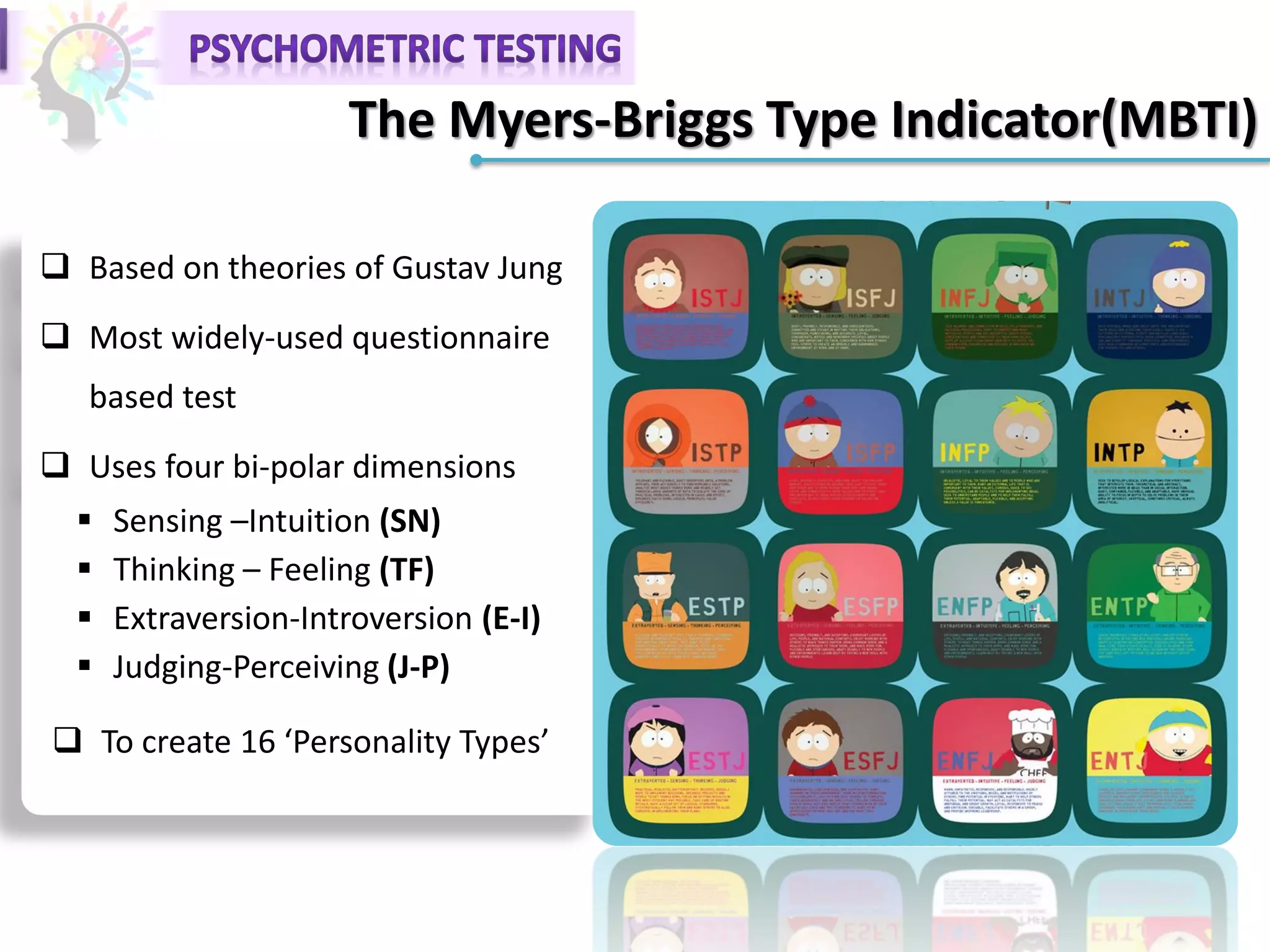
The Myers-Briggs Type Indicator(MBTI)
 Based on theories of Gustav Jung
 Most widely-used questionnaire
based test
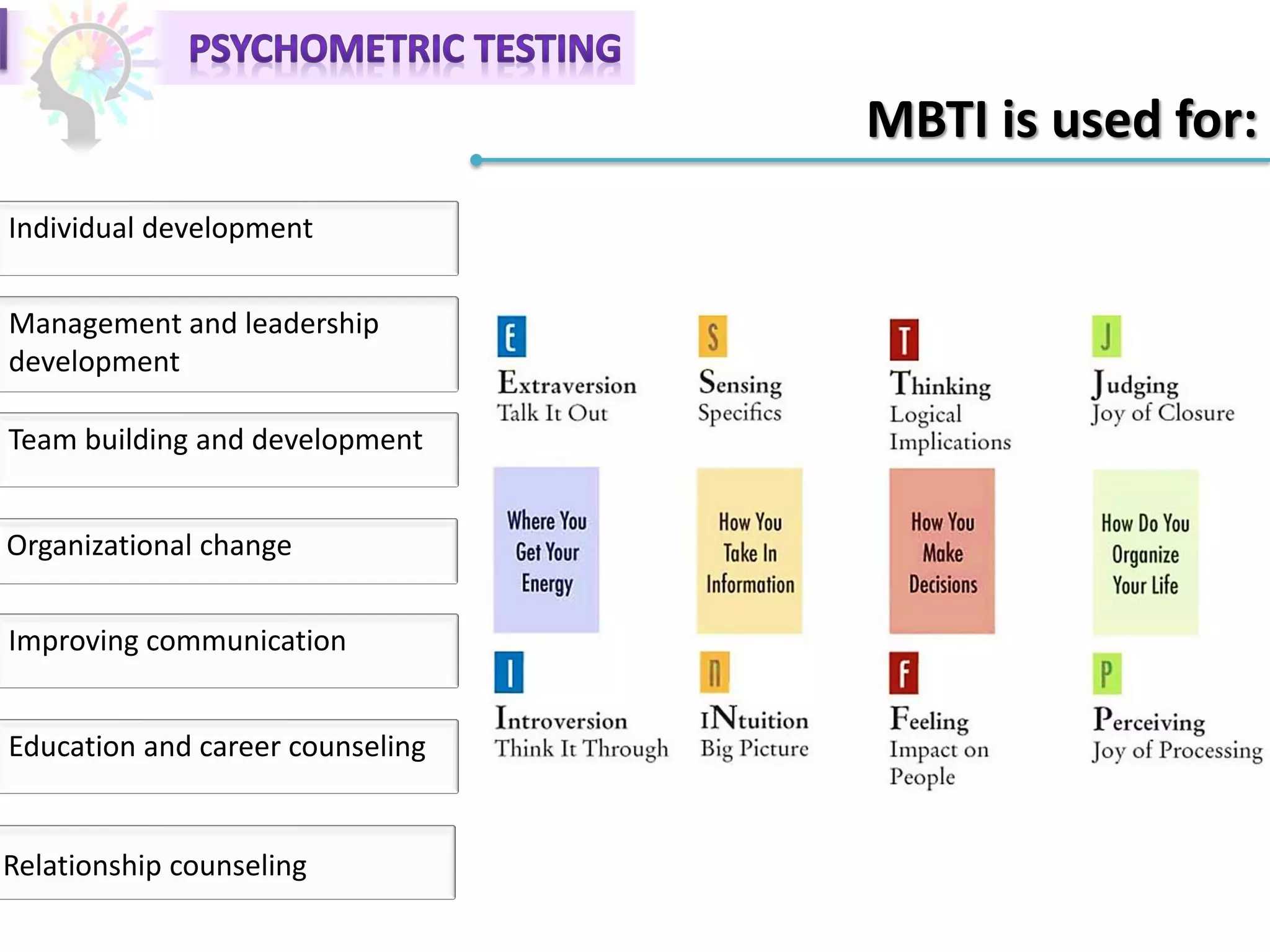
 Uses four bi-polar dimensions
 Sensing –Intuition (SN)
 Thinking – Feeling (TF)
 Extraversion-Introversion (E-I)
 Judging-Perceiving (J-P)
 To create 16 ‘Personality Types’
MBTI is used for:
Individual development
Management and leadership
development
Team building and development
Organizational change
Improving communication
Education and career counseling
Relationship counseling
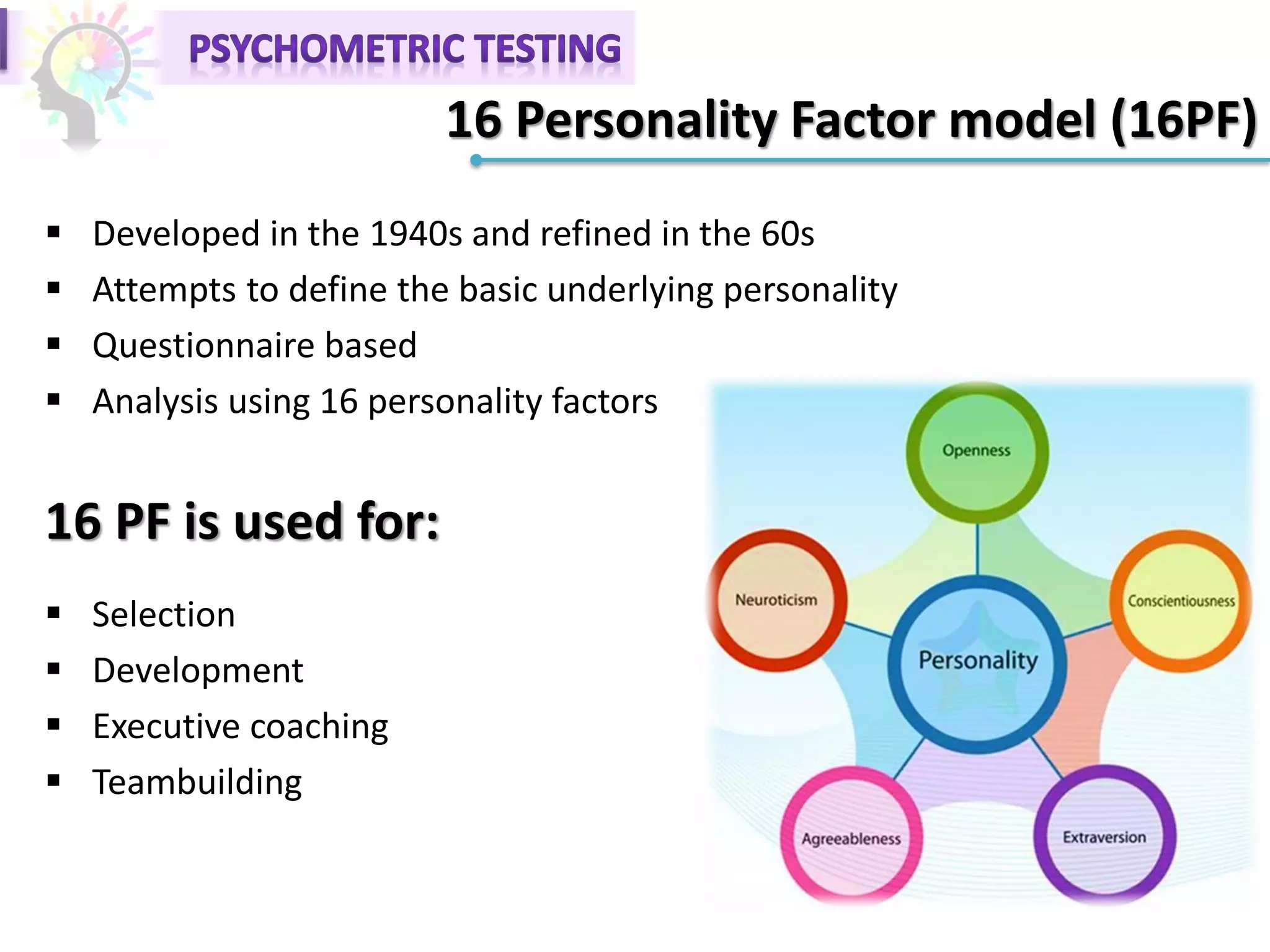
16 Personality Factor model (16PF)
 Developed in the 1940s and refined in the 60s
 Attempts to define the basic underlying personality
 Questionnaire based
 Analysis using 16 personality factors
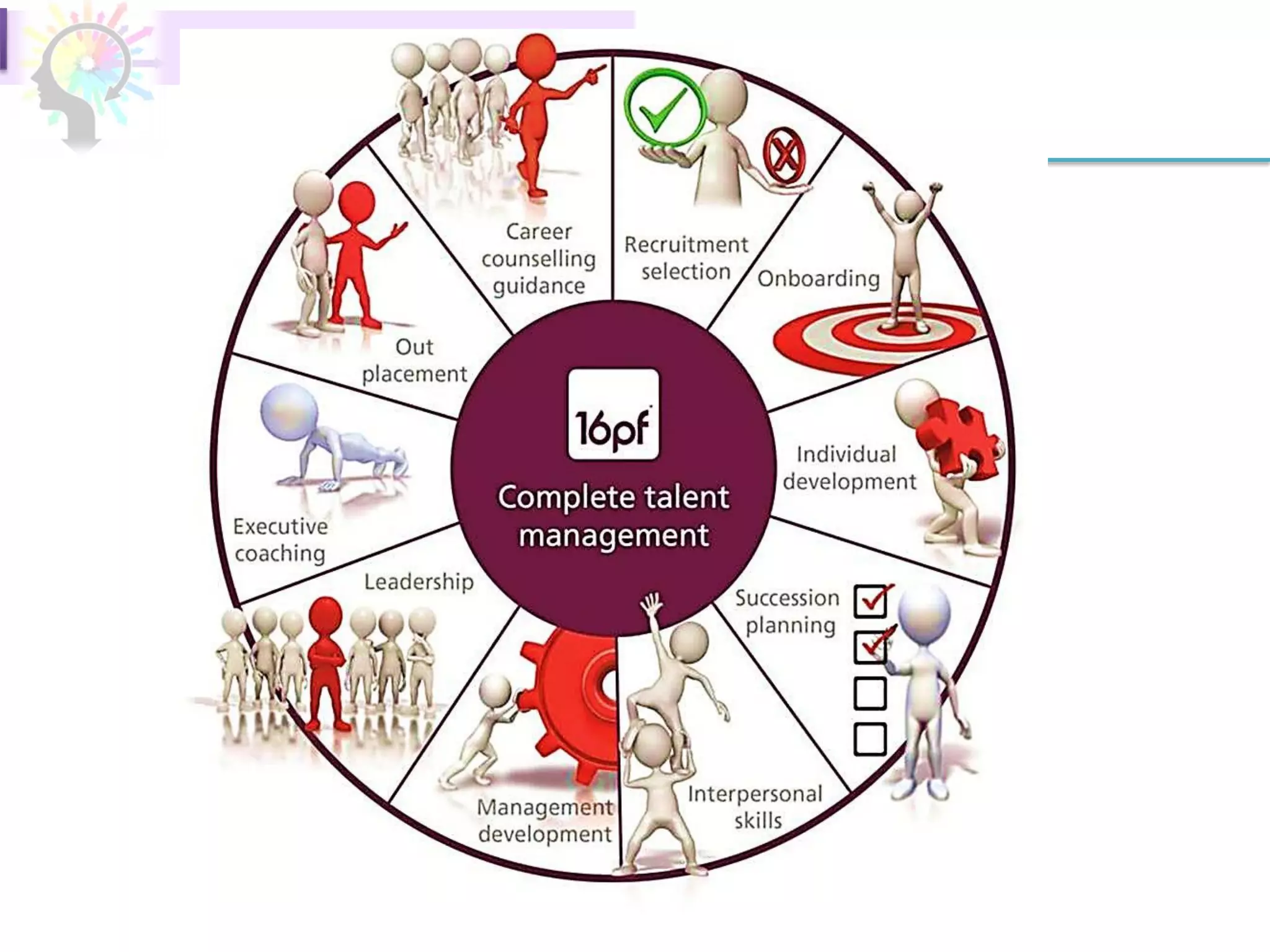
16 PF is used for:
 Selection
 Development
 Executive coaching
 Teambuilding
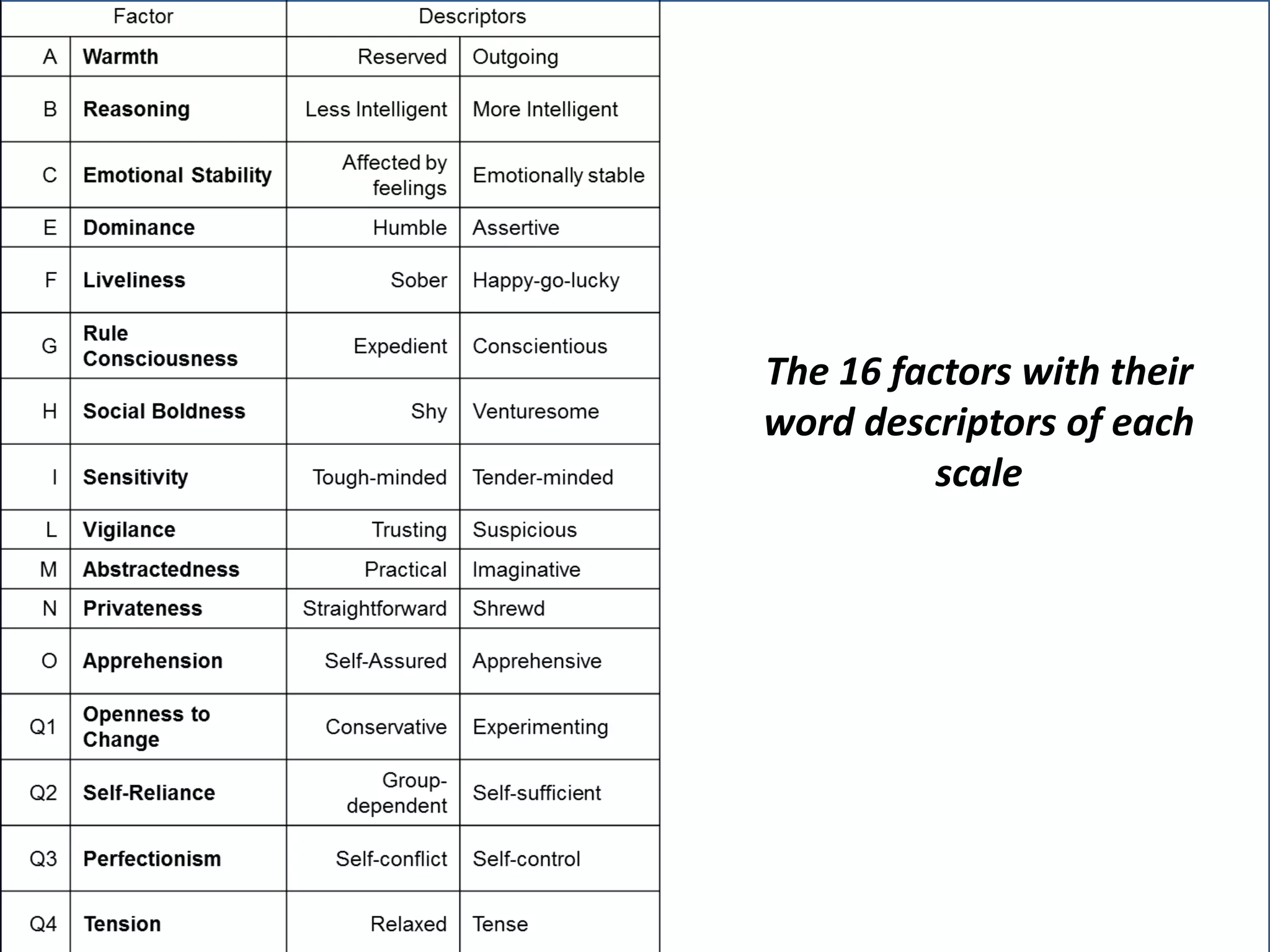
The 16 factors with their
word descriptors of each
scale
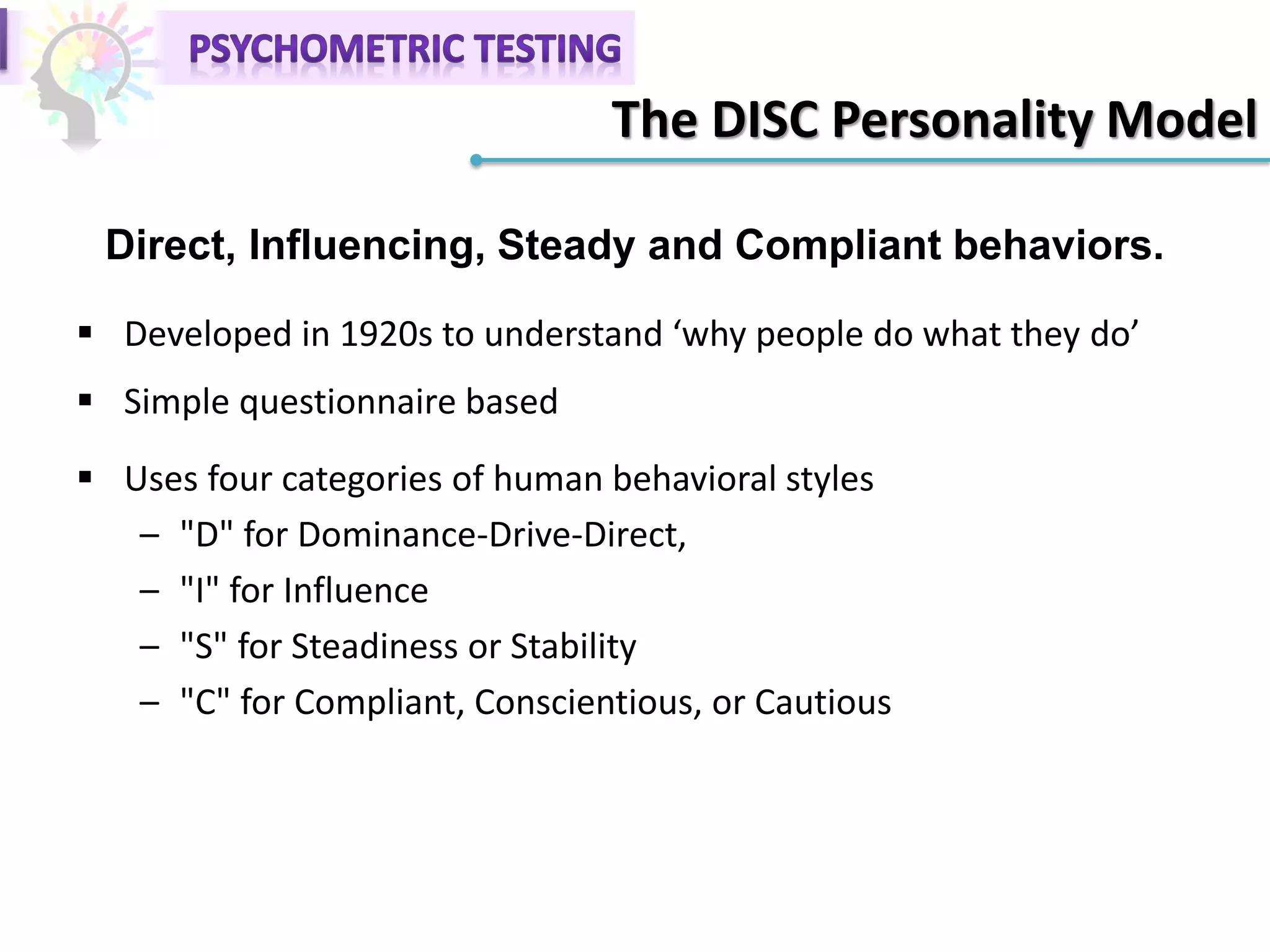
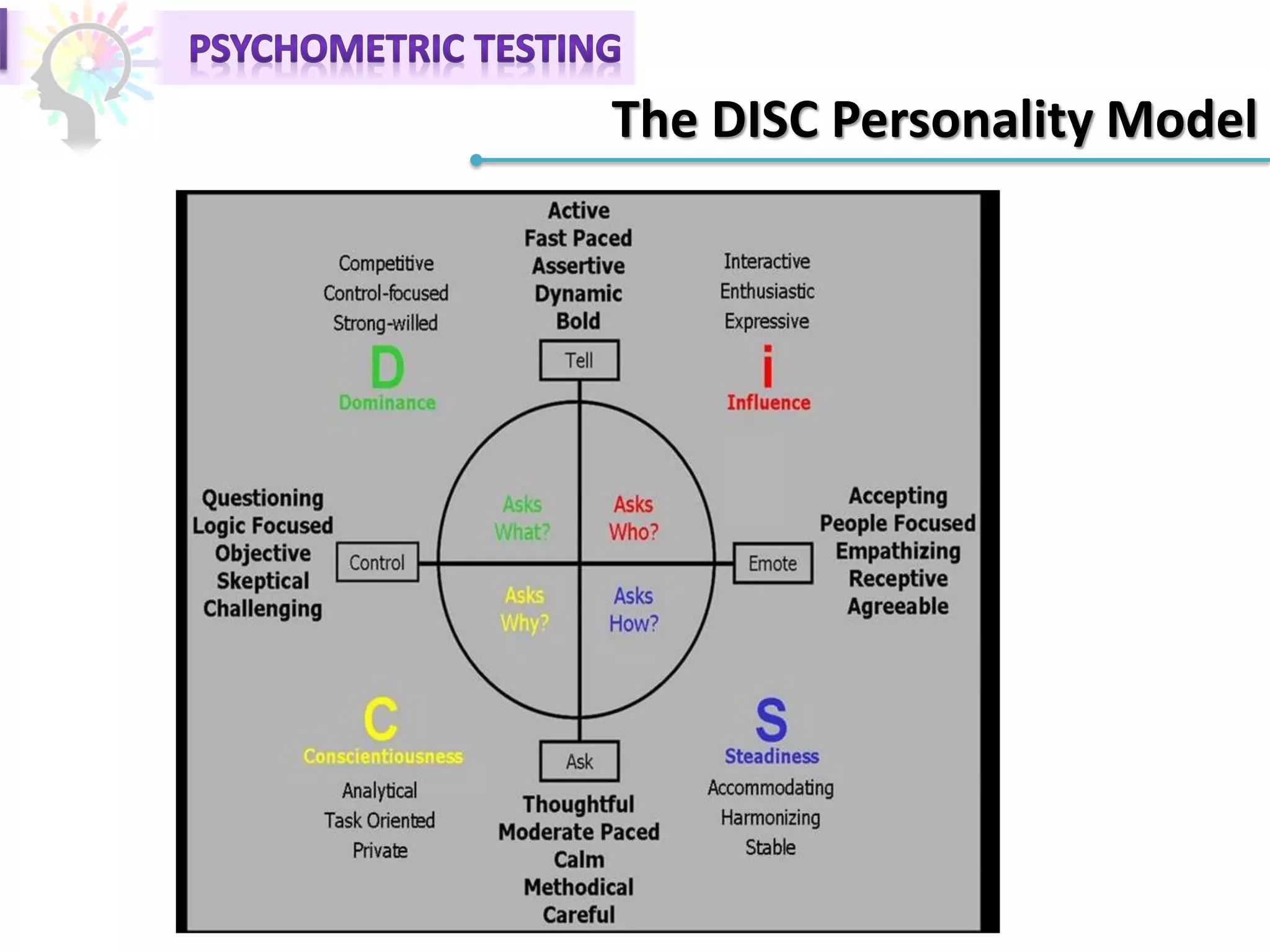
The DISC Personality Model
 Developed in 1920s to understand ‘why people do what they do’
 Simple questionnaire based
 Uses four categories of human behavioral styles
– "D" for Dominance-Drive-Direct,
– "I" for Influence
– "S" for Steadiness or Stability
– "C" for Compliant, Conscientious, or Cautious
Direct, Influencing, Steady and Compliant behaviors.
The DISC Personality Model
DISC is used for:
 As a learning tool
 For career development
 Training, coaching and mentoring
 Organisational development and performance
FIRO-B:
 Devised by American psychologist, Will Schutz, in the 1950's
 Helps people to understand themselves and their
relationships with others
 Based on a 2-hour, 54-question questionnaire
 Describes interpersonal behavior in terms of three primary
dimensions:
1. Need for Inclusion
2. Need for Control
3. Need for Affection
FUNDAMENTAL INTERPERSONAL RELATIONSHIP ORIENTATION-BEHAVIOUR
FIRO-B is used for
 Team building and team development
 Individual development and executive coaching
 Conflict resolution
 Selection and placement
 Management and leadership development
 Relationship counselling
Selecting and Testing Items
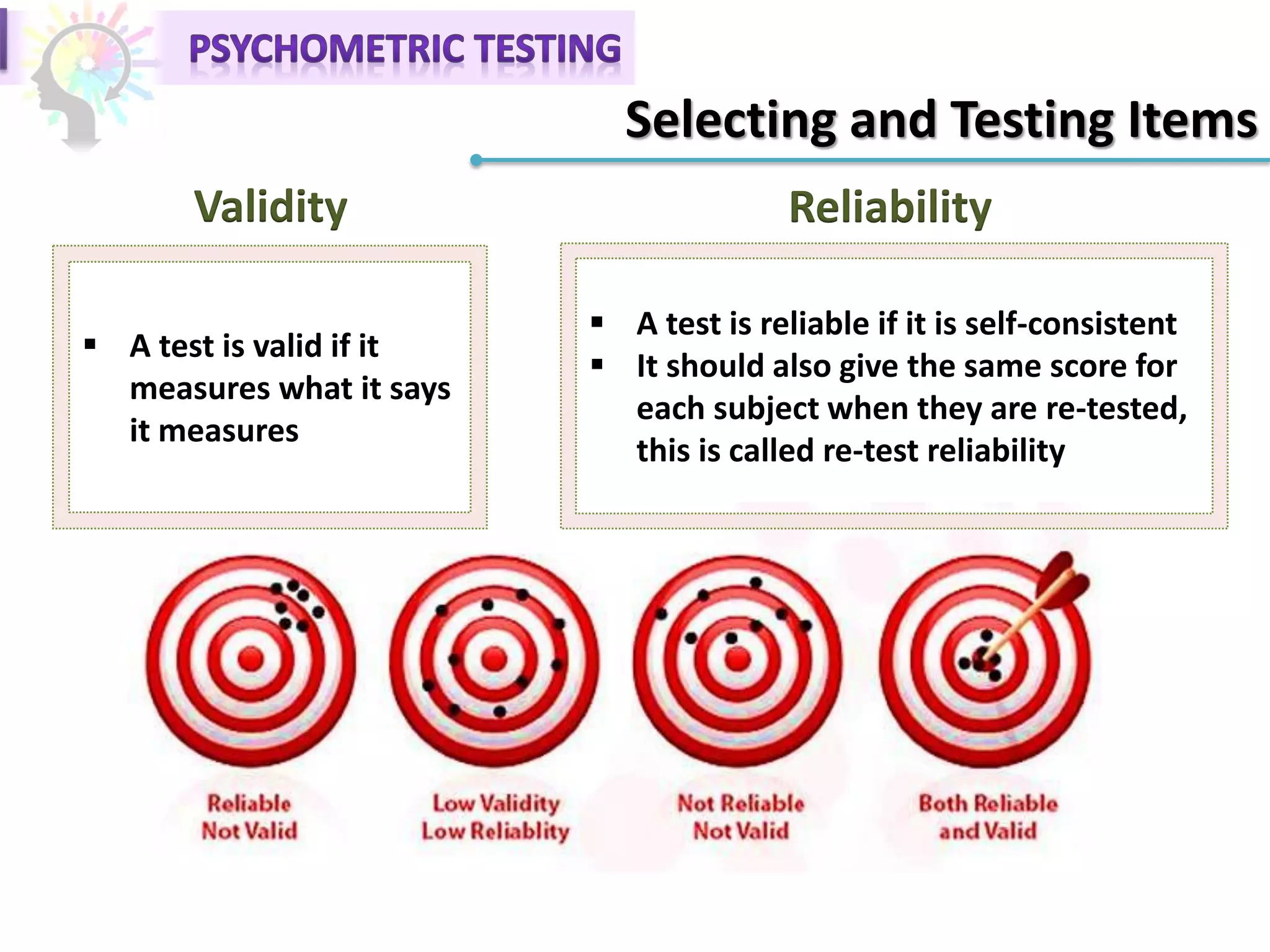
Validity Reliability
 A test is valid if it
measures what it says
it measures
 A test is reliable if it is self-consistent
 It should also give the same score for
each subject when they are re-tested,
this is called re-test reliability
Selecting and Testing Items
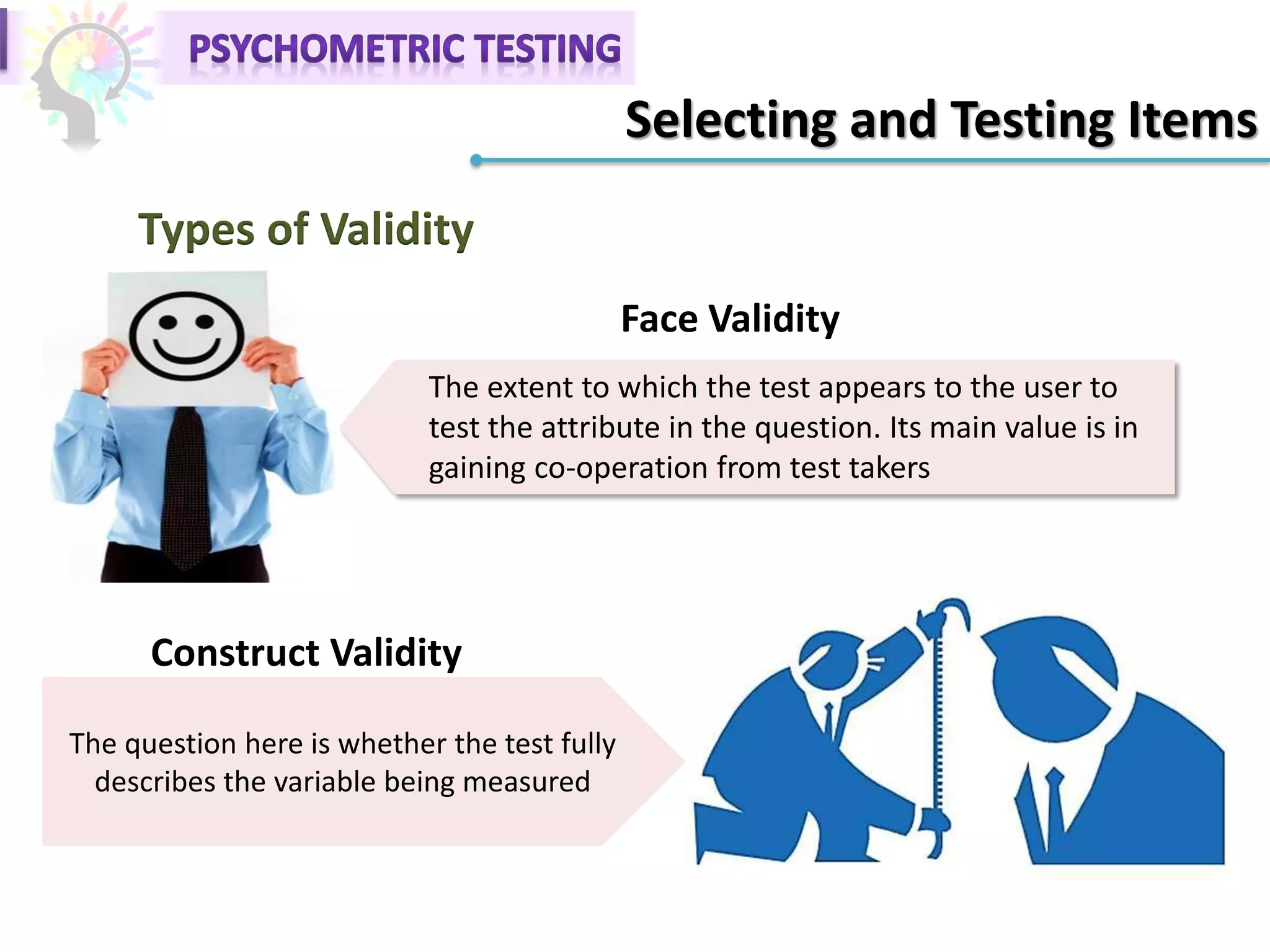
Types of Validity
The extent to which the test appears to the user to
test the attribute in the question. Its main value is in
gaining co-operation from test takers
The question here is whether the test fully
describes the variable being measured
Face Validity
Construct Validity
Selecting and Testing Items
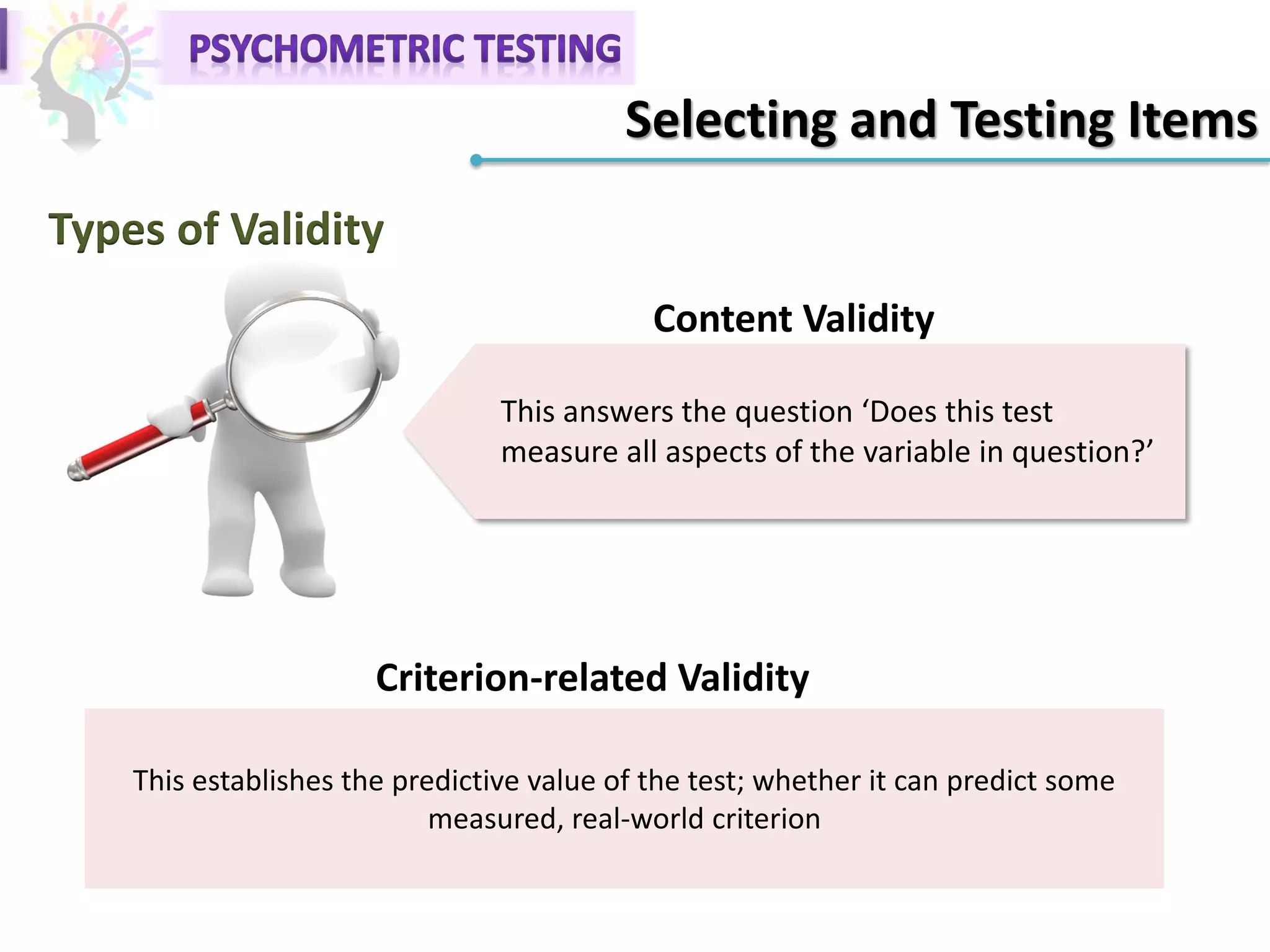
Types of Validity
This answers the question ‘Does this test
measure all aspects of the variable in question?’
Content Validity
This establishes the predictive value of the test; whether it can predict some
measured, real-world criterion
Criterion-related Validity
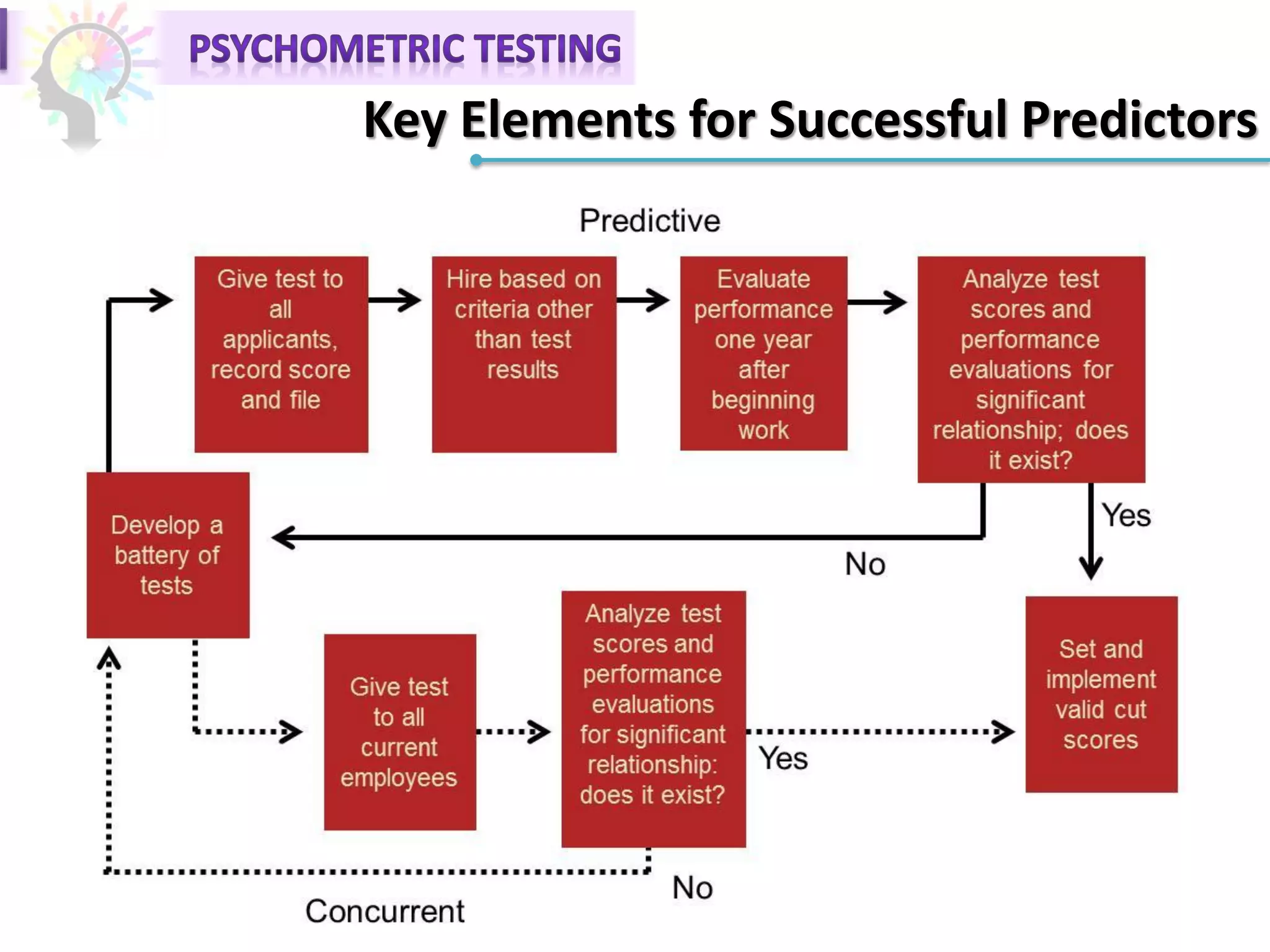
Key Elements for Successful Predictors
A psychometric test should be:
Objective: The score must not affected by the testers' beliefs or values
Standardized: Must be administered under controlled conditions
Reliable: Must minimize and quantify any intrinsic errors
Predictive: Must make an accurate prediction of performance
Non Discriminatory: Must not disadvantage any group on the basis of
gender, culture, ethnicity, etc.
Testing Program Guidelines
1 Use tests as supplements
2 Validate the tests
3 Monitor your testing/selection program
4 Keep accurate records
5 Use a certified psychologist
6 Manage test conditions
7 Revalidate periodically
Reference Books
1. Psychometric Testing – R.K. Sahu
2. Psychological Testing – John Toplis, Victor Dulewicz, Clive Fletcher
Psychometric testing

Psychometric testing

  • 1.
  • 2.
    What are PsychometricTests? Psycho = Mind Metric = To Measure any standardized procedure for measuring sensitivity or memory or intelligence or aptitude or personality etc…. Source : www.thefreedictionary.com
  • 3.
    Psychometrics  Field ofstudy about technique of measuring and mapping the psychological makeup of a human being.  Includes the measurement of knowledge, abilities, attitudes, and personality traits.  Aims to provide employers with a reliable method of selecting the most suitable job applicants or devising career progression.
  • 4.
    Psychometric Tests 1 Thereis no “pass-or-fail” in Psychometric Test 2 It’s about “job-fit” 3 There is a job for everyone, HR’s task is to find the right candidate to fit in the role/job 4 Psychometric Test are based on the assumption “Past behaviour is the best predictor of future behaviour”
  • 5.
    What do psychometrictests measure? How well you work with other people How well you handle stress Whether you will be able to cope with the intellectual demands of the job Your personality, preferences and abilities Most do not analyze your emotional or psychological stability Best match of individual to occupation and working environment
  • 6.
    Kinds of Performance Maximumperformance Have right and wrong answers Tests here relate to our capacity or capability to do certain things. They include tests of intelligence, aptitude or ability Measure the ability of achievement under strict conditions Involve a certain level of difficulty to enable comparison from person to person
  • 7.
    Habitual performance Are self-descriptive Testsattempts to measure characteristics way of behaving. Also involves a consideration of how we perceive the world, and of attitudes, values and interests. Also called as ‘typical performance’ Indicate the most typical behaviour or preferences Don’t involve right or wrong answers Kinds of Performance
  • 8.
    Types of Tests PsychometricSelection Tests Personality & Interest Tests Aptitude & Ability Tests
  • 9.
    Ability & AptitudeTests (usually verbal, numerical and diagrammatic) Personality Inventories (questionnaires) Types of Tests Intelligence Tests Achievement Tests Creativity Tests Interest Inventories Behavioural Tests Neuropsychological Tests Assess capability Assess traits Assess intelligence Assess degree of accomplishment Assess capacity for novelty Assess preference for activities Measure behaviours and their antecedents/consequences Measure cognitive, sensory, perceptual, or motor functions
  • 10.
    Why do Employersuse them? 1 Fair and objective measure of a skill/ability or the potential to acquire it 2 Gives a more rounded picture of suitability for a role 3 Objectively compares candidates’ performance with ‘norm’ levels for a similar ‘population’ 4 Reliable predictor of how well someone is likely to perform in a given job 5 Measuring potential rather than attainment 6 Free from cultural bias
  • 11.
    Integrated Selection Strategy JobPerformance criteria Performance prediction system Test Selection Job Analysis Performance appraisal VALIDATION
  • 12.
    Personality tests Tests thatuse projective techniques and trait inventories to measure basic aspects of an applicant’s personality, such as introversion, stability, and motivation. Disadvantage • Personality tests—particularly the projective type—are the most difficult tests to evaluate and use. Advantage • Tests have been used successfully to predict dysfunctional job behaviors and identify successful candidates for overseas assignments. Measuring Personality and Interests
  • 13.
    Types of PersonalityTests 16 PF MBTI Big Five Thomas Personal Profiling System FIRO-B
  • 14.
    The “Big Five” Extraversion Thetendency to be sociable, assertive, active, and to experience positive effects, such as energy and zeal. Emotional stability/neuroticism The tendency to exhibit poor emotional adjustment and experience negative effects, such as anxiety, insecurity, and hostility. Openness to experience The disposition to be imaginative, nonconforming, unconventional, and autonomous. Agreeableness The tendency to be trusting, compliant, caring, and gentle. Conscientiousness Is comprised of two related facets: achievement and dependability.
  • 15.
    The Myers-Briggs TypeIndicator(MBTI)  Based on theories of Gustav Jung  Most widely-used questionnaire based test  Uses four bi-polar dimensions  Sensing –Intuition (SN)  Thinking – Feeling (TF)  Extraversion-Introversion (E-I)  Judging-Perceiving (J-P)  To create 16 ‘Personality Types’
  • 16.
    MBTI is usedfor: Individual development Management and leadership development Team building and development Organizational change Improving communication Education and career counseling Relationship counseling
  • 17.
    16 Personality Factormodel (16PF)  Developed in the 1940s and refined in the 60s  Attempts to define the basic underlying personality  Questionnaire based  Analysis using 16 personality factors 16 PF is used for:  Selection  Development  Executive coaching  Teambuilding
  • 19.
    The 16 factorswith their word descriptors of each scale
  • 20.
    The DISC PersonalityModel  Developed in 1920s to understand ‘why people do what they do’  Simple questionnaire based  Uses four categories of human behavioral styles – "D" for Dominance-Drive-Direct, – "I" for Influence – "S" for Steadiness or Stability – "C" for Compliant, Conscientious, or Cautious Direct, Influencing, Steady and Compliant behaviors.
  • 21.
  • 22.
    DISC is usedfor:  As a learning tool  For career development  Training, coaching and mentoring  Organisational development and performance
  • 23.
    FIRO-B:  Devised byAmerican psychologist, Will Schutz, in the 1950's  Helps people to understand themselves and their relationships with others  Based on a 2-hour, 54-question questionnaire  Describes interpersonal behavior in terms of three primary dimensions: 1. Need for Inclusion 2. Need for Control 3. Need for Affection FUNDAMENTAL INTERPERSONAL RELATIONSHIP ORIENTATION-BEHAVIOUR
  • 24.
    FIRO-B is usedfor  Team building and team development  Individual development and executive coaching  Conflict resolution  Selection and placement  Management and leadership development  Relationship counselling
  • 25.
    Selecting and TestingItems Validity Reliability  A test is valid if it measures what it says it measures  A test is reliable if it is self-consistent  It should also give the same score for each subject when they are re-tested, this is called re-test reliability
  • 26.
    Selecting and TestingItems Types of Validity The extent to which the test appears to the user to test the attribute in the question. Its main value is in gaining co-operation from test takers The question here is whether the test fully describes the variable being measured Face Validity Construct Validity
  • 27.
    Selecting and TestingItems Types of Validity This answers the question ‘Does this test measure all aspects of the variable in question?’ Content Validity This establishes the predictive value of the test; whether it can predict some measured, real-world criterion Criterion-related Validity
  • 28.
    Key Elements forSuccessful Predictors
  • 29.
    A psychometric testshould be: Objective: The score must not affected by the testers' beliefs or values Standardized: Must be administered under controlled conditions Reliable: Must minimize and quantify any intrinsic errors Predictive: Must make an accurate prediction of performance Non Discriminatory: Must not disadvantage any group on the basis of gender, culture, ethnicity, etc.
  • 30.
    Testing Program Guidelines 1Use tests as supplements 2 Validate the tests 3 Monitor your testing/selection program 4 Keep accurate records 5 Use a certified psychologist 6 Manage test conditions 7 Revalidate periodically
  • 31.
    Reference Books 1. PsychometricTesting – R.K. Sahu 2. Psychological Testing – John Toplis, Victor Dulewicz, Clive Fletcher