HOW AND WHY DO HUMANS ACT AS THEY
DO?
FOCUS ON FACTORS THAT ARE UNIQUE TO
THE INDIVIDUAL
PSYCHOLOGY
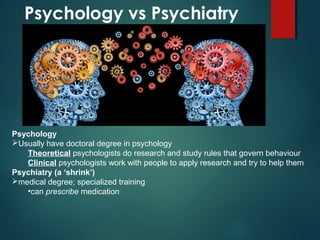
Psychology vs Psychiatry
Psychology
Usually have doctoral degree in psychology
Theoretical psychologists do research and study rules that govern behaviour
Clinical psychologists work with people to apply research and try to help them
Psychiatry (a ‘shrink’)
medical degree; specialized training
•can prescribe medication
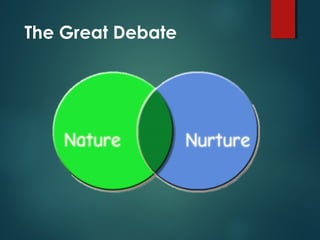
The Great Debate
PSYCHOANALYTIC THEORY
Sigmund Freud
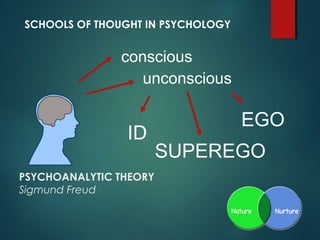
SCHOOLS OF THOUGHT IN PSYCHOLOGY
conscious
unconscious
ID
EGO
SUPEREGO
SELF ASSESSMENT
RATIONALITY VS IRRATIONALITY?
CONTINUITY VS CHANGE?
NATURE VS NURTURE?
PSYCHOANALYTIC THEORY
Sigmund Freud
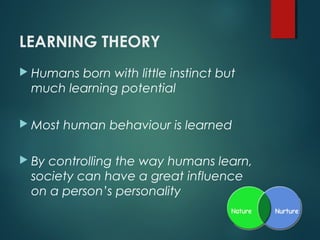
LEARNING THEORY
 Humans born with little instinct but
much learning potential
 Most human behaviour is learned
 By controlling the way humans learn,
society can have a great influence
on a person’s personality
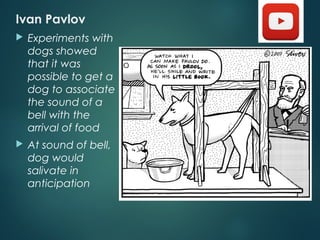
Ivan Pavlov
 Experiments with
dogs showed
that it was
possible to get a
dog to associate
the sound of a
bell with the
arrival of food
 At sound of bell,
dog would
salivate in
anticipation
 this led theorists to believe that learning
was a stimulus-response effect (if correctly
stimulated, it will give the appropriate
response)
 proposed that children who were brought
up in loving families would grow up to
become secure & loving adults
LEARNING THEORY/BEHAVIOURISM
Operant Conditioning
• behavior is sensitive to, or controlled by
its consequences
• study observable behavior rather than
inner workings of mind
JOHN WATSON (behaviourist)
BF SKINNER
•“mind is a black box”
•measured animal’s responses to
reinforcement
POSITIVE VS NEGATIVE
REINFORCEMENT
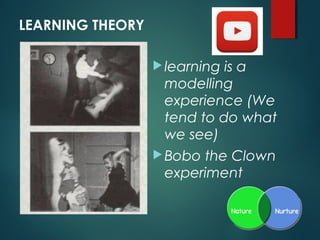
learning is a
modelling
experience (We
tend to do what
we see)
Bobo the Clown
experiment
LEARNING THEORY
CONSOLIDATION
WRITE A BRIEF RESPONSE TO THE FOLLOWING
QUESTIONS IN YOUR OWN NOTES:
Do you think humans are rationally in
control of their behaviour?
Do you think humans are more the
product of nurture or nature? Explain your
thoughts using learning from this lesson.

Psychology Overview

  • 1.
    HOW AND WHYDO HUMANS ACT AS THEY DO? FOCUS ON FACTORS THAT ARE UNIQUE TO THE INDIVIDUAL PSYCHOLOGY
  • 3.
    Psychology vs Psychiatry Psychology Usuallyhave doctoral degree in psychology Theoretical psychologists do research and study rules that govern behaviour Clinical psychologists work with people to apply research and try to help them Psychiatry (a ‘shrink’) medical degree; specialized training •can prescribe medication
  • 4.
  • 5.
    PSYCHOANALYTIC THEORY Sigmund Freud SCHOOLSOF THOUGHT IN PSYCHOLOGY conscious unconscious ID EGO SUPEREGO
  • 7.
    SELF ASSESSMENT RATIONALITY VSIRRATIONALITY? CONTINUITY VS CHANGE? NATURE VS NURTURE?
  • 8.
  • 9.
    LEARNING THEORY  Humansborn with little instinct but much learning potential  Most human behaviour is learned  By controlling the way humans learn, society can have a great influence on a person’s personality
  • 10.
    Ivan Pavlov  Experimentswith dogs showed that it was possible to get a dog to associate the sound of a bell with the arrival of food  At sound of bell, dog would salivate in anticipation
  • 11.
     this ledtheorists to believe that learning was a stimulus-response effect (if correctly stimulated, it will give the appropriate response)  proposed that children who were brought up in loving families would grow up to become secure & loving adults
  • 12.
    LEARNING THEORY/BEHAVIOURISM Operant Conditioning •behavior is sensitive to, or controlled by its consequences • study observable behavior rather than inner workings of mind JOHN WATSON (behaviourist) BF SKINNER •“mind is a black box” •measured animal’s responses to reinforcement
  • 13.
  • 14.
    learning is a modelling experience(We tend to do what we see) Bobo the Clown experiment LEARNING THEORY
  • 15.
    CONSOLIDATION WRITE A BRIEFRESPONSE TO THE FOLLOWING QUESTIONS IN YOUR OWN NOTES: Do you think humans are rationally in control of their behaviour? Do you think humans are more the product of nurture or nature? Explain your thoughts using learning from this lesson.

Editor's Notes

  • #2  Season 3, Episode 16. "Phyllis' Wedding“ (Pavlov experiment)
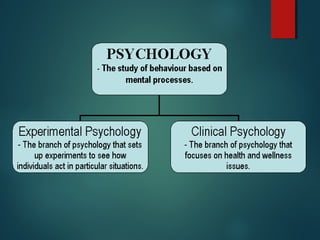
  • #3 Experimental psychology sets up experiments to see how individuals act Clinical psychology develops programs for treating individuals suffering from mental illnesses & behavioural disorders Psychologists use a variety of tools to aid them to obtain answers to their studies. Psychologists use longitudinal studies, where they study individuals over long periods of time. They create surveys and conduct interviews. Psychological event: every thought/emotion
  • #5 The biggest and most persistent issue is the relative contributions of biology and experience – origins of nature vs nurture are ancient Do our human traits develop through experience, or do we come equipped with them? Locke: mind is a blank slate on which experience writes Descartes: some ideas are innate Darwin: proposed evolutionary process – from chance variations in organisms, nature selects those that best enable an organism to survive and reproduce in that particular environment. Darwin’s principle of natural selection – organizing principle of biology He believed this explained behaviours (ie lust and rage) How are differences in intelligence, personality, and psychological disorders influenced by hereditary and by environment? Is grammar innate or formed by experience? Sexual behaviours more ‘pushed’ by inner biology or ‘pulled’ by external incentives? Are gender differences biologically predisposed or socially constructed? Resolution: nurture works on what nature endows – human species has enormous capacity to learn and adapt Every psychological event is also a biological event
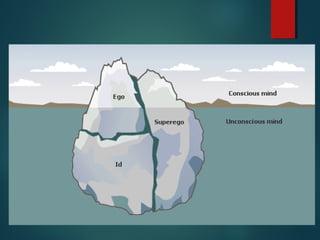
  • #6 The mind is divided into 2 parts: The conscious (part we’re aware of) and the unconscious (part we are not aware of) Unconscious mind has more influence on personality & behaviour Can be further divided into 3 parts: The id encourages us to seek physical satisfaction The superego prompts us to do the moral thing The ego referees between the two and deals with external reality The unconscious sometimes referred to today as the subconscious : these are preconscious (frequently used numbers you have in your memory) – easily accessed, memory – walk, climb steps, dress without thinking – driving, playing the piano But unconscious is your beliefs, values, attitudes – memories you can’t easily access – huge database – things surface from unconscious to subconscious when it is triggered
  • #12 ANY STIMULUS AN ORGANISM CAN PERCEIVE IS CAPABLE OF ELICITING ANY REACTION THAT AN ORGANISM IS ABLE TO MAKE – ANY SOUND, SIGHT OR SMELL CAN INFLUENCE HOW MUCH WE TENSE UP, MOODS, ATTITUDES FORMED – LEARNED REACTION (RELAX: HIT THE BOARD) Learning Theorists agree that humans are born with little instinct but much learning potential. They believe that most human behaviour is learned, especially in child and youth. By controlling the way in which humans learn behaviours, society can have a great influence on their ultimate personalities. Believe that children who were brought up in loving families would grow up to become secure and loving adults, but only if parents provided clear and consistent expectations for good behaviour, and swift but fair consequences for bad behaviour.
  • #13 Watson: psych should only study what we can observe and measure objectively. Scientific study of observable behavior. BEHAVIOURISTS FOCUSED ON WHAT COULD BE LEARNED AND MODIFIED. THEORIES OF LEARNING. Skinner believed that we do have such a thing as a mind, but that it is simply more productive to study observable behavior rather than internal mental events. Operant Conditioning deals with operants - intentional actions that have an effect on the surrounding environment. Skinner set out to identify the processes which made certain operant behaviours more or less likely to occur. TODAY: COMBINATION OF SCIENCE OF BEHAVIOUR AND MENTAL PROCESSES
  • #14 WHAT IS WILL? – the conscious process that directs voluntary movements. Sometimes we act unhesitatingly – choosing which idea to ignore and which to attend is the act of willing – belief in free will
  • #15 Bandura concluded that learning is largely a modeling experience When humans observe behaviour either acceptable or unacceptable they are more likely to practice it