anthropology
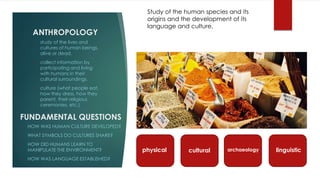
ANTHROPOLOGY
• study of the lives and
cultures of human beings,
alive or dead.
• collect information by
participating and living
with humans in their
cultural surroundings.
• culture (what people eat,
how they dress, how they
parent, their religious
ceremonies, etc.)
Study of the human species and its
origins and the development of its
language and culture.
FUNDAMENTAL QUESTIONS
• HOW WAS HUMAN CULTURE DEVELOPED?
• WHAT SYMBOLS DO CULTURES SHARE?
• HOW DID HUMANS LEARN TO
MANIPULATE THE ENVIRONMENT?
• HOW WAS LANGUAGE ESTABLISHED?
physical cultural archaeology linguistic
PHYSICAL
ANTHROPOLOGY
• EVOLUTION
• GENETIC INHERITANCE
• HUMAN ADAPTABILITY/VARIATION
• APES (PRIMATOLOGY)
• FOSSIL RECORD
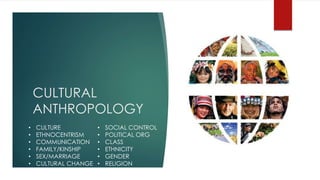
CULTURAL
ANTHROPOLOGY
• CULTURE
• ETHNOCENTRISM
• COMMUNICATION
• FAMILY/KINSHIP
• SEX/MARRIAGE
• CULTURAL CHANGE
• SOCIAL CONTROL
• POLITICAL ORG
• CLASS
• ETHNICITY
• GENDER
• RELIGION
WHAT IS CULTURE? YOU SAID…
DISTINGUISHES ONE GROUP OF PEOPLE FROM ANOTHER
CULTURES ARE SEPARATED
CULTURE BRINGS PEOPLE TOGETHER
THINGS YOU ARE TOLD BY YOUR PARENTS, MYTHS
WAY OF LIFE
TRAITS FROM ONE CULTURE WILL DIVERGE WITH ANOTHER
CULTURE IS TAUGHT
NATIONALITY (TRADITIONS, CELEBRATIONS) VS YOUR WAY OF LIFE WHERE YOU LIVE
LANGUAGES, FOODS, VALUES, RITES OF PASSAGE, RELIGION
ACCEPTING CERTAIN STANDARDS OF BEHAVIOUR
CULTURAL WAYS CAN BE CHANGED
EVERYONE IS DEFINED BY A CULTURE
DEFINES US AS HUMAN BEINGS
PROVIDES AN IDENTITY
WHY DOESN’T EVERYONE KNOW HOW TO RESPECT OTHER CULTURES?
SPECIFIC TIME AND PLACE
ARCHAEOLOGY
• EARLY HISTORY OF CULTURES
• CULTURAL EVOLUTION
• EXCAVATIONS, DATING,
ANALYZING MATERIAL OF PAST
SOCIETIES
LINGUISTIC
ANTHROPOLOGY
• STUDY OF HOW LANGUAGE
INFLUENCES SOCIAL LIFE
• DOCUMENT ENDANGERED
LANGUAGES
• document endangered
languages
ANTHROPOLOGY AND SOCIAL
CHANGE
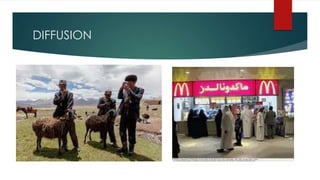
DIFFUSION
DIFFUSION - EXAMPLES
AFTER YOUR GROUP DISCUSSION, SUBMIT A
BRIEF PARAGRAPH IN WHICH YOU EXPLAIN:
• YOUR UNDERSTANDING OF CULTURAL
DIFFUSION
• YOUR EXAMPLE OF CULTURAL DIFFUSION
Diffusion - Seo Taiji & Boys
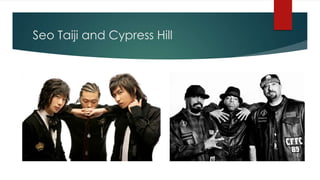
Seo Taiji and Cypress Hill
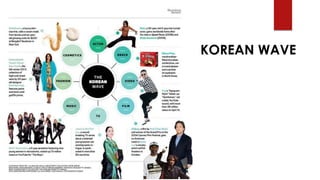
KOREAN WAVE
Girls' Generation 소녀시대 THE BOYS
ACCULTURATION
ACCULTURATION
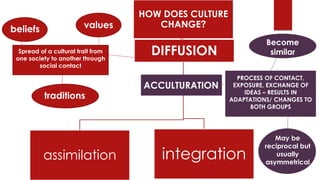
HOW DOES CULTURE
CHANGE?
assimilation integration
DIFFUSION
ACCULTURATION
Spread of a cultural trait from
one society to another through
social contact
beliefs values
traditions
PROCESS OF CONTACT,
EXPOSURE, EXCHANGE OF
IDEAS – RESULTS IN
ADAPTATIONS/ CHANGES TO
BOTH GROUPS
Become
similar
May be
reciprocal but
usually
asymmetrical
DIFFUSION OR ACCULTURATION?
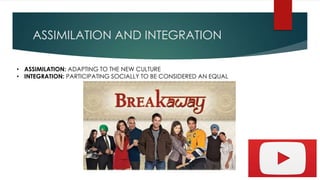
ASSIMILATION AND INTEGRATION
• ASSIMILATION: ADAPTING TO THE NEW CULTURE
• INTEGRATION: PARTICIPATING SOCIALLY TO BE CONSIDERED AN EQUAL
ASSIMILATION AND INTEGRATION
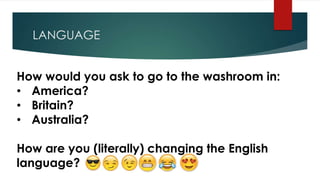
LANGUAGE
How would you ask to go to the washroom in:
• America?
• Britain?
• Australia?
How are you (literally) changing the English
language?
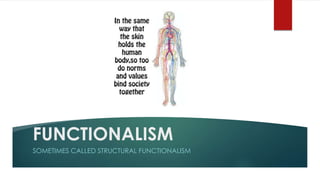
FUNCTIONALISM
SOMETIMES CALLED STRUCTURAL FUNCTIONALISM
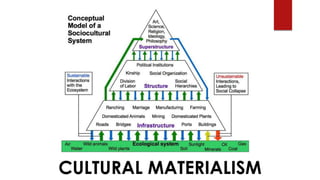
CULTURAL MATERIALISM
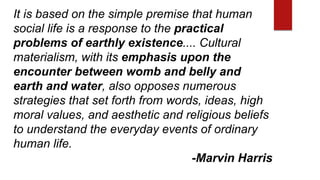
It is based on the simple premise that human
social life is a response to the practical
problems of earthly existence.... Cultural
materialism, with its emphasis upon the
encounter between womb and belly and
earth and water, also opposes numerous
strategies that set forth from words, ideas, high
moral values, and aesthetic and religious beliefs
to understand the everyday events of ordinary
human life.
-Marvin Harris
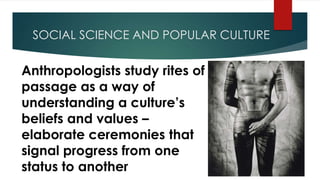
SOCIAL SCIENCE AND POPULAR CULTURE
Anthropologists study rites of
passage as a way of
understanding a culture’s
beliefs and values –
elaborate ceremonies that
signal progress from one
status to another
“BABIES” (2009)
Using evidence from the movie, compose a one-
page (single space) response to one of the
following questions:
1. To what extent does this documentary illustrate how all
human beings are fundamentally the same, yet our
physical and cultural environment shapes us from the
moment we emerge from the womb?
2. To what extent does this documentary shift perspective
on our general belief that “the way we do things is the only
way to do things”?

Anthropology overview

  • 1.
  • 2.
    ANTHROPOLOGY • study ofthe lives and cultures of human beings, alive or dead. • collect information by participating and living with humans in their cultural surroundings. • culture (what people eat, how they dress, how they parent, their religious ceremonies, etc.) Study of the human species and its origins and the development of its language and culture. FUNDAMENTAL QUESTIONS • HOW WAS HUMAN CULTURE DEVELOPED? • WHAT SYMBOLS DO CULTURES SHARE? • HOW DID HUMANS LEARN TO MANIPULATE THE ENVIRONMENT? • HOW WAS LANGUAGE ESTABLISHED? physical cultural archaeology linguistic
  • 3.
    PHYSICAL ANTHROPOLOGY • EVOLUTION • GENETICINHERITANCE • HUMAN ADAPTABILITY/VARIATION • APES (PRIMATOLOGY) • FOSSIL RECORD
  • 4.
    CULTURAL ANTHROPOLOGY • CULTURE • ETHNOCENTRISM •COMMUNICATION • FAMILY/KINSHIP • SEX/MARRIAGE • CULTURAL CHANGE • SOCIAL CONTROL • POLITICAL ORG • CLASS • ETHNICITY • GENDER • RELIGION
  • 5.
    WHAT IS CULTURE?YOU SAID… DISTINGUISHES ONE GROUP OF PEOPLE FROM ANOTHER CULTURES ARE SEPARATED CULTURE BRINGS PEOPLE TOGETHER THINGS YOU ARE TOLD BY YOUR PARENTS, MYTHS WAY OF LIFE TRAITS FROM ONE CULTURE WILL DIVERGE WITH ANOTHER CULTURE IS TAUGHT NATIONALITY (TRADITIONS, CELEBRATIONS) VS YOUR WAY OF LIFE WHERE YOU LIVE LANGUAGES, FOODS, VALUES, RITES OF PASSAGE, RELIGION ACCEPTING CERTAIN STANDARDS OF BEHAVIOUR CULTURAL WAYS CAN BE CHANGED EVERYONE IS DEFINED BY A CULTURE DEFINES US AS HUMAN BEINGS PROVIDES AN IDENTITY WHY DOESN’T EVERYONE KNOW HOW TO RESPECT OTHER CULTURES? SPECIFIC TIME AND PLACE
  • 7.
    ARCHAEOLOGY • EARLY HISTORYOF CULTURES • CULTURAL EVOLUTION • EXCAVATIONS, DATING, ANALYZING MATERIAL OF PAST SOCIETIES
  • 8.
    LINGUISTIC ANTHROPOLOGY • STUDY OFHOW LANGUAGE INFLUENCES SOCIAL LIFE • DOCUMENT ENDANGERED LANGUAGES • document endangered languages
  • 9.
  • 10.
  • 11.
    DIFFUSION - EXAMPLES AFTERYOUR GROUP DISCUSSION, SUBMIT A BRIEF PARAGRAPH IN WHICH YOU EXPLAIN: • YOUR UNDERSTANDING OF CULTURAL DIFFUSION • YOUR EXAMPLE OF CULTURAL DIFFUSION
  • 12.
    Diffusion - SeoTaiji & Boys
  • 13.
    Seo Taiji andCypress Hill
  • 14.
  • 15.
  • 16.
  • 17.
  • 21.
    HOW DOES CULTURE CHANGE? assimilationintegration DIFFUSION ACCULTURATION Spread of a cultural trait from one society to another through social contact beliefs values traditions PROCESS OF CONTACT, EXPOSURE, EXCHANGE OF IDEAS – RESULTS IN ADAPTATIONS/ CHANGES TO BOTH GROUPS Become similar May be reciprocal but usually asymmetrical
  • 22.
  • 23.
    ASSIMILATION AND INTEGRATION •ASSIMILATION: ADAPTING TO THE NEW CULTURE • INTEGRATION: PARTICIPATING SOCIALLY TO BE CONSIDERED AN EQUAL
  • 24.
  • 25.
    LANGUAGE How would youask to go to the washroom in: • America? • Britain? • Australia? How are you (literally) changing the English language?
  • 26.
  • 27.
  • 28.
    It is basedon the simple premise that human social life is a response to the practical problems of earthly existence.... Cultural materialism, with its emphasis upon the encounter between womb and belly and earth and water, also opposes numerous strategies that set forth from words, ideas, high moral values, and aesthetic and religious beliefs to understand the everyday events of ordinary human life. -Marvin Harris
  • 29.
    SOCIAL SCIENCE ANDPOPULAR CULTURE Anthropologists study rites of passage as a way of understanding a culture’s beliefs and values – elaborate ceremonies that signal progress from one status to another
  • 30.
    “BABIES” (2009) Using evidencefrom the movie, compose a one- page (single space) response to one of the following questions: 1. To what extent does this documentary illustrate how all human beings are fundamentally the same, yet our physical and cultural environment shapes us from the moment we emerge from the womb? 2. To what extent does this documentary shift perspective on our general belief that “the way we do things is the only way to do things”?

Editor's Notes

  • #3  Anthropology is the study of humankind around the world and throughout TIME It is concerned with both the biological and the cultural aspects of humans.* anthropologists have thoroughly repudiated the 19th century approach as an expression of racialism and ethnocentrism, the practice of interpreting and judging other cultures by the values of one's own. (All cultures are equally developed according to their own priorities and values; none is better, more advanced, or less primitive than any other) PAST AND PRESENT CULTURES Define culture as the shared symbols, values, beliefs and behaviours of most members of a particular society Starbucks in Seattle is a cultural symbol because it is a representation of the community; coffee, socializing, relaxation, etc Toronto symbols: the TTC, CN Tower, the 6ix, diversity, hockey General Motors plant in Detroit is a cultural symbol as it represents the Detroit community; blue-collar workers, American muscle, quality. Its why they call Detroit "Motor City".  The belief that culture is symbolically coded and can be taught from one person to another means that cultures, although bounded, can change. Think, for example, of the way you dress and what it means to other people. The way you dress could symbolically communicate to others that you care about academics or that you are a fan of your school's football team, or it might communicate that you have adopted an anarchist philosophy or are a fan of punk music. In certain urban environments, the symbolic meaning of people's clothes can signal gang affiliation. Other gang members use these symbolic sartorial signals to recognize enemies and allies. Source: Boundless. “The Symbolic Nature of Culture.” Boundless Sociology. Boundless, 21 Jul. 2015. Retrieved 24 Sep. 2015 from https://www.boundless.com/sociology/textbooks/boundless-sociology-textbook/culture-3/the-symbolic-nature-of-culture-30/the-symbolic-nature-of-culture-189-8968/
  • #4  evolution, genetic inheritance, human adaptability and variation, primatology (apes), the fossil record of human evolution & forensics
  • #5 knowledge, belief, art, morals, law, custom and any other capabilities and habits acquired by man as a member of society. cultural relativism. This approach rests on four major postulates, which directly confront the evolutionist position. 1. Cultural aspects of human behaviour are not biologically based or conditioned but are acquired solely through learning. 2. Cultural conditioning of behaviour is ultimately accomplished through habituation and thus acts through unconscious processes rather than rational deliberation, although secondary rationalizations are often offered to explain cultural values. 3. All cultures are equally developed according to their own priorities and values; none is better, more advanced, or less primitive than any other. 4. Cultural traits cannot be classified or interpreted according to universal categories appropriate to "human nature". They assume meaning only within the context of coherently interrelated elements internal to the particular culture under consideration. HOW CHANGE COMES ABOUT IN CULTURAL GROUPS – COMMON FACTORS
  • #6 Cultural aspects of human behaviour are not biologically based or conditioned but are acquired solely through learning Bugs (worms, larvae, etc.) are a far better source of protein than large animals. It is culture that makes them seem unappetizing, probably (IMHO) because women could “hunt” them at least as well as men could.
  • #8  early history of cultures around the world; major trends in cultural evolution; and techniques for finding, excavating, dating, and analyzing material remains of past societies
  • #9  studies the role of language in community, national, and cross-cultural interactions. It is concerned with the social and cultural factors that underlie people's use of language to share information and shape cultures and community life. Language evolves.  Sometimes a word that once was negative becomes positive, like “terrific” which originally meant terrifying.  Sometimes a word that was once positive becomes negative, as when “awful” changes from awe inspiring to very bad http://www.theguardian.com/science/shortcuts/2013/aug/14/language-literally-losing-its-meaning
  • #10  Anthropologists will also study how change comes about in cultural groups Whether change occurs gradually and whether it’s beneficial Although world cultures differ widely, some common factors exist that cause all cultures to change Internal or external factors lead to change Example: inventions – new product, idea, social pattern that affects the way large groups conduct their daily lives – some created on purpose to address a need in society, others accidental, uninentional
  • #11 Diffusion relates to external factors Spread of a cultural trait from one group to another through CONTACT Trade, migration, war = traits spread from one to the other The mixing of world cultures through different ethnicities, religions and nationalities has increased with advanced communication, transportation and technology This is a MacDonald's restaurant in Saudi Arabia.  This picture shows Kygryz herders.  The Kygryz people live in the mountains of northeast Afghanistan, and are completely isolated from the rest of the world.  However, the Kygryz herders do use cellphones to take pictures and play music (they are useless for communication because cellular service doesn't reach them).  This is an example of cultural diffusion through technology, because the picture shows that even the most isolated people in the world still use cellphones.
  • #13 https://www.youtube.com/watch?v=zAlNrtcPCLw 1993
  • #14 K-Pop: Seo Taiji and Boys, whose successful experimentation with different music styles had sparked a paradigm shift ("A paradigm is what members of a scientific community, and they alone, share“;  a profound change in a fundamental model or perception of events) in the music industry of South Korea. As a result, the integration of foreign musical elements has now become a common practice in the K-pop industry. As Korean pop culture is becoming a increasingly globalized phenomenon and globally popular in many parts of the world allows South Korea to utilize its pop cultural sector to access, tap and break into foreign entertainment markets. By tapping into social networking services and the video sharing platform YouTube, the K-pop industry's ability to secure a sizable overseas audience has facilitated a noticeable rise in the global proliferation of the genre.[6]  Since the mid-2000s, the K-pop music market has experienced double digit growth rates. In the first half of 2012, it grossed nearly US$3.4 billion[7] and was recognized by Time magazine as "South Korea's Greatest Export".[8] First gaining popularity in East Asia in the late 1990s, K-pop entered the Japanese music market towards the turn of the 21st century. In the late 2000s, it grew from a musical genre into a subculture among teenagers and young adults of East and Southeast Asia.  Currently, the spread of K-pop to other regions of the world, via the Korean Wave, is seen in many areas of the world.
  • #17 Base word is culture – way of living and way of life, certain ways and reasons why ppl speak, celebrate, and conduct themselves, express their belief systems Larger geographic into smaller regions Customs, festivities and food As many cultures as there are countries and regions When individuals or groups transition from living a lifestyle of their own culture to moving into a lifestyle of a new culture, they must acculturate – assume the language and customs (the process of contact, exposure, and exchange of ideas between different cultures that results in adaptations and changes to BOTH groups) Learning language and immersion, assimilation LANGUAGE: largest factor in acculturating, you need to immerse yourself in the new culture, move from native country to new country Understand acceptable behaviours, immersion can be stressful, you don’t know any different Learning the meaning of certain words
  • #18 Traditional vs modern Japanese home
  • #19 Japan vs the Beaches
  • #20 Modern Japan vs Mount Pleasant East
  • #21 Vancouver condo and Vancouver ocean residence
  • #22 Culture traits can have one or more of seven characteristics. The first is that they can be learned, such as teaching a specific response to a sound. The students of the school respond to a bell by leaving the classroom to go to the playground for example. This is a learned behavior known as a culture trait. Other characteristics that could be culture traits include something that is transmitted from generation to generation, knowledge that is based on symbols, behavior that is changeable, traditions that can be integrated into the culture and affect future activities, knowledge that is ethnocentric and values that are adaptable to each generation. What things are important to a group of people? A flag of specific colors and shapes, a coat of arms, a lapel pin, a specific word, two fingers held in a V-shape, a place, an identity, a type of behavior, such as drinking alcohol? In and of themselves, these things have no meaning. But meaning can be assigned to them by a group of people who share the ability to communicate those meanings to one another. Through a process called socialization, we teach one another the symbols that have significance to the group. Prior to notions of culture, people were categorized by what is known as "environmental determinism.“ For example, people from the northern climes were believed to be hardy and brave. Or, some believed northerners talked less and used a predominance of consonants in their language because they didn't want to open their mouths too much to let cold air in! On the other hand, people from the southern areas were considered inferior, slow to think, slow to act Another early concept about behavior was the notion of "human nature." Why do people behave a certain way? Some would say, because of some innate, biological trait, or reason. By the 19th century, anthropologists began to notice in their research on groups, that there were behaviors common across diverse boundaries such as race, ethnicity, and religion, where people otherwise had nothing in common biologically except their humanness.  The tangible products of a culture, or those objects with some dimension used by a culture, such as computers, cell phones, clothing and much more, make up what sociologists call material culture. Within these objects, which by the frequency of their use indicates their importance to a culture, one can also find symbolism Helpful: http://www.enotes.com/research-starters/cultural-symbols
  • #23 http://time.com/8515/hungry-planet-what-the-world-eats/ As you watch the video, consider whether this is diffusion or acculturation? Homework: come tomorrow with an example of cultural diffusion or acculturation for a quick discussion tomorrow – bring photo or video to display on digital device http://anthropology.ua.edu/cultures/cultures.php?culture=Diffusionism%20and%20Acculturation – best explanation
  • #24 Assimilation involves the accumulation of information about a new culture and resulting adaptations to match the new culture. Generating new knowledge about a culture might include learning how food is prepared, understanding types of acceptable clothing worn in the new culture, or picking up new habits. A person who fully assimilates has picked up all the habits and traits of their non-native culture Similarly, integration is often used in acculturation theory and includes participating socially in an environment to be considered an equal among the society. You do not have to fully assimilate in order to integrate into a new culture. To integrate into society, you might want to participate in social events, community events, and perhaps engage in local clubs or groups Acculturation and assimilation have most often been studied in European immigrants coming to the United States during the nineteenth and early twentieth centuries, as well as minority groups already living in the United States. 
  • #25 Jahangir "George" Khan is a Pakistani Muslim who has lived in England since 1937. He has a wife in Pakistan. He and his second wife Ella, a British Roman Catholic woman of Irish descent, have been married for 25 years and have 7 children together: Nazir, Abdul, Tariq, Maneer, Saleem, Meenah, and Sajid. George and Ella run a popular fish and chips shop in the neighbourhood. While George is obsessed with the 1971 war between East and West Pakistan and arranging marriages for his children, the children themselves who were born and brought up in Britain, increasingly see themselves as British and reject Pakistani customs of dress, food, religion, and living. This leads to a rise in tensions and conflicts within the family unit. Acculturation and assimilation have most often been studied in European immigrants coming to the United States during the nineteenth and early twentieth centuries, as well as minority groups already living in the United States.  http://anthropology.ua.edu/cultures/cultures.php?culture=Diffusionism%20and%20Acculturation – best explanation
  • #26 LANGUAGE: largest factor in acculturating, you need to immerse yourself in the new culture, move from native country to new country Understand acceptable behaviours, immersion can be stressful, you don’t know any different Learning the meaning of certain words In the United States, the term 'bathroom' is used as opposed to the term 'washroom', which is used in British Columbia. The language and word choices spoken by the native people are referred to as the vernacular. It isn't the john or the bathroom, as many Americans call it. We say the toilet, or (if you want to be specific) the Gents or the Ladies. Other terms include the dunny and the loo. The bathroom is where you keep the bath, which is often not in the same room as the toilet. If you ask for the bathroom, many Australians will think they're being funny by directing you to the wrong room, even when they know perfectly well what you're really looking for. In Great Britain, the bathroom is referred to as the loo. In Australia, a friend or acquaintance is referred to as a mate. As you can see, not only does acculturation include learning a new language or immersing yourself into the culture, it also includes learning the meanings and associations of new words and phrases. http://www.theguardian.com/science/shortcuts/2013/aug/14/language-literally-losing-its-meaning
  • #27 or simply functionalism, is a framework for building theory that sees society as a complex system whose parts work together to promote solidarity and stability macro-level orientation, which is a broad focus on the social structures that shape society as a whole, and believes that society has evolved like organisms Functionalism addresses society as a whole in terms of the function of its constituent elements; namely norms, customs, traditions, and institutions. A common analogy, popularized by Herbert Spencer, presents these parts of society as "organs" that work toward the proper functioning of the "body" as a whole While one may regard functionalism as a logical extension of the organic analogies for societies presented by political philosopherssuch as Rousseau, sociology draws firmer attention to those institutions unique to industrialized capitalist society (or modernity).  Émile Durkheim was concerned with the question of how certain societies maintain internal stability and survive over time. He proposed that such societies tend to be segmented, with equivalent parts held together by shared values, common symbols or, as his nephew Marcel Mauss held, systems of exchanges. Durkheim used the term 'mechanical solidarity' to refer to these types of "social bonds, based on common sentiments & shared moral values, that are strong among members of pre-industrial societies“ explaining the apparent stability and internal cohesion needed by societies to endure over time. Rousseau: All ran headlong to their chains, in hopes of securing their liberty; for they had just wit enough to perceive the advantages of political institutions, without experience enough to enable them to foresee the dangers. The most capable of foreseeing the dangers were the very persons who expected to benefit by them; and even the most prudent judged it not inexpedient to sacrifice one part of their freedom to ensure the rest; as a wounded man has his arm cut off to save the rest of his body. (Rousseau) CHANGE MUST BE SLOW, ORDERLY PROCESS BECAUSE EACH AND EVERY SOCIAL INSTITUTION IS CONNECTED TO THE OTHERS IN A MULTITUDE OF WAYS AND SERVES MANY DIFFERENT HUMAN NEEDS
  • #28 Physical materials, conditions, and economic activity within an environment determine how the ideas and ideology of a culture develop SUPERSTRUCTURE: RELIGION AND IDEOLOGY OF A CULTURE STRUCTURE: HOW IT’S ORGANIZED, SUCH AS POLITICAL SYSTEM, LAWS, FAMILIES INFRASTRUCTURE: TECHNOLOGICAL, ECONOMIC AND DEMOGRAPHIC FACTORS OF A CULTURE, HOW PEOPLE ATTEND TO THEIR BASIC NEEDS OF SURVIVAL AND REPRODUCTION (CHANGES TO DEMOGRAPHICS, OR ECONOMICS, WILL CHANGE ORGANIZATION) influenced by the writings of Karl Marx and Friedrich Engels, The research strategy predicts that it is more likely that in the long term infrastructure probabilistically determines structure, which probabilistically determines the superstructures, than otherwise. Thus, much as in earlier Marxist thought, material changes (such as in technology or environment) are seen as largely determining patterns of social organization and ideology in turn. The Hindu ban on killing cows? Absolutely necessary as a strategy of human existence, Dr. Harris contended: they are much more valuable for plowing fields and providing milk than as a one-time steak dinner."Westerners think that Indians would rather starve than eat their cows," he told Psychology Today. "What they don't understand is that they will starve if they do eat their cows.“ In Dr. Harris's view, then, a manufactured "divine intervention" was needed to encourage people simply to do the practical thing. The Jewish and Muslim bans on eating pork? Pigs eat the same foods as humans, he reasoned, and are expensive to keep. Sheep, goats and cattle, by contrast, thrive on grass, and provide wool, milk and labor. Warfare? A way of curbing population when protein gets scarce. Neckties? A badge men wear to indicate they are above physical labor.Witchcraft? A convenient culprit for the rising protest that church and state faced from the 15th century to the 17th.
  • #29 Marvin Harris thinks male supremacism results from the group’s efforts to secure protein. Populations suffering from a protein shortage practice female infanticide in order to raise more warriors and hunters to compete for animal protein. The resulting shortage in females requires men to steal wives from hostile groups. Polygyny rewards the successful hunter but exacerbates the shortage of women for most men, thus leading to more competition for females. A vicious cycle of violence and warfare is established, along with the demotion of women to beings who are bought, traded, and captured.
  • #30 Anthropologists study rites of passage as a way of understanding a culture’s beliefs and values – elaborate ceremonies that signal progress from one status to another (child to adult) Allow the initiate to gain access to the knowledge and practices of adults within their culture Performed by adults and may involve elaborate marks on the body to represent transformation into adulthood Body modification and body art (tattoos, piercings, decorative scarring) – long history Samoa – adolescent boys from upper class families have the pe’a to mark their transition to adults This is elaborate tattoo begins at waist and ends at knee Three months to apply and year to heal Now about a week to apply Must rely on families to care for and support them – then party as celebration Tattoo is sign of responsibility and membership in community Man is responsible for himself, family, community, church Pain or change mind – shunned – unfinished tattoo marks him for rest of his life In NA takes like a decade to become an adult – and now tattoos are popular just because NA has viewed body modification as deviant and now is considered legitimate self-expression
  • #31 Some things students should know? Balmès is quick to point out that all the families in the film are well-off by their countries' standards. In choosing the participants, "I wanted four equal environments in terms of quality of life," he says, and he also wanted the parents to be "loving people with no big problems." The families have all seen the film and are pleased with it. Balmès has kept in touch with them and is hoping to have them all meet someday, possibly in Namibia. Balmès also wanted to play with the contrast between the four countries and cultures represented. "I chose four places at different development levels in [their] relationship with technology ," he explains. "From the absolutely zero technology of the Namibian family to the science fiction of Tokyo, where you feel like you're in Blade Runner. There, the space is so small, people are living in tiny [pods] almost, [compared with] the gigantic spaces of Mongolia and Namibia."  If there is any message to Babies, Balmès says, it is a very simple one. "I guess what you can read between the lines of the film is that, if children have their basic needs fulfilled and there is love, they'll all do well, wherever they grow up."