

Psychoanalysis
Presentation by: Malik Shahrukh Zeeshan Presented to: Prof. Dr. Metin Colak
Department of Communication and Media Studies
Cyprus International University
Psychoanalytic Theory
Psychoanalytic theory is the theory of personality organization
and the dynamics of personality development that guides
psychoanalysis, a clinical method for treating psychopathology.
First laid out by Sigmund Freud in the late 19th century,
psychoanalytic theory has undergone many refinements since
his work.
Psychoanalytic Theory of Personality
• Sigmund Freud
• Levels of Awareness
• Components of Personality
• Defense mechanisms
• Psychosexual stages
• Criticisms and take home message
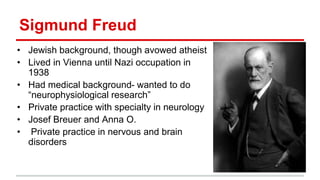
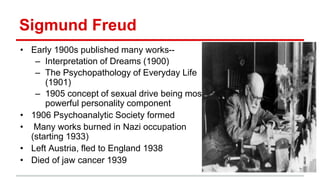
Sigmund Freud
• Jewish background, though avowed atheist
• Lived in Vienna until Nazi occupation in
1938
• Had medical background- wanted to do
“neurophysiological research”
• Private practice with specialty in neurology
• Josef Breuer and Anna O.
• Private practice in nervous and brain
disorders
Sigmund Freud
• Early 1900s published many works--
– Interpretation of Dreams (1900)
– The Psychopathology of Everyday Life
(1901)
– 1905 concept of sexual drive being most
powerful personality component
• 1906 Psychoanalytic Society formed
• Many works burned in Nazi occupation
(starting 1933)
• Left Austria, fled to England 1938
• Died of jaw cancer 1939
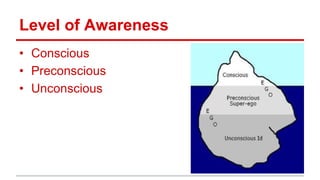
Level of Awareness
• Conscious
• Preconscious
• Unconscious
Concious
● Current contents of your mind that you
actively think of
● What we call working memory
● Easily accessed all the time.
Preconscious
● Contents of the mind you are not currently
aware of
● Thoughts, memories, knowledge, wishes,
feelings
● Available for easy access when needed
Unconscious
● Contents kept out of conscious awareness
● Not accessible at all
● Processes that actively keep these thoughts
from awareness
Freudian Components of Personality
The ID
The Ego
The Super Ego
The ID
● Resides completely at the unconscious level
● Acts under the pleasure principle
- Immediate gratification, not willing to compromise
- Generates all of the personality’s energy
● The moralist and idealistic part of the
personality
● Resides in preconscious
● Operates on “ideal principle”
-Begins forming at 4-5 yrs of age
-Initially formed form environment and others (society, family etc)
-Internalized conventions and morals
● Essentially your “conscience”
The Super Ego
The Ego
Resides in all levels of awareness
Operates under “reality principle”
Attempts negotiation between Id and Superego
to satisfy both realistically
- Conflicts between the Id, Superego and Ego arise in unconscious mind
- Can’t be reached bc in unconscious
- Come out in various ways
- Slips of tongue (Freudian slip)
- Dreams
- Jokes
- Anxiety
- Defense Mechanisms
Conflict of Personality Component
Denial
Refusal to accept external realities because
too threatening to enter awareness
Internal impulses and memories too
threatening so barred from entering awareness
Repression
Projection
Attribute unacceptable thoughts or impulses
onto others (project these inappropriate
thoughts etc onto others)
Displacement
Shifting attention from one target that is no
longer available to a more acceptable or
“safer” substitute
Sublimation
● Healthiest defense mechanism
● Compromise
● Takes socially unacceptable impulses and
turns them into something positive &
acceptable
Reaction Formation
Converting unacceptable and dangerous
impulses into something positive to reduce
anxiety
Rationalization
Explaining an unacceptable behavior in a
way that overlooks present shortcomings or
failures
Regression
Reverting to behavior that is characteristic to an
earlier stage of development when
confronted with stress or anxiety
Psycosexual Development
● Stages of development in which conflict over
Id’s impulses plays out
● Ego must control these impulses
● If not resolved, psychological issues can
emerge later in life
Psycosexul Stages
-Pleasure centering around the mouth (sucking, biting etc)
-Focus: weaning- becoming less dependent
-Not resolved? aggression or dependency later in life-- fixation
with oral activities (smoking, drinking, nail biting etc.)
-Sexual urges towards opposite gender
Criticism
- He studied very few people so not representative sample
- Process of psychoanalysis interviewing- exhibit preconceived
notions and biases
- His measures/methods were untreatable
- Definitions don’t lend themselves to experimentation
- One’s personality is fixed and unchanging
- Obsessed with sex and aggression
Thanks for attention & Time

Psychoanalysis & Sigmund Freud by Malik Shahrukh

  • 1.
    Psychoanalysis Presentation by: MalikShahrukh Zeeshan Presented to: Prof. Dr. Metin Colak Department of Communication and Media Studies Cyprus International University
  • 2.
    Psychoanalytic Theory Psychoanalytic theoryis the theory of personality organization and the dynamics of personality development that guides psychoanalysis, a clinical method for treating psychopathology. First laid out by Sigmund Freud in the late 19th century, psychoanalytic theory has undergone many refinements since his work.
  • 3.
    Psychoanalytic Theory ofPersonality • Sigmund Freud • Levels of Awareness • Components of Personality • Defense mechanisms • Psychosexual stages • Criticisms and take home message
  • 4.
    Sigmund Freud • Jewishbackground, though avowed atheist • Lived in Vienna until Nazi occupation in 1938 • Had medical background- wanted to do “neurophysiological research” • Private practice with specialty in neurology • Josef Breuer and Anna O. • Private practice in nervous and brain disorders
  • 5.
    Sigmund Freud • Early1900s published many works-- – Interpretation of Dreams (1900) – The Psychopathology of Everyday Life (1901) – 1905 concept of sexual drive being most powerful personality component • 1906 Psychoanalytic Society formed • Many works burned in Nazi occupation (starting 1933) • Left Austria, fled to England 1938 • Died of jaw cancer 1939
  • 6.
    Level of Awareness •Conscious • Preconscious • Unconscious
  • 7.
    Concious ● Current contentsof your mind that you actively think of ● What we call working memory ● Easily accessed all the time.
  • 8.
    Preconscious ● Contents ofthe mind you are not currently aware of ● Thoughts, memories, knowledge, wishes, feelings ● Available for easy access when needed
  • 9.
    Unconscious ● Contents keptout of conscious awareness ● Not accessible at all ● Processes that actively keep these thoughts from awareness
  • 10.
    Freudian Components ofPersonality The ID The Ego The Super Ego
  • 11.
    The ID ● Residescompletely at the unconscious level ● Acts under the pleasure principle - Immediate gratification, not willing to compromise - Generates all of the personality’s energy
  • 12.
    ● The moralistand idealistic part of the personality ● Resides in preconscious ● Operates on “ideal principle” -Begins forming at 4-5 yrs of age -Initially formed form environment and others (society, family etc) -Internalized conventions and morals ● Essentially your “conscience” The Super Ego
  • 13.
    The Ego Resides inall levels of awareness Operates under “reality principle” Attempts negotiation between Id and Superego to satisfy both realistically
  • 14.
    - Conflicts betweenthe Id, Superego and Ego arise in unconscious mind - Can’t be reached bc in unconscious - Come out in various ways - Slips of tongue (Freudian slip) - Dreams - Jokes - Anxiety - Defense Mechanisms Conflict of Personality Component
  • 15.
    Denial Refusal to acceptexternal realities because too threatening to enter awareness
  • 16.
    Internal impulses andmemories too threatening so barred from entering awareness Repression
  • 17.
    Projection Attribute unacceptable thoughtsor impulses onto others (project these inappropriate thoughts etc onto others)
  • 18.
    Displacement Shifting attention fromone target that is no longer available to a more acceptable or “safer” substitute
  • 19.
    Sublimation ● Healthiest defensemechanism ● Compromise ● Takes socially unacceptable impulses and turns them into something positive & acceptable
  • 20.
    Reaction Formation Converting unacceptableand dangerous impulses into something positive to reduce anxiety
  • 21.
    Rationalization Explaining an unacceptablebehavior in a way that overlooks present shortcomings or failures
  • 22.
    Regression Reverting to behaviorthat is characteristic to an earlier stage of development when confronted with stress or anxiety
  • 23.
    Psycosexual Development ● Stagesof development in which conflict over Id’s impulses plays out ● Ego must control these impulses ● If not resolved, psychological issues can emerge later in life
  • 24.
    Psycosexul Stages -Pleasure centeringaround the mouth (sucking, biting etc) -Focus: weaning- becoming less dependent -Not resolved? aggression or dependency later in life-- fixation with oral activities (smoking, drinking, nail biting etc.) -Sexual urges towards opposite gender
  • 25.
    Criticism - He studiedvery few people so not representative sample - Process of psychoanalysis interviewing- exhibit preconceived notions and biases - His measures/methods were untreatable - Definitions don’t lend themselves to experimentation - One’s personality is fixed and unchanging - Obsessed with sex and aggression
  • 26.