THE PSYCHOANALYTIC
APPROACH
PART-I
Dr. Maheshbabu.N
Asst Professor
SDM College, Ujire
Email: madhu.pratihasta@gmail.com
Short biography of Sigmund
Freud
 May 6, 1856 – Sigmund Freud Was Born In Freiberg Town,
Czech Republic
 1881 – He Graduated From Medical Faculty, University Of
Vienna
 Moved to Vienna in 1860 until 1938.
 Vienna exciting place of opportunity and optimism. In 1867,
Jews granted political rights and accepted into society.
• Freud assimilated, identifying as a German.
 About the time he was 15, liberal political atmosphere
evaporated and anti-Semitism became virulent, shattering
assimilation
 Graduated from University of Vienna medical school with strong
interest in research but quickly married and realized only
private practice would provide needed financial support.
 Published well received scholarly papers on
neurological disorders.
 1900 – He Released ‘Interpretation Of
Dreams’
 Outbreak of WW II forced him to flee to
London, where he died a year later in 1939.
 In 2006 the house in which Freud was born
renamed it as Stalin square to Freud square
and later opened as a museum.
Personality theory according to
Freud
Personality is defined as follows:
Our characteristic pattern of thinking, feeling, and acting.
Freud’s psychoanalytic perspective proposed that childhood sexuality and
unconscious motivations influence personality.
Freud called his theory and associated techniques psychoanalysis.
Unconscious-large below the surface area which contains thoughts,
wishes, feelings and memories, of which we are unaware.
Free association-the patient is asked to relax and say whatever comes to
mind, no matter how embarrassing or trivial.
Overview of psychoanalysis
 A set of philosophical of human nature
 Psychoanalysis was the first formal theory of
personality .
 Psychoanalysis is both an approach to therapy
and a theory of personality
 Emphasizes unconscious motivation – the main
cause of behavior lie in unconscious mind
 View of human nature
 DETERMINISTIC
 Life is about gaining pleasure and avoiding pain
 HUMAN AS ENERGY SYSTEM
 Freud believe that human are motivated by the
unconscious, where the Id is found along with the
aggression and sex instincts
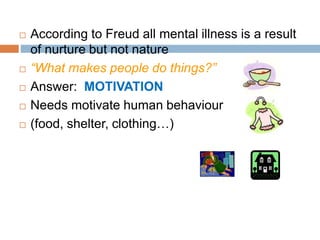
 According to Freud all mental illness is a result
of nurture but not nature
 “What makes people do things?”
 Answer: MOTIVATION
 Needs motivate human behaviour
 (food, shelter, clothing…)
 Being deprived of a need arouses a feeling called a
DRIVE OR DESIRE.
 Haiti
 Animals respond instinctively, humans learn various
ways to respond.
 Human motivation explains the reasons why people
behave the way they do.
 People have DRIVES OR DESIRES in the back of their
minds
 i.e: Will to live, will to die
 Some of these desires cause people to behave
irrationally.
Instincts..
 Instincts, are the basic elements of the
personality, the motivating forces that drive
behavior and determine its directions.
 Instincts are a form of energy – transformed
physiological energy – that connects the
body’s needs with the mind’s wishes.
 It directs to take a certain actions
 (hunger, thirst)
 Freud theory can be called a homeostatic
approach
 Types of instincts
 Life instincts and death instincts
 Life instincts serve the purpose of survival of the
individual and the species by seeking to satisfy
the needs for food, water, air and sex
 Death instincts,
 The unconscious drive toward decay,
destruction and aggression.
 Aggressive drive, the compulsion to destroy,
and kill
Levels of personality
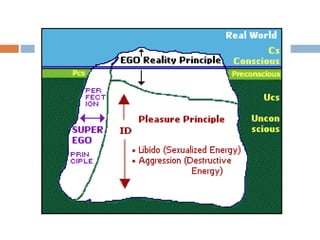
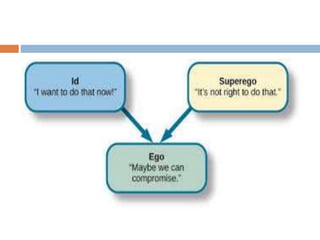
 The Id is a powerful structure of the
personality bcoz it supplies all the energy for
the other two components
 Id is the responsible of direct satisfaction of
bodily needs.
 Tension – food
 The id operates in accordance with freud
called the Pleasure principle.
 Id functions to increase pleasure and avoid
pain
 The id strives for immediate satisfaction of its
needs and does not tolerate delay or
postponement of satisfaction for any reason.
 Instant gratification
 It has no awareness of reality
 Id is the responsibility of direct satisfaction of
bodily needs.
 The ways the id can attempt to satisfy its needs
by reflex action, & fantasy experiences –
Freud labeled as primary thoughts
 The ego is the rational master of personality.
 Indirectly it controls the id needs because, it
determines appropriate and socially acceptable
times, places and objects that will satisfy the id
impulses.
 It directs us to behave intelligently and rationally to
the outside world and to develop the power of
perception, recognition and memory –
 Freud called these abilities secondary process
thought
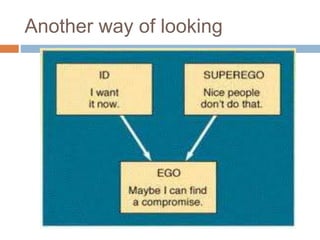
 Ego does not prevent id satisfaction, rather it tries
to postpone in terms of demands of reality
 The Super ego works for moral perfection
 The presses for satisfaction, the ego tries to
postpone it and the superego urges morality
above all.
 SUPEREGO- unconscious part of the mind
that acts as our conscience. Reminds us of
what we should do.
Another way of looking
The psychoanalytic approach Part-I

The psychoanalytic approach Part-I

  • 1.
    THE PSYCHOANALYTIC APPROACH PART-I Dr. Maheshbabu.N AsstProfessor SDM College, Ujire Email: madhu.pratihasta@gmail.com
  • 2.
    Short biography ofSigmund Freud  May 6, 1856 – Sigmund Freud Was Born In Freiberg Town, Czech Republic  1881 – He Graduated From Medical Faculty, University Of Vienna  Moved to Vienna in 1860 until 1938.  Vienna exciting place of opportunity and optimism. In 1867, Jews granted political rights and accepted into society. • Freud assimilated, identifying as a German.  About the time he was 15, liberal political atmosphere evaporated and anti-Semitism became virulent, shattering assimilation  Graduated from University of Vienna medical school with strong interest in research but quickly married and realized only private practice would provide needed financial support.
  • 3.
     Published wellreceived scholarly papers on neurological disorders.  1900 – He Released ‘Interpretation Of Dreams’  Outbreak of WW II forced him to flee to London, where he died a year later in 1939.  In 2006 the house in which Freud was born renamed it as Stalin square to Freud square and later opened as a museum.
  • 4.
    Personality theory accordingto Freud Personality is defined as follows: Our characteristic pattern of thinking, feeling, and acting. Freud’s psychoanalytic perspective proposed that childhood sexuality and unconscious motivations influence personality. Freud called his theory and associated techniques psychoanalysis. Unconscious-large below the surface area which contains thoughts, wishes, feelings and memories, of which we are unaware. Free association-the patient is asked to relax and say whatever comes to mind, no matter how embarrassing or trivial.
  • 5.
    Overview of psychoanalysis A set of philosophical of human nature  Psychoanalysis was the first formal theory of personality .  Psychoanalysis is both an approach to therapy and a theory of personality  Emphasizes unconscious motivation – the main cause of behavior lie in unconscious mind
  • 6.
     View ofhuman nature  DETERMINISTIC  Life is about gaining pleasure and avoiding pain  HUMAN AS ENERGY SYSTEM  Freud believe that human are motivated by the unconscious, where the Id is found along with the aggression and sex instincts
  • 7.
     According toFreud all mental illness is a result of nurture but not nature  “What makes people do things?”  Answer: MOTIVATION  Needs motivate human behaviour  (food, shelter, clothing…)
  • 8.
     Being deprivedof a need arouses a feeling called a DRIVE OR DESIRE.  Haiti  Animals respond instinctively, humans learn various ways to respond.  Human motivation explains the reasons why people behave the way they do.  People have DRIVES OR DESIRES in the back of their minds  i.e: Will to live, will to die  Some of these desires cause people to behave irrationally.
  • 9.
    Instincts..  Instincts, arethe basic elements of the personality, the motivating forces that drive behavior and determine its directions.  Instincts are a form of energy – transformed physiological energy – that connects the body’s needs with the mind’s wishes.  It directs to take a certain actions  (hunger, thirst)  Freud theory can be called a homeostatic approach
  • 10.
     Types ofinstincts  Life instincts and death instincts  Life instincts serve the purpose of survival of the individual and the species by seeking to satisfy the needs for food, water, air and sex  Death instincts,  The unconscious drive toward decay, destruction and aggression.  Aggressive drive, the compulsion to destroy, and kill
  • 11.
    Levels of personality The Id is a powerful structure of the personality bcoz it supplies all the energy for the other two components  Id is the responsible of direct satisfaction of bodily needs.  Tension – food  The id operates in accordance with freud called the Pleasure principle.  Id functions to increase pleasure and avoid pain
  • 12.
     The idstrives for immediate satisfaction of its needs and does not tolerate delay or postponement of satisfaction for any reason.  Instant gratification  It has no awareness of reality  Id is the responsibility of direct satisfaction of bodily needs.  The ways the id can attempt to satisfy its needs by reflex action, & fantasy experiences – Freud labeled as primary thoughts
  • 13.
     The egois the rational master of personality.  Indirectly it controls the id needs because, it determines appropriate and socially acceptable times, places and objects that will satisfy the id impulses.  It directs us to behave intelligently and rationally to the outside world and to develop the power of perception, recognition and memory –  Freud called these abilities secondary process thought  Ego does not prevent id satisfaction, rather it tries to postpone in terms of demands of reality
  • 14.
     The Superego works for moral perfection  The presses for satisfaction, the ego tries to postpone it and the superego urges morality above all.  SUPEREGO- unconscious part of the mind that acts as our conscience. Reminds us of what we should do.
  • 16.