Sigmund Freud And
Psychoanalytical Theory
Aqsa Rani & Fatima Jamshaid
BS Psychology-2A
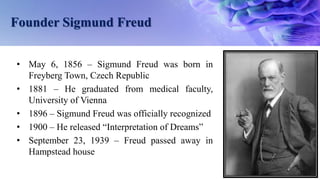
Founder Sigmund Freud
• May 6, 1856 – Sigmund Freud was born in
Freyberg Town, Czech Republic
• 1881 – He graduated from medical faculty,
University of Vienna
• 1896 – Sigmund Freud was officially recognized
• 1900 – He released “Interpretation of Dreams”
• September 23, 1939 – Freud passed away in
Hampstead house
Overview of Psychoanalysis
• A set of philosophy of human nature
• Psychoanalysis is both an approach to therapy and a
theory of personality
• Emphasizes unconscious motivation – the main cause
of behavior lies in unconscious mind
View of Human Nature
• Deterministic
Life is about gaining pleasure and avoiding pain
• Human as energy system
Freud believe that human is motivated by the unconscious, where the Id
is found along with the aggression and sex instincts
Level of Mental life
Conscious
Sub conscious
Unconscious
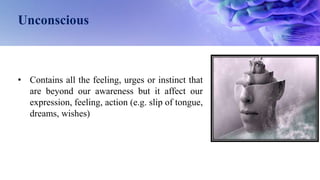
Unconscious
• Contains all the feeling, urges or instinct that
are beyond our awareness but it affect our
expression, feeling, action (e.g. slip of tongue,
dreams, wishes)
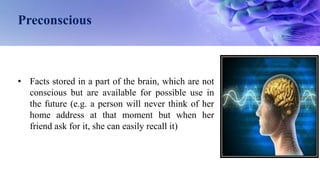
Preconscious
• Facts stored in a part of the brain, which are not
conscious but are available for possible use in
the future (e.g. a person will never think of her
home address at that moment but when her
friend ask for it, she can easily recall it)
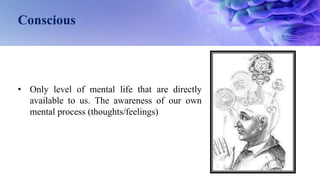
Conscious
• Only level of mental life that are directly
available to us. The awareness of our own
mental process (thoughts/feelings)
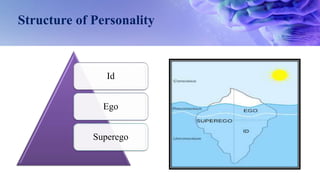
Structure of Personality
Id
Ego
Superego
Id
• Infants are born with Id intact
• Operates on Pleasure Principle – to gain pleasure,
avoid pain
• Driven by sexual and aggressive urge
Ego
• The rational level of personality
• Operates on Reality Principles – does realistic and
logical thinking
• The balance between Id and Superego
Superego
• Partially unconscious
• Operates on Moral Principles
• Able to differentiate between good and bad, right
and wrong
• If people follow their superego, they will feel proud
but if they don’t follow, they will feel guilty and
anxious
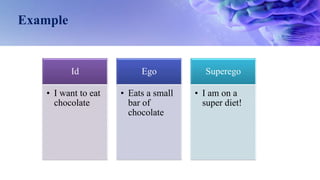
Example
Id
• I want to eat
chocolate
Ego
• Eats a small
bar of
chocolate
Superego
• I am on a
super diet!
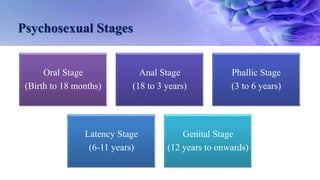
Psychosexual Stages
Oral Stage
(Birth to 18 months)
Anal Stage
(18 to 3 years)
Phallic Stage
(3 to 6 years)
Latency Stage
(6-11 years)
Genital Stage
(12 years to onwards)
Psychosexual Stages
• Children progress through five psychosexual stages during psychosexual
development
• A person become “Fixated” or stuck in a stage when a basic need is not
met, therefore that person will face difficulty in transiting to another
stage
Oral Stage
• Birth to 18 months
• Pleasure centers on the mouth – sucking, biting
• Fixation:
• If the child is over stimulated in this stage, as an adult she/he may
become dependent on cigarette or alcohol, become chatterbox, or derive
pleasure from acquiring possessions (collect things)
• If the child is under stimulated in this stage, as an adult she/he will make
bitingly sarcastic remarks or be argumentative
Anal Stage
• 18 months until 3 years
• Pleasure focuses on bowel movement (withholding/eliminating feces)
• Fixation:
• If parents were over-emphasizing toilet training, the child will develop a
retentive character. He will become obstinate and stingy
• If parents were negligent about toilet training, the child will develop
expulsive trait such as bad temper, cruelty and messy disorderliness
Phallic Stage
• 3 years to 6 years
• Pleasure zone is the sex organ/genitals
• Fixation:
• Oedipus complex in males’/Electra complex in female
• The boy will have the desire to possess his mother and displace his father and the
girl will want to possess the father and remove her mother
• Child whom had been fixated in this stage will develop a phallic character, such as
reckless, proud and vain
• This conflict can also cause the child to be afraid of close relationship and weak
sexual identity
• Freud stated that fixation may be a root of homosexuality
Latency Stage
• 6 years to 11 years, until puberty
• No fixation occur as the child’s energy are focused on peer activities and
personal mastery of learning and physical skills
Genital Stage
• 12 years onwards
• Sexual interest in opposite sex increase
• The child improves their personal identities, develop caring feeling
towards others, establish loving and sexual relationship and progress in
successful careers
• Fixation:
• Frigidity, impotence and unsatisfactory relationship
Defense Mechanism
• Defense mechanism are invented by the Ego
in an attempt to resolve the conflict between
Id and Superego – so that personality can
operate in a healthy manner
• It deny/distort reality while operating in
unconscious level
• If it is used once a while, the purpose of using
it is to reduce stress
• But if it is used frequently, it means the
individual are trying to avoid facing reality
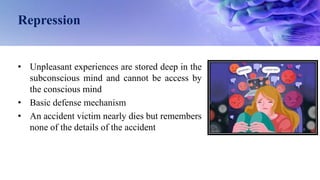
Repression
• Unpleasant experiences are stored deep in the
subconscious mind and cannot be access by
the conscious mind
• Basic defense mechanism
• An accident victim nearly dies but remembers
none of the details of the accident
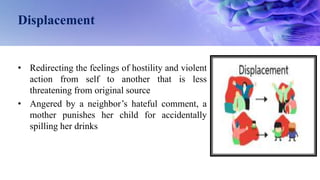
Displacement
• Redirecting the feelings of hostility and violent
action from self to another that is less
threatening from original source
• Angered by a neighbor’s hateful comment, a
mother punishes her child for accidentally
spilling her drinks
Rationalization
• Providing a reasonable explanation to make
undesirable behavior appear logical
• A student who fails a test because she did
not study hard enough blames her failure
on the teacher for using “tricky” question
Denial
• Reality is distorted to make it suit to the
individual’s wishes
• An alcoholic fail to acknowledge that he is addicted
to alcohol
Regression
• Returning to a behavior pattern characteristic of
an earlier stage of development
• After Lucy’s parents bitter divorce, she refuses to
sleep alone in her room and crawling into bed
with her mother
Reaction Formation
• Thinking or behaving in a way that is the
extreme opposite to those that are of real
intention
• A woman who loves an unobtainable man
and behaves as though she hates him
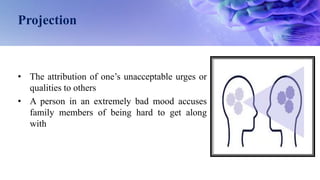
Projection
• The attribution of one’s unacceptable urges or
qualities to others
• A person in an extremely bad mood accuses
family members of being hard to get along
with
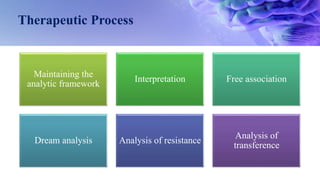
Therapeutic Process
Maintaining the
analytic framework
Interpretation Free association
Dream analysis Analysis of resistance
Analysis of
transference
THANK YOU!
ANY QUESTIONS?

Psychoanalytical Theory and Sigmund Freud

  • 1.
    Sigmund Freud And PsychoanalyticalTheory Aqsa Rani & Fatima Jamshaid BS Psychology-2A
  • 2.
    Founder Sigmund Freud •May 6, 1856 – Sigmund Freud was born in Freyberg Town, Czech Republic • 1881 – He graduated from medical faculty, University of Vienna • 1896 – Sigmund Freud was officially recognized • 1900 – He released “Interpretation of Dreams” • September 23, 1939 – Freud passed away in Hampstead house
  • 3.
    Overview of Psychoanalysis •A set of philosophy of human nature • Psychoanalysis is both an approach to therapy and a theory of personality • Emphasizes unconscious motivation – the main cause of behavior lies in unconscious mind
  • 4.
    View of HumanNature • Deterministic Life is about gaining pleasure and avoiding pain • Human as energy system Freud believe that human is motivated by the unconscious, where the Id is found along with the aggression and sex instincts
  • 5.
    Level of Mentallife Conscious Sub conscious Unconscious
  • 6.
    Unconscious • Contains allthe feeling, urges or instinct that are beyond our awareness but it affect our expression, feeling, action (e.g. slip of tongue, dreams, wishes)
  • 7.
    Preconscious • Facts storedin a part of the brain, which are not conscious but are available for possible use in the future (e.g. a person will never think of her home address at that moment but when her friend ask for it, she can easily recall it)
  • 8.
    Conscious • Only levelof mental life that are directly available to us. The awareness of our own mental process (thoughts/feelings)
  • 9.
  • 10.
    Id • Infants areborn with Id intact • Operates on Pleasure Principle – to gain pleasure, avoid pain • Driven by sexual and aggressive urge
  • 11.
    Ego • The rationallevel of personality • Operates on Reality Principles – does realistic and logical thinking • The balance between Id and Superego
  • 12.
    Superego • Partially unconscious •Operates on Moral Principles • Able to differentiate between good and bad, right and wrong • If people follow their superego, they will feel proud but if they don’t follow, they will feel guilty and anxious
  • 13.
    Example Id • I wantto eat chocolate Ego • Eats a small bar of chocolate Superego • I am on a super diet!
  • 14.
    Psychosexual Stages Oral Stage (Birthto 18 months) Anal Stage (18 to 3 years) Phallic Stage (3 to 6 years) Latency Stage (6-11 years) Genital Stage (12 years to onwards)
  • 15.
    Psychosexual Stages • Childrenprogress through five psychosexual stages during psychosexual development • A person become “Fixated” or stuck in a stage when a basic need is not met, therefore that person will face difficulty in transiting to another stage
  • 16.
    Oral Stage • Birthto 18 months • Pleasure centers on the mouth – sucking, biting • Fixation: • If the child is over stimulated in this stage, as an adult she/he may become dependent on cigarette or alcohol, become chatterbox, or derive pleasure from acquiring possessions (collect things) • If the child is under stimulated in this stage, as an adult she/he will make bitingly sarcastic remarks or be argumentative
  • 17.
    Anal Stage • 18months until 3 years • Pleasure focuses on bowel movement (withholding/eliminating feces) • Fixation: • If parents were over-emphasizing toilet training, the child will develop a retentive character. He will become obstinate and stingy • If parents were negligent about toilet training, the child will develop expulsive trait such as bad temper, cruelty and messy disorderliness
  • 18.
    Phallic Stage • 3years to 6 years • Pleasure zone is the sex organ/genitals • Fixation: • Oedipus complex in males’/Electra complex in female • The boy will have the desire to possess his mother and displace his father and the girl will want to possess the father and remove her mother • Child whom had been fixated in this stage will develop a phallic character, such as reckless, proud and vain • This conflict can also cause the child to be afraid of close relationship and weak sexual identity • Freud stated that fixation may be a root of homosexuality
  • 19.
    Latency Stage • 6years to 11 years, until puberty • No fixation occur as the child’s energy are focused on peer activities and personal mastery of learning and physical skills
  • 20.
    Genital Stage • 12years onwards • Sexual interest in opposite sex increase • The child improves their personal identities, develop caring feeling towards others, establish loving and sexual relationship and progress in successful careers • Fixation: • Frigidity, impotence and unsatisfactory relationship
  • 21.
    Defense Mechanism • Defensemechanism are invented by the Ego in an attempt to resolve the conflict between Id and Superego – so that personality can operate in a healthy manner • It deny/distort reality while operating in unconscious level • If it is used once a while, the purpose of using it is to reduce stress • But if it is used frequently, it means the individual are trying to avoid facing reality
  • 22.
    Repression • Unpleasant experiencesare stored deep in the subconscious mind and cannot be access by the conscious mind • Basic defense mechanism • An accident victim nearly dies but remembers none of the details of the accident
  • 23.
    Displacement • Redirecting thefeelings of hostility and violent action from self to another that is less threatening from original source • Angered by a neighbor’s hateful comment, a mother punishes her child for accidentally spilling her drinks
  • 24.
    Rationalization • Providing areasonable explanation to make undesirable behavior appear logical • A student who fails a test because she did not study hard enough blames her failure on the teacher for using “tricky” question
  • 25.
    Denial • Reality isdistorted to make it suit to the individual’s wishes • An alcoholic fail to acknowledge that he is addicted to alcohol
  • 26.
    Regression • Returning toa behavior pattern characteristic of an earlier stage of development • After Lucy’s parents bitter divorce, she refuses to sleep alone in her room and crawling into bed with her mother
  • 27.
    Reaction Formation • Thinkingor behaving in a way that is the extreme opposite to those that are of real intention • A woman who loves an unobtainable man and behaves as though she hates him
  • 28.
    Projection • The attributionof one’s unacceptable urges or qualities to others • A person in an extremely bad mood accuses family members of being hard to get along with
  • 29.
    Therapeutic Process Maintaining the analyticframework Interpretation Free association Dream analysis Analysis of resistance Analysis of transference
  • 30.
  • 31.